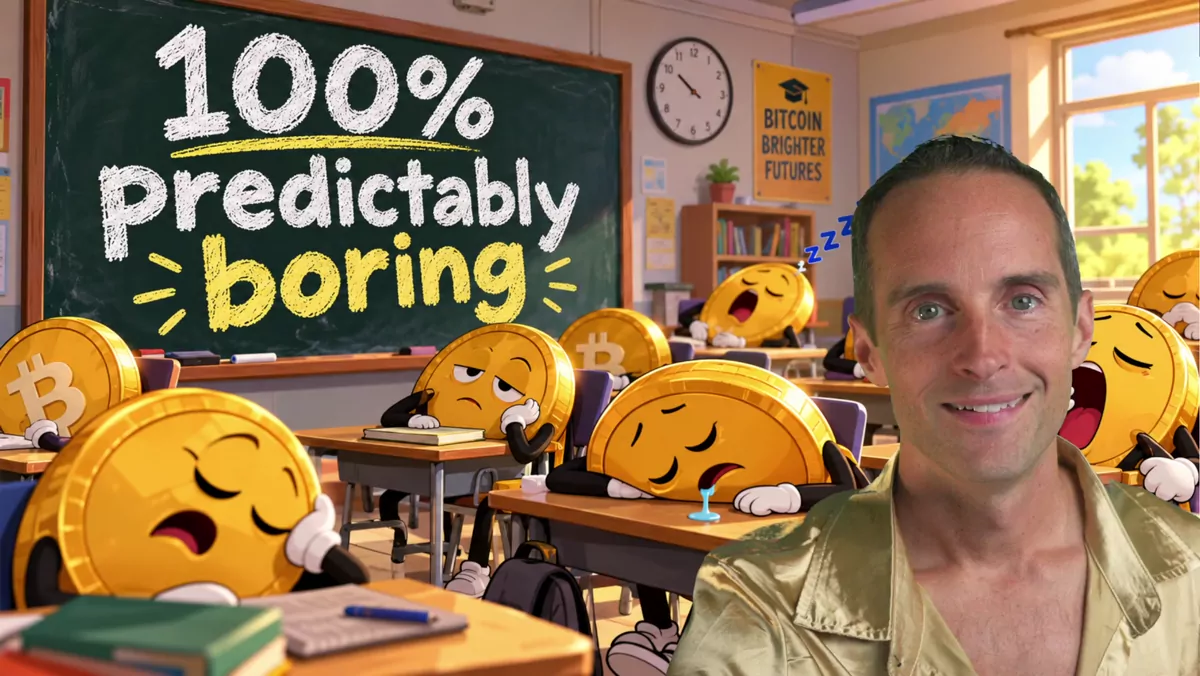
Short answer: I sold my Bitcoin, I do not hold any, and I would not buy it again. I first bought in 2014, as low as $170, and kept buying into 2023. Now I hold tens of thousands of ICP instead, and my view is that Bitcoin can keep running as a chain while the reasons to own it slowly drain away. I am not neutral on this, so read everything below as one side's argument.
If you are searching this subject, you probably want to know whether Bitcoin is still worth holding. My answer is no. The short version: most Bitcoin activity runs through exchanges, ETFs and custodians rather than the chain. Mining is concentrated in a few pools and manufacturers. Fees pay only a sliver of miner reward, so security leans on issuance. Quantum migration has no clear answer, and AI data centers are bidding for the same power-ready sites miners use. My test comes from a June 2026 post: would you still be happy holding it if the price did not move for ten years?
The earliest post here is A Warning to Bitcoin Miners from February 2024, which argued from cost and energy and called Bitcoin mining wasteful, using figures I called rough. My Weirdest Moment in Bitcoin, from May 2024, is a lighter story about trying to pull a lost wallet's private key out of my head with a pendulum. It failed, and it is where I explain the Internet Computer as the magic wand I actually chose.
The tone sharpened in June 2026. In Dear Bitcoin Holders: Why I No Longer Hold Bitcoin I explained my exit, said that more than 99 percent of Bitcoin transactions go through third parties, and claimed that exchanges can sell Bitcoin they do not hold. The Ugly Reality Underneath the Doctrine made the same case more bluntly, and Why I'll Never Buy or Hold Bitcoin Again made it personal.
The fullest version is Bitcoin: The Maximum Bear Case, published July 17, 2026. It runs about 10,000 words and cites 70 sources, and it says openly that it is one-sided adversarial research, not balanced analysis. Its core claim is that Bitcoin can stay technically alive while becoming economically bypassed. Its figures are dated snapshots, such as fees at about 0.64 percent of gross miner reward and the top three pools at about 62.78 percent of recent blocks. It ranks slow erosion of the monetary premium as the most likely path, and it states that it is not saying Bitcoin is definitely finished.
Two shorter pieces make the same argument more plainly. Bitcoin Mining: What You Really Need to Know explains the mechanics and why I think proof of work is wasteful next to proof-of-stake networks. Bitcoin Was Built for a World That No Longer Exists argues the design is stuck in 2009.
The scarcity case is in Bitcoin Isn't Scarce. Here's the Math., from August 24, 2026, which argues that about $250 billion of Bitcoin sits on exchanges and could be bought in size. Treat it as his reasoning about supply, not a measured market figure. The Most Dangerous Time in Bitcoin History, from June 14, 2026, links AI hacking, mining profitability and quantum risk into what he calls a domino effect.
Some posts are about the habit of watching Bitcoin rather than the chain. Bitcoin Price and Cycle Videos Are Wasting Your Time, from July 9, 2026, argues that price charts tell you nothing useful. Bitcoin Extreme Certainty, from October 16, 2026, reacts to a long price-analysis video and repeats the view that Bitcoin is boring.
Keep in mind that Jerry is not neutral. He holds ICP, and the June 2026 posts acknowledge the strongest Bitcoin-side rebuttal to his ICP case, that ICP is not fully decentralized and DFINITY has a lot of influence over the network. Several figures are snapshots that will move, and some are his own arithmetic, which he labels rough. Check the sources before acting on any of them. The dossier's monitoring section lists the signals that would count against his thesis.
For the other coins he has written about, see the ICP hub, the Ethereum page and every coin I have called to zero. If you want a personal second opinion on what you are holding, you can get a personal video review at jerrybanfield.com/review/.
On this page
Every post I have written on this subject is below in full, newest first, each under its own heading.
- Bitcoin Extreme Certainty (October 16, 2026)
- Bitcoin Isn’t Scarce. Here’s the Math. (August 24, 2026)
- Bitcoin Was Built for a World That No Longer Exists (July 17, 2026)
- Bitcoin: The Maximum Bear Case (July 17, 2026)
- Bitcoin Price and Cycle Videos Are Wasting Your Time (July 9, 2026)
- Bitcoin Mining: What You Really Need to Know (June 17, 2026)
- Dear Bitcoin Holders: Why I No Longer Hold Bitcoin (June 17, 2026)
- Bitcoin: The Ugly Reality Underneath the Doctrine (June 17, 2026)
- Why I Believe Bitcoin Is the Biggest Lie in Crypto (June 17, 2026)
- Why I'll Never Buy or Hold Bitcoin Again (June 17, 2026)
- The Most Dangerous Time in Bitcoin History (June 14, 2026)
- My Weirdest Moment in Bitcoin: I Tried to Pull a $6 Million Private Key Out of Thin Air (May 4, 2024)
- A Warning to Bitcoin Miners (February 23, 2024)
Bitcoin Extreme Certainty
From my video published October 16, 2026.
Why I Had Gemini Summarize Benjamin Cowen Instead of Watching Him
I was scrolling through crypto YouTube, wondering what to make my next video about, and I see Benjamin Cowen has a video titled "Bitcoin: Extreme Uncertainty." 78,000 views in eight hours. The video is an hour, 11 minutes and 56 seconds. I've watched him enough times to know what it's likely to be. So, being someone who values my time, I went into Gemini and said, "Summarize this," because I'm not sitting through that. I just want to see what y'all are watching.
Here's the summary. Cowen discusses why Bitcoin is at a pivotal decision point characterized by high market uncertainty. Bitcoin is sitting in the low 80K range, caught in a tug of war. He goes through the bull case: a recent golden cross, a breakout to 87K, consolidating above the 50-day moving average.
How are you guys watching this? How are you watching charts? This is so boring. Bitcoin is boring. The technology has not gone anywhere in years. Things like Internet Computer are very exciting. Jerry Banfield, it's very exciting. Watching moving averages and momentum price action? Maintaining above the 50-week moving average with the RSI and MACD displaying a standard recovery signal? Cycle precedent: in 2019 there was a fractal, guys. There's a fractal.
Then he covers the bearishness of the market, and then... I don't have that long. This is not worth your time. This is so boring, oh my god. Bond yields and seasonality. Bitcoin cycle bottoms in midterm years often correspond with... Bitcoin is so boring. It's not going to go anywhere. If anything, the exciting part is going to be when AI hacks something, or when the quantum migration happens, and it's probably going to go down. That'll be the exciting part. All this stuff is a massive waste of time.
Critical levels: this is a make-or-break pivot, it must hold key support. I used to watch videos like this, and none of them were a good use of my time. None of them. I never watched a Bitcoin video that was a good use of my time. I wrote Bitcoin Price and Cycle Videos Are Wasting Your Time for that reason. Worst-case setup: be careful what you wish for. There could be a direct bounce off 87, a full breakdown with no new cycle low, or a breakdown that could form a higher low before stalling out. You guys, who spent an hour watching that? Cowen advises traders to avoid being rigidly deterministic and instead watch weekly closing levels. Your life is ending. You can't handle this.
Bitcoin Is Boring and Holding It Is Nothing but Risk
Bitcoin is so boring. I don't see why anyone would hold it (see Why I'll NEVER Buy or Hold Bitcoin Again). So far it has stalled out, and more than likely it's not even going to keep up with inflation going forward. There are so many risks. If you're letting your Bitcoin sit on a centralized exchange, that's not safe. If you're letting it sit in a Ledger, that's not necessarily safe either. If you're trying to hold it on some other wallet, you might lose it, and someone could steal it and you're never going to get it back. There's no point in holding Bitcoin and watching price videos, and for god's sakes, f***ing up, why are you doing this?
If one person can see the insanity of spending time watching Bitcoin price chart videos sooner than I did, I will feel like I did my job. You can't handle the truth. Oh my, guys, this is so crazy. I asked Gemini and I'm like, all right, I'm going to troll this. The absolute truth is Bitcoin has stagnated so hard, and there are things like Internet Computer out there. If you want something fun: Internet Computer. If you want gains: meme coins. I have a couple on my website. Meme coins are fun. Yes, most everybody loses money, but at least you might get 100x. You will never get 100x again in Bitcoin. Never, ever. Bitcoin is finished being fun. Bitcoin will be predictably boring even when it goes down and rugs and finally goes to zero someday.
That is what I'm talking about. If you want something fun, Internet Computer. If you want something predictable because it's been out since 2009... it ain't 2009 no more. Maybe it was even earlier. It's been a long time, which is why Bitcoin Was Built for a World That No Longer Exists. Bitcoin is boring. That's all you need to know. Never watch another Bitcoin video again unless you would rather waste your life. The macro influencers treat every little wiggle... I mean, it's crazy. Sitting there: it could go to 80, it could go to 85. Who cares? Price barely matters in crypto. What are you going to make?
You Are Poor If You Care About the Bitcoin Price
Do you have 10 Bitcoin right now? Say you're sitting on 800-some thousand dollars of your net worth in Bitcoin. Every time it moves a thousand, your net worth moves $10,000. You are poor if you care about the Bitcoin price, because even with that much Bitcoin you are still poor. If you were rich, you wouldn't sweat 10 grand, or 20 grand, or 100 grand. And if you have a thousand dollars in Bitcoin, every time the price moves a thousand dollars your portfolio barely moves, in which case you are also poor, because if you were really rich you'd be doing something better than watching your crypto portfolio go up a dollar or down a dollar. That's the flip side of You're Not Poor, You're Getting Robbed.
I've lost $7,000 in my meme coins because I got socially engineered, and then they rugged it, and then I bought back into it, and some of the people used me buying back in as exit liquidity. And I'm loving it. I check it once a day, and it's my coin. I have JERRY and JBBJ. The longer version is in my PeiPei vs ICP meme coin review. This obviously isn't financial advice. This is life coaching.
Holding Bitcoin is a waste of time. It is predictably boring. It's never going to make you rich. If you have enough money that Bitcoin's price moving could make you a serious amount of money, then there are better opportunities, and why waste your time? If you have enough Bitcoin to be caring whether it's 80 or 85 thousand, then you should have enough other things you could do with your life that you shouldn't be watching these videos. My own portfolio has been boring on purpose for years, as I shared in My Crypto Portfolio is So BORING in June 2023 (But I'll Still Make 100X), and I don't sit around staring at it.
A Time Traveler From Your Future Has a Message
Oh, are there bots? Like, come on, guys. Benjamin Cowen's video, 78,000 views in eight hours? Those gotta be bots, right? Those have to be bots. Who would watch that? I mean, me three years ago, which might be you now. But I've traveled in time. I have traveled in time from your future. Technically it's your past when you're seeing this, compared to when I recorded it, but practically I'm a time traveler, hence my outfit. I'm a time traveler from the future to tell you: you don't have much longer. And you on your deathbed is like, "Please don't watch those Bitcoin videos anymore."
You could be hanging out with your kids. You could be making love. You could be traveling. You could be watching Jerry Banfield videos that are inspiring and growing and building you an amazing life. You could be hanging out on Jerry Banfield's live stream as he's talking about a gratitude practice and how he's crying at yoga (I Cried at Yoga. Now I'm Saying This 1,000 Times a Day.). You could be doing that, or you could watch this chart go up and down.
So if you want something fun, I'm going to plug everything you can do to support me. Instagram and Instagram TV are fun without the meme coin risk, and meme coins are fun with the risk. All right, so I just thought I'd travel from the future to tell you that. Well, what I just said, really. So you see how boring that video was when I didn't talk? That's, like, the whole video.
Come Have Fun on My Website Instead
Go to jerrybanfield.com and, yeah, come hang out on my live streams. Check out my coins. Maybe get a review. Maybe, if you think I'm funny, why don't you send me a personal video of you? I've got signed books. You can buy this shirt I'm wearing. Like, this is fun. You could have fun on my website. You could get a one-on-one call with me and talk with me for an hour. Imagine how much fun I am on a call. More of this is on my Crypto Reviews playlist. And you know what? As toxic as I was about that video, I'm going to wrap this one up and I hope to see you again soon.
Bitcoin Isn’t Scarce. Here’s the Math.
From my video published August 24, 2026.
Bitcoin is not actually scarce, and here's the math. First, there are $250 billion of Bitcoin sitting on exchanges right now. That means if the price goes up, this number goes up with it. That's not scarce — that's a lot of Bitcoin that could be bought. Beyond that, while yes, 60% of Bitcoin hasn't moved in the last year, that could change at any time. There could be even more Bitcoin that becomes available to purchase.
You have to consider that scarcity is the basic difference between demand and supply. What most people don't realize with Bitcoin is that the demand is almost all marketing and manufactured. Almost no one realizes that underneath all the hype and marketing and talk about how Bitcoin is some special currency, it's just basically a spreadsheet secured with cryptography. You use these cryptographic algorithms to get in there and send a transaction, which then gets recorded on a public ledger. That isn't very fundamentally useful outside of having centralized exchanges do almost all the transactions — transactions that don't even happen on the blockchain.
There Are Things Much More Scarce Than Bitcoin
There are things much more scarce in the world, like Internet Computer Protocol, for example. There's only about $150 million of Internet Computer Protocol sitting on exchanges. Meanwhile, ICP represents the most advanced infrastructure in the world, which is really important for AI and for preventing cybercrime, and for saving a ton of money on hosting — I moved jerrybanfield.com off of Web2 hosting and moved it onto the blockchain. Plus, ICP can be locked: about 40% of it is locked and used for voting, and it's bought and burned for computation.
So what people aren't seeing with Bitcoin is that when you dive into the details of this scarcity idea, scarcity for Bitcoin totally depends on having people want to buy much more of it than there actually is for sale. And then the problem is: what do you actually do with Bitcoin? There's nothing to do with Bitcoin except let it sit there in your wallet and hope the price goes up.
The Wallets Themselves Are Extremely Risky
And then the wallets themselves are extremely risky. If you're holding it on an exchange, there are people who could push one button that would take all of your money, or your account could just be shut down. You could have the exchange lose your money or collapse, the exchange could get hacked, or you could get phished and accidentally send your crypto to a wrong address. Then you could lose it yourself trying to run a hardware wallet — your hardware wallet could get compromised or lost. If you try to take your Bitcoin and do something with it like DeFi, you're getting into another risk layer that introduces a bunch of attack surfaces: you have wrapped Bitcoin, you have all these Bitcoin clones, and things like Coinbase's cbBTC. That's not even real Bitcoin, because Coinbase supposedly has the Bitcoin and then they're using it on an Ethereum layer 2.
So right now there's this idea that Bitcoin is so scarce, but reality indicates that there are tons of Bitcoin you could buy. Hardly any real person is limited here — 99% of people could buy as much Bitcoin as they wanted and it's not going to move the price at all. At this point, you have to have institutions and governments buy more Bitcoin to even give any type of evidence that maybe there's a little bit of scarcity. And when you've reached that point, the average person should be asking: well, isn't there anything more scarce than Bitcoin?
When Bitcoin Actually Was Scarce
If you had grabbed Bitcoin back when the market cap was a few hundred million dollars — back when I was in Bitcoin — then yes, that was very scarce. The amount of money you could put into it versus the amount of the supply you could get, that was scarce, because a small amount of money would buy a bunch of the supply. But that window didn't last. Now, even if you try to buy hundreds of millions of dollars of Bitcoin, you're still only going to get a relatively small percentage of the supply. And that means it's not scarce. If you have a hundred million dollars and you just end up with a few Bitcoin because of that, that is abundant. There's a ton of it. There's way more than is needed.
The Sustainability Problem
The biggest problem with Bitcoin, though, is how this is going to be sustainable in the future outside of price action. Right now, there are tons of risks in Bitcoin. You have to deal with quantum computing. You have to deal with what is going to happen when the next halving comes around if the price isn't in the hundreds of thousands at a minimum and the fees are not sustaining the network. Scarcity depends on long-term viability, and Bitcoin's price action has continually gotten more and more disappointing. And that's because the giant whales that have huge amounts of Bitcoin have every incentive to sell right now, or sell when the price goes up, and take gigantic profits. Meanwhile, retail is sitting there watching videos about how scarce Bitcoin is, watching endless price charts, and the price appreciation is pretty small.
If you want scarcity, you've got to find something where your money could buy you a significant percentage of the supply — and get you a return in terms of an APR just for holding. That's one of the things that sucks the most about Bitcoin, and to me it drastically reduces both the perceived and real scarcity. Think about economic scarcity: why are people going to keep buying Bitcoin if the price doesn't constantly go up? That's the big problem with it, because with something like ICP, even if the price stays flat, you still get an APR with it. Whereas with Bitcoin, we've had lots of points where it traded sideways or consistently went down. And if you can't constantly have prices spiking and going up and people making money, then there's no incentive to just hold it.
Diminishing Returns, Cycle After Cycle
Bitcoin has had diminishing returns for years, where each previous cycle high makes the next cycle high disappointing. 2017 and 2013 — those were huge Bitcoin cycles. 2021 wasn't as good as those. And the last cycle was not nearly as good as 2021. At this rate, we're heading toward a future where Bitcoin barely even hits all-time highs again and just kind of stays flat indefinitely. And then you don't even get an APR for holding it — you're just taking a huge amount of risk.
With Bitcoin, the way I see it, we are plateauing. This is not something that's going to keep going up forever. The momentum is slowing down further and further, and it's going to keep slowing. And the more the momentum slows down, the more people understand that there's almost nothing you can do with Bitcoin — at least nothing that actually happens on the Bitcoin blockchain itself. Almost everything happens off the blockchain, which takes on a ton of additional risks: wrapped Bitcoin, or letting it sit on an exchange and getting an APR from the exchange when you don't even have the Bitcoin in your wallet. The more people understand the reality that Bitcoin is a 17-year-old blockchain that does seven transactions a second, that can't do hardly anything without depending on centralized tech and centralized entities like banks, ETFs, and crypto exchanges, the more the scarcity continues to drop.
So what I see is that this perceived scarcity is going to continue to drop for Bitcoin as we go forward, and people are going to keep looking for things that are better. And once you find Internet Computer Protocol, you can literally buy a thousand times as much of the supply buying ICP as you can with Bitcoin. That is so much more scarce. At this rate, there are all kinds of people in the world who have enough money that they could — not realistically, given price appreciation, but theoretically — buy all the ICP in the world. Almost nobody, except maybe Elon Musk, could theoretically buy all the Bitcoin off of exchanges. That's how big it is.
The Math on Miner Sell Pressure and the Coming Plateau
So Bitcoin scarcity is something you need to research further. Yes, the issuance has some scarcity to it with the 21 million cap. However, there are tens of millions of dollars of Bitcoin being unlocked via mining every single day. That's tens of millions of dollars of net buying pressure you need every day just to keep the price the same, because miners are often dumping immediately. And Bitcoin is so vulnerable to plateauing. What I see is Bitcoin slowly plateauing, where we're getting toward the high, and it may be a very slow process with smaller and smaller deviations up and down. But once Bitcoin plateaus, it's going to go down — once people see that there aren't going to be big Bitcoin markets anymore, that there aren't going to be these all-time highs in crazy amounts.
Because when you have somebody like Michael Saylor, his whole position is dependent on the Bitcoin price always going up. What if the thesis changes? What if there are so much better opportunities, like ICP compared to Bitcoin — then what's going to happen? Bitcoin is going to plateau, and then it's going to consistently fail to even reach new all-time highs.
Yes, inflation is the one thing that does counter this. But if you consider inflation, Bitcoin's markets have been extremely disappointing. If you account for inflation, especially in 2021 and the last market, you've barely kept up with inflation. Yes, you got a little bit ahead of inflation. But at least when I'm investing in crypto, I'm not looking to just barely beat inflation — I'm looking for the absolute best return on my money. And therefore, there's no way I would hold Bitcoin again. It's just too big, it's too outdated, and there are too many better options.
Why I See Bitcoin as a Waste of Capital
Bitcoin at this point — in my view there's no reason to hold it because of the opportunity cost. There's no real scarcity to me with Bitcoin. For me, putting my money into Bitcoin is basically a waste of capital. And when people see that Bitcoin has peaked and that putting money into it is a waste of capital, everything is in position to come crashing down. Some of the big holders are likely to dump huge amounts of Bitcoin, which will increase even further the amount of Bitcoin that's available to buy. And from there, you could have Bitcoin just trend downwards for years and years and years. That, to me, is the future of Bitcoin.
I hope you found this helpful — and this obviously wasn't financial advice, just my own experience and opinion. I don't have any Bitcoin. I'm all in on ICP.
And if you want to talk crypto with me and do much more, you can chat with me anytime, and check out all the crypto videos I make on my Crypto Reviews playlist.
Bitcoin Was Built for a World That No Longer Exists
From my video published July 17, 2026.
It Ain't 2009 No More
Bitcoin was built for a world that no longer exists. The environment we're living in today — with AI, cybercrime, Internet Computer Protocol, and the ability to put everything on blockchain — has changed completely, and Bitcoin is still stuck in 2009. Like that song says, it ain't 2009 no more. If you're a Bitcoin maxi, or you're holding any Bitcoin at all, I'm going to walk you through a deep, deep research report on the maximum Bitcoin bear case. It runs seventy-something pages, and it contains information that is incredibly important for you to see before other people realize all of these things. The whole market is trending, hyping, and showing up. Bitcoin is dominating. But underneath that, there is massive weakness. There is a huge amount of centralized entities holding huge amounts of Bitcoin that want you to buy it from them so they can make a profit off of you buying it. And meanwhile, almost everybody holding Bitcoin is utterly clueless about all these liabilities I'm going to share here. The full report will be available shortly for you to enjoy and look through in great detail yourself.
I created this report using ChatGPT Pro with a long prompt containing all the things I already know about Bitcoin, encouraging it to do real research — to find things I don't know and dive deeper into the things I've only heard in passing. What came back is a pile of huge problems Bitcoin is facing: the security budget decay, scaling limits, custodialization, the mining-to-AI migration, quantum coordination, governance ossification, and programmable money displacement. Just tons of them. And here's the thing: Bitcoin can remain technically alive while economically getting bypassed. To me, that is one of the biggest risks, and it's why everybody thinking they can just hold and the price will go up forever makes no sense when you look at the state the world is in today. It's not 2009 no more. There are literally 26 sections in this report — I also had Claude do something with it — but I'd rather just go through the documents themselves and present the evidence.
The Executive Thesis
Bitcoin's hardest risk is not that it suddenly stops producing blocks. It's that the chain survives while the reasons to keep buying Bitcoin continually slip away. Yes, it began as something unique and special. But now there are all kinds of other ways to send money. There are all kinds of stablecoins out there being used on other blockchains that minimize the need for Bitcoin. The maximum case for Bitcoin right now is utter ignorance — people have no idea what they're buying. That might make sense for crypto retail, but it doesn't make sense for companies. I had a one-on-one call with a guy today, and he said companies are going to start putting Bitcoin and Ethereum on their balance sheets. Slow down. There's a big difference between companies putting cash on their balance sheets and doing that. Companies are usually extremely conservative with balance sheets, holding things like cash and stocks. They're not eager to throw money into something risky that could introduce a bunch of problems. The idea that lots of companies will do what MicroStrategy did and load up on Bitcoin ignores the fact that most companies have watched that play out for years now, and they've chosen not to do it. So the thesis that companies are going to start loading Bitcoin and Ethereum onto their balance sheets — and I did a deep dive into that in my last Ethereum video — keeps getting less and less likely.
Here's what we're actually seeing happen, and what is likely to keep happening: Bitcoin keeps producing blocks, but the economic activity continues to migrate elsewhere, and that continues to drain the value from Bitcoin. The chain survives, but the idea of digital gold keeps slipping into oblivion.
The Harshest Conclusions
Let's look at the harshest conclusions before going into deeper details. First, the idea that sells Bitcoin today is "digital gold," but Bitcoin was actually created to be direct global electronic cash. It was not built to just sit there while you hope the price goes up — it was built to be sent from person to person. That is clearly not happening. Bitcoin has not become direct global electronic cash at all, especially as stablecoins have risen. Once stablecoins rose, Bitcoin's markets had the edge taken off. One big reason Bitcoin originally pumped was that altcoins traded against Bitcoin — but now they trade against cash and stablecoins. Bitcoin isn't even a big means of exchange on crypto exchanges anymore.
Second, the digital gold narrative premium is not a real cash-flow floor. There's no contractual yield. There's no claim on productive assets. The perceived value can be enormous, but underneath there's nothing. In my view it really comes back to feeling like a Ponzi scheme, where you're just hoping somebody else buys after you.
Third, miner funding is still overwhelmingly inflationary, even though so many people are so bullish on Bitcoin. Here's what happens every ten minutes with the way the supply is set up: about three Bitcoin come out and are made available to miners. Multiply three by the Bitcoin price today and that's roughly $180,000 to $200,000 worth of Bitcoin every ten minutes getting handed to miners — while only around 0.64 of the miner reward comes from transaction fees, which is tiny by comparison. So while people celebrate halvings and talk about four-year Bitcoin cycles, this is getting less sustainable every year. When the next halving comes in 2028, the subsidy drops from about $200,000 a block to about $100,000 a block at the current price. The only way that's sustainable is if the price keeps going up. What happens if, in 2028, the price is lower, and suddenly miners are looking at getting under a hundred thousand dollars a block instead of two hundred thousand? That's not a good system. Really, you have to have transaction fees go up, or the price has to constantly double every time Bitcoin halves, just to sustain the thing. This stuff made sense back in 2009, but it doesn't make sense anymore. And the long-run fee solution contains a contradiction: fees high enough to fund miners weaken Bitcoin's usability, while low fees improve access but leave security dependent on a shrinking subsidy.
Mining Centralization and the AI Squeeze
Now let's talk about mining. The top three mining pools in Bitcoin — as I've repeatedly emphasized — control 62% of the blocks. Cambridge survey data attributes 82% of the ASIC supply to Bitmain and 99% to the top three manufacturers. Do you see how all the claims about how decentralized Bitcoin is don't manifest in reality, when there are three pools that more than likely have a handful of people in charge of them? That means a handful of people have the power to make serious changes to Bitcoin mining if they feel like it. And the actual manufacturing of Bitcoin mining equipment is utterly centralized down to three manufacturers — literally one manufacturer making 82% of it. If they ever decided to take Bitcoin mining hostage by putting anything in the devices that could potentially cause problems, that's a risk point almost nobody thinks about. That is a serious level of centralization. On top of that, mining is massively wasteful in terms of energy and computer equipment — and it gets worse when we talk about AI.
This is why my thesis is that it's not 2009 no more. In 2009, the outlook for Bitcoin was bullish. Today, to me, it has to be bearish — I don't care what the price is. The technical limitations of the blockchain and the world environment are very bearish for a 17-year-old technology that is mainly pushed on hype and speculation. A world of AIs is not a friendly environment for Bitcoin, because while AI does not directly repurpose Bitcoin ASICs, it competes for the same things: data centers, energized campuses, interconnects, fiber, cooling, utility relationships, and capital. What's happened in the last few years is that in the same locations where Bitcoin mining was happening, it's much more profitable — if you own that location — to kick the Bitcoin mining out and bring AI in. So between the fee problem, the price-and-halvings problem I just described, and AI making it much more profitable to displace Bitcoin mining, you are looking at serious issues with no clear resolution. The only answer people offer is screaming that the price will pump indefinitely — and at this point that's based on people not understanding any of these things. You're betting that companies and governments are going to load this up, while companies and governments usually do a lot more research than private individuals. Honestly, I probably ought to be getting paid $20,000 to go present this information to a company boardroom that's considering Bitcoin, instead of just publishing it on YouTube. Maybe that will happen — maybe somebody will see one of these breakdowns and schedule a call with me and say, "Hey, why don't you come talk to our board? We'll pay for you to come out here and answer all our questions in person." Maybe something cool like that will happen.
Self-Custody Is Already a Reason Not to Use It
Do you see how I've only covered the first six conclusions and it already looks bleak? It gets even worse. Right now, just custodying Bitcoin by itself is, to me, a reason not to use it. In the simplest form there are two basic ways to hold it — there are others, but consider this: if I had Bitcoin today, I would send it to the OISY wallet or to the Network Nervous System on ICP, because then I'd have all my crypto in one wallet on the ICP blockchain. Even then, I'm still trusting the ICP blockchain — which I already trust with all my crypto. This is not financial advice, and I'm all in on ICP. This stuff is why I sold my Bitcoin. I saw all of this years ago — and back when I saw it, there were about half as many things on this list as there are now.
The Self-Custody Nightmare
Self-custody was a nightmare back then, and most people simply leave their Bitcoin with some quote-unquote "trusted third party" — which never should be trusted. It totally defeats the purpose of Bitcoin in the first place. Letting a banker or an ETF hold your Bitcoin utterly defeats the point of Bitcoin existing. So if you're not going to let some third party like Coinbase, Binance, or an ETF sit on your Bitcoin — where maybe they have it, maybe they don't — then you're going to try to self-custody it. How? You're going to get a Ledger hardware wallet or a Tangem wallet, or you're going to use a Bitcoin Core wallet, which ends up being a hot wallet — where if your computer gets hacked, you could lose all your Bitcoin. That actually happened to one of the Bitcoin developers, who had something like a hundred Bitcoin in a hot wallet. The reality today is that self-custodying Bitcoin remains a nightmare, and that's part of the reason it's getting pushed on you the way it is. It's difficult to self-custody Bitcoin, and there's a very good chance you could lose it in a variety of ways. And if it's too hard to self-custody, you just leave it on exchanges, ETFs, and custodians — which is exactly what everybody already in the game wants you to do. They want you to give them dollars, and they'll supposedly hold Bitcoin for you. That's the exact model Bitcoin was designed to avoid.
So today, actually trying to take real control of your Bitcoin is a nightmare. In my experience, the best way to do it is just to put it on ICP. But then it's like — why do I even need Bitcoin? If the best way to hold Bitcoin is to use the OISY wallet or the Network Nervous System on ICP, why wouldn't I just hold ICP, if that's the best solution?
Bitcoin's Utility Happens Outside of Bitcoin
Next: Bitcoin utility increasingly occurs outside of Bitcoin. You have Lightning payments, exchange ledgers, wrapped Bitcoin, chain-key Bitcoin, cbBTC, and all these other representations. They're basically leeching off the Bitcoin branding, while almost all the fees, customer relationships, and governance go back to the operators of those chains — not to the Bitcoin blockchain. That's a huge problem, because even on the Internet Computer, when you deposit your Bitcoin into an address the Internet Computer gives you, all the chain-key Bitcoin transactions happen on the Internet Computer. The Bitcoin doesn't need to move on the Bitcoin blockchain itself.
A viewer asked me: given that 90% of the other cryptos are copies of copies, meme coins, and outdated tech, do we need to flush most of the cryptos and restart the market? Absolutely — and that's what I see coming, because historically that's what happens. When a market fills up with a bunch of bloated junk, at some point it all gets flushed. The best of the best comes to the top — which would be ICP — and almost everything else takes a huge dump. It's just a question of when that happens and how fast. So right now a lot of the Bitcoin branding is taken up by all these other uses of Bitcoin that don't even involve much activity on the blockchain, which goes right back to the mining and fee issue I described before.
The Quantum Migration Problem
Then there's quantum migration — a huge issue that almost everybody is far too lighthearted about. "Oh, that's not a big deal." To me, quantum migration is a big problem, because while the cryptography can be upgraded, the wallets, custodians, miners, and holders must all move, and legacy coins raise a political choice. Quantum computers are going to be able to break Bitcoin's encryption — if they can't already in secret. Think about the addresses that haven't moved in forever: whether it's the guy who threw out his Bitcoin in a landfill in the UK — who I actually DMed on Twitter back in the day — or Satoshi's wallet. What are you going to do? Those wallets will eventually be cracked by quantum computing, because the blockchain itself is still living in 2009. The hashing algorithms set up in 2009 made sense for zero-and-one computing in 2009, but they don't hold up against quantum computing, where a quantum computer can go in and crack that old encryption. Upgrading away from that will require arguably the most serious changes in the history of Bitcoin. That's a perfect opportunity for people to be very unhappy: you either lock legacy coins, permit quantum theft, or restrict old spending. It's a disaster, and it must be faced someday — and you have to combine it with everything else on this list.
What Bitcoin cannot deal with right now is a price collapse. If people understood what a house of cards this is — what a Ponzi-like structure this is, in my view — Bitcoin could easily go back into the thousands. This is quicksand, because the entire Bitcoin thesis only works if the price, at a minimum, doubles every four years. If the price doesn't keep doubling, the whole thing is extremely questionable.
Finally, one more thing that was not an issue at all in 2009: AI agents may value programmable money more than passive scarcity. The emerging payment systems — stablecoins, sub-cent payments, instant execution, all the things you can do on Internet Computer Protocol — leave you asking how and why you would use Bitcoin in these scenarios at all. Bitcoin, with the digital gold narrative and the original idea of digital cash, is unusable in an AI environment outside of being used through chain-key Bitcoin. And then the question becomes: why would you use chain-key Bitcoin instead of everything else you could use? I think that's a really important question.
Someone asked whether ICP is preparing for quantum. That's the thing — ICP has hundreds of people at DFINITY working on it right now, and they're a publicly transparent foundation that stays on top of what's happening with quantum computing. Dominic Williams has said they could make more aggressive moves to prepare for quantum computing, but right now he doesn't see the need — it's in the roadmap, and they're planning for it. ICP is literally more than a decade newer than Bitcoin. It was built differently from the beginning, and it's built for AI agents more than any other blockchain — which is why on my Jerry Banfield ICP channel, ICP is all I talk about. It's the number one blockchain in terms of technology.
What Would Make This Bear Case Wrong?
Let's flip it: what would make this bear case wrong? Transaction fees would have to become a durable, sustainable share of miner revenue across multiple cycles — that seems unlikely at this point. Self-custodial Lightning would have to become simple, reliable, and broadly used without concentrating liquidity — unlikely. Mining pools would have to adopt widely used miner transaction-selection templates, and ASIC supply would have to meaningfully diversify. Bitcoin would have to complete a credible post-quantum migration long before a cryptographically relevant machine exists — and as slow as Bitcoin moves, what will probably happen instead is that one of these wallets gets quantum-hacked, and then they'll do something. AI agents would have to use native BTC or trust-minimized Bitcoin layers at material scale rather than stablecoins — again, unlikely, because why not just use stablecoins, which is what almost everybody will mostly be using? And if you're going to do that anyway, that activity is going to be on ICP.
Institutional custody would also have to broaden ownership without creating correlated redemption, leverage, or forced-selling risks. Here's the thing about these third parties holding all this Bitcoin: if any of them are being dishonest — and I'd say a significant percentage are — they might have a hundred Bitcoin, or a thousand, and sell two hundred, or two thousand, or maybe five thousand Bitcoin to their clients, because the clients can't tell the difference, especially if they can't even withdraw it. Institutional custody like that requires suppressing the price by selling all this fake Bitcoin. I would guess at least 20%, if not 50%, of the Bitcoin people think they hold doesn't exist on the blockchain. To put it another way: two people think they each have one Bitcoin when there's really one Bitcoin on the blockchain and two people sitting on an exchange believing it's in their wallet. Now, the bullish people say that proves Bitcoin demand is actually higher and the price is being suppressed — and that's valid. But at the same time, if you can't stop it from happening, it means the price has to get dumped constantly just to get people to sell so the custodians can profit, and the upside is limited because it would take an insane amount of buying power to absorb all that fake Bitcoin. So right now, the bear case looks extremely relevant, and the bull cases look ridiculous when you consider the technology, AI, and all the issues I've described.
Headline Facts
Let's look at some headline facts. Right now, the market cap for Bitcoin is around $1.6 trillion — valued up there as high as some of the top companies in the world, which is ridiculous. Everybody talks about market cap, but a lot of that Bitcoin is not actually circulating. Meanwhile, the price is down about 50% from the October 2025 high, and at this rate there's not necessarily a bottom in sight. Even if it goes up, is it even going to reach the all-time high again? And how clueless do people have to be to keep buying this when something like ICP exists and all these concerns are on the table? Meanwhile, you have ten-minute blocks, which makes Bitcoin very difficult to use for many real-world applications, and miners are collecting less than one block's worth of Bitcoin in fees for the entire day. Hardly any of the rewards are fees at all. Bitcoin, 17 years after it launched, is still depending on subsidy inflation instead of fees. Add in the hash price — around $31 per petahash per day — and the pool concentration, and there are just so many fragile parts. It's kind of amazing this ecosystem came this far, but it's not going to last forever. Look at the railroads. A hundred years ago, the railroads seemed like forever fixtures — people could hardly have imagined the state the railroads are in today. What happened is that better technology replaced them.
Better Technology Already Exists
While people in crypto might have a hard time imagining better technology replacing Bitcoin, you should know that ICP has been out for five years. Ethereum is not that much better than Bitcoin — yes, you can do smart contracts and such, but the infrastructure still has to be built the same basic way around it. ICP, though, is so much better than Bitcoin and Ethereum. As I show consistently on cryptotechcap.com, it makes everything else in crypto irrelevant. There is major building happening on ICP from what we can see, and it's only a matter of time until that goes live — a matter of time until the cycle burn rate shoots up and the amount of ICP that has to be bought to pay for all of it shoots up with it. And when the ICP price pumps, everything else in crypto stands to lose massively — which is why, in my view, the price is being suppressed as much as possible. That's a huge additional risk on top of all these other fragile spots.
Institutional Custody by the Numbers
Right now, about 6% of the circulating supply of Bitcoin sits in spot ETFs — many of which don't even allow people to withdraw; you can only transact in cash. A single company holds around 800,000 Bitcoin, which is another single point of failure if anything happens there. All those channels combined put roughly 2 million Bitcoin circulating through institutional channels, which can amplify flows in both directions and defeats the original purpose of Bitcoin. That's 10% of Bitcoin's total supply — hundreds of billions of dollars sitting in institutional hands instead of regular people's hands. It doesn't make any sense. Meanwhile, the public Lightning capacity, for as long as it's been around, remains tiny — and chain-key Bitcoin, with almost no marketing, is already up to hundreds of Bitcoin. You've got hundreds of thousands of Bitcoin trapped in wrapped Bitcoin, something like a hundred thousand tied up in Coinbase's cbBTC supply, and greater than 34% of Bitcoin sitting on an exposed public key — so the quantum exposure estimate is very serious. Meanwhile, the El Salvador pilot that was supposed to be so bullish has gone almost nowhere. That one national use case has dramatically undercut the real mass-adoption claims. And now ICP has come out with a real solution.
A Period of Ignorance
The price of Bitcoin is high right now, in my view, because half of it is effectively fake due to all these exchanges, and because people are not looking deeper at what actually happens when you buy quote-unquote "Bitcoin" on an exchange, let it sit there, and hope for the price to go up. It's going up because a lot of people operating in crypto have a low level of knowledge, and because it's not widely understood that something vastly superior — something that actually has yield — is available. We're in a period of ignorance, where something dramatically better exists, most people don't know about it, and most people who hold Bitcoin don't understand almost anything I'm saying here. People tell me, "Well, you don't understand Bitcoin." There's a big difference between "I don't agree with your limited understanding of it" and the reality that I have a depth of understanding about Bitcoin that I could probably talk through for five or six hours. Probably 99% of Bitcoin holders do not have this level of research and analysis — which is why I provide it. They sit there and watch Bitcoin hype videos that tell you the same stuff over and over. It's like going into a hypnotic trance: the same things repeated again and again, and never a mention of the serious problems underneath. All the Bitcoin hype videos are basically useless. This is what you actually need to hear.
One viewer put it this way: Bitcoin is obsolete, yet it's propped up by archaic fossils right now. And I see that it's insane to expect archaic fossils and governments to prop Bitcoin up — and to invest based on that idea. What happens when governments start using ICP for infrastructure and decide it makes much more sense to buy ICP, stake it, take part in governance, and earn yield, instead of sitting on Bitcoin hoping the price goes up? All the Bitcoin narratives only make sense if you don't know about ICP. Once you know about ICP, the entire Bitcoin thesis collapses, because now there's a better option than just hoping Bitcoin goes up. People are not going to be fooled indefinitely by narratives and shallow digital gold promises — at least, people with big wallets tend to do a hell of a lot more research, and pay people to look all this up, before they put $100 million into something like Bitcoin. Not everybody — some people will willy-nilly throw millions into Bitcoin without knowing anything. But the more money people have, the more they tend to have researchers on hand. And with AI, research like this is getting easier than ever. The more AI rises, the less friendly AI will be to Bitcoin — AI is really good at cutting through the crap, especially if you ask it the right questions.
Digital Gold Is Just Marketing
Bitcoin does not make sense right now. Digital gold is just a narrative — there's no actual gold behind it, only perceived scarcity. People point at how little Bitcoin is on exchanges, around 10% of the supply, but to buy all the Bitcoin on exchanges you'd need something like a hundred-and-some billion dollars. Meanwhile, you'd only need a hundred-million-and-some dollars to buy all the ICP on exchanges — and ICP is vastly superior to Bitcoin in every single respect. When you look at what this digital gold narrative is based on, it's just talk. It's just marketing. The whole idea that Bitcoin is "digital gold" is ridiculous — ICP fits digital gold much better than Bitcoin does. And if you're thinking Bitcoin is just going to go up because institutions are going to pump it, why would you even support that? Even if it does happen, I don't see why I'd want to participate in that system — any more than I want to participate in the stock market. The truth is that Bitcoin doesn't produce any earnings, rent, interest, or governance cash flows. That doesn't make Bitcoin utterly worthless, but the price targets are merely adoption and scarcity narratives. It's absolutely ridiculous to think Bitcoin will keep going up and up. Right now, the most valuable company in the world is, last I checked, around $2 trillion — and that's roughly Bitcoin at $100,000. So even thinking Bitcoin goes to $200,000 — that it will be worth more than the most valuable company in the world — is ridiculous. Meanwhile, to me, going back to $10,000 seems completely reasonable at some point.
The Scaling Contradiction
I've talked about a lot of this at a high level, but I encourage you to look deeper into all of it, because there are just so many problems. Take the direct scaling contradiction: you simply can't scale Bitcoin without using something else, and as soon as you use something else, why even bother with Bitcoin? It doesn't make any sense to expect a future for something that does about seven transactions per second — and doesn't even actually do them per second; it batches them into ten-minute batches, and you generally need several blocks for confirmation. With 8 billion people on the planet, it makes no sense to think Bitcoin can do anything by itself. And if it's not doing it by itself and needs something else, wouldn't it be more efficient to go straight to that something else — go straight to ICP, or build your own blockchain — instead of trying to route it through Bitcoin? Every practical scaling solution reduces the number of users who interact with the base layer and inserts a service provider, a consensus system, or an external token. To me, that just crushes everything.
Someone asked me whether Michael Saylor is a wacko. I don't think Michael Saylor has done this kind of research on Bitcoin — which you'd think would be impossible. If I were Michael Saylor and had seen this research, I'd be unloading that Bitcoin. But see, if he unloads it, he crashes it. If MicroStrategy unloads its Bitcoin, Bitcoin could go to several thousand dollars — it could absolutely collapse. That's the delicate position this whole thing is in: one single company could collapse Bitcoin by something like 90% if they decided to sell. They're holding roughly as much Bitcoin as a third of the entire amount sitting on exchanges. That's how delicate all of this is. And yes — Dominic Williams is a genius.
The Inflation Nobody Talks About
The Lightning Network is not a solution, and you can't narrative your way out of the halving problem. Right now, miners are receiving about 452 Bitcoin a day — and people complain about ICP's inflation! Multiply it out: if the Bitcoin price is around a hundred thousand dollars, 452 times $100,000 is roughly $45 million. Every single day. Bitcoin miners are getting on the order of $45 million a day, and almost all of it is pure blockchain inflation. Meanwhile, ICP's inflation right now is about 3% — roughly $31 million per year. This is how uninformed people in crypto are: in a single day, Bitcoin has more inflation than ICP has in an entire year — and people complain about ICP tokenomics while Bitcoin runs $45 million a day. All of this gets put into serious question if the price dumps, because then mining becomes utterly unprofitable. And at the next halving, miner issuance falls another 50%, so mining keeps getting less and less profitable into the future. You absolutely have to have the Bitcoin price double just to keep up with this.
Hash Power Is Not Decentralized
You would also have to have fees climb to make up for the shrinking subsidy, and I just don't see how that happens. And the hash power is not very decentralized at this point either. The report includes a detailed graph of it, with Foundry USA right at the top. Right now, the US and China utterly dominate Bitcoin. It makes no sense. Sure, it might make sense for MicroStrategy, a US company, to hold Bitcoin — but it makes no sense for some company in Switzerland to put Bitcoin on its balance sheet. It makes no sense for a country like El Salvador. It makes no sense for a country like China to put Bitcoin on its balance sheet or make it national currency or legal tender, because Bitcoin is dominated and controlled by Chinese mining equipment producers, a mining pool in the USA, and US companies and institutions that hold a ton of it on their balance sheets and therefore have the ability to control the price.
A Brand Without Infrastructure
A viewer said Bitcoin is a brand. Well, here's the thing: big brands need underlying value. Brands need a deliverable, and most big brands have infrastructure. That's exactly what Bitcoin doesn't have. It has a blockchain that's something like ten times smaller than ICP's in terms of the data on it, even though it's 17 years old, and the infrastructure itself does almost nothing. When you think of brands like Coca-Cola, they have infrastructure for delivering huge amounts of soda to people in person. Google — massive infrastructure all over the planet. Microsoft, Apple — infrastructure. They have huge resources that deliver real things to real people. Bitcoin does not. It has a tiny little blockchain — I could fit at least ten complete copies of the Bitcoin blockchain on the computer I'm using right now. The blocks themselves are tiny, and very few people actually interact with the blockchain itself. Bitcoin is not infrastructure. It is a speculative protocol with all this hype built on top of it, where the thing itself is supposedly where the value is derived from — but there's a massive disconnect between the thing itself and the perceived value. At some point, people are going to figure that out. And the people with large amounts of money are going to figure it out first, not crypto retail.
Derper Zombies vs. Critical Thinkers
I don't think the ICP creator community is as full as it will be shortly, because high-IQ voices stand out amidst the noise. The level of information those of us in ICP are providing is so far past what the rest of zombie crypto is providing that it draws intelligent people in. Watch my Bitcoin breakdown and then go watch somebody else's Bitcoin video: one of them is a derper zombie looking at price charts and quoting narratives you've heard a hundred times — which works if you're in a trance and you don't think critically. "Yes sir. Yep, it's going to go up. Yep, these addresses are active. Oh, look at this price chart. Look what happened before — it's going to happen again." That's derper-zombie territory, not thinking critically at all. But critical thinkers are often the decision-makers, especially for large amounts of money. Sure, crypto retail is full of people who will follow authority into a trance, but a lot of the big-money people are not like that — that's how they became big-money people. They're critical thinkers who look deeper and analyze further. And when somebody who's not in the US or China looks at a chart showing 27% of the mining controlled by a single US company, and the majority of the mining equipment production controlled by a Chinese company — if you're outside the US or China, it doesn't make sense to invest in this at all.
AI and Bitcoin Are Opposites
And if you're excited about AI, it doesn't make sense to invest in Bitcoin at all. AI and Bitcoin are literally opposites: Bitcoin is an old, pre-AI technology, while AI requires new infrastructure just to support it — and Bitcoin can't fit into that at all. Frankly, the rest of crypto can't truly fit into it either. With AI, you get direct competition for power. AI competes for every dollar of investment and everything around Bitcoin mining. If you want to monetize your power, you're going to be much better off monetizing it with AI. If you want to monetize your data center, same thing. AI data center electricity demand is scaling much faster than mining. Look at how much power these AI data centers are going to consume — that cuts directly into what Bitcoin needs. AI is already cutting into Bitcoin mining and will continue to cut further. And you can see how vulnerable Bitcoin mining already is. Mining is the center of this whole setup, and it's a massively wasteful activity accomplishing nothing except supporting a blockchain that almost nobody actually uses directly — you interact with it through centralized tech. Critical-thinking minds are going to look at this and run from Bitcoin.
One viewer wondered whether Bitcoin is like a Trojan horse, a house of cards, or a false flag. I could absolutely see that. To me, crypto as a whole can seem like a giant Trojan horse or house of cards — though real value has come out of it. Bitcoin as a prototype was valuable. Ethereum as a prototype was valuable. ICP as infrastructure is valuable. Almost everything else in crypto has been like lying, cheating, stealing — modern-day organized crime. And to be clear, not every Bitcoin mining facility is instantly going to turn into an AI data center. But when you need huge amounts of power to run these mining facilities and AI pays better, there's just not much incentive to keep investing in Bitcoin mining when you can invest in AI instead.
We've already covered the mining, and "be your own bank" is a severe usability burden — it's just not something the average person is up for, and the average person knows it. There's also the lost coin paradox — an enormous amount of Bitcoin is simply lost — and the ETF problems I've already talked about. And look at the depth of this report: I don't even have time to really get into most of it. I could sit and talk for another thirty-plus minutes just on quantum. Here's what has to happen: quantum is not an imminent prediction — it's a coordination deadline with an unknown date. Once a quantum-capable attacker emerges, there's a migration deadline where every wallet and coin has to move. If you migrate early, you move to larger signatures and heavy coordination — ideal in a lot of ways, but still going to cause problems. If you restrict legacy coins, you get a property-rights dispute Bitcoin could really snowball over. If you allow movement, you get theft and supply shock. All of it becomes a governance crisis for Bitcoin. Do you see the level of detail in this thinking? People tell me I think too much. Yeah — this is the level I'm thinking at. If you're going to put a hundred million dollars into something, this is the level you would think at — not derpy crypto retail, throwing money in and hoping the price goes up.
I'll skip the conspiracy angle. But as for people talking about Bitcoin like it's somehow private: it's very easy to surveil. It's ridiculous to think anything you do with Bitcoin is private at all, especially when an exchange has you KYC'd. And as I said before, El Salvador shows that legal status does not manufacture demand, because of the technology. People call me a classical lateral thinker — I'd say I'm a deep thinker. I think through a lot of different probabilities and scenarios. I'm not saying Bitcoin is definitely finished; it just looks like most probabilities are not going to go well from here.
Where a Bitcoin Collapse Is Most Likely to Begin
Now let's get to the finale: the chart of where a Bitcoin collapse or long decline is most likely to begin. The number one scenario is slow monetary premium saturation — fewer and fewer new buyers just wandering into Bitcoin hoping the price goes up. That leaves you stuck with older buyers: people who have been holding, people who want to unload. And the price action, as we've seen, has continued to disappoint. The 2017 bull run for Bitcoin was much better than 2021, and there was hardly anything in 2025 compared to 2021. Whatever the next Bitcoin bull market is, it's likely to continue being disappointing — and the more disappointing it is, the more people will sell as soon as they're in profit, and the harder it becomes to reach higher and higher prices, because nobody holds while believing the price will even get past all-time highs.
They're like the guy I talked to today, who booked a one-on-one call with me — almost everybody who gets on a one-on-one call with me holds more crypto than I do, which I suppose makes sense: if you're paying to talk with me for thirty minutes, it's very worthwhile when you're sitting on big positions. This guy is holding a number of big crypto positions, and in a lot of them he's basically just waiting so he can sell at a profit — and it hardly has to be any profit. He's in losses now, and he just wants to get back to even. That's the mindset. Almost everybody in crypto is there. Hardly anybody even cares about a bull market anymore — hardly anybody even believes in one.
Fourteen Scenarios for Decline
All most people are trying to do now is exit their existing positions. That's a lot different from previous bull-market euphorias, when people were throwing around numbers like Bitcoin to a million dollars and nobody was thinking through whether that made any technical sense. The report lays out fourteen different scenarios, each rated for probability on a one-to-five scale. The probability of slow monetary premium saturation is very, very high, the impact is high, and the speed is slow — it's not going to happen overnight. What happens instead is that Bitcoin keeps sliding further and further down. It may hit a point where it stops even hitting new highs and just keeps returning to old lows without reaching new highs at all. Imagine if, in the next Bitcoin bull market, it didn't even get back to $120,000. Can you imagine the disappointment? That has been the recent experience in crypto — people have been so disappointed, and so quick to exit their positions. Maybe Bitcoin reaches a high someday of something like $180,000 — but imagine if whatever the next market is doesn't even get back to that.
You also have to adjust for inflation. Look at the previous bull markets — 2013, 2017. If you adjust for inflation, Bitcoin has barely kept up; it's only been slightly ahead of inflation in the more recent markets. There was a ton of inflation between 2017 and 2021, and while the Bitcoin price did pump and hit a high in 2021, adjusted for inflation it was a pretty weak high compared to 2017. Same thing for 2025. Adjust for inflation, then compare it against how much gold has pumped, and Bitcoin is already showing extremely clear signs of slow monetary premium saturation. Even if every other issue on this list gets handled, this is a nearly certain outcome in my view: Bitcoin relative to gold keeps sliding, and then the whole narrative collapses.
Squeezes, Unwinds, and Shocks
Then there's the security budget squeeze, which we've already covered — the fees don't provide any real money, so the system has to keep running on inflation, which makes mining unsustainable. Custodialization hollowing out the thesis, which we've also covered, is a very high probability scenario with lesser impact, but again slow. Then there are others, like an ETF or treasury-company reflexive unwind. Remember how much FTX going down destroyed Bitcoin? Well, there's now a whole collection of entities that could all go down — and with AI hacking, there are more and more opportunities for that to happen. And with quantum computers, you never know: one of these exchange wallets could get hit with a quantum hack. No Bitcoin wallet is truly safe from a quantum attack. Some — like the 34% with exposed public keys — are easier targets than others, but a quantum computer with high enough power can brute-force just about anything. You could feed a public key straight in and run through the probabilities in an insanely short amount of time and crack almost any wallet eventually. There are already enough easy wallets that even less powerful machines — which more than likely exist in secret — can probably crack some of them now. It's just a matter of time until it happens, or until there's a big upgrade. And this is on top of all the other issues that almost nobody in Bitcoin considers.
An energy or regulatory shock is also very likely. I saw a clip of a bomb getting dropped on Iran, and I thought: that's just insane. Can you imagine a missile blowing up in your neighborhood? Why are we doing that in 2026? Well, one consequence of conflict like that is energy. Do you remember the last Bitcoin bear market, when energy narratives smeared Bitcoin endlessly? I've got news for you: nothing has happened since then to change the reality that Bitcoin was built in 2009 and takes a huge amount of energy. That means any time the system decides to attack Bitcoin, those energy narratives will come piling back in — and the higher gas prices go, and the more AI demands power, the more those Bitcoin energy narratives will come firing out. When you see the energy narratives start to propagate again, you'll know dark times are coming for Bitcoin.
Where I Stand
I would sell my Bitcoin now if I had any — and I already sold mine years ago, because I saw that ICP has such a better future. Yes, ICP has slipped against Bitcoin so far, but in my view ICP could 10x or 100x against Bitcoin very easily, because it's infrastructure. I've gone on for 53 minutes here and barely gotten through the beginning of this report — I encourage you to dig into all of it yourself. If you want more research and analysis like this on crypto, you can find my ongoing breakdowns on my Crypto Reviews playlist.
If you'd like to talk crypto with me — or anything at all: YouTube, crypto, dating, content creation, AI — you can schedule a one-on-one call with me. I'm sticking to promoting the one-on-one calls primarily now. And if you'd like a one-on-one call every month, you can also join my community on Skool.
Thank you very much for reading. I hope you all have a wonderful day.
Bitcoin: The Maximum Bear Case
Originally published July 17, 2026.
I had this research dossier prepared as the maximum credible bear case on Bitcoin — the strongest argument that can honestly be made for how Bitcoin could fail — as the research backbone for a video I'm working on. I'm publishing the entire dossier here so you can check every claim and follow every source yourself. Bracketed codes like [B07] point to the linked source ledger at the end of this post.
Read this with both eyes open: it is deliberately one-sided adversarial research, not balanced investment analysis, and none of it is financial advice — I'm not a financial advisor. You should also know up front that I'm all in on the Internet Computer Protocol, which this research covers directly. The core thesis in one sentence: Bitcoin can remain technically alive while becoming economically bypassed — ownership migrating to custodians, payments to internal ledgers and secondary layers, programmability to wrapped assets and other chains, and power-ready mining campuses to AI — while the base layer must keep replacing a halving-driven subsidy that still funds nearly all of its security.
1. Executive thesis
Bitcoin’s hardest risk is not that it suddenly stops producing blocks. It is that the chain survives while the reasons to pay an extraordinary monetary premium for BTC steadily migrate elsewhere.
Bitcoin began as peer-to-peer electronic cash without a financial intermediary. Its direct base-layer capacity and ten-minute block cadence never became a mass-retail payment rail. The market instead elevated a different thesis: scarce digital gold secured by proof of work. That thesis can remain powerful, but it rests on social demand, custody behavior, miner economics, technical coordination, and an expectation that no superior reserve or programmable asset displaces it. [B01, B07, B56–B59]
The maximum bear case therefore does not require Bitcoin to be hacked or switched off. It requires a slower separation between the valuable activities surrounding Bitcoin and the token’s own economic foundation: institutions hold claims through custodians; exchanges settle internally; Lightning and wrapped representations execute elsewhere; miners depend primarily on issuance; and AI-era applications choose stablecoins and programmable chains. [B18–B29, B46–B55]
The ten hardest bearish conclusions
1. Bitcoin did not become direct global electronic cash. The whitepaper’s payment framing confronts a base layer with roughly ten-minute blocks, limited block weight and probabilistic settlement. Global retail use therefore requires batching, custodians or secondary systems. [B01, B02, B58, B59]
2. “Digital gold” is a narrative premium, not a cash-flow floor. BTC has no contractual yield or claim on productive assets. Its value can be enormous, but there is no revenue multiple or redemption value that prevents a long repricing if marginal demand weakens. [B01, B56, B57]
3. Miner funding is still overwhelmingly inflationary. Using a recent fee snapshot, roughly 99.36% of gross miner reward came from the 3.125 BTC subsidy and only 0.64% from transaction fees. Each halving reopens the question of who pays for security. [B07, B64]
4. The long-run fee solution contains a contradiction. High fees can fund miners but weaken Bitcoin as an affordable settlement and payment system. Low fees improve access but leave security dependent on a shrinking subsidy, a rising BTC price, or lower hash expenditure. [B01, B07, B64, B65]
5. Mining has multiple concentration layers. The top three pools produced about 62.78% of recent blocks, while Cambridge survey data attributed 82% of ASIC supply to Bitmain and more than 99% to the top three manufacturers. Pool shares are not ownership, but pools and vendors remain operational choke points. [B07–B12]
6. AI changes the opportunity cost of mining infrastructure. AI does not repurpose Bitcoin ASICs; it competes for energized campuses, interconnects, fiber, cooling, utility relationships and capital. Several mining-origin companies now advertise hundreds of megawatts of contracted AI/HPC capacity. [B13–B17]
7. Self-custody remains a human-factors obstacle. Seed backups, passphrases, firmware, addresses and irreversible transfers create failure modes that ordinary financial users avoid by returning to exchanges, ETFs and custodians. Convenience recreates the trusted-party model Bitcoin was designed to avoid. [B18, B40–B43]
8. Bitcoin utility often accrues outside Bitcoin. Lightning payments, exchange ledgers, WBTC, cbBTC and other representations can make BTC more useful while fees, data, customer relationships and governance accrue to other operators or chains. [B21–B29]
9. Quantum migration is a coordination and property-rights problem. The cryptography can be upgraded in principle, but wallets, custodians, miners and holders must move. Legacy coins raise a political choice: permit quantum theft, restrict old spending, or create rescue rules. [B30–B35]
10. AI agents may value programmable money more than passive scarcity. Emerging agent-payment systems emphasize stablecoins, sub-cent payments, instant execution, identity and programmable controls. BTC may remain collateral, but reserve status does not guarantee transaction-layer dominance. [B46–B55]
What would make this bear case wrong?
- Transaction fees become a durable and substantial share of miner revenue across multiple cycles without excluding ordinary settlement.
- Self-custodial Lightning becomes simple, reliable and broadly used without concentrating liquidity and routing in a few service providers.
- Mining pools adopt widely used miner-selected transaction templates and ASIC supply meaningfully diversifies.
- Bitcoin completes a credible post-quantum migration long before a cryptographically relevant machine exists.
- AI agents use native BTC or trust-minimized Bitcoin layers at material scale rather than stablecoins on programmable chains.
- Institutional custody broadens ownership without creating correlated redemption, leverage or forced-selling risks.
DATA FIRST
2. Twenty-five headline facts
Snapshot metrics can change daily. Use the date and source code in speaker notes. Derived figures are explicitly labeled as calculations, not protocol guarantees or forecasts.
| Metric | Dated fact | Maximum-bear interpretation | Status |
|---|---|---|---|
| Market value | BTC ≈ $62,779; market cap ≈ $1.26T | A trillion-dollar premium rests mainly on future monetary demand, not distributable cash flow. | VERIFIED [B56] |
| Drawdown | ≈ 50.3% below the Oct. 6, 2025 high | Even the dominant crypto asset can lose half its value without a chain failure. | VERIFIED [B56, B57] |
| Base cadence | Target around 10 minutes per block | Unsuitable for instant native retail settlement without accepting zero-confirmation or using another layer. | VERIFIED [B01, B07, B58] |
| Block capacity | 4,000,000 weight units | Finite settlement bandwidth; transaction throughput varies with size. | VERIFIED [B02, B59] |
| Current subsidy | 3.125 BTC/block ≈ 450 BTC/day | Security is primarily funded by new issuance. | VERIFIED / CALC [B01, B07] |
| Fee snapshot | ≈ 0.020 BTC/block ≈ 2.88 BTC/day | Fees were less than 1% of gross reward in this snapshot. | VERIFIED / CALC [B07] |
| Reward mix | 99.36% subsidy / 0.64% fees | Long-run security still depends on an unresolved transition. | CALC [B07] |
| Hashprice | $31.33 per PH/day | Miners operate under thin, volatile unit economics. | VERIFIED [B07] |
| Pool concentration | Top 3 ≈ 62.78%; top 4 ≈ 72.70% | Block-template and payout coordination is concentrated. | VERIFIED / CALC [B07] |
| ASIC concentration | Bitmain 82%; top 3 >99% | Hardware supply is oligopolistic. | VERIFIED [B08] |
| Mining electricity | 138.2 TWh annualized at June 30, 2024 | Security requires an industrial energy footprint that must be economically justified every cycle. | VERIFIED [B08] |
| Energy mix | 52.4% sustainable / 47.6% fossil in survey estimate | The picture is mixed: not “all dirty,” but still exposed to energy politics and price. | VERIFIED [B08] |
| Data-center demand | 415 TWh in 2024 → 945 TWh by 2030 base case | AI raises competition for grid capacity and power-ready sites. | VERIFIED [B13] |
| Core Scientific | ≈590 MW leased customer power; intends HDC conversion across portfolio | A major mining-origin operator explicitly prefers predictable AI/HPC economics. | VERIFIED [B15] |
| TeraWulf | >360 MW contracted critical IT load | Power infrastructure is being monetized for AI. | VERIFIED [B16] |
| Hut 8 | 597 MW contracted AI capacity | Another mining-origin company has a large AI pipeline. | VERIFIED [B17] |
| U.S. spot ETFs | 1,207,947 BTC | About 6.0% of circulating supply sits in a regulated fund channel. | VERIFIED / CALC [B19, B56] |
| Strategy | 843,738 BTC | A single public company represents about 4.2% of circulating supply. | VERIFIED / CALC [B20, B56] |
| Two channels combined | 2,051,685 BTC ≈ 10.23% circulating | Concentrated institutional channels can amplify flows in both directions. | CALC [B19, B20, B56] |
| Public Lightning capacity | ≈ 4,430 BTC ≈ 0.0221% circulating | Public capacity is small relative to the asset base; private channels are not observable. | VERIFIED / CALC [B21, B22] |
| WBTC supply | ≈ 116.1K BTC-equivalent | Major BTC utility exists as a custodial token on another chain. | VERIFIED [B25, B26] |
| cbBTC supply | ≈ 92K–95K BTC-equivalent | Coinbase custody powers another external representation. | VERIFIED RANGE [B27, B28] |
| Quantum exposure estimate | BIP 361 authors: >34% of BTC had exposed a public key by Mar. 1, 2026 | A draft estimate, not consensus; still shows migration scale. | PROPOSAL CLAIM [B32] |
| El Salvador pilot | Acceptance/use remained minimal despite subsidies in IMF study | One national case undercuts automatic mass-adoption claims. | VERIFIED, LIMITED [B44, B45] |
| ICP Bitcoin integration | Canisters can query UTXOs and sign/broadcast BTC without a conventional bridge or custodian | Bitcoin programmability can be delivered by another network. | VERIFIED [B51, B67, B68] |
NARRATIVE AUDIT
3. From “electronic cash” to “digital gold”
A narrative can evolve legitimately. The bearish question is whether the new narrative solves the old technical limitations—or merely prices around them.
The whitepaper is explicit: Bitcoin is an electronic cash system intended to allow online payments directly between parties without a financial institution. Its incentive section anticipates a future in which fees replace issuance. Its privacy model accepts that transactions are public and relies partly on address separation. [B01]
The market’s dominant modern thesis is different. Bitcoin is treated less as daily cash and more as digitally scarce reserve collateral. That shift protected Bitcoin from having to win retail payments, but it also made valuation more dependent on a social store-of-value consensus. A store of value does not need high transaction throughput; it does need enduring demand, credible security, accessible custody and confidence that the monetary premium will not migrate to another asset. [B01, B18–B20, B56, B57]
Three unresolved narrative gaps
| Narrative | Promise | Bearish gap | Sources |
|---|---|---|---|
| Electronic cash | Direct peer-to-peer payments without financial institutions. | Base-layer cadence/capacity make mass retail impractical; users adopt custodians or layers. | [B01, B58, B59] |
| Digital gold | Scarce, neutral asset held for long-term protection. | Scarcity alone does not create demand; custody and financialization can re-centralize control. | [B18–B20, B40–B43] |
| Global reserve asset | A politically neutral alternative to debt-based money. | Reserve use requires liquidity, legal integration, stable purchasing power and operational custody—usually through institutions. | [B18–B20, B44, B45] |
Valuation has no contractual floor
BTC does not produce earnings, rent, interest or governance cash flows. That does not make it worthless; gold also lacks contractual cash flow. It does mean that price targets are primarily adoption and scarcity narratives. At the current circulating supply, $200,000 per BTC implies roughly $4.0 trillion of market capitalization, $300,000 implies about $6.0 trillion, and $1 million implies roughly $20.1 trillion. Market capitalization is not the same as cash required to move price, but the scale shows how much sustained global demand the most aggressive targets assume. [B56]
| BTC price | Implied market cap at current supply | Relative to July 17, 2026 |
|---|---|---|
| $10,000 | $0.20T | 0.16× current snapshot |
| $25,000 | $0.50T | 0.40× current snapshot |
| $62,779 | $1.26T | 1.00× current snapshot |
| $100,000 | $2.01T | 1.59× current snapshot |
| $200,000 | $4.01T | 3.19× current snapshot |
| $300,000 | $6.02T | 4.78× current snapshot |
| $1,000,000 | $20.06T | 15.93× current snapshot |
DISCIPLINE Do not claim Bitcoin “must” return to $10,000 or “cannot” reach $200,000. The defensible point is that neither target is anchored by cash flow; both require assumptions about future demand, liquidity and narrative durability.
BASE LAYER
4. The direct-scaling contradiction
Bitcoin targets one block approximately every ten minutes. The block-weight limit constrains how much transaction data can settle in each block. Exact transactions per second vary by transaction size, batching and script type, so “seven TPS” is only a rough shorthand. The more durable point is that native capacity is orders of magnitude below global consumer-payment demand. [B01, B02, B58, B59]
An illustrative mass-adoption calculation
At an illustrative seven transactions per second, Bitcoin would process about 604,800 base-layer transactions per day. If eight billion people each needed one on-chain transaction per day, the required throughput would be roughly 92,593 transactions per second. At seven TPS, one transaction for every person would take about 36 years. This is simplified capacity math—not a forecast and not an attack on batching—but it demonstrates why direct mass adoption requires layers or custodians.
| Scaling route | What it solves | What it reintroduces |
|---|---|---|
| Base-layer use | Strong final settlement, globally replicated history. | Slow confirmation, finite block space, variable fees, public transaction graph. |
| Batching | More users represented by one on-chain transaction. | Users depend on the batch operator and do not individually settle each transfer. |
| Custodial ledger | Instant, cheap internal transfers. | No on-chain ownership; withdrawal and counterparty risk. |
| Lightning | Fast off-chain payments backed by channels. | Liquidity, routing, uptime, channel-management and onboarding complexity. |
| Wrapped BTC / sidechains | Programmability and DeFi. | Bridge, federation, custodian, oracle or external-consensus risk. |
The fee-market trap
- If base-layer demand is weak, blocks remain cheap but fee revenue may not replace the subsidy.
- If demand is strong, fees rise and low-value users are pushed to custodians, batching or secondary systems.
- If most activity is batched, millions of economic transfers may create only a few base-layer fees.
- If secondary systems keep most customer revenue, Bitcoin may secure the asset while other companies capture the economics.
MAXIMUM-BEAR INTERPRETATION Bitcoin’s direct scaling problem is not that no solution exists. It is that every practical solution reduces the number of users who interact with the base layer and often inserts a service provider, another consensus system, or an external token representation.
LIGHTNING
5. Lightning: useful technology, incomplete mass-market answer
Lightning permits rapid off-chain transfers through bidirectional payment channels. It can deliver excellent payments in favorable conditions. The bear case is not that Lightning is fake; it is that the network’s liquidity, routing, uptime and recovery requirements tend to create specialized providers, hosted wallets and custodial abstractions. [B21–B24]
Five structural frictions
| Friction | Technical reality | Bearish implication |
|---|---|---|
| Inbound liquidity | A user cannot receive arbitrary value merely by installing a noncustodial wallet; capacity must be arranged. | Pushes onboarding toward LSPs, channel marketplaces or custodians. |
| Routing uncertainty | Balances are not globally public; routes may fail and retry. | Large or unusual payments are less reliable than a centralized ledger. |
| Online/hot-key requirement | Channels require monitoring, backups and operational availability. | Service providers simplify operation but become trust and surveillance points. |
| Base-layer dependency | Opening, closing and emergency settlement consume block space. | High-fee periods can make channel management expensive. |
| Measurement opacity | Private channels and custodial Lightning transfers are not visible. | Adoption claims can be difficult to verify independently. |
Lightning can strengthen Bitcoin by making BTC usable and by generating some on-chain channel demand. Yet a successful Lightning payment does not necessarily pay an L1 miner, and a custodial Lightning payment can be only a database update. Therefore “more Bitcoin payments” and “more Bitcoin security revenue” are not equivalent. [B21–B24, B64]
SECURITY BUDGET
6. The halving problem Bitcoin cannot narrate away
Proof of work is only as strong as the economic incentive to keep expending work.
The whitepaper anticipates that transaction fees can eventually replace new issuance. In the current era, however, issuance still dominates miner funding. Using a recent Hashrate Index snapshot of roughly 0.02 BTC in fees per block, gross rewards were approximately 452.88 BTC per day: 450 BTC subsidy and 2.88 BTC fees. [B01, B07]
The three ways the budget can stay whole
| Adjustment mechanism | Why it helps | Bearish tradeoff |
|---|---|---|
| BTC price rises | Fewer BTC still buy the same or more energy and hardware. | Requires repeated price appreciation just to maintain comparable dollar security. |
| Fees rise | Users directly fund mining. | High fees price out smaller settlements and push activity off-chain. |
| Mining cost falls / hashrate falls | Network reaches a lower-cost equilibrium. | Security expenditure and attack cost may decline; concentration may rise among efficient operators. |
THE CONTRADICTION A mature Bitcoin needs users to pay enough in fees to secure a trillion-dollar asset, but the strongest payment-adoption story requires transactions to be cheap and mostly off-chain. A rising price can postpone this contradiction; it does not resolve it.
What to monitor each halving cycle
- Fee share of total miner revenue across full years, not isolated congestion spikes.
- Hashprice after difficulty adjustment and miner capital expenditure.
- Hashrate recovery after halvings versus BTC price appreciation.
- The share of settlement demand from durable economic use versus inscriptions or temporary speculation.
- Whether miners sell reserves, issue equity, take debt or convert sites to AI/HPC to remain solvent.
MINING STRUCTURE
7. Decentralized hash power, concentrated coordination
Bitcoin mining is geographically and corporately distributed, but block production is coordinated through pools. A pool’s market share is not the same as ownership of the underlying machines because miners can redirect hash rate. Nevertheless, pools commonly construct block templates, select transactions and administer payouts. Concentrated pools can therefore become censorship, policy and operational choke points even without owning all participating ASICs. [B07, B10–B12, B66]
Concentration exists at multiple layers
| Layer | Measured concentration | Why it matters | Sources |
|---|---|---|---|
| Pools | Top 3 ≈ 62.78% in recent snapshot | Template selection, payouts, policy and relay dependencies. | [B07, B10] |
| ASIC vendors | Bitmain 82%; MicroBT 15%; Canaan 2.1% | Supply-chain, firmware, geopolitical and backdoor concerns—without evidence of a specific backdoor. | [B08] |
| Firmware | 44.4% manufacturer; 26.4% Vnish; 17.6% proprietary in Cambridge survey | Operational software concentration and update risk. | [B08] |
| Energy markets | Low-cost power and interconnects are geographically scarce | Mining clusters where regulation and utility policy can affect large shares. | [B08, B09] |
| Capital markets | Industrial miners depend on debt/equity, equipment finance and hosting contracts | Financial distress can force selling, consolidation or business-model migration. | [B15–B17] |
The strongest rebuttal is that miners are mobile and economically motivated to leave a misbehaving pool. That is true. The bear response is that rapid switching still requires compatible firmware, payout confidence, connectivity and alternative pools with sufficient scale. Concentration is not proof of imminent censorship, but it narrows the number of entities that must coordinate—or fail—during an emergency. [B07, B10–B12]
AI OPPORTUNITY COST
8. AI does not replace ASICs—it competes for everything around them
A Bitcoin ASIC cannot economically train a frontier AI model. The serious argument is different: AI companies bid for the same scarce inputs that make industrial mining possible—energized land, utility interconnects, substations, fiber, cooling expertise, construction teams and capital. In constrained markets, a site owner will favor the workload with the best risk-adjusted return. [B13–B17]
The evidence is explicit
| Company | Disclosed shift | Bearish inference | Source |
|---|---|---|---|
| Core Scientific | Approximately 590 MW leased customer power with CoreWeave; intends to convert every megawatt in its portfolio to high-density colocation over three years. | Management says HDC offers long-duration, predictable contracted revenue compared with volatile mining. | [B15] |
| TeraWulf | Over 360 MW critical IT load; $6.7B contracted revenue, potentially $16B with extensions. | Mining campuses can become AI cloud infrastructure where location and grid characteristics permit. | [B16] |
| Hut 8 | 597 MW contracted AI capacity; approximately $16.8B aggregate base-term contract value. | A mining-origin platform can allocate its best sites toward AI while separating or de-emphasizing mining. | [B17] |
How AI can weaken Bitcoin mining
- Raise the market value of power-ready campuses, making mining the lower-value use of scarce interconnection capacity.
- Pull public-company capital expenditure, management attention and engineering talent toward longer-term AI contracts.
- Increase utility collateral, minimum-demand and infrastructure requirements that favor better-capitalized operators.
- Create regional political competition: communities may prefer jobs and taxable AI services to a highly automated mining load.
- Make miners more willing to curtail or exit when BTC hashprice is weak, accelerating post-halving consolidation.
IMPORTANT LIMIT Not every mine can become an AI data center. AI facilities demand low latency, strong fiber, high reliability and advanced cooling. Remote mines with interruptible power may remain best suited to mining. The bear case is selective displacement of the highest-quality sites, not universal conversion.
ENERGY AND POLICY
9. Mining sustainability is an economic question before it is an environmental slogan
Cambridge estimated annualized Bitcoin electricity use of 138.2 TWh as of June 30, 2024—about 0.54% of global electricity consumption—and approximately 39.8 MtCO2e in associated emissions. Its survey estimated a 52.4% sustainable mix and 47.6% fossil mix, with natural gas the largest single source at 38.2%. The credible bear case should not call mining “entirely dirty.” It should ask whether future security revenue justifies an energy system of this scale. [B08, B09]
| Issue | Bull interpretation | Maximum-bear interpretation |
|---|---|---|
| Electricity intensity | Security expenditure is the product, not a byproduct. | If monetary premium or fees weaken, the same energy burden becomes harder to defend politically. |
| Flexible load | Mining can curtail and monetize stranded/variable energy. | Flexibility also means miners can be the first large load disconnected or outbid. |
| Sustainable share | Cambridge estimated a slight sustainable majority. | A large fossil share remains exposed to carbon policy, gas pricing and local opposition. |
| E-waste and refresh cycle | Efficiency rises through newer ASICs. | Specialized machines have limited alternative use and can become obsolete after difficulty and price changes. |
| Jurisdictional mobility | Mining can relocate. | Relocation can concentrate activity in fewer permissive or low-cost jurisdictions. |
The long-run sustainability test is not whether mining can use renewable energy. It can. The test is whether a shrinking issuance schedule and volatile fee market will pay enough to keep that energy and specialized hardware committed when AI, grid services, industrial electrification and other loads are bidding for power. [B08, B13–B17]
SELF-CUSTODY
10. “Be your own bank” is a severe usability burden
Bitcoin replaces institutional account recovery with key control. That is a fundamental innovation and a fundamental usability problem. A seed phrase or backup can grant full control; losing it can permanently destroy access. Transactions are irreversible, addresses are unforgiving, and operational security extends across devices, firmware, backups, inheritance and physical coercion. [B40–B43, B61]
| Model | Convenience | Risk transferred to |
|---|---|---|
| Exchange / broker | Password recovery, familiar UI, instant internal transfers. | Counterparty, withdrawal, insolvency, surveillance and seizure risk. |
| Spot ETF | Traditional brokerage, tax reporting, institutional custody. | No native withdrawal for ordinary holders; market hours, sponsor/custodian and legal structure. |
| Hardware wallet | Keys isolated from general-purpose computer. | Supply-chain trust, firmware, backup, address verification, inheritance and user error. |
| Multisignature | Reduces single-key failure. | More devices, vendors, backups, coordination and recovery complexity. |
| Mobile hot wallet | Convenient spending. | Phone compromise, phishing, cloud backup and malware risk. |
| Paper/metal backup | Offline durability. | The backup itself becomes a bearer instrument vulnerable to theft, fire, discovery or loss. |
BlackRock explicitly markets IBIT as simplifying the operational and custody complexities of holding Bitcoin directly. That is adoption—and an admission that direct ownership is difficult. The easier Bitcoin becomes for mainstream investors, the more the experience resembles traditional finance and the less users interact with Bitcoin’s permissionless ownership model. [B18]
The lost-coin paradox
Provably burned BTC is only a small, measurable subset of lost supply. Large “lost coin” estimates model dormancy, key loss and early inactivity; they cannot prove which keys still exist. Reduced effective float can support scarcity, but an asset whose scarcity partly depends on users permanently losing access has a weak consumer-protection story. [B38, B39]
DO NOT OVERSTATE Hardware wallets generally improve security when used correctly. The credible criticism is not that Ledger or Trezor is proven to contain a backdoor. It is that safe self-custody requires users to trust hardware, firmware and procedures while retaining irreversible responsibility for every mistake.
FINANCIALIZATION
11. ETFs and treasury companies can strengthen price while weakening the original thesis
Institutional vehicles expand access, liquidity and legitimacy. They also concentrate beneficial ownership behind sponsors, custodians, authorized participants, brokers and corporate balance sheets. Users gain price exposure without native keys or direct transaction capability. [B18–B20, B62]
Why concentration cuts both ways
| Channel | Why it helps Bitcoin | Maximum-bear transmission |
|---|---|---|
| Bull-market reflexivity | ETF inflows and treasury issuance buy BTC, raise price and improve collateral capacity. | Higher prices permit more issuance and buying. |
| Bear-market reflexivity | Outflows, debt refinancing, preferred dividends or risk limits can force selling. | The same structures can transmit traditional-market stress into BTC. |
| Custody concentration | Professional controls reduce retail key-loss risk. | A small set of custodians becomes systemically important. |
| Regulatory integration | More legal clarity and institutional acceptance. | Compliance, sanctions and court orders gain leverage over a larger share of economically held BTC. |
| Paper exposure | Easy portfolio allocation and derivatives. | Price exposure can grow faster than self-custodial settlement demand or miner fees. |
This is not proof that ETFs are fractionally reserved or that a forced liquidation is imminent. The risk is structural: a monetary asset promoted as independent of banks increasingly reaches its largest holders through conventional financial infrastructure. [B18–B20]
OFF-CHAIN OPACITY
12. The majority claim cannot be proven—but the measurement problem is itself important
When two customers trade BTC on the same exchange, the platform may update an internal database without moving Bitcoin on-chain. The same is true for broker accounts, ETF share transfers, derivatives and some custodial Lightning payments. Because these ledgers are private, no public dataset can establish the exact percentage of “Bitcoin transactions” occurring off-chain. [B18–B24]
CREDIBLE WORDING Say: “A large and economically important share of Bitcoin trading and transfers occurs on centralized or off-chain infrastructure that the blockchain cannot audit.” Do not say: “The majority of all Bitcoin transactions are centralized” unless you clearly identify a specific metric and dataset.
Why the opacity matters
| Question | Measurement reality | Bearish implication |
|---|---|---|
| Adoption statistics | Exchange trades and balances can dwarf on-chain counts. | On-chain transaction growth may understate use; exchange volume may overstate unique economic activity. |
| Reserve assurance | Users see account balances, not UTXOs. | Solvency and segregation require audits, regulation or trust. |
| Fee capture | Internal transfers pay no miner fee. | Economic activity can grow without funding Bitcoin security. |
| Censorship resistance | The chain may be permissionless. | The interface most users touch can freeze, limit or report them. |
| Price formation | Centralized venues and derivatives set marginal price. | A “decentralized asset” can have centralized liquidity and liquidation mechanics. |
EXTERNAL VALUE CAPTURE
13. Wrapped Bitcoin and “Bitcoin DeFi” export trust and economics
Bitcoin’s base layer is intentionally limited in programmability. To use BTC in lending, automated markets or complex smart contracts, holders often lock BTC with a custodian or bridge and receive a token on another chain. WBTC and cbBTC alone represented roughly 208,000–211,000 BTC-equivalent units in the cited snapshots—more than 1% of circulating BTC. [B25–B29, B56]
| Representation | Model | New trust/economic surface |
|---|---|---|
| WBTC | Custodian/merchant framework mints ERC-20 WBTC against BTC. | Custody, governance and Ethereum smart-contract risk; fees and activity accrue off Bitcoin. |
| cbBTC | Coinbase holds BTC 1:1 and issues a programmable token. | Single-custodian and platform-policy dependence. |
| tBTC | Threshold-cryptography bridge design reduces single-custodian dependence. | Bridge, signer-set, smart-contract and external-chain risk remain. |
| Sidechains/federations | BTC-pegged functionality with separate execution. | Federation or consensus assumptions differ from Bitcoin L1. |
| ICP / ckBTC | Threshold keys and direct Bitcoin integration without a conventional custodian. | Depends on ICP consensus, NNS-controlled system components and Bitcoin confirmations. |
The strongest bullish interpretation is that external utility increases demand for BTC as collateral. The maximum-bear interpretation is that Bitcoin becomes inert reserve inventory while customer relationships, application fees, governance and innovation occur elsewhere. The asset is useful, but the network becomes a settlement backend rather than the economic center. [B25–B29, B51, B67]
GOVERNANCE
14. Bitcoin’s resistance to change can become resistance to survival
Bitcoin has no foundation with unilateral authority and no token-holder voting. Consensus changes emerge through proposals, implementation, public review and voluntary adoption by developers, node operators, miners, wallets, exchanges and businesses. That process is a defense against capture. It is also slow, informal and difficult to compel. [B03–B06, B69]
| Context | Strength | Bearish liability |
|---|---|---|
| Normal conditions | Conservative review prevents rushed monetary or consensus changes. | Feature development is slow and contentious. |
| Known edge cases | Consensus-cleanup work can remove legacy quirks carefully. | Even narrow fixes can take years of review and activation design. |
| Economic disagreement | No leader can force a rule change. | Competing implementations and chain splits become possible. |
| Emergency cryptography | Broad coordination protects legitimacy. | A deadline may require coercive rules for legacy outputs and rapid ecosystem upgrades. |
| Reference-client influence | Bitcoin Core is open source and users choose software. | A relatively small reviewer/maintainer community still has agenda-setting and implementation influence. |
Ossification is safest when the future resembles the past. Quantum migration, fee-market stress and new censorship pressure are precisely the situations where the future may not cooperate.
Do not describe Bitcoin Core maintainers as a controlling board. They cannot compel node upgrades or change consensus alone. The credible criticism is that effective protocol change requires a diffuse social coalition, while the code-review bottleneck and default implementation give a small number of highly specialized contributors disproportionate practical influence. [B03, B04, B69]
QUANTUM MIGRATION
15. Quantum is not an imminent prediction—it is a coordination deadline with an unknown date
A sufficiently capable quantum computer running Shor’s algorithm could derive private keys from exposed ECDSA or Schnorr public keys. Grover’s algorithm weakens hash security more modestly, roughly to the square root of classical strength. Bitcoin can adopt post-quantum signatures, but alternatives are larger and migration must happen before an attacker can act. [B30–B35]
Why exposed and dormant coins matter
BIP 361’s authors estimated that more than 34% of BTC had revealed a public key on-chain by March 1, 2026. That is a draft-proposal estimate, not an independently ratified network statistic. BIP 360 specifically identifies P2PK outputs, reused outputs and Taproot outputs as long-exposure categories. Early P2PK coins commonly associated with Satoshi are therefore central to the debate. [B31, B32, B60]
| Response | Principle preserved | Maximum-bear consequence |
|---|---|---|
| Voluntary migration only | Preserves existing spending rules. | Lost, dormant, inaccessible or inattentive coins remain stealable. |
| Sunset vulnerable outputs | Reduces attacker opportunity. | Changes the spending conditions of old coins and can strand legitimate holders. |
| Rescue protocol | Attempts to distinguish authentic owners from quantum attackers. | Complexity, disputes, new cryptographic assumptions and governance legitimacy. |
| Allow quantum theft | No discretionary freeze or confiscation rule. | Large coin movement, supply shock, miner incentives and collapse in confidence. |
| Emergency fork after attack | Community responds to observed theft. | Rollback/fork disputes undermine finality and monetary neutrality. |
NIST finalized its first post-quantum standards in 2024 and urged administrators to begin transitioning. That does not mean Bitcoin will be broken within a decade. It means mature systems should account for migration lead time. Bitcoin’s deliberate governance makes lead time especially valuable. [B33]
THE CREDIBLE CLAIM Bitcoin’s quantum risk is not a date prediction. The deadline is unknown, upgrades take years, and legacy coins may force the community to decide what remains spendable.
SATOSHI AND LOST SUPPLY
16. Anonymous origin: a narrative risk, not a license for conspiracy
Bitcoin’s creator disappeared, leaving no founder with recognized authority. This has protected the system from founder control and regulatory dependency. It also leaves the identity, motivations and possible key holdings of the earliest dominant miner unresolved. [B01, B36, B37]
| Claim | Status | Use in the video |
|---|---|---|
| Creator identity is unknown. | VERIFIED | The historical record does not establish who controlled the Satoshi identity. |
| An early dominant miner may control a very large coin set. | INFERENCE / DISPUTED ESTIMATE | Patoshi-pattern research suggests a large set; BitMEX and others show why “Satoshi owns exactly 1.1M BTC” is too confident. |
| Movement of cryptographically linked early coins could shock markets. | SCENARIO | It would not break Bitcoin, but could affect price, attribution, quantum fears and the founder narrative. |
| The CIA invented Bitcoin. | UNSUPPORTED / EXCLUDE | No credible evidence establishes this. “Satoshi Nakamoto” does not literally translate to “central intelligence”; the claim is selective folk etymology. |
| A government agency holds Satoshi’s keys. | UNSUPPORTED / EXCLUDE | Possible in the abstract, but unsupported and not needed for a serious bear case. |
The movement-shock scenario
If a large set of early coins moved, markets would have to answer several questions at once: Was Satoshi alive? Were the keys sold or compromised? Was quantum capability involved? Would custodians freeze deposits? Would early supply be distributed? None of these possibilities changes the 21 million cap, but all can change perceived float, confidence and price. [B31, B32, B36, B37]
The fact that early coins have not moved is not proof that keys are lost or inaccessible. Dormancy is not cryptographic evidence of loss. Treat estimates as ranges and hypotheses. [B36–B39]
PRIVACY AND FUNGIBILITY
17. Public money is easy to audit—and easy to surveil
Bitcoin is pseudonymous, not private. The public ledger exposes transaction relationships, and address reuse or clustering can link activity. Exchanges and custodians connect identities to addresses through onboarding and withdrawals. The whitepaper itself acknowledges the public transaction graph and recommends fresh key pairs to reduce linkage. [B01, B63]
| Surface | Benefit | Bearish consequence |
|---|---|---|
| Public UTXO graph | Anyone can verify supply and settlement. | Anyone can analyze payment history and counterparties. |
| KYC entry/exit points | Regulated access and fraud controls. | Identity can be linked to on-chain history. |
| Taint/compliance systems | Institutions screen sanctions and illicit flows. | Coins can have different practical acceptability despite protocol-level equivalence. |
| CoinJoin/privacy tools | Can improve transaction ambiguity. | May attract compliance scrutiny and have usability/liquidity limits. |
| Custodial privacy | Internal transfers are not public. | The custodian sees everything and controls access. |
The maximum bear case is that institutional adoption does not make Bitcoin censorship-resistant for ordinary users. It makes the base asset transparent while the usable interfaces become permissioned. The chain may remain neutral, yet a user’s bank, exchange, broker, ETF, wallet front end or compliance provider can still deny service. [B18–B20, B40–B45, B63]
REAL-WORLD ADOPTION
18. El Salvador shows that legal status does not manufacture daily demand
El Salvador’s experiment is only one country and should not be treated as a universal referendum. It is still a valuable stress test because adoption was promoted through law, public infrastructure and subsidies. IMF analysis later found that acceptance and use remained minimal and did not visibly transform inclusion or remittances. Policy changes made private acceptance voluntary, required taxes in U.S. dollars and reduced the public sector’s Bitcoin role. [B44, B45]
| Policy lever | Bull mechanism | Bearish reality |
|---|---|---|
| Legal tender / legal recognition | Can remove formal barriers. | Cannot force consumers and merchants to prefer volatile, technically complex money. |
| Subsidized wallet | Reduces initial onboarding cost. | Users may claim incentive and stop using the system. |
| Merchant acceptance | Creates nominal payment reach. | FX volatility, accounting and conversion push merchants to instant dollar settlement. |
| Remittances | Potentially bypasses expensive intermediaries. | Stablecoins and fintech rails may be easier and more price-stable. |
| National reserves | Signals political support. | Exposes public balance sheets to price and custody risk. |
The broader implication is not that Bitcoin has no real users. It is that ideological and legal support do not automatically overcome volatility, custody, UX and merchant-accounting friction. In an AI-agent economy, the payment rail that wins may be the one that applications can program invisibly, not the asset with the strongest macro narrative. [B44–B50]
AI AGENTS
19. Digital gold may be the wrong primitive for machine commerce
AI agents require more than scarcity. They need machine-readable permissions, spending limits, identity, high-frequency settlement, deterministic APIs, tiny transaction sizes and programmable escrow. Current commercial experiments from Coinbase, Stripe and AWS emphasize stablecoins and fast programmable networks for these functions. [B46–B50]
| Agent requirement | Economic need | Bitcoin mismatch |
|---|---|---|
| Micropayments | Sub-cent or usage-based payment. | Native BTC fees and block cadence are mismatched; Lightning requires liquidity and operational services. |
| Autonomous authorization | Agents act within policies without exposing master keys. | Bitcoin scripting and wallet tooling are less expressive than smart-account platforms. |
| Identity/reputation | Agents need authenticated service relationships. | Bitcoin addresses provide ownership, not a full identity or application environment. |
| Streaming settlement | Pay per token, query, second or byte. | BTC L1 cannot economically settle each event. |
| Application compute | Code, data and payment interact in one workflow. | Bitcoin executes limited scripts; compute and state live elsewhere. |
Bitcoin can still serve as reserve collateral underneath agent systems. But if agents earn, spend and account in stablecoins while using BTC only as remote collateral, then transaction fees, developer mindshare and network effects accrue elsewhere. “Digital gold” may survive while missing the fastest-growing category of digital economic activity. [B46–B50]
THE AI-ERA QUESTION Why would an autonomous agent hold a non-yielding, volatile asset that requires external layers for identity, compute and micropayments when it can hold a programmable stable asset inside the environment where it already operates?
ICP AS ARCHITECTURAL THREAT
20. From “digital gold” to “computational gold”
“Computational gold” is a thesis, not an established category. The argument is that an AI-era reserve asset may derive demand not only from scarcity but from access to useful, sovereign compute. ICP’s token can be staked for governance and converted into cycles that pay for computation, storage and network services. Applications can pay users’ gas, integrate identity and interact directly with Bitcoin. [B51–B55, B67, B68]
| Dimension | Bitcoin | Internet Computer |
|---|---|---|
| Primary role | Scarce bearer asset and settlement network. | Programmable compute, storage, governance and chain-key asset integration. |
| Transaction cadence | Probabilistic blocks around 10 minutes. | Fast application execution; Bitcoin deposits still wait for BTC confirmations. |
| User gas | Users or service layers pay fees. | Canister developers prepay cycles; users can interact without holding ICP. |
| Application stack | Limited script; websites/backends usually external. | Canisters can host application logic and state on-chain. |
| Identity | Keys/addresses and external wallet UX. | Internet Identity/passkey-oriented account layer. |
| Bitcoin integration | Native asset and UTXO settlement. | Canisters query Bitcoin, hold derived addresses, sign and broadcast using threshold keys. |
| BTC representation | Native BTC. | ckBTC is 1:1 BTC with chain-key mint/redeem and no conventional custodian. |
| Governance | Off-chain social consensus; no token vote. | On-chain NNS voting and protocol-controlled system canisters. |
| New risks | Mining, custody, governance, quantum migration. | ICP consensus, NNS governance, subnet, threshold-key, canister and screening risks. |
How ICP can absorb Bitcoin utility
- Canisters can hold Bitcoin addresses, read UTXOs, construct transactions and broadcast them without a conventional bridge or custodian. [B51]
- Threshold ECDSA/Schnorr means no single node holds the complete private key used by a canister. [B51, B55]
- ckBTC provides a fast programmable representation backed 1:1 by BTC, while mint/redeem remains dependent on Bitcoin confirmations and ICP system components. [B51, B67, B68]
- A developer can build a full-stack application where users never manage gas, a browser wallet or network switching. [B52–B54]
- If AI agents and enterprises value integrated compute, identity, payments and governance, ICP can win the application layer while Bitcoin remains passive collateral. [B46–B55]
FAIR CAVEAT ICP does not eliminate trust; it replaces Bitcoin’s mining/custody/layer model with ICP consensus, governance, subnets, threshold cryptography and system canisters. ckBTC also uses a checker canister with NNS-governed compliance logic. Present this as a competing architecture with different risks, not a risk-free solution.
The maximum-bear competitive thesis
Bitcoin can become the collateral inside systems that make the Bitcoin network economically secondary.
The more developers can use BTC through ICP, Ethereum, Base, custodians or stablecoin credit markets without touching Bitcoin except at deposit and withdrawal, the more Bitcoin resembles vault inventory. That can support asset demand, but it limits native fees, programmability and user relationships. If ICP adoption makes full-stack blockchain applications substantially easier, Bitcoin’s lack of compute becomes not minimalism but economic dependence. [B25–B29, B46–B55, B67, B68]
RANKED FAILURE PATHWAYS
21. Where a Bitcoin collapse or long decline is most likely to begin
Scores are judgment calls for presentation design, not statistical forecasts. Probability/pace/impact use a 1–5 scale. “Impact” means maximum plausible damage to BTC price and monetary premium, not certainty that the network stops.
| Rank | Pathway | Mechanism | P | I | S | Warning indicators |
|---|---|---|---|---|---|---|
| 1 | Slow monetary-premium saturation | New buyers no longer accept ever-higher scarcity valuation; BTC underperforms productive and programmable assets. | 5 | 4 | 2 | BTC/BTC-gold-relative weakness; stagnant active ownership; declining long-term inflows. |
| 2 | Security-budget squeeze | Fees fail to replace subsidy while price appreciation slows; hash expenditure and miner diversity weaken. | 4 | 5 | 2 | Fee share low across cycles; hashprice compression; post-halving bankruptcies. |
| 3 | Custodialization hollows out the thesis | ETFs/exchanges dominate ownership and transfers; users gain exposure but lose censorship resistance and on-chain behavior. | 5 | 3 | 2 | Rising custodial share; withdrawals fall; internal transfers dominate products. |
| 4 | AI/HPC opportunity-cost migration | Best mining sites and capital move to contracted compute; mining becomes a residual interruptible load. | 4 | 3 | 3 | More MW converted; miner capex shifts; AI contracts outvalue mining. |
| 5 | Programmable-money displacement | Stablecoins and full-stack chains capture agents, payments and application demand. | 4 | 4 | 2 | Agent-payment standards exclude BTC; stablecoin settlement grows; BTC used only as collateral. |
| 6 | ETF / treasury reflexive unwind | Outflows, leverage, debt or preferred obligations create concentrated forced selling. | 3 | 5 | 5 | Persistent ETF redemptions; treasury discount; refinancing stress; reserve sales. |
| 7 | Pool / ASIC centralization shock | Censorship, template coordination, firmware vulnerability or supply-chain disruption hits a concentrated layer. | 4 | 4 | 3 | Top pools/vendors gain share; miner template autonomy remains low. |
| 8 | Wrapped-BTC / bridge failure | A major representation depegs or custodian is compromised, triggering BTC-linked DeFi liquidations. | 3 | 4 | 5 | Reserve mismatch, bridge exploit, depeg, emergency governance. |
| 9 | Lightning stagnation or custodial convergence | Noncustodial UX does not improve; payments consolidate in hosted wallets and stablecoins. | 4 | 3 | 2 | Capacity/channels stagnate; hosted usage rises; routing reliability remains weak. |
| 10 | Governance deadlock in an emergency | Stakeholders cannot coordinate a critical consensus or cryptographic migration. | 3 | 5 | 4 | Competing activation proposals, client splits, exchange uncertainty. |
| 11 | Quantum migration crisis | A credible quantum capability emerges before wallet/custodian migration is complete. | 2 | 5 | 5 | Major PQ milestones; exposed-key theft; emergency legacy-output restrictions. |
| 12 | Major custodian compromise | A systemically important custodian loses keys or freezes withdrawals. | 3 | 5 | 5 | Proof-of-reserve gaps, legal seizure, operational compromise, insurance dispute. |
| 13 | Energy or regulatory shock | A major jurisdiction limits mining, grid access or equipment imports. | 3 | 4 | 4 | Power bans, special tariffs, export controls, carbon restrictions. |
| 14 | Hash primitive failure | A fundamental cryptographic break affects proof of work or transaction integrity. | 1 | 5 | 5 | Credible academic break or real collision/second-preimage evidence. |
The most likely path is not technical death
The highest-probability scenario is a slow repricing: Bitcoin continues operating, remains the largest proof-of-work network and may still appreciate in nominal terms, but loses relative value to productive assets and programmable networks. The most violent scenarios—quantum theft, custodian failure or a treasury unwind—are less likely but faster. This distinction prevents the presentation from depending on a dramatic “Bitcoin goes to zero” claim.
MONITORING DASHBOARD
22. A monthly dashboard for testing the thesis
| Domain | Track | Bear confirmation | Bear falsifier |
|---|---|---|---|
| Security budget | Fee share of miner revenue; hashprice; hash rate after difficulty adjustment; miner gross margin. | Fee share stays persistently low while subsidy halves; hashprice and miner diversity fall. | Fees become durable, broad-based and meaningful without extreme congestion. |
| Mining concentration | Top 3/4 pool share; ASIC vendor share; Stratum V2/template autonomy. | Pool share rises; miners lack template control; vendor diversification stalls. | Template selection decentralizes and vendor market share broadens. |
| AI displacement | MW converted from mining to AI/HPC; contracted revenue; miner capex mix. | Best sites/capital repeatedly move toward AI. | Mining economics outcompete AI on suitable sites after full conversion costs. |
| Custodialization | ETF/corporate/custodian BTC; exchange reserves; self-custody withdrawals. | Price exposure grows while native ownership/withdrawals stagnate. | Self-custody and direct settlement grow with institutional adoption. |
| Lightning | Public/private capacity estimates; channel count; routing success; noncustodial wallet use. | Capacity and channels stagnate; hosted wallets dominate. | Noncustodial onboarding becomes invisible and reliable. |
| Wrapped BTC | Supply by representation; reserve attestations; depegs; DeFi collateral. | External BTC supply grows while native fees do not. | Trust-minimized layers create substantial, recurring L1 settlement demand. |
| Quantum readiness | PQ BIPs, implementations, wallet/exchange support, exposed-key migration. | Debate stays unresolved as quantum capability advances. | A widely deployed migration completes well before credible threat. |
| AI-agent economy | x402/MPP volumes; stablecoin agent wallets; BTC-native agent payments. | Agents standardize on stablecoins and programmable chains. | BTC/Lightning becomes a leading agent settlement asset. |
| ICP threat | Canister activity, cycles burned, ckBTC supply/volume, Bitcoin-enabled apps. | ICP absorbs Bitcoin application utility and user experience. | ICP growth does not reduce BTC native demand or security fees. |
| Market structure | BTC relative performance vs gold, equities, ICP and stablecoin activity; ETF flows. | BTC loses relative momentum across a full cycle. | BTC gains monetary share while maintaining decentralization and security. |
Suggested red-alert thresholds
- Top three pools remain above 60% for six months and miner-selected template adoption remains marginal.
- Transaction fees average below 5% of miner revenue through the next halving while BTC price fails to compensate.
- More than one major listed miner commits the majority of its best power capacity to AI/HPC.
- Persistent ETF/corporate outflows coincide with announced debt, preferred-stock or reserve sales.
- A credible post-quantum migration receives no broad implementation support by the time cryptographic experts materially shorten risk timelines.
- Agentic payment standards reach substantial volume with no meaningful native-BTC or noncustodial-Lightning share.
CLAIM BANK
23. Strong claims, weak claims and corrections
| Status | Claim | Why / correction |
|---|---|---|
| Use | “Bitcoin can remain operational while its monetary premium and economic relevance decline.” | Central thesis; separates chain survival from investment success. |
| Use | “Current miner funding is still overwhelmingly subsidy-based.” | Dated calculation: about 99.36% in the cited snapshot. |
| Use | “AI competes for miners’ power-ready sites, interconnections and capital.” | Accurate mechanism; avoids false ASIC/GPU equivalence. |
| Use | “A large, unmeasurable amount of Bitcoin activity occurs on private ledgers.” | Recognizes opacity without inventing a majority statistic. |
| Use | “Bitcoin scaling works by moving many users away from direct L1 interaction.” | Describes batching, custody, Lightning and wrapped assets. |
| Use | “Quantum migration could force a property-rights decision about legacy coins.” | Supported by active BIP discussions. |
| Use carefully | “Satoshi may control hundreds of thousands of BTC.” | Use broad range and disputed-attribution language. |
| Use carefully | “Lost coins reduce effective float.” | True directionally; magnitude and price effect are unquantifiable. |
| Use carefully | “ICP can make Bitcoin programmability easier.” | Cite official architecture and disclose ICP-specific risks. |
| Do not use | “Most Bitcoin transactions are centralized.” | No comprehensive dataset covers private internal ledgers. |
| Do not use | “AI data centers reuse mining ASICs.” | False mechanism; AI competes for surrounding infrastructure. |
| Do not use | “Bitcoin will be broken by quantum computers in 2027.” | No reliable fixed deadline. |
| Do not use | “Satoshi definitely owns 1.1 million BTC.” | Patoshi attribution and quantity are disputed. |
| Do not use | “Satoshi Nakamoto means central intelligence.” | Not a literal translation and not evidence. |
| Do not use | “The CIA created Bitcoin.” | Unsupported conspiracy claim. |
| Do not use | “Hardware wallets have backdoors.” | No evidence for a blanket claim; discuss trust and failure surfaces. |
| Do not use | “Bitcoin cannot scale.” | It scales through layers and intermediaries; the criticism is the tradeoff. |
| Do not use | “Bitcoin mining is entirely fossil-powered.” | Cambridge estimated a 52.4% sustainable share. |
Rebuttal-resistant formulations
- Instead of “Bitcoin has no utility,” say “Bitcoin’s utility increasingly depends on infrastructure that can capture the customer, fees and control outside Bitcoin.”
- Instead of “miners will all switch to AI,” say “AI raises the opportunity cost of the highest-quality mining sites and capital.”
- Instead of “Lightning failed,” say “Lightning’s noncustodial liquidity and operational requirements have limited transparent, mass-market adoption.”
- Instead of “quantum kills Bitcoin,” say “quantum forces a migration whose hardest questions are coordination and legacy property rights.”
- Instead of “ICP replaces Bitcoin,” say “ICP can absorb the programmable utility Bitcoin lacks, leaving BTC as passive collateral.”
VIDEO BLUEPRINT
24. Methodology and limits
This document is intentionally adversarial. It searches for failure surfaces, adverse feedback loops and competitive displacement rather than providing a balanced portfolio recommendation. A credible adversarial document must still make the strongest version of opposing facts visible where they limit a claim.
| Standard | Application |
|---|---|
| Snapshot discipline | Market, pool, fee, ETF, Lightning and wrapped-token data are dated. They can change before publication. |
| Primary-source preference | Protocol documents, company filings, official technical documentation and institutional research are favored over commentary. |
| Derived calculations | Percentages and scenario values are reproduced from cited inputs and labeled calculations. |
| No false precision | Private-ledger transaction share, lost coins, Satoshi holdings and quantum timelines are not presented as known quantities. |
| Scenario scoring | Probability/impact/speed scores are editorial judgments, not statistical forecasts. |
| Competitive comparison | ICP is presented as a competing architecture with explicit ICP-specific risks, not as an assumption-free replacement. |
| Price neutrality | No price target is asserted. Market-cap arithmetic illustrates required scale, not fair value or capital inflow. |
| Falsifiability | The monitoring dashboard identifies observations that would weaken the bear thesis. |
Key uncertainties
- Fee conditions can change rapidly during speculative or application-driven congestion.
- Public Lightning metrics exclude private channels and cannot observe custodial transfers.
- Mining-energy estimates depend on survey coverage and modeling assumptions.
- AI/HPC contract capacity is not the same as delivered capacity or realized profit.
- Institutional holdings do not imply coordinated control or imminent selling.
- Post-quantum proposals are drafts and can change materially.
- ICP adoption, ckBTC use and AI-agent payment standards are emerging and uncertain.
COPY-READY PROMPT
25. Linked source ledger (70 records)
Every bracketed code in the dossier maps to one record below. Web metrics are snapshots; the presentation should retain the access date in speaker notes. “Supports” describes how each source is used and does not imply that the publisher endorses the bear thesis.
- B01 — Bitcoin: A Peer-to-Peer Electronic Cash System Satoshi Nakamoto | 2008 | Open source Supports: Original payment, incentive, privacy and fee-transition claims.
- B02 — Bitcoin Core 29.0 Release Notes Bitcoin Core | 2025 | Open source Supports: Current software and consensus-related implementation context, including block weight.
- B03 — BIP 2: BIP process Bitcoin Improvement Proposals | 2016 | Open source Supports: How protocol proposals are documented, reviewed and advanced.
- B04 — Contributing to Bitcoin Core Bitcoin Core GitHub | Accessed 2026-07-17 | Open source Supports: Review, testing and contribution process for the reference implementation.
- B05 — BIP 54: Consensus Cleanup Bitcoin Improvement Proposals | Draft | Open source Supports: Example of long-lived consensus edge cases and the challenge of conservative upgrades.
- B06 — Consensus cleanup topic Bitcoin Optech | Accessed 2026-07-17 | Open source Supports: Technical discussion of consensus-cleanup proposals.
- B07 — Bitcoin Mining Pools Comparison Hashrate Index / Luxor | Snapshot 2026-07-17 | Open source Supports: Hashrate, pool shares, block time, hashprice and fee-per-block snapshot.
- B08 — Cambridge Digital Mining Industry Report Cambridge Centre for Alternative Finance | April 2025 | Open source Supports: Energy, emissions, costs, geography, ASIC manufacturer and firmware concentration.
- B09 — Cambridge Bitcoin Electricity Consumption Index Cambridge Centre for Alternative Finance | Live model | Open source Supports: Model-based Bitcoin electricity estimates and methodology.
- B10 — Bitcoin mining centralization B10C | April 2025 | Open source Supports: Pool template construction and block-production concentration.
- B11 — Keeping Proof of Work Decentralized Fidelity Digital Assets | 2024 | Open source Supports: Mining-pool concentration and decentralization tradeoffs.
- B12 — Decentralization in Bitcoin and Ethereum Networks NBER Working Paper 25592 | 2019 | Open source Supports: Economic analysis of mining pools and concentration.
- B13 — Energy and AI: Energy demand from AI International Energy Agency | 2025 | Open source Supports: 415 TWh data-center use in 2024 and 945 TWh 2030 base-case projection.
- B14 — DOE Releases New Report Evaluating Increase in Electricity Demand from Data Centers U.S. Department of Energy / LBNL | December 2024 | Open source Supports: U.S. data-center demand: 176 TWh in 2023 and 325–580 TWh projected by 2028.
- B15 — Core Scientific 2025 Form 10-K Core Scientific / SEC filing | 2026 | Open source Supports: 590 MW CoreWeave relationship and stated intent to convert every portfolio MW to HDC.
- B16 — TeraWulf Announces Fluidstack Expansion TeraWulf | August 2025 | Open source Supports: Over 360 MW critical IT load and multibillion-dollar AI/HPC contracts.
- B17 — Hut 8 Commercializes Beacon Point AI Campus Hut 8 | May 2026 | Open source Supports: 597 MW contracted AI capacity and $16.8B aggregate base-term value.
- B18 — iShares Bitcoin Trust ETF BlackRock / iShares | Snapshot 2026-07-16 | Open source Supports: Fund assets, fee, and explicit simplification of direct-custody complexity.
- B19 — U.S. Bitcoin ETF AUM Tracker BitcoinTreasuries / Bitbo | Snapshot 2026-07-15 | Open source Supports: 1,207,947 BTC held by U.S. spot Bitcoin ETFs.
- B20 — Strategy now holds 843,738 BTC Strategy | May 2026 | Open source Supports: Strategy holdings, reserve and capital-structure disclosures.
- B21 — Lightning Network statistics mempool.space | Snapshot July 2026 | Open source Supports: Public Lightning capacity, nodes and channels.
- B22 — Lightning Network Explorer Amboss | Snapshot July 2026 | Open source Supports: Alternative public Lightning network measurement.
- B23 — Mastering the Lightning Network Antonopoulos, Osuntokun, Pickhardt | Open-source book | Open source Supports: Liquidity, routing, privacy, uptime and service-provider tradeoffs.
- B24 — Lightning Network Daemon documentation Lightning Labs | Accessed 2026-07-17 | Open source Supports: Operational and implementation context for Lightning nodes and channels.
- B25 — Wrapped Bitcoin documentation WBTC Network | Accessed 2026-07-17 | Open source Supports: Custodial wrapped-Bitcoin architecture and participants.
- B26 — Wrapped BTC token tracker Etherscan | Snapshot July 2026 | Open source Supports: WBTC token supply snapshot.
- B27 — Coinbase Wrapped BTC Coinbase | Accessed 2026-07-17 | Open source Supports: 1:1 Coinbase-custodied BTC representation for external-chain DeFi.
- B28 — Coinbase Wrapped BTC market data CoinGecko | Snapshot July 2026 | Open source Supports: cbBTC circulating-supply snapshot.
- B29 — tBTC Threshold Network | Accessed 2026-07-17 | Open source Supports: Decentralized bridge design for Bitcoin representations.
- B30 — Quantum resistance Bitcoin Optech | Updated through 2026 | Open source Supports: Shor/Grover implications, migration tradeoffs and developer discussion.
- B31 — BIP 360: Pay-to-Merkle-Root Bitcoin Improvement Proposals | Draft | Open source Supports: Proposed output type reducing long-exposure quantum attack surface.
- B32 — BIP 361: Post Quantum Migration and Legacy Signature Sunset Bitcoin Improvement Proposals | Assigned February 2026 | Open source Supports: Proposed phased migration and legacy-signature restrictions; exposed-key estimate.
- B33 — NIST Releases First 3 Finalized Post-Quantum Encryption Standards NIST | August 2024 | Open source Supports: Official PQ standards and recommendation to begin transition.
- B34 — Bitcoin Optech Newsletter #348 Bitcoin Optech | April 2025 | Open source Supports: Discussion of forcing migration from quantum-vulnerable outputs.
- B35 — Bitcoin Optech Newsletter #384 Bitcoin Optech | December 2025 | Open source Supports: Post-quantum migration and cryptographic-agility discussions.
- B36 — The Well Deserved Fortune of Satoshi Nakamoto Sergio Demian Lerner / Bitslog | April 2013 | Open source Supports: Patoshi-pattern estimate and early-miner attribution hypothesis.
- B37 — Satoshi’s 1 Million Bitcoin BitMEX Research | August 2018 | Open source Supports: Critical analysis reducing confidence in simplistic 1.1M-BTC claims.
- B38 — A systematic study of provably unspendable Bitcoin arXiv | March 2025 | Open source Supports: Narrow, provable category of burned BTC; distinction from dormant coins.
- B39 — Bitcoin’s Invisible Burn: Lost Coins Outpace New Supply BitGo | 2025 | Open source Supports: Synthesis of model-based lost-coin estimates and uncertainty.
- B40 — Securing your wallet Bitcoin.org | Accessed 2026-07-17 | Open source Supports: Self-custody, backup, encryption and operational risks.
- B41 — Some things you need to know Bitcoin.org | Accessed 2026-07-17 | Open source Supports: Irreversibility, volatility, experimental status and wallet-security warnings.
- B42 — What is a wallet backup? Trezor | Accessed 2026-07-17 | Open source Supports: Backup/seed phrase as complete access and loss point.
- B43 — What is Ledger Recover? Ledger | Accessed 2026-07-17 | Open source Supports: Optional identity-based recovery and encrypted-shard trust model.
- B44 — El Salvador: Selected Issues International Monetary Fund | March 2025 | Open source Supports: Evidence of minimal adoption in a heavily subsidized national experiment.
- B45 — IMF approves 40-month EFF for El Salvador International Monetary Fund | February 2025 | Open source Supports: Policy changes: voluntary private acceptance, taxes in USD, reduced public role.
- B46 — x402 documentation Coinbase Developer Platform | Accessed 2026-07-17 | Open source Supports: Agentic and machine-to-machine HTTP payments.
- B47 — Agentic Wallet documentation Coinbase Developer Platform | Accessed 2026-07-17 | Open source Supports: AI-agent wallets using stablecoins on fast programmable chains.
- B48 — Stripe Sessions 2026 announcements Stripe | 2026 | Open source Supports: Stablecoin micropayments and streaming-payments direction.
- B49 — Everything announced at Sessions 2026 Stripe | 2026 | Open source Supports: Machine Payments Protocol, agentic commerce and microtransactions.
- B50 — AWS WAF and Stripe enable agentic payments Stripe | 2026 | Open source Supports: Machine-to-machine payment infrastructure and interoperability.
- B51 — Bitcoin integration Internet Computer Developer Docs | Accessed 2026-07-17 | Open source Supports: Canisters interact with Bitcoin without conventional bridges or custodians; threshold keys and ckBTC.
- B52 — Canisters Internet Computer Developer Docs | Accessed 2026-07-17 | Open source Supports: Full-stack smart-contract architecture and persistent compute.
- B53 — Network economics Internet Computer Developer Docs | Accessed 2026-07-17 | Open source Supports: Cycles, compute payment and reverse-gas economic model.
- B54 — Internet Identity DFINITY Foundation | Accessed 2026-07-17 | Open source Supports: Passkey-oriented identity and account-access model.
- B55 — The Internet Computer for Geeks DFINITY Foundation | Current whitepaper | Open source Supports: ICP architecture, consensus, chain-key cryptography and compute model.
- B56 — Bitcoin market data CoinMarketCap | Snapshot 2026-07-17 | Open source Supports: Price, market cap, circulating supply and all-time-high snapshot.
- B57 — BTCUSD market data TradingView | Snapshot 2026-07-17 | Open source Supports: Performance, supply and all-time-high snapshot.
- B58 — Bitcoin developer guide: block chain Bitcoin.org | Accessed 2026-07-17 | Open source Supports: Confirmations, proof of work and transaction-settlement mechanics.
- B59 — BIP 141: Segregated Witness Bitcoin Improvement Proposals | 2015 | Open source Supports: Block-weight design and 4,000,000 weight-unit limit.
- B60 — BIP 341: Taproot Bitcoin Improvement Proposals | 2020 | Open source Supports: Taproot output/key structure relevant to quantum exposure.
- B61 — BIP 39: Mnemonic code for generating deterministic keys Bitcoin Improvement Proposals | 2013 | Open source Supports: Seed-phrase design widely used in Bitcoin wallets.
- B62 — Bitcoin Treasuries BitcoinTreasuries.net | Snapshot July 2026 | Open source Supports: Institutional, public-company and government BTC holdings.
- B63 — Bitcoin privacy model Bitcoin Wiki | Accessed 2026-07-17 | Open source Supports: Address clustering and pseudonymity limitations.
- B64 — Bitcoin transaction fee estimates mempool.space | Snapshot July 2026 | Open source Supports: Fee market, blocks and mempool conditions.
- B65 — Bitcoin network data Blockchain.com charts | Accessed 2026-07-17 | Open source Supports: Historical hash rate, fees, transaction counts and miner revenue.
- B66 — A Measurement Study on Bitcoin Mining arXiv | 2019 | Open source Supports: Empirical mining-pool behavior and network-level concentration.
- B67 — Chain-key Bitcoin (ckBTC) Internet Computer Developer Docs | Accessed 2026-07-17 | Open source Supports: ckBTC mint/redeem, confirmation and checker mechanics.
- B68 — Bitcoin Checker canister Internet Computer Developer Docs | Accessed 2026-07-17 | Open source Supports: Compliance-screening dependency and NNS-governed system component.
- B69 — Bitcoin Core project website Bitcoin Core | Accessed 2026-07-17 | Open source Supports: Reference implementation, releases and project scope.
- B70 — Bitcoin Stack Exchange: protocol and wallet questions Community technical archive | Accessed 2026-07-17 | Open source Supports: Supplementary technical context; not used alone for load-bearing claims.
FINAL RESEARCH NOTE The strongest case against Bitcoin does not require a secret founder, a guaranteed quantum date, or a claim that the chain is useless. It requires only that Bitcoin’s monetary premium, miner security budget and ownership model fail to keep pace with the programmable, institutionally integrated and AI-native financial systems growing around it.
Bitcoin Price and Cycle Videos Are Wasting Your Time
From my video published July 9, 2026.
I used to spend a lot of time watching videos about Bitcoin price charts and cycles, so I understand why you might do that. But I have a very valuable public service announcement for you today: stop. You are throwing your life away every minute you spend watching a video about Bitcoin at this point. In my experience, they're all useless. For example, a lot of you watch Benjamin Cowen's videos. I went through and summarized all his recent videos — hours of him talking — and I found them utterly useless. Utterly. Because even if everything goes well, oh my God, Bitcoin might go up a little bit. And it went up in the past, so it might go up again. It's such a waste of time.
I've been in crypto 12 years, and here's what I believe is actually worth your time: figuring out where there's an outlier opportunity in crypto. Now, I'm not a financial advisor, and this isn't financial advice. I'm just a dude who's found what I believe is the best technology in crypto that's drastically undervalued. And every single moment you spend looking at a price chart, you're wasting your time. You're saying to life, "I don't really care" — that out of all the things you could be doing with your time, like exercising, enjoying relationships with friends and family, making money, enjoying life, traveling; out of all the content you could watch and all the things you could learn, you can't think of anything better to do than have some guy say the same basic thing in every video that he said in the last one. Which, I guess, kind of describes my content too — it's similar. But there's a difference.
Ranking Crypto by Raw Capabilities
I've identified the most valuable technology in crypto by its raw capabilities, based on 100 different questions with yes-or-no answers. ICP has 97 yeses on that chart. The next best is Polkadot at 33, which I certainly wouldn't buy, and Kusama, which is practically dead. And where does Bitcoin fall on this chart? How many things can Bitcoin actually do with its technology? Now, the common response is, "Well, it's all about marketing. It's all about talk and hype, and tech doesn't matter in crypto." Bitcoin answers yes to 10 of these questions. I would say Bitcoin is overvalued by at least 85 percent right now. That means, in my view, it could easily go back into the tens of thousands when people figure out that the actual blockchain itself is nearly useless and has huge potential problems in front of it — like quantum computing and how to deal with that. Plus, it can only do about seven transactions a second, which is utterly useless in the world of global finance, which is why all these other altcoins are saying they're the future.
But ICP does more than everything else in crypto combined in terms of what its tech is capable of doing. And it is getting adopted. I'm using it personally. And what I can tell you is that no amount of Bitcoin price charts, none of this other crypto content, is worth your time. You should be ferociously territorial about your time and only watch Jerry Banfield videos, because Jerry Banfield videos are coming from a whole other level. What you'll find is that when you level up your life, you can't stand to waste your time. Things like Bitcoin price chart videos — even the idea of watching a Bitcoin price chart video makes me want to throw up. It's a total devaluation of my time, which is precious and so short. If I'm going to take in information, I want to learn stuff that nobody else knows. I want to be way ahead of the market. Knowing about ICP is way ahead of the market. In 99 percent of scenarios, I believe ICP is going to drastically outperform Bitcoin in the future. And no amount of videos about Bitcoin price charts or cycles is going to help you identify the most undervalued and overlooked technology in crypto that is getting adopted and solving huge real-world problems. That will be the entire story in the future. And once it is, Bitcoin is useless in that scenario outside of being a collector's item.
Price Charts Are Not Organic
Plus, I don't believe in looking at price charts. I've spent enough time to know that if you're looking at a price chart, there's no useful information there for you. Because price charts are not organic. You might not have known that, but price charts are not natural movements. In my experience, they are unnatural financial engineering and manipulations — intentional moves by insiders to make things go up and make things go down. And there are much bigger narratives at work. The world is so complicated and so deep that it's absurd to simplify it down to a Bitcoin price chart. One of those Benjamin Cowen videos is a perfect example. He said something like, "In the past, at this same time, Bitcoin was $5,700, and today it's $57,000" or whatever it was recently. That sounds like practicing witchcraft or wizardry or something — which, hey, I am down with that. But that has gone straight to a level of superstition. And at what point do you take superstition seriously in your investing? Now, I realize perhaps some of the top people in the world have psychics and things like that they use. But they're not looking at the Bitcoin price chart for the future. They're looking for stuff like this.
It's not "how can I earn with Bitcoin?" The best you're going to do today is figure out how to turn a dollar into two or three at most. Absolute best case scenario, you might turn one into three by waiting a while with Bitcoin. With ICP, the question becomes: how do I turn a dollar into a thousand, or a hundred, or at least fifty? Because if you rank by actual blockchain capabilities, ICP is as dominant or more dominant over the rest of crypto technologically as Bitcoin is by market cap. Let that sink in for a minute. ICP is as technologically dominant over the rest of crypto as Bitcoin is by market cap. But Bitcoin's market cap is fragile. And what we haven't seen before on a Bitcoin price chart is a seriously disruptive technology coming along in crypto. Ethereum was a little bit disruptive. Stablecoins were a little bit disruptive. With ICP, we're talking about something you could rebuild the whole internet on. It solves huge problems like AI. For example, I have AI gaming that I'm doing now — you can see it on my Jerry Banfield games channel — and I'm able to build that on ICP. You can't do that on anything else. When you're taking your time to look at a Bitcoin price chart, you're not getting any information like that.
Learn Something Powerful or at Least Have a Laugh
The goal of taking in information should always be to take in the most powerful, meaningful information you can at all times — or at least be entertained. I was just watching a friend's TV show and laughing at the drama. I watched some Mr. Beast videos lately, and afterwards I felt a combination of entertained and disgusted with myself for supporting his corporatization of YouTube. But at least I was entertained. At least I had a laugh. I went to a stand-up comedy show a couple of nights ago. I met people. I had a laugh. If you're not having a laugh looking at these Bitcoin price chart videos, you're also not learning anything useful. So everything should be about taking in something that makes you laugh, makes you enjoy, makes you open your heart, makes you have fun — or gives you information that's so fantastically powerful that you'll be able to level yourself up, help other people, print money, and make the absolute best investments you possibly could make. Not financial advice. That's not happening here.
Part of me feels a little defeated even trying to make this point. How many people who are looking at price charts every day are actually going to stop once they realize what a waste of time that is? I figure if even one of you stops looking at Bitcoin price charts, let me know in the comments — or even better, join Jerry Banfield Family and tell me how much time I've saved you, because this could save you thousands of hours of your time. Maybe you don't look at Bitcoin price charts that much — maybe it's hundreds of hours of your time, or even 10 hours. Ten hours is valuable to you, isn't it? But you should be taking this to a bigger mindset: where else are you wasting your time? One thing I'm obsessed with is not wasting my time. Do not waste my time. I've even stopped asking women out on dates because they've just been wasting my time — if you're not interested in me enough to ask me out on a date, I'm not asking you. I am obsessed with taking the time I have and spending it like every piece is gold. So you won't catch me watching a Bitcoin price chart video. If you want to see how I evaluate crypto projects by their actual technology instead of their charts, take a look at my Crypto Reviews playlist.
I hope these ten minutes I've taken to tell you something that could save you a bunch of time have popped you out of the trance you're in — because I've been there, I've done that, and I've stopped. I've grown past it. I've seen beyond the Bitcoin price chart videos. And I hope you can too. I'd love to hear about it if you have.
Bitcoin Mining: What You Really Need to Know
From my video published June 17, 2026.
You're about to understand how Bitcoin mining works, and how most of crypto mining works in general. My hope is that once you see it, it stops feeling mysterious. That's usually what happens when you explain how something actually functions.
Here's the way I think about it. You can picture the Bitcoin blockchain as a giant spreadsheet. Mining is the process of deciding who gets to add new entries to that spreadsheet and update everybody's balances. Bitcoin mining runs on the SHA-256 algorithm, which is basically a little guessing game. There's an enormous number, and every computer running these mining programs is trying to guess a number that meets the conditions set by the last problem that was solved. Whoever guesses the correct solution to the next problem gets to add the next block.
This is what lets Bitcoin mining be determined somewhat randomly and somewhat by your computing power. The more computers you have, quote, Bitcoin mining, what they're really doing is just guessing a whole bunch of times at the right combination to solve the math problem. Then, based on how long it took to solve, the difficulty gets adjusted by the network. If Bitcoin blocks are getting mined too quickly, meaning the math problem is too easy, the blockchain adjusts and makes the problem harder. If blocks aren't being mined often enough, it makes the problem slightly easier.
Watching Bitcoin Blocks In Real Time
You can see Bitcoin blocks in real time right now on mempool.space. You can see who mined each block. What you'll notice is that Foundry USA has something like a third of the entire computing power on the planet that is doing Bitcoin mining. Antpool also has a huge share, and so does ViaBTC. So all the people saying Bitcoin mining is decentralized, in theory it should be. In practice, you have public companies taking in huge amounts of money from investors to buy massive amounts of computers that do insane amounts of guesses.
This is where you hear people talk about the hash rate. The hash rate is basically how many guesses each computer can take at the problem every second. The block reward for Bitcoin right now is three Bitcoin. The halving means that after a certain number of blocks have been mined, the block reward gets cut in half. Over the long term, in my view, this is probably not going to work out that well, because eventually, if the Bitcoin price doesn't constantly go up and up, and if more of the value moves onto things like layer twos, it may not make sense to put all this computing power behind Bitcoin. But for now, it functions just fine.
Right now, every few minutes, one Bitcoin miner gets paid three Bitcoin plus all the fees. You can look at a single block where Foundry USA got 3.158 Bitcoin, around $300,000 worth of Bitcoin. People say that Bitcoin doesn't have inflation, but the way I see it, you could look at mining as token unlocks. That's exactly what mining does. So there was about $314,000 of Bitcoin in that block, or if you just stick with the three Bitcoin and set the fees aside, about $300,000 of Bitcoin unlocked ten minutes ago, about $300,000 unlocked seventeen minutes ago, twenty minutes ago, twenty-nine minutes ago.
If you go throughout an entire day, with maybe ten to fifteen blocks an hour, that's millions of dollars an hour being received by Bitcoin miners. That turns into tens of millions of dollars, and depending on the price, close to hundreds of millions of dollars every single day, depending on how many blocks are mined. This is Bitcoin that wasn't previously accessible on the chain, unlocked through mining. And then miners will often dump their Bitcoin immediately so they can pay their expenses.
Why I Believe Proof Of Work Is Wasteful
What's really important about Bitcoin mining, and mining on these other coins, is that I've come to believe it's massively wasteful for the value it delivers. This is why most new cryptos are proof of stake. With Bitcoin mining, there's no real incentive to hold Bitcoin. You're literally just holding Bitcoin, hoping the price goes up over time. You don't get anything by holding it. You don't get to control the network at all. There's no built-in reason to hold the token. So to me, proof-of-work mining is not sustainable for the long term.
When you look at something like the Internet Computer Protocol by comparison, the entire power consumption of Internet Computer is around 354 kilowatts. That's basically like running a couple of blocks of houses and air conditioners in my neighborhood. Bitcoin mining is, in my estimation, about a million times more wasteful in terms of energy than the Internet Computer blockchain. And the Internet Computer blockchain is also hosting websites, including my own website. This is why some people, like Elon Musk, effectively killed the last Bitcoin bear market when he raised the energy concern. Elon is big into energy with electric cars and solar and going to Mars, and Bitcoin is massively wasteful in terms of energy.
A couple of years ago, the system, what I'd call the crypto matrix, was flooding the conversation with how wasteful Bitcoin's energy use was. Although one could fairly argue that banks waste plenty of energy themselves with all their locations and everything else. But Bitcoin's mining process uses a huge amount of computing power in an extremely wasteful way. You have all these computers, and every few years they make better ones, so all the old Bitcoin mining machines just get thrown out, and hopefully some of them get recycled. Bitcoin mining takes a huge amount of computers all over the planet and a huge amount of energy just to do a very simple thing.
The Decentralization Question
Bitcoin maxis will tell you it's worth it for the decentralization of the network. But in my opinion it's not really decentralized. Foundry USA could basically do whatever it wanted to the Bitcoin blockchain at this point, and it'd be very hard for anybody to stop them. So Bitcoin mining is this term that's been made to make you think it's some weird, exotic thing, but it's basically just a process of guessing a number in an algorithm. If you guess that number, you get to process the next block in the Bitcoin blockchain.
With Bitcoin, there's also nothing to stop Foundry USA or some of these pools from causing problems. You could have a lot of chaos on the blockchain if some of these mining pools started doing fraudulent things with transactions. You can have things like a double spend, where you spend it on one block and somebody else mines another block and the Bitcoin was spent differently on each block. This is why Bitcoin transactions take a really long time to confirm.
Fifteen years ago, Bitcoin mining was a big innovation. It was really cool. But today there are proof-of-work blockchains that mine way faster than Bitcoin and crank blocks out constantly. Even so, most things in crypto are moving toward proof of stake, because proof of stake gives you a reason to hold the coin. Most of the top cryptos are proof of stake now. Ethereum is proof of stake, Solana is proof of stake, Cardano is proof of stake. A lot of these others are proof of stake because it gives you a very clear reason to hold the coin.
On Internet Computer, for example, if you hold the coin, you get to vote on new proposals and you get rewards, and the inflation is given to holders of the coin. On Ethereum, if you look at ultrasound.money, changing Ethereum away from proof of work to proof of stake appears to have been a fantastic change for the system. If you compared it to proof of work, you'd see that the network would be wasting a ton more computing power and would have to pay way more out. If you want to go deeper into how all of this fits together, you can explore my Crypto Reviews playlist.
Dear Bitcoin Holders: Why I No Longer Hold Bitcoin
From my video published June 17, 2026.
This is a message I've wanted to share for a long time with the people holding Bitcoin. I bought my first Bitcoin back in 2014, and to each of you who is holding Bitcoin today, I genuinely care about you and I want you to be successful with your crypto investing. That said, this is not financial advice. I'm not a financial advisor. I want to be completely transparent about my own position before I say anything else: I don't hold any Bitcoin anymore, and I do hold tens of thousands of ICP, which is Internet Computer Protocol. So you know exactly where I stand.
I hear endless talk about Bitcoin's ups and downs: game over, here we go, 1000x. To me, almost nobody is talking about the things that really matter when it comes to Bitcoin.
Almost Every Bitcoin Transaction Goes Through a Third Party
The thing that really matters, the thing I never hear anyone else mention, is that almost everything that happens with Bitcoin, in terms of people buying and selling, goes through a third party. For example, if you go on a crypto exchange like Coinbase and you place an order to buy Bitcoin, you didn't actually do anything on the blockchain. All of that is happening on Coinbase's servers, on their website, and in their databases. And if somebody else then sells you their Bitcoin, very often the Bitcoin itself does not move on the blockchain at all.
This is a huge problem because, from what I see, more than 99 percent of Bitcoin transactions are done through a third party, which means the blockchain itself is almost irrelevant.
Two Paths for the Future of Crypto
What I see playing out in crypto right now is one of two basic paths we can go down. And yes, there can certainly be overlap between them. Path number one is the path we seem to mostly be on today: a future where centralized entities hold everything for you. I believe this is very bad, because of what can happen when centralized entities are handling 99 percent of Bitcoin transactions. They can sell fake Bitcoin. And it seems to me this is already happening a lot. It keeps the price suppressed and keeps the price manipulated.
Let me walk through how this works. Say I have one Bitcoin on the blockchain and I send it to a crypto exchange. If they're an honest exchange, they will not have any sell orders placed for that one Bitcoin until I place a sell order myself. Then, when somebody else buys that one Bitcoin, in an ideal scenario they would immediately take it off the exchange, and the exchange would simply make a tiny transaction fee of one percent or less from the whole thing. You can see how little money that is for them.
Now let's look at a parallel scenario. Even if nine out of ten exchanges are honest and only one is dishonest, let's look at that dishonest one. Realistically, I suspect it's more like two out of ten, or maybe five or six out of ten. I put one Bitcoin on the dishonest exchange. As soon as I deposit it, they put a sell order in themselves. Maybe they put two or three sell orders in. I don't even sell mine immediately, because I'm just holding it on the exchange. But they sell $300,000 of Bitcoin the moment I deposit one Bitcoin. Now you've got three people holding fake Bitcoin. Then I place a sell order for mine, and a fourth person buys it. The exchange has now collected $400,000. I take my $100,000 out and get it back in the bank.
So far, everybody thinks everything is fine. But now you have four people who all believe they each own one Bitcoin, when really there's only one actual Bitcoin on the exchange. As long as none of them withdraw it, there's no problem. Even if one person withdraws the real Bitcoin, you've still got three stooges holding fake Bitcoin. As long as the exchange can manage its crypto balances, suspend withdrawals when they run out, and avoid getting caught, they can get away with selling fake Bitcoin.
That means when prices are high, they can sell massive amounts of fake Bitcoin, then intentionally dump the price in order to rebuy it cheaper, and then hand people actual Bitcoin when they want to withdraw. Best-case scenario for them: they sell a bunch of people fake Bitcoin when it's high, then buy that fake Bitcoin back from those same people when the price is low. They literally never even had the Bitcoin, but they make huge profits trading something they don't actually have.
Why the Bitcoin Blockchain Itself Has Become Almost Irrelevant
This is the state of Bitcoin today as I see it. I've spent these minutes on it because the core of my message to Bitcoin holders is this: the actual Bitcoin blockchain has become almost irrelevant, because the technology that powers it requires you to interact with third parties. Whether it's downloading the Bitcoin Core wallet and trying to interact with the blockchain using it, which is a hot wallet that can be hacked, or whether you're using a Ledger, which is a third-party device that interacts with the Bitcoin for you, a device that you didn't build and that could have backdoors. All the other devices basically have the same kinds of problems.
Then, when you actually look into the Bitcoin blockchain itself, there's a handful of mining pools and companies that own two thirds or more of all Bitcoin mining. All the narratives I see about how decentralized the Bitcoin blockchain is just don't hold up when you research the hash rate yourself. It looks totally centralized to me. If you combine Foundry USA, Antpool, F2Pool, and one or two others, you'd have total control of Bitcoin mining. You could censor transactions. You could block by country or by address. You could do almost anything. Only five or so people would have to collude across these pools and companies to gain total control of the Bitcoin blockchain.
On top of that, if you look at the Bitcoin supply on the blockchain itself, it's incredibly centralized. A tiny, tiny number of addresses, less than one percent, hold the majority of Bitcoin today.
Bitcoin Can't Be a World Currency Built on the Old System
What I'm saying to everybody holding Bitcoin today is that I think there are better opportunities. I honestly can't see how we go forward and have Bitcoin succeed in the reality of today's environment. People talk about Bitcoin becoming a new world currency, but that's not going to work if it operates on the same basic principle as the existing financial system: centralized third parties holding everything for you. It doesn't really matter whether those centralized third parties are holding US dollars, Bitcoin, Ethereum, or stocks, because you don't have control of it yourself.
So the second alternative future I see is one where we get technology that lets you actually interact with the blockchain yourself, participate in governance yourself, and self-custody everything yourself, where you truly don't need any middle people between you and the blockchain. With Bitcoin, you have to have people between you and the blockchain. And in my experience, every other crypto besides Internet Computer Protocol has the same problem.
There's an alternate future where Internet Computer Protocol actually serves as the best Bitcoin layer too. The only way I see Bitcoin getting used directly on-chain, without totally relying on centralized third parties, is through the Chain Key Bitcoin technology that's on Internet Computer Protocol right now. And why do you think there hasn't been much hype or support for that? Because the centralized entities holding all the Bitcoin don't want you to find a decentralized version of it, one where you could send instant transactions for almost no fee.
Earlier this year I gave away $1,000 of Bitcoin to 1,000 people. I had a guy at an AA meeting recently ask me, "Can you make something showing how I could send $10 of Bitcoin from one person to another?" And honestly, that's shockingly difficult to do with Bitcoin. But you can do it easily on ICP.
So the second way I see things playing out is where we get technology that truly cuts out crypto exchanges, banks, and third-party wallets like Ledger, MetaMask, and Coinbase Wallet. It doesn't matter which one, they're all third-party wallets that sit between you and the blockchain. The original vision for Bitcoin was amazing: to cut out the middle person, whether that's a government or a bank getting in between you and me in a transaction. But the reality today is that Bitcoin has been relegated entirely to the realm of third parties taking it over.
Why I Personally Don't Hold Bitcoin Anymore
The way I see Bitcoin today, it's almost totally controlled by centralized third parties: banks, institutions like ETFs, and third-party wallets that have backdoors and could potentially transact your Bitcoin without your permission. If you lose their device, you're totally beholden to them, because you need their device to interact with the Bitcoin blockchain. You don't even really have control of the coins yourself.
So I have a serious concern about whether Bitcoin is viable long term. I don't personally see any reason I would hold Bitcoin right now, because it's become driven purely by narratives. It's become almost like a meme coin. And the problem is it's already too valuable. If Bitcoin had a $100 billion market cap, that would be one thing, and I was in it back then. But the price is far too high now. This is not financial advice. Bitcoin is already worth as much as some of the most valuable companies on earth.
To me, there are so many risks and so many ways things can go wrong: crypto exchanges manipulating prices, more and more institutions selling potentially fake Bitcoin and then going bankrupt again and again. Then there's quantum computing. It looks like the Bitcoin blockchain will have to be upgraded, and some of the old wallets will be very vulnerable to quantum computing, and I don't see a clear way to upgrade them.
So in my view there are tons of risks with Bitcoin, and I see very little upside. The more upside there is, the more lucrative it becomes to sell fake Bitcoin. When the price is low, it's not as lucrative. When the price goes higher, more fake Bitcoin can be sold, and the more the price will have to come back down so these third parties can rebuy the fake Bitcoin from their own customers. To me, this is a no-win scenario at this point.
Now, I think Bitcoin was an exceptional buy at $170 when I first bought it. I stacked it all the way up to $17,000, sold, and made hundreds of thousands in 2017 and 2018 in crypto. I didn't hold any Bitcoin for a while after that. Then I started stacking it again around $16,000 and made more money on the way up. But where it's at today, I just think Internet Computer Protocol is so far superior in almost every way. With Bitcoin, you don't make any money unless the price of Bitcoin goes up.
Why I moved my money to Internet Computer Protocol
On Internet Computer Protocol, in my experience you can earn around 13% APR, either by staking it directly in the Network Nervous System or by running it through something like Water Neuron, which I have tutorials on. So I understand the hesitation. Someone will say, "I have a thousand ICP, but I'm not ready to sell my BTC." And then the Bitcoiners will argue that ICP isn't decentralized and that DFINITY has too much control of the network. Those are valid points, and I want to acknowledge them honestly.
But here's the thing. Did you hear what I just said about how things are actually happening with Bitcoin today? Whatever you think of the decentralization of the Bitcoin blockchain, I don't personally see any meaningful decentralization of it today. The mining is not at all decentralized. It is massively energy wasteful. By my own calculations, Bitcoin mining uses about a million times as much energy as Internet Computer Protocol does to perform the same amount of productive computation. It is incredibly wasteful in terms of computer equipment too. And despite all of that energy, it still isn't decentralized.
As I said, there are roughly five mining companies and pools that control around two thirds of Bitcoin mining, which is enough to take it over completely. The Bitcoin supply itself is not meaningfully decentralized either. Almost all of it is held by centralized third parties, and almost everybody transacting it is holding it with centralized third parties, which brings back every problem I just described.
What Bitcoin really has going for it
So while you can argue there are issues with Internet Computer, the technology is so far advanced past Bitcoin that, to me, the only thing Bitcoin really has going for it today is the marketing, and essentially the meme or the cult of Bitcoin. That, to me, is the number one thing it has going for it. The reality of the Bitcoin blockchain and how it's being used today is ugly, as I see it. The decentralization of the blockchain is meaningless and barely seems to exist, and everybody is just going through third parties and letting their coins sit in third-party wallets. This is not a new world currency. It's more of the same of what we already had.
I hope that if you're holding Bitcoin, you can let this message sink in and really think about it. I'm not telling you what you should buy or what you should sell. That's not my role. But I do believe you should be very aware of the realities of anything you are holding. If I've said something here you didn't already know about Bitcoin, I'd encourage you to look it up right now. Verify it. Is it true that there are only about five mining pools and companies that own the majority of the hash rate? Search "Bitcoin rich list" and see whether it's true that less than 1% of holders own the majority of the supply. Is it true that the vast majority of Bitcoin transactions don't even touch the blockchain because they go through third parties? In my view, you should know that information before you decide where your money sits.
Why I sold all my Bitcoin
For me, all of that means I don't want any Bitcoin. I don't want to invest my money in this, and I don't want to support it anymore. I've come to believe its time has passed. That's why I sold all my Bitcoin a year and a half ago and moved into Internet Computer Protocol, because in my view Bitcoin's time has come and gone. The time to buy Bitcoin was ten or eleven years ago, when I bought it. Today, I'd go so far as to say it has become a centralized system, almost a Ponzi-like dynamic where a whole crowd of people are simply holding it and, in many cases, selling fake or paper Bitcoin. There's almost no useful technology there for humanity, and almost nothing the regular person can actually benefit from.
I share this message because I'd genuinely love to offer constructive feedback if Bitcoin is in your crypto portfolio. I'd encourage you to take the time to digest it. Think about it. Don't take any impulsive actions. And consider honestly: is Bitcoin the best place I could possibly have my money invested, both in terms of making the world a better place and in terms of getting a return on my investment? Would you be happy holding Bitcoin if the price didn't move for ten years? At this point, the way I see it, that is a very real possibility, or that it only moves a little.
With Internet Computer, if the price doesn't move for ten years, I'll still earn 13% every year. With Bitcoin, if the price doesn't move, you're literally sitting there earning nothing, and boredom and fatigue will eventually push people to sell. If you want to go deeper on how I think about all of this, I put together my Crypto Reviews playlist where I walk through these ideas in more detail. I appreciate you taking the time to read this and to think it through with me.
Bitcoin: The Ugly Reality Underneath the Doctrine
From my video published June 17, 2026.
You're about to read something that may be hard to digest: the dark, ugly, disgusting side of Bitcoin underneath the doctrine that people are preaching today. I've owned Bitcoin. I bought my first Bitcoin as early as 2014, so I've been in this for 11 years. I've researched thousands of altcoins. I know this information is difficult for some of you who are holding Bitcoin to process, but I believe it's incredibly important that you do.
Before I go any further: I'm not a financial advisor, and this is not financial advice. Here's a fact that should make you stop and think. I hold tens of thousands of Internet Computer Protocol, but I have zero Bitcoin in my wallet. As much as I know about crypto, you should ask why. Why doesn't he have any Bitcoin despite all of this?
The Comment That Inspired This
Let me show you the comment that inspired me to make this. Someone told me I'm crazy to say that Bitcoin sucks and to warn people not to be invested in Bitcoin. First of all, I'm not telling you not to be invested in Bitcoin. I'm telling you there are very important things you need to think about that sit outside of what I call the Bitcoin doctrine.
The Bitcoin doctrine is that it's the only thing in crypto that has stood the test of time. That's not true. There are plenty of other cryptos that have stood the test of time too: Litecoin, Ethereum, Dogecoin. Plenty have been around a while. Yes, Bitcoin has stood the test of time better than most, but the real question is where things are going. Let's get off the past and look at where the future is going.
Apple, Amazon, and Google have withstood the test of time as well. And I actually use the products they create. I don't use the Bitcoin blockchain, but I use Apple, Google, and Amazon every day. They've stood the test of time, but I have no interest in investing in them because I think they're already accurately valued. I don't see why I'd invest in something that's already accurately valued.
Then came this whole rant that ICP sucks in comparison, that tech is light years past it, that ICP is a terrible investment. But in my experience ICP gives you a return. It's valued 500-plus times less than Bitcoin. To me, it's the only thing that delivers the full value of blockchain that nothing else does.
When an Investment Becomes a Religion
Here's the thing. This person said they still hold Bitcoin as a core holding. And this is exactly where I see people turn Bitcoin into a doctrine, into a faith or a religion, rather than dealing with the reality of it. This pattern is typical for most people, and it's so important. If you can personally break past this level of thinking, this level of treating it like a religion, you've done something rare.
Look at my response in that exchange. I said: your reply didn't address any of the issues I pointed out that are critical. The massive amount of Bitcoin held by centralized entities. The fact that almost all transactions occur through centralized entities, not even through the blockchain itself. The fact that Bitcoin mining is nearly totally centralized. You can look this up easily yourself. The fact that there's a small number of people on the Bitcoin Core GitHub, which is not meaningfully decentralized. The fact that there's an anonymous founder, which means there's a huge wallet that we have no idea what could happen with. If the founder has truly passed, which I don't believe the holder of those keys actually has, then somebody has that wallet. And being anonymous, there's no transparency. And the fact that to interact with Bitcoin, almost everyone has to go through a third-party interface like a Ledger wallet.
The response I gave is based on cold hard facts that you can easily look up and that I've shown in a bunch of videos in the past. The way the reply came back to me sounded more like what you'd hear at church if I were speaking against the doctrine than like a discussion of the actual facts of Bitcoin as a reality today.
The Ugly Reality Underneath the Hype
What I think is massively important is that we look at the absolutely ugly, disgusting reality of Bitcoin today: almost nothing that's said about Bitcoin, almost none of the narratives and the hype, actually plays out in reality.
When you hear about how decentralized Bitcoin is and you go look it up, I don't see almost any decentralization at all. You've got five or so miners that control mining. There's literally one that has a third of the hash power, and a second one such that the two of them together hold 50%. That's not decentralized. The holdings, if anything, have been getting more centralized.
If you're holding Bitcoin, there's a good chance you're holding it on a centralized exchange. There's a good chance you don't even actually have real Bitcoin. I estimate there are hundreds of billions of dollars of Bitcoin that people think they have right now. If we all had some way, like on Internet Computer, to take a snapshot of the Bitcoin that crypto exchanges and ETFs are telling us we hold, and we combined that snapshot with all the holdings actually on the blockchain, there'd probably be millions of extra Bitcoin. Paper Bitcoin. Bitcoin that has been sold by a centralized entity but doesn't actually exist on the blockchain.
That's possible because almost everybody holding Bitcoin has some centralized entity holding it for them. Because of that, the centralized entities like crypto exchanges and ETFs are able to sell fake paper Bitcoin and make themselves huge amounts of money doing so. You have no accountability or transparency to stop that from happening, unless you take your Bitcoin off the centralized exchange and put it in a wallet, which then generally will be a third-party wallet like a Ledger or a Tangem. And if you lose access to that third-party wallet, you can lose access to your Bitcoin. That's an ugly reality today, especially when you compare it to Internet Computer, where you can go straight into the blockchain on a web URL.
Why I Sold All of Mine
When you look at the market value of Bitcoin, it's already valued alongside some of the most valuable companies in the world. To me, Bitcoin has just become a Ponzi scheme at this point. I don't see any reason why someone new would buy into it. I sold all my Bitcoin in profits years ago, because I don't want to hold something that today is not fulfilling the value cryptocurrency is meant to deliver.
The goal of Bitcoin when it was created was to cut out the middleman, to cut out the trusted third party moderating the transaction between you and me. The reality today is that for almost everybody doing anything with Bitcoin, the third party has slipped back in. The insanity is that people treat Bitcoin like a religion instead of treating it like an investment. An investment is something that should be researched without emotion and based on fact-finding. To me, investing is about looking at the best opportunities to create value both for the world and for myself. The question today is whether Bitcoin is the best way to create value for myself and the world, and in my view it's absolutely not.
If you're buying Bitcoin today, the reality is that in almost every case you're buying it from some centralized entity that stockpiled huge amounts of it. There's no transparency as to whether you're even getting real Bitcoin unless you can pull it off the exchange. And then in most cases you have to rely on a third party to even hold it. That totally defeats the point of crypto.
Compare the Bitcoin market to ICP. ICP, in my opinion, has massive life-changing potential, whereas Bitcoin is so big already that I don't see how much further up it's likely to be able to go. Now, this is not financial advice or a price prediction. Anything can happen. What I see is that Bitcoin right now has turned into the matrix crypto, a centralized crypto. By the time you see big companies and ETFs pushing Bitcoin, you've missed the opportunity. It's gone. It's not what it looks like. If you believe in banks and centralized stuff, they have stocks you can invest in, and at this point Bitcoin has turned into something like that.
You Don't Even Use the Thing You're Holding
The reality is that almost none of you actually use the Bitcoin blockchain on an everyday basis. It's absolutely insane to me to invest in something you don't use on a daily basis. If your Bitcoin is sitting on an exchange, you are not using the Bitcoin blockchain on a daily basis, and you don't even know whether you have real Bitcoin or not. You've been sold this idea of Bitcoin because it's profitable to sell it to you. People are making huge amounts of money because they're already holding the Bitcoin, many of them selling fake Bitcoin, and they're making massive amounts selling you the idea of it.
Many of you holding Bitcoin and acting like it's a religion you have faith in have never even looked for the reality. The reality is ugly. The reality is disappointing. That's why I don't hold any, after I had been buying Bitcoin as low as $170 and dollar-cost-averaging into it at $16,000. When I found Internet Computer, I thought, Bitcoin sucks by comparison. That's the technological reality. That's not the cult-coin reality, but to me Bitcoin is basically the largest cult coin today. There's almost no value in the technology itself. Yes, the blockchain has run for 15 years, but many other companies and many other things have run successfully for 15 years. This is not special.
I've been creating content for 14 years. I do have a little meme coin I created that most of the community holds, called JBBJ. But just because I've been creating content for 14 years does not mean you should buy a meme coin I created. Do you see the big disconnect between those two things? Just because I've been creating content for 14 years doesn't mean everything I'm saying is right, and it doesn't mean every video I make is going to go viral.
I Know What Delusion Looks Like
The delusion with Bitcoin is shocking to me, and I know about delusion. I'm a sober alcoholic now. I've been sober 11 years, and the delusion I was personally in when I used to drink was total. Everybody around me thought I looked insane, but from my point of view I was being perfectly reasonable. That's what Bitcoin investors look like to me today. You all look insane. You've been drinking some kind of cult Kool-Aid, and you almost never even look at the reality of the situation with Bitcoin. You're seriously delusional and stuck in confirmation bias.
I tell you that with love, because people telling me that is how I snapped out of the delusion that my drinking was reasonable and that I wasn't really hurting anybody. It's because everybody told me, dude, you're insane, you're delusional, you're an alcoholic, you need to get sober.
So I'm telling everybody in Bitcoin today: you need to look up the facts, the technological facts, and you need to put your investment in perspective. If I'm going to hold some big market-cap thing, I'd rather hold a stock of a company like Apple, Google, Microsoft, or Amazon that I actually use every day, and where holding the stock gives me some legal ownership. There are much higher levels of accountability there than with Bitcoin. I would much rather hold the stock of a company I use every day than hold Bitcoin. At this point, that's what Bitcoin should be compared with. And I'd be under no delusion that holding Amazon or Apple is going to give me some huge multiplier. It's unreasonable to expect anything else out of Bitcoin either.
Go Check Your Own Facts
If you've looked all this up, if you've actually examined the hash rate, looked at the chart, looked at the reality of everything I'm saying, and you still think Bitcoin is worth holding, then that's different. But you need to check the facts of your own investment. You need to stop just practicing doctrine and faith and repeating things other people have told you. You need to go look at all the legitimate criticisms of Bitcoin, and not just from me. You need to look at many people saying similar things from different angles, because that's exactly what I've done with Internet Computer. I've looked at all the critics, all the haters. I've looked at every worst-case scenario. I've even come up with them myself. The key to seeing whether you're in a delusion or not is to look at everyone on the other side of your delusion. If you can stomach all of that, then it's worth considering.
This is not financial advice. I'm not telling you to do anything except to research, to think, to digest this information, and to question yourself. If you want to dig deeper into how I think about all of this, you can explore my Crypto Reviews playlist.
Why I Believe Bitcoin Is the Biggest Lie in Crypto
From my video published June 17, 2026.
Bitcoin is the biggest lie in crypto today. That's right, I said it, and I know I'm way over the line for a lot of people. I'm going to say it plainly: in my view, Bitcoin is going to zero, and I can't stand Bitcoin anymore. I know some of you's first reaction is going to be, "Oh, I hate this." But stick with me, because if you're holding Bitcoin, you really need to listen to this, think it through, and not be a zombie about it.
I actually asked ChatGPT about this, and I'm going to expand on what it said, but you can literally ask ChatGPT yourself and look at what it tells you. People get so mad when I say Bitcoin is not decentralized. The majority of Bitcoin's hash rate is controlled by a handful of mining pools. I showed this in a previous discussion using a hash rate index. You can look any of this up yourself. ChatGPT is pulling from the same kind of information it crawled.
The core components are not decentralized
The development of Bitcoin is centralized. The Bitcoin Core team has a handful of people who hold the real power over it, and Microsoft owns GitHub, where it lives. The third point is arguably even more important: the Bitcoin supply, as I've shown in a bunch of previous discussions, is extremely centralized, with about 0.28% of wallets holding roughly 80% of the Bitcoin today.
I'll show this one again, because I know some of y'all aren't going to look it up. Pull up the Bitcoin rich list. When you're talking about how decentralized Bitcoin is, and how this is supposedly better than regular money, no, it's not. About 0.28% of the Bitcoin addresses hold a collective 82% of the supply. That is not an improvement on what we're already doing.
So all the core components of Bitcoin are not decentralized at all. The mining is centralized too. I know I keep coming back to this, but it matters, because most people holding Bitcoin have never actually looked at it. If you look at the Bitcoin hash rate and the pools, you can see it for yourself. Foundry USA controls about a third on its own, and then two more pools together hold over half. That's two-thirds in just a few hands. This is obscene. That is not decentralization.
It is not a peer-to-peer currency anymore
Bitcoin is not a peer-to-peer currency in practice. The transactions are slow, around 10 minutes a block, and hours if you really want a confirmed transaction. You can't use Bitcoin for everyday purchases. That's why people are building on layer twos now, and those layer twos end up being centralized themselves. You end up with all this Bitcoin sitting in centralized wallets, and then people steal it, which has happened over and over again.
This stops merchants from actually adopting it, which kills the very thing I got excited about when I got into Bitcoin. You had countries like El Salvador making it legal tender. Companies that once accepted Bitcoin have largely stopped, because it's volatile and inefficient. That's the truth, and I don't think a lot of people can handle the truth.
Bitcoin became a Wall Street asset
Even worse today, Bitcoin is a Wall Street asset. This was not the case when I got in back in 2014. But now they can manipulate the prices, they're taking transaction fees off of all these people, and it has become a tool for institutional investors. All the current hype has people so confused. They're hyping up ETFs, showing all these videos of Trump and Elon and Jerome Powell and whoever else. To me, those are useless. You're hyping up that institutional money is flowing into it, but that means institutions then have control over it.
This is the part where I think they're setting you up. Governments get you to buy Bitcoin and then hold the Bitcoin for you in all these ETFs, and at that point they have total control. They could even take away your ability to self-custody it. Do you see that coming?
It is not the best store of value
Number four, Bitcoin is not the best store of value. In 2023 and 2024 Bitcoin had a few rough years and went down a lot, and gold has outperformed Bitcoin at certain times. On top of that, gold has real-world utility. You can buy gold chains, or you can put gold in electronics. Gold has all kinds of real uses. Bitcoin does not. At this point it's like a meme coin to me.
Even though people talk about the fixed supply, there's still Bitcoin being unlocked through mining, and the higher the price goes, the higher that effectively makes the inflation. People are so stuck on this supply argument, but it's not going to be sustainable through the halvings either unless the price keeps going higher. And in my opinion it has all these other issues that will prevent the price from going that much higher anyway.
Better alternatives already exist
And I didn't tell ChatGPT to say this, I promise I didn't tell it to say this, it just knows it. To me, this is the number one issue: better alternatives exist. My websites are fully on-chain on the blockchain. My open chat community is like a Discord or a Telegram, except it runs directly on the blockchain. That lets me do things like run hundreds of giveaways to the community.
Better alternatives like ICP, the Internet Computer, let you easily self-custody without a third-party wallet. You can build entire applications like open chat where you can easily send money. I've sent money to a thousand people at a time in open chat. The tech for this is crazy.
So any of you holding Bitcoin, in my view you are pumping whales' bags. You're pumping up Wall Street's bags. You're counting on Wall Street and governments and ETFs to bail out your Bitcoin bags. Meanwhile, you're not investing in real innovation like the Internet Computer, which is valued at a few billion dollars instead of trillions. Today you can get something like 13,000 ICP for one Bitcoin. Bitcoin is valued hundreds of times more than ICP, but in my opinion ICP has the best tech in crypto.
That's what's called opportunity cost. To me, everyone holding Bitcoin instead of holding ICP is essentially wasting their investment money. You're not doing the world any good, you're just making rich people richer. Whereas buying ICP, in my belief, supports the most innovative, most useful, most powerful technology in crypto, and the only thing that can deliver real Web3.
The narrative keeps changing
Number five, Bitcoin's narrative keeps changing. First it's digital cash, then it's digital gold, and now it's an institutional asset. How is Bitcoin an institutional asset that governments should hold? To me, this is like the ultimate Ponzi scheme. If you can get the taxpayers to dump money into your Ponzi scheme to bail it out, which has certainly been done in the stock market, then that's nothing like any of the reasons I got into Bitcoin.
These narratives don't hold up. Bitcoin is not digital gold. Gold is a metal used in a lot of things on earth that people also like wearing around their neck. The digital cash story has clearly failed. And this institutional asset narrative is ridiculous. The truth, in my opinion, is that Bitcoin today is whatever benefits the whales and institutions controlling it.
Nobody is going to seriously debate you that Bitcoin's technology is outdated. Ethereum, Solana, and ICP have smart contracts. You can do so much more than just send transactions. There are a bunch of copies of Bitcoin too, like Litecoin and Dogecoin. And the energy inefficiency of Bitcoin is disgusting. ICP is more than a million times more energy efficient. Look at the amount of energy and computing power wasted on centralized Bitcoin mining. It would be one thing if it were truly distributed, but why are we wasting so much energy when a handful of miners already control the whole pool? There's been basically no innovation in the Bitcoin protocol besides adding stuff to the block.
A trap, not a movement
This is what I see, and this is what I believe a lot of you are falling into. In my opinion, governments are using Bitcoin to trap you. CBDCs could easily be paired with a Bitcoin ETF to transition you into a digital, controlled system. Once governments approve these ETFs, they could easily ban self-custody. And the more the price spikes, the more inefficient self-custody becomes anyway.
Bitcoin started as an anti-establishment movement, but to me it isn't one anymore. I've come to believe it's a false hope for decentralization, and it's just popular to talk positive about Bitcoin today. But look at it honestly and tell me Bitcoin is the top crypto. In my opinion, Bitcoin is the worst crypto at this point. It can't go up that much higher given how high it already is, and there are so many reasons it could go to zero. If the CIA is sitting on those early coins, they could take this thing to zero at any time. If anyone ever guesses a private key, there are so many ways this goes to zero. If you want to keep going deeper on how I think about all of this, you can dig into my Crypto Reviews playlist. I hope this was useful for you.
Why I'll Never Buy or Hold Bitcoin Again
From my video published June 17, 2026.
I'm telling you this because I care about you as a crypto investor. I want you to have the best information and to see through the tricks and the traps. To me, Bitcoin has become a trap today that investors have gotten into. Keep in mind, this is not financial advice. I'm not a financial advisor. I bought Bitcoin as early as 2014, as low as $170, and I was still buying it in 2023. But I would never buy it again. I have tens of thousands of ICP because that looks like the best opportunity to me in crypto, and what I'm describing is only possible on Internet Computer Protocol.
I've been responding to comments about Bitcoin, and the latest one said something like, "It sounds like you've known about Bitcoin and you think you understand it, but your comments don't reflect that." Really? I've been in Bitcoin for 11 years, researching every different aspect of it. And here's what I see happen in the discussion of Bitcoin: it's always directed away from the most important, critical failure points.
The Distribution Problem
People say, "Well, every currency is mostly held by small groups." Yes, but look at the Bitcoin rich list. If you look at the distribution, it's horrible. The reality is that 82% of all the Bitcoin in the world is held by 0.28% of holders, less than 1%. So what is decentralized about that? The response is always, "Well, it's all mostly held by small groups anyway." Sure, but is this getting better? Is this giving us something better than what we already have? In my view, no.
I did a previous video about Bitcoin called Bitcoin: The Ugly Reality Beneath the Doctrine, and if you haven't seen that one, it sets this one up better. It looks to me like Bitcoin has essentially become a religion for a lot of people, where you're not looking at the reality of it anymore. You're looking at confirmation bias, believing what you've seen before. You're looking at narratives. You're repeating doctrine rather than looking at the day-to-day actual reality of Bitcoin, which is what I focus on.
The Centralization Of Mining Power
Many of you who supposedly know more about Bitcoin are likely to say, "No miner controls more than 50% of the hash rate." But Foundry USA controls over 30%, and Antpool combined with Foundry USA, just two pools, does control more than 50%. Just two pools. Now yes, the miners don't enforce consensus, but that doesn't mean their raw power means nothing. That's drastically different. The raw power of the miners is incredibly centralized. The block size wars were as much as a decade ago, eight to ten years ago, and that argument is dated.
Then I said the anonymous founder with a million coins is concerning, and the comment came back, "Well, that's not a big deal, it's only one out of 21 million." That's $96 billion sitting there, and you have no idea who controls that wallet. What could they do with less than 1.5% of all Bitcoin? I'll give you some ideas of what I could do with $96 billion. I could buy a whole country with that much money. This is what people argue so consistently while refusing to look into the details.
Almost No One Actually Touches The Blockchain
I point out that almost everything, 99 plus percent of what happens with Bitcoin today, is people going through third parties that aren't even touching the actual blockchain. The comment seems sensible on the surface: "Well, you don't have to use the third party, you can just go direct, like ICP." Not at all similar. On ICP, you can go straight to a URL on the Network Nervous System that you can simply bookmark. You go into the Network Nervous System, manage all your tokens, stake, and vote, all in one spot, totally cutting out the third party.
Compare that to what you have to do on Bitcoin. You have to download the Bitcoin Core wallet, download the entire Bitcoin blockchain, and that is a hot wallet. Even one of the Bitcoin developers got their hot wallet drained, around 100 Bitcoin stolen, because the official Bitcoin Core wallet is a hot desktop wallet. That is absolutely not approachable to the masses. That's an actual fact. So yes, anybody can download a Bitcoin Core wallet and run a node, but there's also nothing to stop nodes on Bitcoin from doing whatever they want either. There are all kinds of attacks and crazy scenarios that are possible with nodes if someone desired to create them, including ones we haven't even seen before.
Sharing Uncomfortable Facts
The takeaway from one comment was, "You would be better off not talking about Bitcoin than continuing to carry on about it, as I think you push more of us away." Really? Is it because I'm sharing uncomfortable facts that you'd rather not hear about? It's like walking into church and saying you can't actually know exactly what happened 2,000 years ago. When I was a police officer and you'd show up to a car accident that had just happened, people would have completely different stories about something that happened five minutes ago. And yet you're supposed to know precisely what happened 2,000 years ago? There's literally no way to have any certainty about something that long ago, and all the information we're getting comes through centralized, censored accounts. You get booed out of church, and that's what this feels like.
Does every single person who responds, all 100 of them, think the same thing? No. There are a lot of you with open minds. You've been sold this narrative about Bitcoin, but it's just a narrative. In my experience, the reality does not match the narratives you've been sold. I know, because I've seen the narratives and I've seen the reality.
The Myth Of "Fair" Distribution
One of the most critical issues is when people talk about how Bitcoin has "fair distribution because of proof-of-work mining," while ICP and other coins "just gave them out to whoever they wanted, and that's not fair." Bitcoin mining is not at all fair. Can you go in and participate in Bitcoin mining? No. Even when I was in Bitcoin in 2014, it was not approachable for a regular person to get into mining, because you had to have all this technical knowledge. That's a barrier to entry for the masses.
Sure, you could just learn how to be a developer, buy the equipment you needed for thousands of dollars, set it up, and start paying a massive power bill. Is that fair that anyone can do it? No. Those are exactly the things that stop the masses from participating. Proof-of-work mining, from the very beginning, has been a system where the masses are excluded and the rich and the elite get richer. There's nothing fair about that distribution. With ICP, yes, the initial foundation and investors got everything distributed to them, but at least there's some transparency with that. At least people bought into it very clearly. And at least it's not wasting massive amounts of energy today.
A few years ago, Bitcoin mining energy usage was attacked relentlessly. Remember, that could restart at any time. It's less likely now only because all these centralized entities have loaded up on Bitcoin and they want to sell you their Bitcoin and make money off you transacting it. The reality is that almost all the Bitcoin being transacted today isn't even happening on a blockchain. It's been completely compromised by all these centralized entities making a fortune off of selling you a narrative, while the actual technology, when you go to use it, looks very different.
The Reality Of Using The Blockchain Today
Go to the mempool and look at the reality of using the actual Bitcoin technology today. Yes, you can go to a centralized crypto exchange and it'll immediately tell you that you have some crypto in your wallet, but you don't actually know that unless you're using the blockchain. Right now, Antpool and Foundry USA just got four out of the last five blocks mined, with Foundry USA getting three of them. ViaBTC, another big pool, got the other. That's the reality.
The fees: you're paying 40 cents per vByte. The amount of data you can put on a Bitcoin blockchain versus the cost is ridiculous. You can't put hardly any data on the Bitcoin blockchain, and you have to pay 40 cents per vByte. The pictures on our phones work in megabytes, which is a million times bigger than a byte. So at 40 cents per vByte, multiply that by a million: $400,000 for a megabyte of data. Seriously. This technology is so outdated. And it's slow. There were 13 minutes between some of these blocks, then eight minutes, then three minutes between others, and three minutes is faster than average, because the blocks run on average every 10 minutes.
This is not practical for making everyday transactions, which are the majority of transactions people make. Going to the grocery store? Not practical. Sending money to a friend? Not practical. I have a guy in an AA meeting who said, "Can you do a video showing how to send $10 in Bitcoin?" I told him that would actually be very difficult. How are you going to buy the Bitcoin? Sign up for an exchange, go through KYC, verify your identity. Then sure, you can try to withdraw it from the exchange, after you've spent all that time signing up, connecting your bank account, and moving money out of your bank account onto the exchange. Then when you try to send it, just go ahead and wait hours for the transaction to actually be confirmed.
Or I could go on Internet Computer, sign up for a free Internet Identity wallet, hand you $10 in chain-key Bitcoin right there, and you could send it. The reality is that Bitcoin cannot be used for everyday transactions, and that's exactly what we need crypto for. We don't need crypto to put a bunch of money in and save it. Most people in the world don't even have much money saved. They just need a form of money they can do everyday transactions with, without having to go through a third party. And in my view, ICP is the only technology in the world that can do that.
Failed Across The Board
Bitcoin, from what I've seen, has completely failed in almost every way. Its original objective was to be decentralized, peer-to-peer internet money. Today, the reality of how almost everyone, 99 plus percent of people, interact with Bitcoin is through some centralized exchange or ETF. The majority of the hype today is about governments, ETFs, and exchanges loading up even more and then trying to sell it back to the people and take profits.
From where I got into Bitcoin 11 years ago, this looks to me like we've failed across the board. To me, it looks absolutely insane today to be a Bitcoin maxi. It even looks insane to me to hold Bitcoin today, because of the market valuation. As I've said in previous videos, which this particular comment of course does not address, the market cap of Bitcoin now rivals the most valuable companies in the world.
Comparing Bitcoin's market cap to the most valuable companies on earth
Here is an experiment I like to run. If you ask your favorite AI agent what the most valuable companies in the world are valued at today, you can see exactly what it tells you. What you'll notice is that Bitcoin's market cap is actually higher than all but the very highest companies in the world. Bitcoin sits at almost $2 trillion today, and when I look at that number, I don't see why that would be worth investing in. To me, that seems like an ideal point to cash out rather than buy in.
Consider the companies in that same league. When I asked ChatGPT, it gave Apple a market cap of $3.28 trillion. Microsoft came in at $2.9 trillion. Nvidia and Amazon didn't even make it onto the chart it generated, even though they're obviously enormous. Google sat at around $1.8 trillion. Think about how massive Google is and how much I personally use it every single day. Think about everything Google touches, from phones to its search engine dominance to AI to email. That is a staggering level of dominance.
Then you look at Bitcoin valued at roughly the same level as Google, and the comparison falls apart for me. Google has essentially consumed the planet. It's hard to go almost anywhere and find somewhere people aren't using Google. Meanwhile, the vast majority of people in the world do not use Bitcoin, and I see no real reason why they would buy it. For most people in the world, Bitcoin offers no practical value, because you can't easily take $10 of it and hold it yourself without going through a centralized third party, which defeats the entire purpose of the blockchain. In my experience, Bitcoin is almost useless in terms of what you can actually do with it unless you're simply holding it.
The confirmation bias I see around Bitcoin
What I see around Bitcoin is massive confirmation bias. You've been told a thousand times how great Bitcoin is. You've been shilled the same narratives hundreds of times about Bitcoin's decentralization. You've listened to all these Bitcoin podcasts. From my point of view, a lot of people are deep into what feels like a cult at this point, deep into a delusion, and they're not actually using the thing they're defending.
So here's my challenge, offered with love. Try to send me $10 in Bitcoin and tell me how difficult and impractical that is. Go to the grocery store and try to pay in Bitcoin. Try to do everyday things with it. Try to buy some Bitcoin without using a centralized exchange. Try to give away Bitcoin to a thousand people at once. I've actually done exactly that on the Internet Computer Protocol. Try to send Bitcoin out and pay all your employees in it, and see how difficult and impractical that is for everyone involved.
In my experience, all of the things you can do with Bitcoin are easier, faster, and cheaper on the Internet Computer Protocol. I believe that's the technological reality today. And if someone isn't willing to research this and look it up, I have to say this with love: I think they're stuck in confirmation bias and not interested in getting out of it. I'd encourage anyone to look up the technological facts as they stand right now. There are many other blockchains that, in my view, can do everything Bitcoin does and do it much better. There's higher competition than ever, with ICP being what I consider the absolute best, alongside other chains with smart contracts and all these meme coins.
Why I believe this is the worst time to buy and hold Bitcoin
To me, today seems like the absolute worst moment in the history of Bitcoin to buy into it and hold it. When I've needed liquidity, I've dumped it. This is not financial advice, it's simply what I've already done. I sold my Bitcoin at a much lower price and moved into ICP because of everything I'm describing here. I'm making these crypto videos because I genuinely hope they help change someone's life. I'm not telling you to do anything specific except this: go try to look this stuff up and validate what I'm saying for yourself.
I think many people are in this state because they've just listened to others pump Bitcoin over and over again, and they've done far too little research themselves. They haven't checked out the technology, and they haven't asked where the future is actually going. Google has a dominant position and a market cap the same size as Bitcoin, and Google is clearly going to be here for the long term. Bitcoin, in my opinion, could very easily disappear. It does not have the dominant global position that Google does, that Apple does, that Amazon does, that Meta does, that Tesla does.
These companies valued at the same level as Bitcoin are, to me, fundamentally far stronger investments at this point, because they have real products, real value, and real presence all over the world. Bitcoin, in my view, could easily go to zero. I don't actually know what will happen. This is just my opinion, and I hope it's been useful. If you want to keep exploring how I think about all of this, you can find more of my thinking on my Crypto Reviews playlist. What I care about most is helping people take the original value Bitcoin once promised and make it clear and practical, which is exactly what I believe we need.
The Most Dangerous Time in Bitcoin History
From my video published June 14, 2026.
Bitcoin is at one of the most dangerous moments in its history, and almost nobody sees it. Governments and ETFs have been pulled into accumulating whole Bitcoin — which conveniently gives the insiders their exit. Meanwhile several threats are converging into what I think is a genuine domino effect. This is my analysis, not financial advice.
AI hacking makes holding it riskier
Almost everything that touches Bitcoin runs on expensive infrastructure that takes real effort to secure — and most people interact with Bitcoin through third parties: exchanges, custodial wallets, ETFs. AI-driven hacking is hitting all-time highs and can probe every weak point at once. That makes another FTX-style collapse — an exchange suddenly "losing the keys" — more likely, not less. Wherever you hold Bitcoin, the cost of keeping it safe keeps climbing.
AI can kill mining profitability
Here's the threat people miss. AI is so profitable that the same companies running Bitcoin mining can make three to five times as much by pulling out the miners and rolling in GPUs for AI infrastructure. Mining has only ever been viable because the price trended up. Reverse that and you get a negative spiral: price drops, mining gets less profitable, miners quit, hash rate falls, and the "massive, wasteful" mining everyone calls Bitcoin's great strength starts taking down the security of the whole network.
The energy narrative is coming back
More AI means more demand for power, and Bitcoin is an enormous power hog. You can count on the energy criticism returning with force — the argument that all that electricity should be going to AI instead of to securing a coin. That narrative alone can weigh heavily on the price.
Quantum computing is the kiss of death
I've been warning about the quantum-computing risk to Bitcoin for at least nine years, and we're finally close. The upgrades to prepare Bitcoin need to happen now, because what's public is almost certainly behind what's being done privately. I'd argue there may already be machines that, if someone chose to, could crack certain Bitcoin keys — even open Satoshi's wallet. The way the blockchain is built, dealing with that means an ugly choice: a hard fork to lock the old supply, or let quantum computers simply take it.
There's a better option: ICP
Put it all together and it's the worst time to hold Bitcoin — most of the gains are already made, and it's only up because of large institutional buyers. The Internet Computer solves the exact things Bitcoin struggles with: no mining, so no power hog and no death spiral; security directly on chain instead of through fragile third parties; and the biggest research-and-development team in crypto, which can ship whatever quantum-resistant upgrades are needed. It's the same conclusion as why market caps are a distraction — the value and the price have drifted far apart.
Bitcoin is in a genuinely dangerous position, and none of this is financial advice. For more breakdowns, watch my Crypto Reviews playlist here.
My Weirdest Moment in Bitcoin: I Tried to Pull a $6 Million Private Key Out of Thin Air
From my video published May 4, 2024.
I've been in crypto and Bitcoin ten years now, and here's the weirdest thing I've ever done, which I don't really want to admit to. I'd love to hear everybody else's weird stories too and see what y'all have done, so consider this me going first.
The lost wallet that started it
Back in 2017, there was a guy who used to mine Bitcoin and lost his wallet file, and it had about 103 Bitcoin in it. At the time I filmed this, that was worth over six million dollars, and nothing had happened with that address in years. It hasn't done anything in a long time. He said anyone is welcome to it: "I've given up trying." So that's permission, although technically anyone could post that.
Why would somebody post that in 2017? The Bitcoin price was a lot lower back then. The way I look at it is, okay, somebody gave permission that if you can get into that wallet, you can have it.
So at the same time, I had just bought a pendulum from the crystal shop downtown, and I was into all these esoteric practices, which I still am. Things like downloading information from the ether, the Akashic Record, directly into your mind. Long story short, I got the idea that I could just download the private key to this wallet directly into my mind, and that using the pendulum would help get it into reality, where I could then have this 103 Bitcoin be my own.
The pendulum, and why I thought it could work
Now, there were a lot of small problems with this. Besides whether you could do it or not, here's the idea behind using a pendulum: you can get at answers that consciously might be difficult, but subconsciously you know. The little momentum in your body, the little thoughts you have that may be below the surface, will impact the pendulum.
So I got this pendulum out, and I'm sitting there, and I didn't tell anybody about this either. I'm sitting in the office by myself with this pendulum, and the first thing I tried was, can I use this pendulum to predict the future? Can I ask the pendulum if the price of Bitcoin will be higher in two minutes? I tried that, and it didn't work.
And then I was thinking, yeah, I'll just download it, because I get kind of euphoric sometimes about what I'm capable of, and then often crash back down to earth. But the benefit of that is I often do push into areas that other people don't think are possible. This one, so far, turned out to be a little too far.
The plan: pulling a 256-digit private key out of my mind
So what I tried to do — well, I initially was thinking I could just straight up take each digit directly out of my mind through the pendulum. Ask it, was it a one or a zero? Because these are ultimately 256-digit binary private keys. When you get down to the bottom of it, a private key is just 256 zeros or ones in a row. With a pendulum, that'd be pretty easy. I just ask 256 questions in a row: "Is the first digit of this Bitcoin wallet address a zero?" And if the pendulum says yes, I'll write zero. If it says no, I write one.
Well, it turns out it isn't super easy to take those 256 digits and put them straight into a usable private key. I did finally figure it out, but it took some research just to see how to do that. But before any of that, I realized I ought to do a simple test first. I should grab my own private key out of my own wallet and see if the pendulum can tell me my own private key.
Testing it on my own wallet — and failing
So I got my own private key out of my own Bitcoin wallet and turned it into the 256 digits, zeros or ones. I get on the pendulum, I'm sitting on the floor, I'm all excited, I'm like, all right, I'm going to prove this works. And it didn't work. It would not give me my own private key out of my own Bitcoin wallet. And I was devastated.
I went back and forth on this idea for months. I'd get all excited, and I'd do the next step to research it — like figuring out how to get the 256-digit raw binary into an actual key you could use in a wallet. I kind of did this in steps. But the grand finale of it was sitting there asking the pendulum, and I had actually seen the key too. I literally had seen my own key in zeros and ones in my wallet. So I looked at it and I'm like, what's the tenth digit, zero or one? And the pendulum gives me the wrong answer. I'm like, wow, I just wasted so much time on this.
Why the idea still isn't totally dead
And there's still part of me that thinks maybe it's not totally lost. Maybe you just weren't doing the pendulum right. Maybe you need to dream each individual digit, because I've heard stories of people dreaming the lottery numbers and winning the lottery off of dreaming the lottery numbers. So, believe it or not, this idea is still not totally dead in my head — that maybe I could just dream the private key.
I've seen weird, magical things happen, things you might find unbelievable. So to me it gets to be very much like, okay, this is the key, I'm going to do this, this is definitely possible that I could remote view the private key to this wallet. The question is just, how do I do that?
The bigger question: do you even want it?
But ironically, I also got into a more esoteric question: do you really want it? Let's assume I did successfully pull the private key for this wallet. Now I've suddenly got 103 Bitcoin, which at the time was six and a half million dollars. Well, how are you going to explain how you got a hold of that Bitcoin?
In theory, I was thinking, I'd be happy to give half of it back to the guy who lost it. But how could you prove who actually lost it? And how could you prove that it isn't somebody else's legitimate Bitcoin? Couldn't somebody else come along and say, "Hey, this guy stole my private key, that's my Bitcoin"? Anybody who's watching this address could see if the Bitcoin moved or not. It looks like this was mining Bitcoin back around 2011 when all the coins came in and got stacked up, and nothing has been sent out of it. It looks like people have even sent some Bitcoin to this wallet as a kind of tip, like, "Hey, look how much your Bitcoin is worth now."
And I realized it'd actually be very problematic if I did successfully get a hold of this Bitcoin. Because if you start to do some supernatural ability like that, and I'm very committed to openness and honesty and transparency, then I would have to tell everybody I did that. It wouldn't be right to keep it secret. But then if I tell everybody, that sets up somebody else claiming, "Hey, you stole my Bitcoin." Then how do I pay tax on it? I didn't buy it, I just kind of got a hold of it. And then what happens when some of the people in, say, the CIA find out, "Hey, this guy just remote viewed a Bitcoin private key"? They'd need to go knock on his door and pay him a visit, because if he can remote view Bitcoin private keys, that's dangerous, and we need to put a lid on that. So, ironically, one key reason I look at why I haven't actually done this is because it's surprisingly very problematic if I really did pull it off.
That whole tangent of esoteric questions is honestly where my favorite Bitcoin stories live, and I keep going down those roads in my conversation with God about Bitcoin, crypto, and the ICP price. If that side of crypto speaks to you, you can join Jerry Banfield Family and go deep on it with me there.
Why a magic windfall might ruin your life anyway
I'm very much into how magical life is — that we can do anything, that we are God and we're creating this universe. What I like to do is try to set my magic upon things that will be convenient and that won't be reality-destroying. It's the magic of life, but at the same time, if you cross certain lines, it really could blow your whole existing reality up.
Suddenly getting 103 Bitcoin would do that. I've had a lifetime of being in debt. Even if I just sold a few hundred thousand dollars worth of this Bitcoin and paid the tax on it, I'd be debt free. I'd pay off my house loan, my business loans, my wife's student loans — we'd be debt free. And ironically, in some ways that makes things too easy. I remember thinking that if I could win the lottery, if I could dream the lottery numbers, I wouldn't want to, because winning the lottery often destroys people's lives. And if I did pull this 103 Bitcoin, I can imagine there'd be a bunch of people asking me for money — my friends, my family — and that could be really annoying.
But also, our struggles and our challenges often give a lot of meaning to our lives. Sometimes a magic solution — you'd think you would wish for a magic solution to the things in your life, but really, often the things in your life are self-created. I self-created this financial situation, and a magic wand just deleting all of it isn't necessarily the gift it looks like.
The magic wand I actually chose
The way I look at it, the Internet Computer is the magic wand that's going to give me this in a way that's very authentic and transparent. I look at it that Internet Computer is going to give me this value, where there's not going to be any financial concerns ever again in my life, because of Internet Computer protocols. So I've managed to manifest that in a different way that's much more convenient — and that other people can do too.
Whereas if I pull some Bitcoin private key out of the ether — well, the amount of possible Bitcoin private keys is something like 10 to the 83rd power, a one with 83 zeros after it. It's pretty much impossible to guess. I've actually found websites that constantly generate tons of Bitcoin private keys, and they've never found a single address with any Bitcoin in it at all. Those websites can run indefinitely, and more than likely they'll never find one address with Bitcoin in it. If you want the longer version of how I got from chasing impossible windfalls to a strategy that actually works, I've laid it out in how I went from $0 to crypto millionaire without buying Bitcoin or altcoins, and that CIA tangent above is its own rabbit hole in if the CIA created Bitcoin, ICP makes even more sense.
What this weird experiment actually taught me
So I am grateful that, as weird as this experience was, I learned a lot from it. I pushed my mental boundaries. I dared to think something was possible that most people would think is impossible. And I love that my thinking is that open — I seriously was focused on, and believed, that somebody else essentially gave this Bitcoin to me, and that I could even help them recover it.
I hope this has been one of the more interesting stories you've ever heard about crypto, which is why I've shared it. If you enjoyed it, you can keep up with my newest videos in my Crypto Reviews playlist. And if you've got your own weird crypto story, come share it with me — I read and reply to every one inside the community.
A Warning to Bitcoin Miners
From my video published February 23, 2024.
My friends, this is a warning to everyone who's investing in Bitcoin miners or is looking at the future of Bitcoin mining. I think things are going to go very poorly investing in Bitcoin mining in the long term, and maybe even in the short term. I want to walk you through some things I haven't heard anyone talk about to support my point here. Many of you have asked me, Jerry, what do you think about Bitcoin mining? Absolutely under no circumstances would I buy a stock in a Bitcoin mining company, and under no circumstances would I buy any Bitcoin mining rigs. That's because, in my opinion, there's something way better available, and because I've seen how other people like Elon Musk have responded to the massive, wasteful Bitcoin mining and computation. I've heard all the defenses, and I'm going to cut through all that right here.
There's also things like quantum computing. I think Bitcoin could easily crash when Satoshi's wallet gets quantum-compute hacked, which you can't really stop from happening as far as I can see. Therefore, I don't think Bitcoin itself is going to do very well in the long term, which to me makes Bitcoin mining even worse.
The number one reason I'd never invest in Bitcoin miners
But what's the number one reason, to me, that investing in Bitcoin miners is such a poor idea? Let's do something that, somehow out of all the conversations I've seen about Bitcoin mining, nobody's ever said. So I'm going to say it. Let's think about the amount of computation Bitcoin mining uses, and let's compare that to the best that's available, which obviously, if you've watched any of my videos before, is going to be on the Internet Computer.
Right now the hash rate for Bitcoin is 550 million terahashes per second. That's a lot of numbers, but I'm going to break this down in a way that's easy to digest. That's the total amount of computation that's being used currently for Bitcoin mining. Now, keep in mind the rewards for Bitcoin mining are about to drop in half, which means the Bitcoin price needs to double just for things to come out even for Bitcoin miners. So far it's done that, but going forward it's going to be more and more difficult, because there are better options.
Let's look at the price per terahash to buy a new Bitcoin miner. This does not even consider the massive use of energy required to do Bitcoin mining. And let me address all the Bitcoin miner maxis out there who will say, well, this computation is valuable, banks use a lot of energy. That's true. But at what point are we humans going to start just looking for the best solutions and letting go of the old stuff? My question to all the Bitcoin miner maxis is: is this the best option for humanity today?
The cost works out to about $12 per terahash. So we'll do a little math. It's $12 per terahash, and there are 550 million terahashes a second, so I think we've got enough zeros, times 12. That's the current approximate cost if you wanted to essentially make all the Bitcoin mining hardware on the current newest standard. Really it costs more than this in many cases, but there are wholesale discounts. Long story short, the current Bitcoin mining hardware could be valued at approximately $6 billion today.
What is all that hardware actually doing?
So there's $6 billion of computer hardware that's going into mining Bitcoin today. But let's think for a second: what is that hardware actually doing? That hardware is solving a pretty trivial math problem. I mean, it's a difficult math problem to solve, but it's like giving everybody a Rubik's cube and saying whoever does the Rubik's cube first gets to decide who does the next Bitcoin block. It's not doing something that's actually useful. It's essentially just a competition that's gone to a $6 billion equipment-level investment.
This also means that for all the people who say Bitcoin mining is decentralized — no, it's not. It's not decentralized anymore. Have you noticed? If you want to do Bitcoin mining, you have to spend around, by the time you add shipping and tax, about $3,000. And guess how much of the network that would get you? If you bought one $3,000 mining machine, you would have one two-millionth of the Bitcoin mining power. So you basically are never going to get a block in your entire life with a $3,000 machine. You'd really have to spend a lot of money. You'd have to spend at least $100,000 to hope you could even get a block.
And would you even get a block if you spent $100,000? Well, you could expect to get one out of 73,000 blocks with that current amount of mining hardware, and it takes about 10 minutes a block. So you'd need 700,000 minutes to go by with $100,000 of mining hardware. With 24 hours in a day, you'd be lucky to get one block in a year putting $100,000 into Bitcoin mining. And all this time, your hardware is essentially doing nothing for the planet. Your hardware is just spinning, trying to solve a problem.
If you want a deeper version of where I land on all this, I put it in Bitcoin Mining: What You Really Need to Know, and I think we're living through the most dangerous time in Bitcoin history for exactly these reasons.
The Internet Computer is doing valuable work instead
What almost nobody talking about Bitcoin mining realizes is that there's an Internet Computer, and the hardware on the Internet Computer actually is doing valuable things, like serving the web. My website is hosted on the Internet Computer. My community, which is in OpenChat and linked on jerrybanfield.com, is on the Internet Computer. So if we look at this not from individuals with our little viewpoints, trying to make profits and pitch our own stuff, but if we look at this as a step up to the big-brain level of humanity and think, what should we do building the infrastructure of this planet — there's a crypto that has changed the game forever. It's called the Internet Computer. It is, to me, the biggest change we've ever seen in crypto since Bitcoin was first invented.
It's a change from all this Bitcoin stuff — all this mining, all these transactions, where most people don't even interact with the Bitcoin blockchain directly. They do it through a third party, like an exchange or a wallet. And if you're interacting through some hardware wallet, you're relying on their software and their hardware. Then all these apps like Bitcoin Ordinals, you have to interact through third-party services, which inevitably are centralized, which ruin the real value of the Bitcoin network. Bitcoin can only do about one megabyte per block per 10 minutes. That means you need 20 minutes, or two blocks and all the block space, just to put one photo on chain, assuming you could even do that.
So the biggest change we've ever seen in crypto, in my view, is that now the Internet Computer Protocol is the first full-stack platform where you can build your website, as I've done, and have everything on chain. The picture is on chain. It's not off on some third party. This means you can have tokens — these Service Nervous System tokens that have launched are directly on chain, governed by DAOs — and you have a new infrastructure that can give all the value Bitcoin can give. It's the most technologically advanced layer two for Bitcoin, and really, if you're even going to scale Bitcoin, I'd argue you need the Internet Computer to do it.
Comparing the cost of the two networks
Let's compare the Internet Computer's computation and use of human resources to Bitcoin. Right now there are 1,399 total node machines in the Internet Computer Protocol network, and these node machines are doing thousands of transactions a second. They are doing valuable transactions, like serving the web, running code in smart contracts, and executing things like Bitcoin Ordinal layer-two transactions and Ethereum layer-two transactions. They're doing all kinds of things.
So how much does this network cost? There are 1,399 node machines on the network. CityScape on YouTube, who's a developer, did a recent computation showing how much the nodes actually cost on the Internet Computer Protocol. I'll be honest, I don't think I actually watched the whole video, but the figure that came out of it was that an ICP node costs around $10,000 — it can be ten or twenty thousand dollars depending on what kind of node it is, but let's go with around $9,000 to $10,000. So you can do the math for yourself, but we'll do it here to make it simpler: 1,399 nodes times $10,000. That's the entire cost of the infrastructure if you're using the Internet Computer.
Now, the nodes have a minimum of four units, so if you actually want to run nodes you need a minimum of four node machines — you can't run one single machine. But if I'm counting each node individually, then 1,399 node machines would cost roughly $1.4 million dollars.
So let's take a look at these two infrastructures. Bitcoin's infrastructure costs $6 billion. The Internet Computer's costs about $1.4 million, which, if you do a little math, is about 4,000 times less.
Now look at what each network does with that money
Now let's look at the computation each network actually does. In a Bitcoin transaction you have about one megabyte of data, and Bitcoin, I believe, can do about seven transactions a second. The Internet Computer's transactions — technically the Ethereum-equivalent transactions are a little more complicated, but for simplicity's sake, the ETH-equivalent transactions give you an idea of the computation that's happening on the Internet Computer. You can compare that to Bitcoin transactions.
So the cost of the network is 4,000 times less. Now let's look at the difference in transactions you get out of that infrastructure. You take the ETH-equivalent transactions, around 267 of them, divided by seven. Computationally, the Internet Computer is doing about 38,000 times as much computation a second as the Bitcoin and Ethereum networks. This is just a rough figure. So now multiply the cost-effectiveness of this. The Internet Computer network is, by my rough math, 150 million times more cost-efficient than the Bitcoin mining network. Think about that for the globe, for the people on this planet.
Is it worth investing in technology that is 150 million times more efficient at doing simple computations? To me, this is the number you need to see. Bitcoin mining is not the future, because the Internet Computer network, computationally — if you're looking at just buying hardware and putting it to work — is 150 million times more efficient than the Bitcoin network at doing simple things like sending transactions. And the thing is, it can do things the Bitcoin network can't even do either. But just for purely sending transactions, it's hundreds of millions of times more efficient.
So for everybody saying that Bitcoin mining is the future and you should invest in it — no, in my opinion, this is the future. This is why I'm all in on the Internet Computer: because I'm thinking from the whole-planet point of view. As a whole planet, if we're buying computers and using energy to run them, it doesn't make sense to me to buy anything outside of the Internet Computer, because it's so ridiculously efficient. I keep these conversations going in my Crypto Reviews playlist if you want to go deeper on how I'm thinking about all of this.
The energy, the security, and what you can build
Look at the power consumption. The entire Internet Computer network uses about 357 kilowatts. That is such a tiny amount of energy. And this, to me, is the future, because it solves one of the largest problems we have in the world on the internet, which is cybercrime. When you build using this crypto, and you're able to build your website and all of your other applications with this technology, you are mostly safe, as far as we can see, from cybercrime. From my experience using it for two and a half years, you don't need firewalls, you don't need a huge IT security team, and you're also safe from being spied on by hostile governments and from third-party companies shutting you down. This is the infrastructure I believe we need for humanity.
This does everything you want to do with cryptocurrency. You can build anything you want on it, from CBDCs to crypto games fully on chain, to websites on chain, social networks on chain, and real-world assets like gold on chain. This is the network. And this is why you need to compare things in life, because until you compare the sheer amount of computation — and this doesn't even talk about the energy. I mean, Bitcoin mining uses probably a million times or something like that as much energy as the Internet Computer does. There's vastly superior technology out there. If you want my full take on where Bitcoin actually goes from here, I laid it out in why Bitcoin's future is being built on ICP.
Comparing the two as an investment
And unlike Bitcoin mining, here's my experience: if you put $100,000 into the Internet Computer, you'll get about 15% back in voting rewards a year, indefinitely, if you lock it up and you vote on everything like I do — and that's without touching the principal. Compare that to Bitcoin mining, where you throw in $100,000 and you've got something like a 50-50 chance of even getting one single block. And consider that with Bitcoin mining, because the mining machines are always getting better, if you run your machines for a few years your principal is essentially going to go toward zero. These Bitcoin mining machines, these Bitcoin mining companies — essentially all their mining equipment in a few years will be worthless.
You put $100,000 into the Internet Computer, even if the price stays flat — which to me is almost impossible because of all the things I'm saying, and because it's the biggest change we've ever seen — but even if the price stayed flat, you get about 15% back in rewards and your principal stays there. So if you compare that to Bitcoin mining, in my opinion there's something way, way better — better for the people who are mining, better for the planet, better for the climate, and better for users. If you actually send a transaction on the Bitcoin network, it's not a great experience. It's only a marginal improvement over wiring money at my bank, and in some ways many people clearly would rather wire money at their bank than use the Bitcoin network. But ICP is a very good, instantaneous transfer experience. This is where I believe the future is going. This is just my opinion and my experience, not investment advice — please do your own research before risking any money.
So to me, being invested in Bitcoin miners is very, very dangerous, because there's this vastly superior infrastructure available, because there's a way better alternative available. That's why I'm all in on ICP. There's nothing better I see in crypto. I've been here 10 years, and that's why I've told you about it. If you want to chat with me when I'm offline, you can find me on OpenChat. Thanks for reading to the end, and I'll get to work on another one for you.