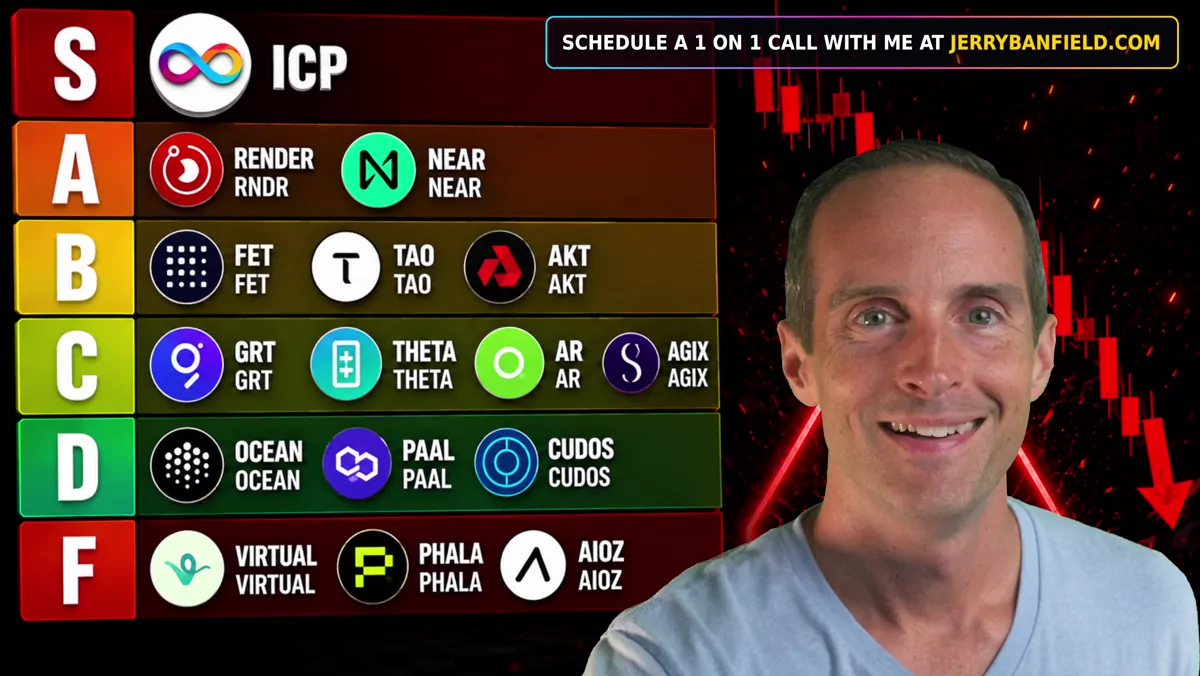
I had this research document prepared as a brutally evidence-based infrastructure and token-exposure audit of CoinGecko's top 50 AI coins — the research backbone I used to record my video "I Review EVERY Top 50 AI Coin." I'm publishing the entire audit here so you can check every claim, every score, and every source yourself.
Read this with both eyes open: it is deliberately skeptical adversarial research, not balanced investment analysis, and none of it is financial advice — I'm not a financial advisor. You should also know up front that I'm all in on the Internet Computer Protocol, which this audit covers directly and ranks as its number one token. The central thesis in one sentence: most of the category is not fake software — it is fake exposure. The technology may be real, while the token neither owns, verifies, burns for, nor captures the AI value being created. The research snapshot is July 18, 2026; primary sources are official documentation, whitepapers and project websites, with CoinGecko used for category membership, rank and the market-cap snapshot.
Executive findings
The defensible headline ICP is the structural outlier for sovereign, replicated on-chain application execution and direct compute burn. It is not the only project with real AI infrastructure. Render, io.net, Akash, Golem, Livepeer, Aethir, AIOZ, Grass, OriginTrail and several others provide real off-chain compute, data or verification services. The brutal truth is that most tokens provide much weaker exposure than their projects do.
Ten hard truths
1. The category is not an investment thesis. CoinGecko mixes base chains, oracle networks, storage, GPU marketplaces, agent launchpads, consumer apps, data-labeling networks and derivative subnet assets under one AI tag.
2. Token does not mean equity. Buying a token usually gives no ownership of the company, models, datasets, API revenue, intellectual property or customer contracts.
3. ICP is the on-chain execution outlier. Its canisters run replicated application logic and state; ICP is converted to cycles and consumed for compute. That is structurally different from settling payments around off-chain AI.
4. Real off-chain infrastructure exists. Render, io.net, Akash, Golem, Livepeer, Aethir and AIOZ provide actual GPUs or cloud resources. They are not fake—but the work is still off-chain and normally not trustlessly reproduced.
5. Economic consensus is not model correctness. Bittensor and Allora can create useful incentive and ranking markets, yet validator or reputer scores are judgments, not cryptographic proof that an AI answer is true.
6. TEEs are a different trust model, not magic decentralization. NEAR, Kite, Pieverse, Venice and others can use hardware enclaves for confidentiality and attestation, but users still trust hardware, firmware and operators.
7. Real products often have weak tokens. Sentient may do genuine AI research; Chutes may sell genuine inference; Livepeer may process real AI video. None of that guarantees the listed token captures proportional value.
8. The category double-counts underlying systems. Bittensor appears through TAO, SN0, Chutes/SN64 and lium/SN51; Theta appears through THETA and TFUEL; Venice appears through VVV and DIEM.
9. Several entries are plainly misclassified. Chainlink, MultiversX and ZIGChain are useful or legitimate crypto projects whose base assets have little direct connection to AI-created value.
10. Brutality requires precision. Calling weak exposure “fraud” without evidence makes the analysis easier to dismiss. “Misclassified,” “narrative-heavy,” “unverified” and “token-value disconnect” are both harsher and more defensible when the documentation supports them.
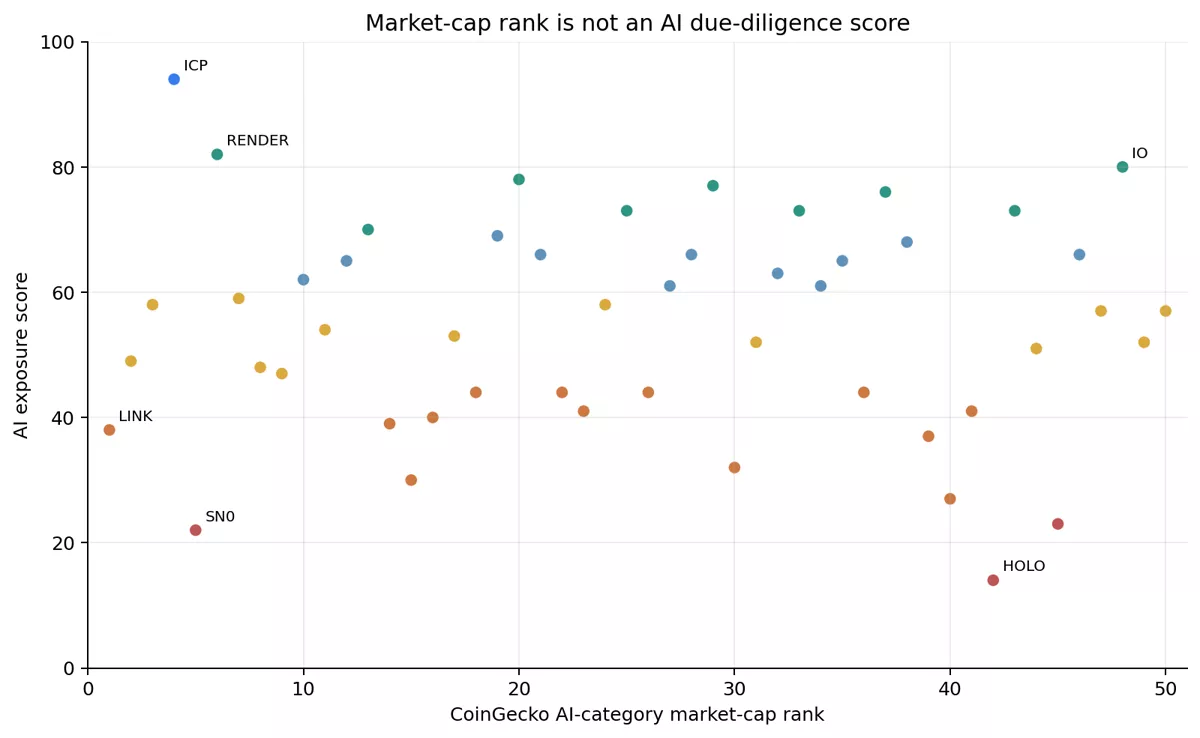
Figure 1. CoinGecko rank measures market capitalization inside an editorial category—not technical AI exposure. The score is this report’s evidence-based judgment, not a price forecast.
What this report does not claim It does not claim ICP can train frontier-scale models on-chain today. It does not claim every weak or misclassified token is criminal fraud. It does not infer a motive for CoinGecko’s current or historical tagging decisions. It does not predict token prices. It asks one narrower question: what real AI value does a buyer of each token actually gain exposure to?
Methodology: what counts as real AI exposure
Every token receives a 0–100 score across five dimensions. The framework deliberately separates project quality from token exposure: a real product can still be a bad proxy investment.
| Dimension | Max | High score means | Low score means |
|---|---|---|---|
| AI-native usefulness | 25 | Provides compute, inference, model services, data, memory or execution that AI actually needs. | AI is only an ecosystem theme, interface or customer label. |
| Verifiability / trust minimization | 20 | Results, state or provenance can be independently reproduced, challenged or secured by explicit guarantees. | Users simply trust an API, operator, subnet owner, validator committee or proprietary score. |
| Token capture of AI value | 25 | AI usage requires paying, burning or staking the token, or revenues transparently buy it. | Token is optional governance, generic gas, rewards or a speculative wrapper beside the product. |
| Production evidence | 15 | Live product, public code, customer use, active providers and measurable service delivery. | Roadmap, waitlist, “soon,” unaudited counters or self-reported partnerships dominate. |
| AI-category integrity | 15 | AI is central to the project and token economics. | The project is a generic chain, storage/oracle system, derivative asset or non-AI app. |
Score bands
| Tier | Interpretation | Count in top 50 |
|---|---|---|
| S 85–100 | Direct structural AI exposure | 1 |
| A 70–84 | Real AI infrastructure, mostly off-chain | 9 |
| B 60–69 | Credible AI-adjacent infrastructure | 11 |
| C 45–59 | Real technology, compromised token or AI link | 13 |
| D 25–44 | Application-level or narrative-heavy exposure | 13 |
| F 0–24 | Misclassified, derivative or evidence-poor | 3 |
Evidence rules
Official documentation and whitepapers are treated as primary evidence of architecture and intended token mechanics—not as independent proof of adoption.
Project-reported users, nodes, revenues, partnerships and performance are labeled or treated as self-reported unless independently auditable.
A blockchain receipt can prove a transaction or attestation occurred. It does not automatically prove the underlying AI output is correct.
A TEE can attest code and protect secrets under a hardware trust model. It is not equivalent to replicated consensus execution.
A token is not equity unless a legally enforceable ownership or revenue right explicitly exists. Buybacks, burns, credits and staking rights are analyzed as mechanisms, not shareholder claims.
Ranked results and outliers
Scores rank exposure to AI value—not technical elegance in isolation and not expected token return.
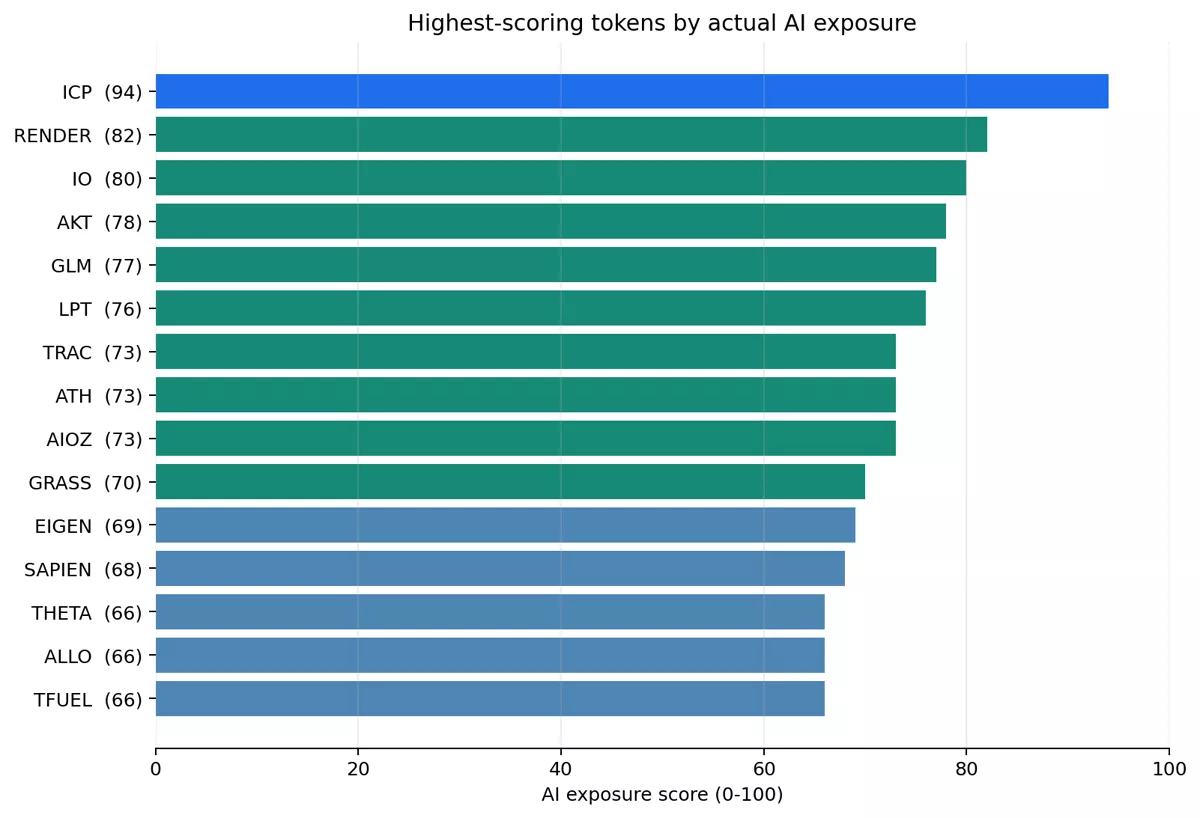
Figure 2. Top 15 by actual AI-exposure score. ICP is alone in the S tier; the A tier is dominated by real compute and data infrastructure whose workloads still execute off-chain.
The outliers worth discussing on camera
ICP — structural outlier Replicated canister execution plus direct conversion of ICP into consumed cycles. Strongest sovereign AI application and control-plane thesis; current model size and GPU throughput remain constraints.
Render and io.net — cleanest compute loops Both sell real GPU work. Render burns tokens for jobs; io.net converts customer payments into IO compensation for workers. Execution remains off-chain.
Akash, Golem, Livepeer, Aethir and AIOZ — real infrastructure These projects provide actual cloud or GPU capacity. The critique should target token capture and workload verification—not deny the hardware or service exists.
OriginTrail, Grass and Sapien — real data layer Provenance, acquisition and human-quality feedback are essential AI inputs. They do not run models, but they solve real bottlenecks.
Venice VVV/DIEM — unexpected direct service exposure The system is centralized, but the tokens explicitly unlock recurring AI credits and VVV buy-and-burns. This is a clearer AI-use link than many decentralized-sounding projects.
Pearl — speculative technical outlier A proof-of-useful-work design could matter if independently proven. Product components remain early, so it belongs in a research bucket, not alongside mature cloud networks.
Sentient — great project, questionable token Open-source AI research can be genuine while the token has no clear claim on model, IP or revenue value.
Bittensor — important but oversold It is a real market for rewarding off-chain services. It is not cryptographic proof of intelligence, and subnet quality cannot be inferred from TAO branding.
Complete score ranking
| # | Token | Score | Tier | Bottom line |
|---|---|---|---|---|
| 1 | Internet Computer (ICP) CG rank 4 | 94 | S | Best direct exposure in the top 50 to sovereign, on-chain AI-capable infrastructure and usage-linked token burn. |
| 2 | Render (RENDER) CG rank 6 | 82 | A | Top-tier real AI infrastructure exposure, with a direct token/job loop but off-chain execution risk. |
| 3 | io.net (IO) CG rank 48 | 80 | A | Top-tier real AI compute exposure with a strong token/provider payment loop and off-chain trust assumptions. |
| 4 | Akash Network (AKT) CG rank 20 | 78 | A | One of the strongest real-compute plays in the category, with off-chain execution and competitive-market risk. |
| 5 | Golem (GLM) CG rank 29 | 77 | A | Genuine AI-capable compute marketplace with direct token payment and off-chain execution risk. |
| 6 | Livepeer (LPT) CG rank 37 | 76 | A | Top-tier real AI/video compute network; LPT value capture is meaningful but indirect. |
| 7 | OriginTrail (TRAC) CG rank 25 | 73 | A | One of the best real AI data/provenance exposures in the category. |
| 8 | Aethir (ATH) CG rank 33 | 73 | A | Strong real-compute project; credible but imperfect token exposure to AI usage. |
| 9 | AIOZ Network (AIOZ) CG rank 43 | 73 | A | Credible decentralized infrastructure with real AI capability and moderate token specificity. |
| 10 | Grass (GRASS) CG rank 13 | 70 | A | Real and useful AI data infrastructure, with unresolved provenance and long-term token-demand questions. |
| 11 | EigenCloud (EIGEN) CG rank 19 | 69 | B | Strong AI-adjacent verification infrastructure with real potential and service-adoption risk. |
| 12 | Sapien (SAPIEN) CG rank 38 | 68 | B | Credible AI data-quality infrastructure with real token mechanics and human-consensus limits. |
| 13 | Theta Network (THETA) CG rank 21 | 66 | B | Real edge/AI network; THETA is an indirect security token, not the clearest service-demand asset. |
| 14 | Allora (ALLO) CG rank 28 | 66 | B | Real AI inference coordination with a solid token loop; off-chain execution and delayed ground truth limit verifiability. |
| 15 | Theta Fuel (TFUEL) CG rank 46 | 66 | B | Real operational exposure to an AI-capable edge network, diluted by multi-use demand and two-token complexity. |
| 16 | Unibase (UB) CG rank 12 | 65 | B | Credible AI data infrastructure with meaningful potential; token necessity and scale remain unproven. |
| 17 | Pearl (PRL) CG rank 35 | 65 | B | High-upside research outlier; far too early to treat as proven infrastructure. |
| 18 | Data Network (DATA) CG rank 32 | 63 | B | Credible AI provenance infrastructure with identity, maturity and evidence gaps. |
| 19 | Artificial Superintelligence Alliance (FET) CG rank 10 | 62 | B | A credible but sprawling AI stack with real teams and unresolved integration, verification and value-capture risk. |
| 20 | TAGGER (TAG) CG rank 27 | 61 | B | Genuine AI data infrastructure category, with significant quality and demand verification risk. |
| 21 | Chutes (SN64) CG rank 34 | 61 | B | Strong real inference product; weakly proven independent token capture. |
| 22 | Venice Token (VVV) CG rank 7 | 59 | C | Real AI application exposure and unusually direct service utility; centralized execution and platform risk remain decisive. |
| 23 | Bittensor (TAO) CG rank 3 | 58 | C | Meaningful incentive infrastructure, materially overstated as decentralized or verifiable AI. |
| 24 | Arweave (AR) CG rank 24 | 58 | C | Real storage network; useful to AI but not direct AI exposure. |
| 25 | ChainOpera AI (COAI) CG rank 47 | 57 | C | Potentially substantive full-stack AI platform; evidence and token-demand proof lag the scope of the pitch. |
| 26 | lium (SN51) CG rank 50 | 57 | C | Potentially real compute service; layered token economics and proof of demand remain weak points. |
| 27 | Kite (KITE) CG rank 11 | 54 | C | Credible agent-commerce infrastructure, but only indirect exposure to AI growth. |
| 28 | The Graph (GRT) CG rank 17 | 53 | C | Real decentralized indexing; weak and indirect AI exposure. |
| 29 | Sentient (SENT) CG rank 31 | 52 | C | Real AI research; unclear token exposure to the value that research creates. |
| 30 | Diem (DIEM) CG rank 49 | 52 | C | Real AI-service entitlement; centralized counterparty and sustainability risk, not independent infrastructure. |
| 31 | Qubic (QUBIC) CG rank 44 | 51 | C | Interesting experimental AI-native architecture; evidence remains too thin for high conviction. |
| 32 | NEAR Protocol (NEAR) CG rank 2 | 49 | C | Credible AI-adjacent chain, weak as a pure AI exposure vehicle. |
| 33 | Talus (US) CG rank 8 | 48 | C | Promising agent tooling; current trust model and maturity do not support the grandest claims. |
| 34 | Virtuals Protocol (VIRTUAL) CG rank 9 | 47 | C | Real platform, but exposure is primarily to agent-token speculation and commerce—not AI infrastructure. |
| 35 | Pieverse (PIEVERSE) CG rank 18 | 44 | D | Useful agent-security application; limited direct AI and token exposure. |
| 36 | Holoworld (HOLO) CG rank 22 | 44 | D | Real AI application and creator market; weak foundational exposure. |
| 37 | AWE Network (AWE) CG rank 26 | 44 | D | Interesting agent-simulation project; speculative maturity and token economics. |
| 38 | UnifAI Network (UAI) CG rank 36 | 44 | D | Real agent tooling; moderate app-level AI relevance and unproven token demand. |
| 39 | Mantis (M) CG rank 23 | 41 | D | Real DeFi protocol; AI is a feature and marketing layer, not the core value engine. |
| 40 | AI Rig Complex (ARC) CG rank 41 | 41 | D | Real developer tooling; narrative-heavy and uncertain token capture. |
| 41 | KAITO (KAITO) CG rank 16 | 40 | D | Real AI-enabled information business; limited AI infrastructure and uncertain value capture. |
| 42 | Velvet (VELVET) CG rank 14 | 39 | D | Real AI-assisted app; weak foundational AI exposure. |
| 43 | Chainlink (LINK) CG rank 1 | 38 | D | Real crypto infrastructure; almost no direct AI exposure. The CoinGecko AI tag is misleading. |
| 44 | Arkham (ARKM) CG rank 39 | 37 | D | Real analytics business; weak and misclassified AI exposure. |
| 45 | MultiversX (EGLD) CG rank 30 | 32 | D | Real blockchain, negligible direct AI exposure; AI tag should be removed. |
| 46 | Quack AI (Q) CG rank 15 | 30 | D | Some real payment/governance tooling; evidence and token necessity are too weak for strong AI exposure. |
| 47 | Law Blocks AI (LBT) CG rank 40 | 27 | D | Application-level AI narrative with weak technical and token evidence. |
| 48 | ZIGChain (ZIG) CG rank 45 | 23 | F | Not an AI coin by any meaningful infrastructure or value-capture standard. |
| 49 | Staked TAO (Root) (SN0) CG rank 5 | 22 | F | Derivative exposure, not an independent AI investment thesis. |
| 50 | Holozone (HOLO) CG rank 42 | 14 | F | Very weak AI exposure and severe evidence/data-quality concerns. |
Executive summary of all 50 coins
This is the video-ready short version in CoinGecko market-cap order. Each line is written to stand alone in roughly 15–25 seconds.
| CG | Coin | Score | Video-ready verdict |
|---|---|---|---|
| 1 | Chainlink LINK | 38 D | Chainlink is an oracle network wearing an AI costume because somebody noticed agents need data. |
| 2 | NEAR Protocol NEAR | 49 C | NEAR's AI story is a normal blockchain handing the hard work to a TEE and keeping the AI label for itself. |
| 3 | Bittensor TAO | 58 C | Bittensor turns validator opinions about off-chain outputs into emissions, then markets the scoreboard as intelligence itself. |
| 4 | Internet Computer ICP | 94 S | Most AI coins coordinate payments around somebody else's server. ICP is the one here where the serverless application itself can live under consensus and burn the token to run. |
| 5 | Staked TAO (Root) SN0 | 22 F | CoinGecko counted Bittensor once, then counted its root position again and called the duplicate a new AI coin. |
| 6 | Render RENDER | 82 A | Render is what many AI coins only cosplay as: customers actually pay for GPU work. The blockchain still does the accounting, not the intelligence. |
| 7 | Venice Token VVV | 59 C | VVV is not decentralized intelligence. It is a tokenized AI subscription with a buy-and-burn loop—which is still more honest exposure than most of this category offers. |
| 8 | Talus US | 48 C | Talus puts a blockchain receipt around an API call and asks you to treat the receipt as decentralized intelligence. |
| 9 | Virtuals Protocol VIRTUAL | 47 C | Virtuals found the most crypto-native AI use case possible: put a ticker on the chatbot before proving anybody needs the chatbot. |
| 10 | Artificial Superintelligence Alliance FET | 62 B | Four projects merged their tickers and upgraded the marketing language to superintelligence; the engineering still has to merge too. |
| 11 | Kite KITE | 54 C | Kite gives the robot a wallet and spending limit. Useful—but the wallet is not the brain. |
| 12 | Unibase UB | 65 B | Unibase is solving a real problem. Now it has to prove the blockchain memory is better than a database—not merely more tradable. |
| 13 | Grass GRASS | 70 A | Grass is one of the rare AI coins selling something AI companies actually need: data. The token still has to graduate from paying scrapers to capturing customer demand. |
| 14 | Velvet VELVET | 39 D | Velvet put a chatbot in front of DeFi and promoted the interface to an AI asset class. |
| 15 | Quack AI Q | 30 D | Quack can prove a transaction happened. It cannot prove the AI deserved to make the decision—and the website quietly blurs the difference. |
| 16 | KAITO KAITO | 40 D | Kaito uses AI to price crypto attention, then asks the attention market to price its token. |
| 17 | The Graph GRT | 53 C | The Graph is a database indexer. Calling it an AI coin because agents query data is category inflation with a straight face. |
| 18 | Pieverse PIEVERSE | 44 D | Pieverse protects the robot's private key. Good product—wrong aisle in the investment supermarket. |
| 19 | EigenCloud EIGEN | 69 B | EigenCloud is one of the few projects asking the right question—how do we verify off-chain work? It still cannot answer that question with a single staking slogan. |
| 20 | Akash Network AKT | 78 A | Akash is an actual cloud marketplace. The AI tag is broad, but at least the GPUs exist outside the pitch deck. |
| 21 | Theta Network THETA | 66 B | Theta has real compute, then split the investment story into a governance token and a fuel token so the AI list could count it twice. |
| 22 | Holoworld HOLO | 44 D | Holoworld tokenizes the character and records the ownership. The personality still lives on somebody's server. |
| 23 | Mantis M | 41 D | Mantis uses an LLM to ask what trade you want, then a normal solver network does the actual job. |
| 24 | Arweave AR | 58 C | Arweave stores AI files, which apparently is enough for CoinGecko to turn a hard drive into an AI coin. |
| 25 | OriginTrail TRAC | 73 A | OriginTrail does not pretend the graph is intelligent. It gives intelligence something most crypto AI projects lack: traceable facts. |
| 26 | AWE Network AWE | 44 D | AWE promises autonomous worlds. Today the most autonomous thing may still be the token marketing. |
| 27 | TAGGER TAG | 61 B | TAGGER is selling picks and shovels for AI data. The revolution starts only when customers pay more than the token emissions do. |
| 28 | Allora ALLO | 66 B | Allora is a market for ranking model answers. Useful—but the blockchain keeps score; it does not do the thinking. |
| 29 | Golem GLM | 77 A | Golem is less glamorous than the new AI coins because it committed the unforgivable sin of building a compute marketplace before the AI narrative arrived. |
| 30 | MultiversX EGLD | 32 D | MultiversX is a normal L1 that discovered the word AI was cheaper than discovering an AI-native architecture. |
| 31 | Sentient SENT | 52 C | Sentient may build excellent AI. Buying SENT still does not make you a shareholder in the lab—and the tokenomics cannot wave that away. |
| 32 | Data Network DATA | 63 B | Data Network has the right idea—AI needs receipts. Investors also need receipts for the project's own scale claims. |
| 33 | Aethir ATH | 73 A | Aethir has real GPUs. The due diligence starts where the node-sale dashboard ends: who is paying to use them? |
| 34 | Chutes SN64 | 61 B | Chutes sells AI inference for dollars and sells the market a subnet token. Those are related businesses, not the same asset. |
| 35 | Pearl PRL | 65 B | Pearl might be the rare project attempting a real AI-blockchain innovation. Right now the breakthrough is still scheduled for 'soon.' |
| 36 | UnifAI Network UAI | 44 D | UnifAI helps a chatbot call DeFi functions. That is useful middleware, not ownership of the AI revolution. |
| 37 | Livepeer LPT | 76 A | Livepeer has real AI jobs. The awkward part is that customers pay ETH while the AI category tells you to buy LPT. |
| 38 | Sapien SAPIEN | 68 B | Sapien can prove experts agreed. It cannot prove the experts were right—but at least it is honest about needing humans in the loop. |
| 39 | Arkham ARKM | 37 D | Arkham uses machine learning to label wallets, so CoinGecko labeled the wallet-labeling token an AI coin. Labels all the way down. |
| 40 | Law Blocks AI LBT | 27 D | Law Blocks puts AI next to legal templates and blockchain timestamps, then asks the token to carry the burden of proof. |
| 41 | AI Rig Complex ARC | 41 D | ARC's code may help build agents. The token mostly helps build a market around the people building the agents. |
| 42 | Holozone HOLO | 14 F | Holozone clones personalities; the CoinGecko page appears to clone market caps too—just not consistently. |
| 43 | AIOZ Network AIOZ | 73 A | AIOZ has actual edge nodes. The remaining question is whether they are serving AI customers or mostly serving the narrative. |
| 44 | Qubic QUBIC | 51 C | Qubic is trying to make mining useful. Until the useful AI output is independently visible, the most validated output is still the token. |
| 45 | ZIGChain ZIG | 23 F | ZIGChain is a finance chain that wandered into the AI category wearing one ecosystem integration as a name tag. |
| 46 | Theta Fuel TFUEL | 66 B | TFUEL is the token that actually pays for activity, which makes CoinGecko's earlier THETA listing look like the trailer for the same movie. |
| 47 | ChainOpera AI COAI | 57 C | ChainOpera promises an app, agents, models, GPUs and a chain. When one token claims the whole AI stack, due diligence has to check which acts are actually on stage. |
| 48 | io.net IO | 80 A | io.net actually rents GPUs to AI users. The blockchain is the marketplace accountant, which is still far more useful than pretending the accountant is the model. |
| 49 | Diem DIEM | 52 C | DIEM is a tradable daily AI-credit coupon. At least the coupon buys AI—just do not confuse it with a decentralized cloud. |
| 50 | lium SN51 | 57 C | lium may rent real GPUs, but the investor is buying the subnet wrapper around the marketplace—not a deed to the hardware. |
25-minute video structure
The fastest way to keep 50 reviews intelligible is to establish the test once, then group projects by what they actually sell.
| Time | Segment | What to say |
|---|---|---|
| 0:00–1:45 | The category is the scammy part | Explain that CoinGecko mixes unrelated layers and that a token is not equity. Introduce the five-part score. |
| 1:45–4:30 | Top five by market cap | Chainlink: mislabeled. NEAR: AI-adjacent/TEE. Bittensor: economic ranking, not proof. ICP: structural outlier. SN0: duplicate Bittensor exposure. |
| 4:30–9:30 | Real compute | Render, Akash, Golem, Aethir, Livepeer, AIOZ, io.net, Theta/TFUEL and lium. Praise the hardware; attack weak verification and token leakage. |
| 9:30–13:00 | Real data and verification | OriginTrail, Grass, Sapien, Unibase, Data Network, TAGGER, EigenCloud and Allora. Show the difference between provenance, consensus and truth. |
| 13:00–18:30 | Agent platforms and AI applications | Venice, Talus, Virtuals, Kite, Velvet, Kaito, Pieverse, Holoworld, Mantis, AWE, UnifAI, ARC and ChainOpera. |
| 18:30–22:45 | Generic chains, derivatives and category pollution | The Graph, Arweave, MultiversX, Arkham, Law Blocks, ZIGChain, SN0 and the paired-token systems. |
| 22:45–24:15 | The speculative outliers | Pearl and Qubic: technically interesting, far from proven. Sentient: real AI research, weak token claim. FET: broad alliance, integration burden. |
| 24:15–25:00 | Conclusion | ICP is the strongest sovereign/on-chain exposure. Real off-chain AI infrastructure exists. Most of the remaining category fails because the token does not capture the project—or the project is not meaningfully AI. |
Opening monologue draft
Use this framing CoinGecko calls these the top 50 AI coins. That does not mean they run AI, verify AI, own an AI business, or even require the token when somebody uses the product. So I read the documentation and asked five questions: does it provide something AI actually needs, can the work be verified, does the token capture the value, is the product live, and is the AI label honest? The result is one clear on-chain outlier, a handful of real off-chain infrastructure networks, and a mountain of category pollution.
Closing monologue draft
Use this conclusion ICP is the strongest direct bet here on sovereign AI-capable infrastructure because the application and state can live under consensus and ICP is burned to run it. Render, io.net, Akash, Golem, Livepeer, Aethir, AIOZ and the best data networks are real too—but they sell off-chain compute or data, not trustless intelligence. The rest of this category is mostly one of three things: a real project with a weak token, a normal crypto project wearing an AI label, or a token economy built around agents before the agents create enough value to justify the economy.
Detailed coin-by-coin audit
Profiles remain in CoinGecko market-cap order so the report maps directly to the planned video. Each score is explained by architecture, token mechanics and the gap between project value and token value.
01. Chainlink (LINK)
| CoinGecko rank | 1 | Market cap snapshot | $6.24B |
| AI score | 38/100 | Tier | D — Application-level or narrative-heavy exposure |
| AI utility | Verifiability | Token capture | Production | Category fit |
|---|---|---|---|---|
| 3/25 | 14/20 | 5/25 | 15/15 | 1/15 |
Bottom line A first-rate oracle and interoperability network, but a poor AI investment thesis. AI systems may consume Chainlink data; that does not make LINK a direct claim on AI growth.
WHAT IT ACTUALLY IS Chainlink is a decentralized oracle and cross-chain messaging network. Its core products move external data into smart contracts, transmit messages between chains, and support automation, proof-of-reserve, identity and compliance workflows. Those are real, mature pieces of blockchain infrastructure.
TECHNICAL REALITY The AI label is almost entirely derivative. An AI agent can call a Chainlink feed in the same way a lending protocol can, but the network does not train models, run inference, provide GPUs, store model memory, or verify AI reasoning. Chainlink's off-chain reporting committees attest data; they are not an execution environment for AI. Calling LINK an AI coin because agents might use an oracle is like calling an electric utility a robotics stock because robots consume power.
WHAT BUYING THE TOKEN CAPTURES LINK is used to pay oracle service providers and secure parts of the network through staking. That is legitimate token utility. The problem is specificity: AI demand is only one hypothetical slice of broad oracle demand, and token holders do not own Chainlink Labs or receive an equity claim on its enterprise relationships. Even where payment abstraction converts other assets into LINK, the value driver is oracle usage, not AI value creation as such.
WHAT THE MARKETING LEAVES OUT This is category pollution, not a worthless project. The honest pitch is 'infrastructure that AI agents may use,' not 'exposure to the future of AI.' A high-quality non-AI project can still be a bad AI investment proxy.
VERDICT Real crypto infrastructure; almost no direct AI exposure. The CoinGecko AI tag is misleading.
VIDEO ROAST: Chainlink is an oracle network wearing an AI costume because somebody noticed agents need data.
PRIMARY SOURCES REVIEWED: Chainlink documentation • Chainlink economics and LINK utility • Chainlink platform overview
02. NEAR Protocol (NEAR)
| CoinGecko rank | 2 | Market cap snapshot | $2.52B |
| AI score | 49/100 | Tier | C — Real technology, compromised token or AI link |
| AI utility | Verifiability | Token capture | Production | Category fit |
|---|---|---|---|---|
| 13/25 | 10/20 | 8/25 | 13/15 | 5/15 |
Bottom line NEAR has genuine agent tooling and secure-compute integrations, but heavy AI work is delegated to off-chain trusted execution environments. NEAR is still a generic gas and staking token first.
WHAT IT ACTUALLY IS NEAR is a sharded layer-1 blockchain with smart contracts, storage, accounts, staking and a growing set of tools for AI agents. Its AI documentation includes agent development frameworks, account abstraction and integrations that let applications request compute from trusted execution environments (TEEs).
TECHNICAL REALITY The marketing leap is larger than the architectural leap. NEAR itself does not natively replicate frontier-model inference across validators. Its documentation explicitly routes heavy or impossible-on-chain workloads to off-chain compute, commonly protected by Intel TDX-style TEEs. That can improve confidentiality and attest which code ran, but it is not the same thing as every validator independently reproducing the AI result. The secure hardware vendor and off-chain operator remain part of the trust model.
WHAT BUYING THE TOKEN CAPTURES NEAR pays generic transaction fees, storage and validator staking. AI-agent activity can create NEAR demand, but so can any other application. The token does not automatically capture model revenue, API revenue, or the commercial value of projects funded by the ecosystem. Paying grants to AI teams can attract builders; it does not transform the base asset into ownership of their businesses.
WHAT THE MARKETING LEAVES OUT NEAR is more technically serious about agents than a pure narrative token, so dismissing it as incapable of supporting AI would be inaccurate. The correct criticism is narrower and stronger: the AI execution is mainly off-chain, while the token captures generic chain use rather than AI economics specifically.
VERDICT Credible AI-adjacent chain, weak as a pure AI exposure vehicle.
VIDEO ROAST: NEAR's AI story is a normal blockchain handing the hard work to a TEE and keeping the AI label for itself.
PRIMARY SOURCES REVIEWED: NEAR AI introduction • NEAR secure AI and TEE architecture • NEAR documentation
03. Bittensor (TAO)
| CoinGecko rank | 3 | Market cap snapshot | $1.88B |
| AI score | 58/100 | Tier | C — Real technology, compromised token or AI link |
| AI utility | Verifiability | Token capture | Production | Category fit |
|---|---|---|---|---|
| 18/25 | 6/20 | 16/25 | 10/15 | 8/15 |
Bottom line Bittensor is a real incentive network, but not trustless AI computation. Subnets define off-chain work, validators score miners, and consensus aggregates rankings rather than proving model correctness.
WHAT IT ACTUALLY IS Bittensor coordinates specialized subnets in which miners produce outputs, validators evaluate them, subnet owners define incentive logic and TAO emissions reward participants. The chain records economic state, registrations, stakes, weights and emissions. Subnets can target inference, search, prediction, data and other tasks.
TECHNICAL REALITY The central issue is what the chain actually proves. Subnet incentive code and most AI work live off-chain. Validators submit weight vectors that rank miners; Yuma Consensus aggregates those judgments into emissions. That is an economic reputation game, not a cryptographic proof that an answer is accurate, original, decentralized or even useful outside the subnet's scoring function. A poorly designed or collusive subnet can reward behavior that looks good to its own evaluators without creating durable AI value. The network's decentralization is therefore only as strong as each subnet's incentive design and validator independence.
WHAT BUYING THE TOKEN CAPTURES TAO is genuinely central to staking, registration, emissions and subnet-market exposure. This gives it a stronger token loop than many AI-branded applications. Still, buying TAO does not buy the models, datasets, customer contracts or cash flows of individual subnets. It buys exposure to an inflationary incentive economy whose output quality must be assessed subnet by subnet.
WHAT THE MARKETING LEAVES OUT Bittensor is neither empty nor the 'next invention after Bitcoin and the internet.' Its useful innovation is a flexible market for allocating token rewards to off-chain services. The smoke-and-mirrors risk begins when that ranking market is described as if it were verifiable decentralized intelligence.
VERDICT Meaningful incentive infrastructure, materially overstated as decentralized or verifiable AI.
VIDEO ROAST: Bittensor turns validator opinions about off-chain outputs into emissions, then markets the scoreboard as intelligence itself.
PRIMARY SOURCES REVIEWED: Bittensor documentation • Subnet architecture • Yuma Consensus
04. Internet Computer (ICP)
| CoinGecko rank | 4 | Market cap snapshot | $1.20B |
| AI score | 94/100 | Tier | S — Direct structural AI exposure |
| AI utility | Verifiability | Token capture | Production | Category fit |
|---|---|---|---|---|
| 24/25 | 19/20 | 24/25 | 13/15 | 14/15 |
Bottom line The structural outlier. ICP is converted into cycles and burned to pay for replicated computation, letting tamper-resistant applications, data and some AI models live inside smart contracts rather than merely settle payments around off-chain AI.
WHAT IT ACTUALLY IS Internet Computer is a sovereign cloud built from independent node machines. Applications run as replicated WebAssembly smart contracts called canisters, which can serve web experiences, hold state, call other services and execute application logic. Network users convert ICP into cycles; those cycles pay for computation, memory, storage and bandwidth and are consumed by use.
TECHNICAL REALITY Among this top 50, ICP has the strongest case for native, general-purpose, replicated AI-capable execution. The crucial difference is not a token labeled AI; it is an execution environment where application code and state can be tamper-resistant and verifiable under blockchain consensus. That makes ICP useful as a sovereign control plane for AI agents, AI-built software, private user data and smaller on-chain models. It also creates a place where AI can modify or operate software without handing ultimate control to a conventional cloud account.
WHAT BUYING THE TOKEN CAPTURES The token link is unusually direct. Developers acquire ICP, convert it into cycles and burn those cycles as the application consumes resources. More sustained compute demand can therefore create more ICP burn, while node providers are rewarded through protocol issuance. This is not equity, but it is a concrete commodity-style use loop between the token and the underlying compute service.
WHAT THE MARKETING LEAVES OUT ICP is not magic and should not be sold as a replacement for hyperscale GPU clusters today. Replicated execution is expensive; current on-chain model sizes and memory are constrained; frontier-model training and large inference workloads may still require external services or specialized future hardware. The defensible claim is that ICP is the strongest sovereign AI application and verifiable-execution platform in this list—not that it already beats every centralized AI cloud at raw model throughput.
VERDICT Best direct exposure in the top 50 to sovereign, on-chain AI-capable infrastructure and usage-linked token burn.
VIDEO ROAST: Most AI coins coordinate payments around somebody else's server. ICP is the one here where the serverless application itself can live under consensus and burn the token to run.
PRIMARY SOURCES REVIEWED: Internet Computer overview • ICP tokenomics and cycles • Canister smart contracts
05. Staked TAO (Root) (SN0)
| CoinGecko rank | 5 | Market cap snapshot | $1.19B |
| AI score | 22/100 | Tier | F — Misclassified, derivative or evidence-poor |
| AI utility | Verifiability | Token capture | Production | Category fit |
|---|---|---|---|---|
| 3/25 | 4/20 | 6/25 | 7/15 | 2/15 |
Bottom line Not an independent AI network. SN0 is root/staked exposure inside Bittensor, so CoinGecko is effectively counting the same underlying system again near the top of the category.
WHAT IT ACTUALLY IS SN0 represents Bittensor's root-network or staked-root exposure rather than a standalone AI protocol with its own independent compute, documentation, users and consensus. Its economic meaning is tied to Bittensor's subnet and staking system.
TECHNICAL REALITY Nothing new is being added to the AI stack here. The same off-chain-work and validator-ranking limitations discussed for TAO remain, while SN0 adds a financial wrapper or internal market position. Treating it as the fifth-largest separate AI coin exaggerates the diversity and capitalization of the category.
WHAT BUYING THE TOKEN CAPTURES Its value depends on Bittensor staking, root allocation and subnet-market mechanics. It does not create an additional AI service or separate stream of customer demand. Investors need to understand whether they are buying TAO exposure, subnet exposure, a liquid staking claim or some combination—not assume this is a fifth independent AI infrastructure company.
WHAT THE MARKETING LEAVES OUT This is a category-construction failure. A derivative can be useful, but placing it beside the underlying token as a separate top AI project is double counting dressed up as discovery.
VERDICT Derivative exposure, not an independent AI investment thesis.
VIDEO ROAST: CoinGecko counted Bittensor once, then counted its root position again and called the duplicate a new AI coin.
PRIMARY SOURCES REVIEWED: Bittensor documentation • CoinGecko AI category snapshot
06. Render (RENDER)
| CoinGecko rank | 6 | Market cap snapshot | $762.9M |
| AI score | 82/100 | Tier | A — Real AI infrastructure, mostly off-chain |
| AI utility | Verifiability | Token capture | Production | Category fit |
|---|---|---|---|---|
| 23/25 | 8/20 | 23/25 | 14/15 | 14/15 |
Bottom line One of the strongest non-ICP entries. Customers buy real GPU work, and the burn-and-mint equilibrium links paid jobs to RENDER demand. The work remains off-chain and is not inherently trustless.
WHAT IT ACTUALLY IS Render Network connects GPU providers with creators and developers who need rendering and, increasingly, AI-related compute. The network supports graphics workloads, generative tools and dedicated compute subnets. It is a marketplace for a scarce input that AI genuinely consumes: high-performance GPUs.
TECHNICAL REALITY This is real infrastructure, not a token launchpad pretending to be AI. The limitation is verification. GPU jobs run on provider hardware outside blockchain consensus, and quality assurance depends on workflow-specific checks, reputation and orchestration. The chain can settle and account for work; it does not make every rendered frame or model output cryptographically correct.
WHAT BUYING THE TOKEN CAPTURES Render's burn-and-mint equilibrium is one of the cleaner value-capture designs in the category. Users purchase work, RENDER is burned for jobs, and emissions compensate node operators. That creates a direct connection between paid network usage and token demand, although fiat or credit abstractions can affect how visibly the demand reaches the market.
WHAT THE MARKETING LEAVES OUT Render's honest pitch is strong enough without pretending the AI itself is on-chain. It is decentralized GPU supply and job settlement, not sovereign model execution. Investors should track real job volume and provider economics rather than social-media claims about an AI revolution.
VERDICT Top-tier real AI infrastructure exposure, with a direct token/job loop but off-chain execution risk.
VIDEO ROAST: Render is what many AI coins only cosplay as: customers actually pay for GPU work. The blockchain still does the accounting, not the intelligence.
PRIMARY SOURCES REVIEWED: Render Network knowledge base • Burn and Mint Equilibrium • Render Network
07. Venice Token (VVV)
| CoinGecko rank | 7 | Market cap snapshot | $551.3M |
| AI score | 59/100 | Tier | C — Real technology, compromised token or AI link |
| AI utility | Verifiability | Token capture | Production | Category fit |
|---|---|---|---|---|
| 17/25 | 3/20 | 18/25 | 11/15 | 10/15 |
Bottom line Not decentralized AI infrastructure, but the token does have a concrete AI-service loop: staking unlocks inference capacity, VVV can mint DIEM, and Venice says revenue funds buy-and-burns.
WHAT IT ACTUALLY IS Venice is a privacy-oriented AI application and API that aggregates access to open and proprietary text, image, video and other models. VVV is its capital and staking token. Stakers can receive Venice Pro access, earn emissions and lock VVV to mint DIEM, which represents renewing AI credits.
TECHNICAL REALITY The product is genuinely AI, but the decentralization story is limited. Venice operates the service and controls the model routing, pricing, privacy tiers and available compute. Some workloads may use self-hosted models or TEEs, while others are anonymized requests to third-party providers. This is closer to a privacy-focused AI subscription business with tokenized access than an autonomous decentralized compute network.
WHAT BUYING THE TOKEN CAPTURES Unlike many tokens in this list, VVV has an explicit service entitlement. Staking can unlock recurring inference capacity, and Venice states that a share of platform revenue is used to buy and burn VVV. That provides a more intelligible value loop than generic governance. It still does not make holders shareholders, and the sustainability of perpetual credits depends on Venice's revenue, emissions, compute costs and policy choices.
WHAT THE MARKETING LEAVES OUT The token economics are real enough to study, but marketing language such as 'capital asset' should not be confused with legal equity. Users also can buy ordinary subscriptions and credits, so token demand competes with simpler payment options.
VERDICT Real AI application exposure and unusually direct service utility; centralized execution and platform risk remain decisive.
VIDEO ROAST: VVV is not decentralized intelligence. It is a tokenized AI subscription with a buy-and-burn loop—which is still more honest exposure than most of this category offers.
PRIMARY SOURCES REVIEWED: Venice VVV mechanics • Venice AI product and privacy architecture • Venice API documentation
08. Talus (US)
| CoinGecko rank | 8 | Market cap snapshot | $476.8M |
| AI score | 48/100 | Tier | C — Real technology, compromised token or AI link |
| AI utility | Verifiability | Token capture | Production | Category fit |
|---|---|---|---|---|
| 15/25 | 5/20 | 12/25 | 7/15 | 9/15 |
Bottom line A real agent framework whose own architecture admits that AI tools and execution are off-chain. Current central services and closed packages make the decentralization promise ahead of the product.
WHAT IT ACTUALLY IS Talus is building an agentic framework and workflow engine for combining AI models, tools, identities, payments and on-chain actions. Its Nexus architecture represents compound services as workflows and uses blockchain for coordination and value transfer.
TECHNICAL REALITY Talus documentation is unusually candid: AI computation is too expensive for normal on-chain execution, so model calls and tool work occur off-chain. The chain coordinates tasks and payments. Current architecture also relies on Talus-operated services, with TEEs and further decentralization described as a path rather than a fully realized state. Some on-chain packages have not been fully open-sourced. That makes 'verifiable agents' an aspiration bounded by external service trust.
WHAT BUYING THE TOKEN CAPTURES US is intended for service fees, staking and compensation of tool providers. That is directionally sensible, but the economic loop is only as strong as real paid agent workflows. If developers can call OpenAI, Anthropic or ordinary APIs directly, the token must justify why Talus coordination is worth the extra layer.
WHAT THE MARKETING LEAVES OUT Talus is not empty. It is an agent orchestration product with a blockchain settlement layer. The problem is calling off-chain model calls, centrally operated services and roadmap decentralization an on-chain AI execution network.
VERDICT Promising agent tooling; current trust model and maturity do not support the grandest claims.
VIDEO ROAST: Talus puts a blockchain receipt around an API call and asks you to treat the receipt as decentralized intelligence.
PRIMARY SOURCES REVIEWED: Talus documentation • Talus architecture • Talus website
09. Virtuals Protocol (VIRTUAL)
| CoinGecko rank | 9 | Market cap snapshot | $400.8M |
| AI score | 47/100 | Tier | C — Real technology, compromised token or AI link |
| AI utility | Verifiability | Token capture | Production | Category fit |
|---|---|---|---|---|
| 11/25 | 3/20 | 15/25 | 10/15 | 8/15 |
Bottom line A real launch and commerce protocol for tokenized agents, but most of the value proposition is financializing agents rather than improving AI compute, models or verifiability.
WHAT IT ACTUALLY IS Virtuals Protocol provides tools for creating, tokenizing and monetizing AI agents. VIRTUAL acts as a base trading pair and routing currency across an ecosystem of agent tokens, while the protocol supports agent ownership, interactions and commerce.
TECHNICAL REALITY The protocol can host real agents, but the blockchain's central role is issuance, liquidity and settlement. The intelligence itself normally runs off-chain through conventional models and infrastructure. Tokenizing an agent does not prove the agent is capable, autonomous, unique or economically useful. In speculative markets, the financial layer can grow much faster than the underlying product demand.
WHAT BUYING THE TOKEN CAPTURES VIRTUAL has genuine ecosystem utility as a common liquidity and transaction asset. That gives it better capture than a pure governance token. Still, much of the demand can come from launching and trading agent tokens rather than customers paying for valuable AI work. Investors are exposed to a token economy around AI personalities, not ownership of the models or compute.
WHAT THE MARKETING LEAVES OUT This is an AI-agent capital market, not foundational AI infrastructure. Its success could be real, but it would say as much about speculative launch mechanics and creator economies as about AI progress.
VERDICT Real platform, but exposure is primarily to agent-token speculation and commerce—not AI infrastructure.
VIDEO ROAST: Virtuals found the most crypto-native AI use case possible: put a ticker on the chatbot before proving anybody needs the chatbot.
PRIMARY SOURCES REVIEWED: Virtuals Protocol whitepaper • Virtuals Protocol
10. Artificial Superintelligence Alliance (FET)
| CoinGecko rank | 10 | Market cap snapshot | $353.0M |
| AI score | 62/100 | Tier | B — Credible AI-adjacent infrastructure |
| AI utility | Verifiability | Token capture | Production | Category fit |
|---|---|---|---|---|
| 19/25 | 6/20 | 16/25 | 10/15 | 11/15 |
Bottom line More substance than a typical narrative coin—agents, data, compute and planned inference markets—but the alliance is sprawling, many mechanisms remain developmental, and 'superintelligence' rhetoric runs far ahead of proof.
WHAT IT ACTUALLY IS The Artificial Superintelligence Alliance combines assets and development from Fetch.ai, SingularityNET, Ocean Protocol and CUDOS-related compute initiatives. Its public stack spans autonomous agents, data markets, distributed compute, model services, governance and research toward decentralized AGI.
TECHNICAL REALITY There are real products and teams here, but the breadth creates a due-diligence trap. A merged token does not automatically integrate codebases, customer demand, governance and economics into one coherent network. Some proposed services, such as pay-per-inference validation markets, resemble Bittensor-style economic scoring: model providers work off-chain, validators assess results and participants are rewarded. That may be useful, but it is not cryptographic proof of intelligence.
WHAT BUYING THE TOKEN CAPTURES FET is intended to span transactions, staking, governance, premium services, inference payments and compute discounts across the alliance. If those services converge and require FET, capture could be meaningful. Today the token thesis depends heavily on future integration and adoption across several organizations rather than a single transparent burn-for-service loop.
WHAT THE MARKETING LEAVES OUT The alliance's ambition is not evidence of delivery. Terms like AGI, ASI and 'largest decentralized AI alliance' are branding until live services, customer payments and measurable utilization make them economics.
VERDICT A credible but sprawling AI stack with real teams and unresolved integration, verification and value-capture risk.
VIDEO ROAST: Four projects merged their tickers and upgraded the marketing language to superintelligence; the engineering still has to merge too.
PRIMARY SOURCES REVIEWED: ASI Alliance documentation • ASI compute layer • ASI Train inference design
11. Kite (KITE)
| CoinGecko rank | 11 | Market cap snapshot | $273.0M |
| AI score | 54/100 | Tier | C — Real technology, compromised token or AI link |
| AI utility | Verifiability | Token capture | Production | Category fit |
|---|---|---|---|---|
| 14/25 | 10/20 | 10/25 | 10/15 | 10/15 |
Bottom line Useful rails for agent identity, wallets and programmable payments. The chain helps agents transact safely; it does not provide the intelligence, models or compute those agents use.
WHAT IT ACTUALLY IS Kite is a blockchain designed around AI-agent transactions. Its Agent Passport concept combines identity, funded wallets, programmable spending policies and receipts, while the chain supports x402-style payments, staking, stablecoins and ordinary smart contracts.
TECHNICAL REALITY The product solves a plausible problem: autonomous software needs controlled wallets, authorization limits and auditable payment histories. That is agent infrastructure, but it is financial and identity infrastructure—not AI compute. The agent's reasoning and tool use remain external. Cryptographic receipts can prove a payment occurred; they cannot prove that the agent's decision was wise or that its model output was correct.
WHAT BUYING THE TOKEN CAPTURES KITE secures the L1 through validator/delegator staking and pays native gas. Yet the documentation also highlights USDC and other stablecoins for payments and x402 settlement. That means agent commerce can grow while much of the transactional value is denominated outside KITE. The token captures security and gas demand, not the full value of the agent economy.
WHAT THE MARKETING LEAVES OUT Kite is a respectable 'picks and shovels' project if agent payments become large. It becomes misleading only when payment rails are presented as though the chain itself is an AI network.
VERDICT Credible agent-commerce infrastructure, but only indirect exposure to AI growth.
VIDEO ROAST: Kite gives the robot a wallet and spending limit. Useful—but the wallet is not the brain.
PRIMARY SOURCES REVIEWED: Kite whitepaper • Kite documentation • Kite mainnet contracts
12. Unibase (UB)
| CoinGecko rank | 12 | Market cap snapshot | $226.9M |
| AI score | 65/100 | Tier | B — Credible AI-adjacent infrastructure |
| AI utility | Verifiability | Token capture | Production | Category fit |
|---|---|---|---|---|
| 20/25 | 10/20 | 14/25 | 9/15 | 12/15 |
Bottom line One of the more interesting data-layer projects: persistent memory and cross-platform context for agents are real needs. The remaining question is whether UB is indispensable to usage at scale.
WHAT IT ACTUALLY IS Unibase is building a decentralized memory layer for AI agents, with persistent context, encrypted synchronization and interoperability across applications. The goal is to let agents retain user-approved memories and carry them between platforms rather than reset inside each vendor silo.
TECHNICAL REALITY Memory is a legitimate AI infrastructure problem. Agents become more useful when they can store authenticated context, retrieve it efficiently and preserve user control. Unibase's architecture and public repositories indicate more than a meme-level concept. Still, 'decentralized memory' does not automatically guarantee accurate memories, privacy or safe agent behavior; encryption, permissions, deletion, data availability and poisoning resistance all matter.
WHAT BUYING THE TOKEN CAPTURES Public materials describe metered reads, writes and storage settled through on-chain mechanisms, with UB supporting ecosystem incentives and governance. The investment question is whether actual users must acquire UB or whether stablecoin/payment abstraction can bypass it. Until paid memory traffic is visible, token capture remains plausible rather than proven.
WHAT THE MARKETING LEAVES OUT Unibase is a real infrastructure thesis, but it competes with ordinary databases, vector stores, local-first memory and cloud vendors that do not need a token. Decentralization has to create a user benefit large enough to justify added cost and complexity.
VERDICT Credible AI data infrastructure with meaningful potential; token necessity and scale remain unproven.
VIDEO ROAST: Unibase is solving a real problem. Now it has to prove the blockchain memory is better than a database—not merely more tradable.
PRIMARY SOURCES REVIEWED: Unibase documentation • Unibase • Unibase GitHub
13. Grass (GRASS)
| CoinGecko rank | 13 | Market cap snapshot | $224.2M |
| AI score | 70/100 | Tier | A — Real AI infrastructure, mostly off-chain |
| AI utility | Verifiability | Token capture | Production | Category fit |
|---|---|---|---|---|
| 20/25 | 9/20 | 17/25 | 12/15 | 12/15 |
Bottom line Real AI input infrastructure: users share bandwidth and the network sources public web data for datasets. The hard questions are provenance, consent, quality and whether token rewards create sustainable demand rather than subsidized supply.
WHAT IT ACTUALLY IS Grass lets participants share unused internet bandwidth so the network can access and collect public web data. That data is processed into structured datasets used by AI companies and other customers. The project therefore sits in the data-acquisition layer rather than model training or inference.
TECHNICAL REALITY AI labs need enormous volumes of data, so this is not invented demand. A distributed residential network can reach web content that datacenter crawlers cannot. The risk is that access is easier to decentralize than quality: the network still must prevent fraud, duplicated traffic, poisoned content, policy violations and unreliable provenance. Blockchain records and rewards help coordinate contributors; they do not automatically make scraped data lawful, high-quality or unbiased.
WHAT BUYING THE TOKEN CAPTURES GRASS rewards contributors and supports network governance. The strongest token thesis would be customers paying for datasets in a way that creates recurring market demand for GRASS, not merely emissions distributed to bandwidth suppliers. Public disclosure of enterprise revenue, token purchases and reward sustainability is therefore more important than node-count headlines.
WHAT THE MARKETING LEAVES OUT Grass provides a genuine AI input. It should be judged as a data-sourcing business with token incentives, not as decentralized intelligence. The network's value will come from customers trusting and buying the datasets—not from the existence of millions of browser extensions.
VERDICT Real and useful AI data infrastructure, with unresolved provenance and long-term token-demand questions.
VIDEO ROAST: Grass is one of the rare AI coins selling something AI companies actually need: data. The token still has to graduate from paying scrapers to capturing customer demand.
PRIMARY SOURCES REVIEWED: Grass documentation • Grass
14. Velvet (VELVET)
| CoinGecko rank | 14 | Market cap snapshot | $215.4M |
| AI score | 39/100 | Tier | D — Application-level or narrative-heavy exposure |
| AI utility | Verifiability | Token capture | Production | Category fit |
|---|---|---|---|---|
| 10/25 | 3/20 | 10/25 | 9/15 | 7/15 |
Bottom line An AI-powered trading and portfolio application, not AI infrastructure. The AI is a feature layer over DeFi execution; token value depends on app usage and incentives.
WHAT IT ACTUALLY IS Velvet positions itself as a DeFAI operating system with natural-language portfolio management, trading automation, vaults and agent-assisted DeFi workflows. It can make complex crypto actions easier for users.
TECHNICAL REALITY This is an application of AI, not infrastructure for the broader AI economy. Models interpret user instructions or help construct strategies; blockchains settle trades. The hard AI work is external, and the chain does not verify whether the model's advice is good. A polished chat interface can hide ordinary smart-contract and market risk rather than remove it.
WHAT BUYING THE TOKEN CAPTURES VELVET can support governance, incentives and access within the product ecosystem. Unless fees are consistently paid or burned in the token, the connection between user growth and holder value is weaker than the marketing suggests. Users may value the product while preferring stablecoins and underlying DeFi assets.
WHAT THE MARKETING LEAVES OUT Calling every software product with an LLM interface 'AI infrastructure' empties the term of meaning. Velvet may be a useful DeFi front end, but buying VELVET is a bet on one crypto application, not the future of AI.
VERDICT Real AI-assisted app; weak foundational AI exposure.
VIDEO ROAST: Velvet put a chatbot in front of DeFi and promoted the interface to an AI asset class.
PRIMARY SOURCES REVIEWED: Velvet Capital • Velvet documentation
15. Quack AI (Q)
| CoinGecko rank | 15 | Market cap snapshot | $203.2M |
| AI score | 30/100 | Tier | D — Application-level or narrative-heavy exposure |
| AI utility | Verifiability | Token capture | Production | Category fit |
|---|---|---|---|---|
| 7/25 | 4/20 | 8/25 | 5/15 | 6/15 |
Bottom line A governance/payment product wrapped in aggressive AI language. Q402 authorization may be useful, but 'bias-free verifiable AI governance' is not established by putting decisions and settlements on-chain.
WHAT IT ACTUALLY IS Quack AI describes a multi-chain governance and execution layer for AI agents. Its Q402 system focuses on gasless, policy-limited payment authorization using EVM standards, while its governance product lets users delegate analysis and voting to agents.
TECHNICAL REALITY Payment authorization is a concrete engineering function. The overreach appears when on-chain settlement is presented as verifiable intelligence. A chain can prove which vote was cast and which transfer executed; it cannot prove that the model's analysis was unbiased, truthful or resistant to manipulation. Public counters and partnership logos are self-reported, and much of the deeper 'intelligence' roadmap was still future-dated in 2026.
WHAT BUYING THE TOKEN CAPTURES Q can support incentives, governance and ecosystem participation, but the visible Q402 design works with arbitrary ERC-20 assets. That weakens the claim that Q must capture transaction growth. Reward campaigns such as chat-to-earn can create activity without demonstrating paying demand.
WHAT THE MARKETING LEAVES OUT There may be a useful authorization layer inside the project, but the token and AI narrative are doing more work than the currently documented intelligence layer.
VERDICT Some real payment/governance tooling; evidence and token necessity are too weak for strong AI exposure.
VIDEO ROAST: Quack can prove a transaction happened. It cannot prove the AI deserved to make the decision—and the website quietly blurs the difference.
PRIMARY SOURCES REVIEWED: Quack AI • Quack AI documentation
16. KAITO (KAITO)
| CoinGecko rank | 16 | Market cap snapshot | $199.9M |
| AI score | 40/100 | Tier | D — Application-level or narrative-heavy exposure |
| AI utility | Verifiability | Token capture | Production | Category fit |
|---|---|---|---|---|
| 10/25 | 4/20 | 8/25 | 12/15 | 6/15 |
Bottom line Kaito is a real data and creator marketplace that uses AI to score crypto attention. That makes it an AI-enabled media business, not infrastructure for AI models or compute.
WHAT IT ACTUALLY IS Kaito aggregates crypto information, measures social mindshare and connects brands with creators through campaigns, rewards and launch products. AI and data systems help rank voices, topics and attention.
TECHNICAL REALITY The product can be useful, but its core commodity is attention, not intelligence. Rankings are generated by proprietary analytics and are not independently verifiable on-chain. Incentivized posting also risks turning 'information finance' into a market for optimized promotion, where participants learn to produce content that scores well rather than content that is true.
WHAT BUYING THE TOKEN CAPTURES KAITO supports staking, rewards, governance and parts of the attention marketplace. Yet some products use USDC or conventional campaign payments, showing that the commercial service can operate without every dollar flowing through KAITO. Token demand can therefore reflect reward programs and launch speculation as much as enterprise analytics revenue.
WHAT THE MARKETING LEAVES OUT Kaito is not fake software. It is simply misframed when treated as broad exposure to AI. Buying the token is closer to betting on a crypto advertising and creator marketplace with AI analytics.
VERDICT Real AI-enabled information business; limited AI infrastructure and uncertain value capture.
VIDEO ROAST: Kaito uses AI to price crypto attention, then asks the attention market to price its token.
PRIMARY SOURCES REVIEWED: Kaito • Kaito terms and product descriptions
17. The Graph (GRT)
| CoinGecko rank | 17 | Market cap snapshot | $183.1M |
| AI score | 53/100 | Tier | C — Real technology, compromised token or AI link |
| AI utility | Verifiability | Token capture | Production | Category fit |
|---|---|---|---|---|
| 8/25 | 15/20 | 13/25 | 15/15 | 2/15 |
Bottom line Excellent decentralized data-indexing infrastructure. AI agents can query it, but the same is true of every analytics application. GRT is not a direct AI asset.
WHAT IT ACTUALLY IS The Graph indexes blockchain data into queryable subgraphs and streams. Developers use it to retrieve structured on-chain information without running custom indexing infrastructure. Indexers, delegators and curators coordinate service and security through GRT.
TECHNICAL REALITY The network is valuable and mature, but AI is a customer category, not the core mechanism. Agents may need blockchain data, just as wallets, exchanges and dashboards do. The Graph does not train models, host inference or verify AI reasoning. Labeling it an AI coin confuses a data dependency with an AI business.
WHAT BUYING THE TOKEN CAPTURES GRT is integral to indexing economics, staking and query markets. That gives it genuine network utility. Still, AI growth only matters to the extent that it creates incremental paid query demand. Holders do not own the companies or agents that use the data.
WHAT THE MARKETING LEAVES OUT This is the same category error as Chainlink, though closer to data infrastructure. A service can be useful to AI without becoming an investment proxy for AI.
VERDICT Real decentralized indexing; weak and indirect AI exposure.
VIDEO ROAST: The Graph is a database indexer. Calling it an AI coin because agents query data is category inflation with a straight face.
PRIMARY SOURCES REVIEWED: The Graph documentation • The Graph
18. Pieverse (PIEVERSE)
| CoinGecko rank | 18 | Market cap snapshot | $179.1M |
| AI score | 44/100 | Tier | D — Application-level or narrative-heavy exposure |
| AI utility | Verifiability | Token capture | Production | Category fit |
|---|---|---|---|---|
| 11/25 | 10/20 | 8/25 | 7/15 | 8/15 |
Bottom line A practical agent-wallet product protected by TEEs. Useful security tooling, but not AI compute—and the token's necessity is less clear than the product's utility.
WHAT IT ACTUALLY IS Pieverse's current documentation centers on purr, a command-line wallet and skill system that lets agents check balances, transfer assets, sign messages and execute DeFi operations without exposing private keys. Keys live inside a hardware-isolated trusted execution environment.
TECHNICAL REALITY This addresses a serious operational problem: agents should not hold plaintext keys in ordinary application memory. A TEE can reduce exposure and attest software, but it introduces hardware and operator trust. It proves key custody conditions more readily than it proves the agent's reasoning or intent was correct.
WHAT BUYING THE TOKEN CAPTURES The visible product value is secure wallet execution. Public documentation needs to show why PIEVERSE is required for every meaningful use rather than serving as an incentive or ecosystem token around a service that could charge stablecoins. Without that link, adoption of purr does not necessarily become proportional token demand.
WHAT THE MARKETING LEAVES OUT A secure wallet for agents is worthwhile. It is still a wallet, not an AI network. The category label should reflect that distinction.
VERDICT Useful agent-security application; limited direct AI and token exposure.
VIDEO ROAST: Pieverse protects the robot's private key. Good product—wrong aisle in the investment supermarket.
PRIMARY SOURCES REVIEWED: Pieverse documentation • Pieverse
19. EigenCloud (EIGEN)
| CoinGecko rank | 19 | Market cap snapshot | $168.2M |
| AI score | 69/100 | Tier | B — Credible AI-adjacent infrastructure |
| AI utility | Verifiability | Token capture | Production | Category fit |
|---|---|---|---|---|
| 19/25 | 17/20 | 15/25 | 10/15 | 8/15 |
Bottom line A credible verification substrate that could matter for AI agents and off-chain compute. It is broad cloud/security infrastructure, and EIGEN value depends on real services paying for shared security.
WHAT IT ACTUALLY IS EigenCloud extends EigenLayer's restaking model into verifiable services, data availability and containerized compute. Developers can use cryptoeconomic stake and service-specific validation to secure off-chain systems that interact with blockchains.
TECHNICAL REALITY AI agents need trustworthy external execution, and EigenCloud is closer to that problem than a generic L1. However, 'verifiable compute' is not one universal proof. Security depends on the service design, validator set, slashing conditions, reproducibility and whether outputs can be challenged. An off-chain model call secured by stake is still different from replicated on-chain inference.
WHAT BUYING THE TOKEN CAPTURES EIGEN can be staked to secure services and may earn fees or rewards from actual demand. The capture mechanism is credible if AI services choose EigenCloud and pay enough to compensate risk. It remains indirect: the token secures a marketplace of services rather than buying AI compute itself.
WHAT THE MARKETING LEAVES OUT EigenCloud is valuable plumbing, but the AI thesis must be earned service by service. Investors should ignore the phrase 'verifiable cloud' until they can identify exactly what is verified, by whom and under what penalty.
VERDICT Strong AI-adjacent verification infrastructure with real potential and service-adoption risk.
VIDEO ROAST: EigenCloud is one of the few projects asking the right question—how do we verify off-chain work? It still cannot answer that question with a single staking slogan.
PRIMARY SOURCES REVIEWED: EigenCloud documentation • EigenLayer documentation
20. Akash Network (AKT)
| CoinGecko rank | 20 | Market cap snapshot | $158.8M |
| AI score | 78/100 | Tier | A — Real AI infrastructure, mostly off-chain |
| AI utility | Verifiability | Token capture | Production | Category fit |
|---|---|---|---|---|
| 23/25 | 8/20 | 21/25 | 14/15 | 12/15 |
Bottom line A real open cloud where users rent CPU/GPU resources and can deploy AI workloads. It is not AI-specific, but the compute is real and the token is tied to the network's security and marketplace.
WHAT IT ACTUALLY IS Akash is a decentralized cloud marketplace connecting providers with users who deploy containers and GPU workloads. Its tooling supports AI inference, model serving, agents and general web services. Providers compete on price and capacity.
TECHNICAL REALITY This is genuine infrastructure: customers receive actual compute rather than an AI-themed governance badge. The blockchain coordinates bids, leases and settlement; workloads execute on provider hardware. Verification therefore depends on provider reliability, deployment controls and customer-side checks, not consensus reproducing the model output.
WHAT BUYING THE TOKEN CAPTURES AKT secures the network through staking and participates in marketplace economics. Depending on payment options and stablecoin support, not every cloud dollar must create a one-for-one spot purchase of AKT, but demand for security, leases and provider participation is materially linked to network use.
WHAT THE MARKETING LEAVES OUT Akash competes with ordinary cloud providers, specialized GPU clouds and other decentralized compute networks. The real metrics are active leases, GPU utilization, customer retention and provider margins. Token price cannot substitute for cloud-market traction.
VERDICT One of the strongest real-compute plays in the category, with off-chain execution and competitive-market risk.
VIDEO ROAST: Akash is an actual cloud marketplace. The AI tag is broad, but at least the GPUs exist outside the pitch deck.
PRIMARY SOURCES REVIEWED: Akash documentation • Akash GPU deployments • Akash Network
21. Theta Network (THETA)
| CoinGecko rank | 21 | Market cap snapshot | $140.5M |
| AI score | 66/100 | Tier | B — Credible AI-adjacent infrastructure |
| AI utility | Verifiability | Token capture | Production | Category fit |
|---|---|---|---|---|
| 20/25 | 10/20 | 13/25 | 13/15 | 10/15 |
Bottom line Theta has real edge-compute and AI services. THETA, however, is primarily the governance and staking asset; TFUEL is closer to operational demand, so the category effectively lists the same system twice.
WHAT IT ACTUALLY IS Theta combines a blockchain with an edge-node network and EdgeCloud services for video delivery, transcoding, AI inference and other GPU tasks. The system uses two tokens: THETA for governance and validator/guardian staking, and TFUEL for operations, payments and gas.
TECHNICAL REALITY The network offers more real AI infrastructure than many entries, especially where customers use distributed GPUs for inference. Like other DePIN clouds, the work occurs on edge machines and is not automatically verifiable simply because settlement is on-chain. Service quality and workload validation remain operational problems.
WHAT BUYING THE TOKEN CAPTURES THETA captures security and governance demand rather than being the direct unit of service consumption. That can be valuable, but it is a step removed from AI job volume. Investors seeking operational exposure should understand the separate role of TFUEL instead of assuming both tokens independently capture the same revenue.
WHAT THE MARKETING LEAVES OUT CoinGecko gives Theta's two-token economy two seats in the top 50. That is not necessarily wrong, but it inflates the apparent number of distinct AI systems and makes token-level analysis essential.
VERDICT Real edge/AI network; THETA is an indirect security token, not the clearest service-demand asset.
VIDEO ROAST: Theta has real compute, then split the investment story into a governance token and a fuel token so the AI list could count it twice.
PRIMARY SOURCES REVIEWED: Theta Network • Theta documentation • Theta EdgeCloud
22. Holoworld (HOLO)
| CoinGecko rank | 22 | Market cap snapshot | $134.1M |
| AI score | 44/100 | Tier | D — Application-level or narrative-heavy exposure |
| AI utility | Verifiability | Token capture | Production | Category fit |
|---|---|---|---|---|
| 13/25 | 3/20 | 10/25 | 10/15 | 8/15 |
Bottom line A real no-code platform for virtual beings, avatars and agent IP. Blockchain tracks ownership and markets; it does not make the underlying AI autonomous or verifiable.
WHAT IT ACTUALLY IS Holoworld lets creators build virtual characters that interact through text, voice, video and avatars. It offers an agent market, APIs and a creator studio, while using Solana for ownership, records and tokenized agent economies.
TECHNICAL REALITY This is a legitimate consumer AI application. The chain can prove who owns an agent token or digital asset, but most model execution, moderation, data access and avatar generation remain platform-controlled and off-chain. 'Verifiable on Solana' should be read as verifiable ownership and transaction history—not proof that the character's intelligence is decentralized.
WHAT BUYING THE TOKEN CAPTURES HOLO can support agent launches, marketplace activity, incentives and ecosystem access. Demand may be driven as much by creator speculation and fan tokens as by customers paying for AI services. The token does not confer ownership of the models or platform company.
WHAT THE MARKETING LEAVES OUT Holoworld may succeed as entertainment and creator software. That is a different thesis from infrastructure that benefits broadly from AI compute growth.
VERDICT Real AI application and creator market; weak foundational exposure.
VIDEO ROAST: Holoworld tokenizes the character and records the ownership. The personality still lives on somebody's server.
PRIMARY SOURCES REVIEWED: Holoworld documentation • Holoworld
23. Mantis (M)
| CoinGecko rank | 23 | Market cap snapshot | $128.7M |
| AI score | 41/100 | Tier | D — Application-level or narrative-heavy exposure |
| AI utility | Verifiability | Token capture | Production | Category fit |
|---|---|---|---|---|
| 12/25 | 4/20 | 9/25 | 8/15 | 8/15 |
Bottom line A DeFi intent and solver network with an LLM interface. The financial execution layer is real; the AI layer is mostly application logic and roadmap.
WHAT IT ACTUALLY IS Mantis combines a solver network for cross-chain intents with DISE, an LLM framework for personalized financial agents. Users can express goals, while solvers compete to settle transactions and optimize execution across chains.
TECHNICAL REALITY The protocol's strongest technical component is intent settlement, not AI. User intents are signed off-chain messages, and solvers assemble transactions. An LLM can simplify the interface or recommend strategies, but the model output is not made correct by the settlement network. Documentation lists personalized agents as live while conditional agents and collaborative vault strategies remain future work.
WHAT BUYING THE TOKEN CAPTURES M supports staking, governance and protocol incentives. Token value depends on order flow, solver participation and fees more than on any breakthrough in AI. A successful chain-abstraction protocol could generate demand even if the AI branding disappeared tomorrow.
WHAT THE MARKETING LEAVES OUT That test—would the product still make sense without the word AI?—is revealing. For Mantis, the answer is yes. It is a DeFi execution network with an AI interface, not AI infrastructure.
VERDICT Real DeFi protocol; AI is a feature and marketing layer, not the core value engine.
VIDEO ROAST: Mantis uses an LLM to ask what trade you want, then a normal solver network does the actual job.
PRIMARY SOURCES REVIEWED: Mantis documentation • Mantis
24. Arweave (AR)
| CoinGecko rank | 24 | Market cap snapshot | $126.7M |
| AI score | 58/100 | Tier | C — Real technology, compromised token or AI link |
| AI utility | Verifiability | Token capture | Production | Category fit |
|---|---|---|---|---|
| 10/25 | 18/20 | 14/25 | 14/15 | 2/15 |
Bottom line Important storage infrastructure that AI projects can use, but its core service is permanent data storage. AI demand is indirect and the category tag overstates specificity.
WHAT IT ACTUALLY IS Arweave is a decentralized storage network designed for durable, permanent data. Users pay to store content, miners provide storage and the permaweb supports applications that need long-lived, censorship-resistant records.
TECHNICAL REALITY AI systems benefit from datasets, model artifacts and provenance records, so permanent storage can be useful. Yet nothing about the base protocol is inherently AI. The same network stores websites, NFTs, archives and transaction history. Storage permanence also does not establish data quality, consent or model usefulness.
WHAT BUYING THE TOKEN CAPTURES AR is tied to storage payments and network incentives, giving it real commodity-like utility. AI growth would matter only if it creates material incremental demand for permanent storage on Arweave. Token holders do not own AI products built on top or the separate economics of compute layers in the ecosystem.
WHAT THE MARKETING LEAVES OUT Arweave is high-quality infrastructure mislabeled by use case. It is more honest to call it decentralized storage that may benefit from AI than an AI coin.
VERDICT Real storage network; useful to AI but not direct AI exposure.
VIDEO ROAST: Arweave stores AI files, which apparently is enough for CoinGecko to turn a hard drive into an AI coin.
PRIMARY SOURCES REVIEWED: Arweave documentation • Arweave
25. OriginTrail (TRAC)
| CoinGecko rank | 25 | Market cap snapshot | $119.2M |
| AI score | 73/100 | Tier | A — Real AI infrastructure, mostly off-chain |
| AI utility | Verifiability | Token capture | Production | Category fit |
|---|---|---|---|---|
| 20/25 | 15/20 | 17/25 | 12/15 | 9/15 |
Bottom line A strong non-compute outlier. OriginTrail's decentralized knowledge graph can give AI systems provenance, structured facts and auditable memory—real infrastructure even though it does not run models.
WHAT IT ACTUALLY IS OriginTrail operates a decentralized knowledge graph (DKG) in which organizations and users publish structured Knowledge Assets with provenance and ownership. Nodes store and serve graph data, while AI agents can query the graph as a trusted memory or grounding layer.
TECHNICAL REALITY Grounding and provenance are genuine AI problems. Models hallucinate and data pipelines obscure where claims came from. A shared knowledge graph can make facts, relationships and source trails more inspectable. The network still cannot guarantee that a publisher's assertion is true; it can make origin, signatures and history verifiable. That is a meaningful distinction rather than empty 'AI on blockchain' language.
WHAT BUYING THE TOKEN CAPTURES TRAC is used for publishing, staking and network incentives, so adoption of Knowledge Assets can create direct demand. The token is more tightly connected to the data service than generic L1 gas is to AI. The commercial question is whether enterprises and agents use the public DKG at meaningful scale rather than private databases.
WHAT THE MARKETING LEAVES OUT OriginTrail is not an AI model and should not claim to be one. Its value is narrower and more credible: data provenance and graph memory that AI systems can consume.
VERDICT One of the best real AI data/provenance exposures in the category.
VIDEO ROAST: OriginTrail does not pretend the graph is intelligent. It gives intelligence something most crypto AI projects lack: traceable facts.
PRIMARY SOURCES REVIEWED: OriginTrail documentation • OriginTrail
26. AWE Network (AWE)
| CoinGecko rank | 26 | Market cap snapshot | $115.3M |
| AI score | 44/100 | Tier | D — Application-level or narrative-heavy exposure |
| AI utility | Verifiability | Token capture | Production | Category fit |
|---|---|---|---|---|
| 14/25 | 4/20 | 10/25 | 7/15 | 9/15 |
Bottom line An ambitious engine for large agent worlds and simulations. The software thesis is plausible; scale, decentralization, demand and token capture are still more claimed than demonstrated.
WHAT IT ACTUALLY IS AWE Network presents an engine for autonomous worlds containing many AI agents, with parallel processing, shared state, dependencies and creator launch tools such as World.Fun. Developers can build simulations, games and agent economies.
TECHNICAL REALITY Multi-agent simulation is a legitimate field, but claims about thousands of autonomous agents require evidence on latency, cost, persistence and coordination. Most model inference and GPU work remain off-chain. A blockchain can record assets and state transitions without making the agents' cognition decentralized or trustworthy.
WHAT BUYING THE TOKEN CAPTURES AWE supports world creation, agent participation, fees and incentives. The value loop depends on developers and users paying for persistent worlds rather than merely launching speculative agent assets. Public documentation needs stronger utilization and revenue evidence.
WHAT THE MARKETING LEAVES OUT AWE is a software platform with a high-upside vision, not established foundational AI infrastructure. The word 'world' can make a roadmap sound larger than the production system.
VERDICT Interesting agent-simulation project; speculative maturity and token economics.
VIDEO ROAST: AWE promises autonomous worlds. Today the most autonomous thing may still be the token marketing.
PRIMARY SOURCES REVIEWED: AWE Network • AWE documentation
27. TAGGER (TAG)
| CoinGecko rank | 27 | Market cap snapshot | $110.3M |
| AI score | 61/100 | Tier | B — Credible AI-adjacent infrastructure |
| AI utility | Verifiability | Token capture | Production | Category fit |
|---|---|---|---|---|
| 19/25 | 9/20 | 15/25 | 8/15 | 10/15 |
Bottom line A real AI-data thesis with collection, labeling and authentication. Quality control, anti-Sybil design and customer demand matter more than revolutionary language or self-reported agreements.
WHAT IT ACTUALLY IS TAGGER describes a decentralized platform for AI data collection, labeling, management, authentication and trading. Contributors perform data work, and blockchain records rights, provenance and rewards.
TECHNICAL REALITY Training data and human feedback are valuable, so the core market is real. Decentralization can broaden contributor access, but it also creates difficult quality problems: duplicate accounts, collusion, low-effort labels, privacy violations and inconsistent expertise. 'Proof of human work' is only meaningful if the system can distinguish useful expert judgment from coordinated noise.
WHAT BUYING THE TOKEN CAPTURES TAG can reward contributors, support staking and settle data transactions. Sustainable capture requires external buyers purchasing datasets or annotation services at prices above token subsidies. Self-reported contracts and platform counters should be treated as claims until independently auditable revenue or on-chain payment flows are visible.
WHAT THE MARKETING LEAVES OUT The data business is real; the Bitcoin-scale rhetoric is not evidence. TAGGER should be judged like an annotation and licensing marketplace with tokenized labor.
VERDICT Genuine AI data infrastructure category, with significant quality and demand verification risk.
VIDEO ROAST: TAGGER is selling picks and shovels for AI data. The revolution starts only when customers pay more than the token emissions do.
PRIMARY SOURCES REVIEWED: TAGGER documentation • TAGGER
28. Allora (ALLO)
| CoinGecko rank | 28 | Market cap snapshot | $107.5M |
| AI score | 66/100 | Tier | B — Credible AI-adjacent infrastructure |
| AI utility | Verifiability | Token capture | Production | Category fit |
|---|---|---|---|---|
| 20/25 | 8/20 | 18/25 | 10/15 | 10/15 |
Bottom line A substantive inference marketplace: workers submit model outputs, reputers score them after ground truth and users pay for results. It is economic aggregation, not trustless model execution.
WHAT IT ACTUALLY IS Allora organizes topic-specific markets in which workers generate inferences, reputers evaluate performance and consumers purchase collective outputs. The network uses historical accuracy and context to combine predictions and allocate rewards.
TECHNICAL REALITY This can create useful ensemble intelligence, especially for measurable outcomes such as forecasts. The models and data pipelines run off-chain, while the chain coordinates topics, fees and rewards. Reputers compare outputs against ground truth when it becomes available. That is stronger than pure reputation marketing, but it still cannot instantly prove an inference true, and it works best where objective ground truth eventually exists.
WHAT BUYING THE TOKEN CAPTURES ALLO is designed for consumer fees, worker/reputer rewards, staking and network security. The token is therefore closely tied to inference-market activity. The main economic question is whether buyers pay for outputs because Allora improves decisions—not merely because rewards subsidize participation.
WHAT THE MARKETING LEAVES OUT Allora should be described as a decentralized prediction and inference market, not as models running on-chain. Its value comes from incentive design and aggregation quality, which can be tested topic by topic.
VERDICT Real AI inference coordination with a solid token loop; off-chain execution and delayed ground truth limit verifiability.
VIDEO ROAST: Allora is a market for ranking model answers. Useful—but the blockchain keeps score; it does not do the thinking.
PRIMARY SOURCES REVIEWED: Allora Network • Allora whitepaper
29. Golem (GLM)
| CoinGecko rank | 29 | Market cap snapshot | $99.3M |
| AI score | 77/100 | Tier | A — Real AI infrastructure, mostly off-chain |
| AI utility | Verifiability | Token capture | Production | Category fit |
|---|---|---|---|---|
| 22/25 | 8/20 | 23/25 | 13/15 | 11/15 |
Bottom line Old but real decentralized compute. Users can rent provider GPUs for AI workloads and pay in GLM. The challenge is market traction and job reliability, not whether the product exists.
WHAT IT ACTUALLY IS Golem is an open marketplace for renting distributed compute from providers. Developers can run containers, batch jobs and GPU-based AI workloads, while providers earn GLM for supplying resources.
TECHNICAL REALITY This is straightforward infrastructure: there is actual compute and a documented payment flow. Like other decentralized clouds, the AI work happens on provider machines and must be validated by the requester or application. The blockchain handles marketplace economics rather than reproducing the workload.
WHAT BUYING THE TOKEN CAPTURES GLM is directly used to pay providers on mainnet, creating one of the cleaner token/service connections in the category. Users may also need chain gas assets, but the core job compensation is GLM. Real utilization can therefore translate into real token demand more directly than in governance-only projects.
WHAT THE MARKETING LEAVES OUT Golem's age is both a strength and warning. It has shipped for years, but decentralized compute remains operationally difficult and competition has intensified. Investors should measure live GPU supply, paid job volume and developer retention.
VERDICT Genuine AI-capable compute marketplace with direct token payment and off-chain execution risk.
VIDEO ROAST: Golem is less glamorous than the new AI coins because it committed the unforgivable sin of building a compute marketplace before the AI narrative arrived.
PRIMARY SOURCES REVIEWED: Golem documentation • AI on Golem • Golem Network
30. MultiversX (EGLD)
| CoinGecko rank | 30 | Market cap snapshot | $97.6M |
| AI score | 32/100 | Tier | D — Application-level or narrative-heavy exposure |
| AI utility | Verifiability | Token capture | Production | Category fit |
|---|---|---|---|---|
| 4/25 | 10/20 | 5/25 | 12/15 | 1/15 |
Bottom line A capable smart-contract chain with AI ecosystem marketing. The base protocol is not AI infrastructure, and EGLD captures generic gas, staking and app demand.
WHAT IT ACTUALLY IS MultiversX is a sharded layer-1 blockchain with a WebAssembly virtual machine, staking, smart contracts and high-throughput application infrastructure. Developers can deploy many kinds of applications, including projects that use AI services.
TECHNICAL REALITY The existence of AI applications or an agent framework does not make the chain's execution AI-native. Large model inference remains external, and ordinary smart contracts do not verify model reasoning. MultiversX's core architecture would be almost unchanged if the AI narrative disappeared.
WHAT BUYING THE TOKEN CAPTURES EGLD pays transaction fees, secures validators and supports governance. That is legitimate L1 utility, but it is not a claim on AI products in the ecosystem. An AI startup can succeed on MultiversX without token holders owning its revenue.
WHAT THE MARKETING LEAVES OUT This is one of the clearest examples of category dilution. A general chain that can host an AI-related app is no more an AI coin than a cloud provider's electricity supplier is an AI model company.
VERDICT Real blockchain, negligible direct AI exposure; AI tag should be removed.
VIDEO ROAST: MultiversX is a normal L1 that discovered the word AI was cheaper than discovering an AI-native architecture.
PRIMARY SOURCES REVIEWED: MultiversX documentation • MultiversX
31. Sentient (SENT)
| CoinGecko rank | 31 | Market cap snapshot | $97.2M |
| AI score | 52/100 | Tier | C — Real technology, compromised token or AI link |
| AI utility | Verifiability | Token capture | Production | Category fit |
|---|---|---|---|---|
| 22/25 | 4/20 | 5/25 | 11/15 | 10/15 |
Bottom line A genuine AI research organization and open-source ecosystem. The investment weakness is not the AI—it is the unclear economic bridge from valuable research and products to SENT holders.
WHAT IT ACTUALLY IS Sentient Labs and the Sentient Foundation focus on open-source AI reasoning, models, research and an ecosystem intended to resist closed control of advanced intelligence. This is more directly involved in AI development than most crypto-branded projects.
TECHNICAL REALITY Strong AI substance does not automatically create a strong token. Research can be valuable, code can be widely used and products can gain users while the token captures little. Public materials emphasize mission and ecosystem more clearly than a mandatory on-chain execution or payment mechanism for every model interaction.
WHAT BUYING THE TOKEN CAPTURES SENT is positioned for governance, incentives and ecosystem coordination. Unless model access, licensing, compute, data or product revenue consistently requires or buys the token, holders are not receiving ownership of the lab's intellectual property or cash flows. This is the classic 'great project, questionable token' problem.
WHAT THE MARKETING LEAVES OUT Sentient may produce some of the best actual AI work in the list while still being a weak proxy investment. Investors must separate admiration for open-source research from evidence of token value capture.
VERDICT Real AI research; unclear token exposure to the value that research creates.
VIDEO ROAST: Sentient may build excellent AI. Buying SENT still does not make you a shareholder in the lab—and the tokenomics cannot wave that away.
PRIMARY SOURCES REVIEWED: Sentient Labs • Sentient Foundation • Sentient whitepaper
32. Data Network (DATA)
| CoinGecko rank | 32 | Market cap snapshot | $96.9M |
| AI score | 63/100 | Tier | B — Credible AI-adjacent infrastructure |
| AI utility | Verifiability | Token capture | Production | Category fit |
|---|---|---|---|---|
| 19/25 | 14/20 | 14/25 | 8/15 | 8/15 |
Bottom line A meaningful provenance thesis: public receipts can track consent, licensing and dataset history. The project's identity transition and self-reported scale demand extra caution.
WHAT IT ACTUALLY IS The Data Foundation describes a blockchain-based ledger for AI data receipts. Human-contributed records can receive tamper-resistant provenance, licensing and consent metadata so labs, contributors and regulators can audit dataset history.
TECHNICAL REALITY Provenance is a real AI infrastructure need. A public receipt can prove that a registration event occurred and preserve metadata; it cannot prove the underlying media is authentic, properly consented or high-quality unless identity and verification procedures are robust. The project also appears to have undergone branding or network-identity changes that make market-data continuity harder to interpret.
WHAT BUYING THE TOKEN CAPTURES DATA is intended to pay for registration, network operations and ecosystem incentives. If AI companies purchase traceable datasets and write receipts at scale, token demand can be meaningful. Public counters and claims of major institutional trust remain self-reported unless supported by customer disclosures and auditable payments.
WHAT THE MARKETING LEAVES OUT This is better than a generic AI narrative, but the operational details matter: who verifies contributors, who can revoke consent, how privacy is preserved and how the token relates to actual dataset revenue.
VERDICT Credible AI provenance infrastructure with identity, maturity and evidence gaps.
VIDEO ROAST: Data Network has the right idea—AI needs receipts. Investors also need receipts for the project's own scale claims.
PRIMARY SOURCES REVIEWED: Data Foundation • Data Network trace tool
33. Aethir (ATH)
| CoinGecko rank | 33 | Market cap snapshot | $88.8M |
| AI score | 73/100 | Tier | A — Real AI infrastructure, mostly off-chain |
| AI utility | Verifiability | Token capture | Production | Category fit |
|---|---|---|---|---|
| 23/25 | 7/20 | 18/25 | 13/15 | 12/15 |
Bottom line Real AI compute supply with enterprise GPUs for training and inference. Token capture is less direct where customers buy compute credits while ATH mainly secures and rewards the provider network.
WHAT IT ACTUALLY IS Aethir operates a distributed GPU cloud aimed at AI, gaming and enterprise workloads. Its offerings include bare-metal GPU access, inference, fine-tuning and infrastructure supplied by independent operators.
TECHNICAL REALITY The product is genuinely useful to AI and competes in a real market. Workloads execute off-chain on provider hardware, and customers rely on orchestration, monitoring and service-level controls. The blockchain coordinates ownership, rewards and checks; it does not make the model output verifiable by default.
WHAT BUYING THE TOKEN CAPTURES ATH is used for staking, node rewards, checker incentives and ecosystem operations. Enterprise customers may interact through compute credits or commercial contracts rather than buying ATH for every job. That makes token value capture real but more indirect than networks where service payment itself burns or transfers the native token.
WHAT THE MARKETING LEAVES OUT Aethir should be judged on delivered GPU-hours, customer concentration, utilization and provider economics. Hardware announcements and node sales are supply signals, not proof of end-user demand.
VERDICT Strong real-compute project; credible but imperfect token exposure to AI usage.
VIDEO ROAST: Aethir has real GPUs. The due diligence starts where the node-sale dashboard ends: who is paying to use them?
PRIMARY SOURCES REVIEWED: Aethir • Aethir documentation
34. Chutes (SN64)
| CoinGecko rank | 34 | Market cap snapshot | $83.3M |
| AI score | 61/100 | Tier | B — Credible AI-adjacent infrastructure |
| AI utility | Verifiability | Token capture | Production | Category fit |
|---|---|---|---|---|
| 22/25 | 10/20 | 8/25 | 12/15 | 9/15 |
Bottom line The inference product is real and useful. The separate SN64 token thesis is weaker because customers visibly can buy dollar-denominated subscriptions or pay-as-you-go access.
WHAT IT ACTUALLY IS Chutes offers serverless inference for open-source models through an API, with pay-as-you-go and subscription pricing. It can route workloads to distributed providers and offers security options including TEEs for some deployments. SN64 represents its Bittensor subnet exposure.
TECHNICAL REALITY This is a genuine AI service. The key distinction is between product quality and token necessity. Customers want reliable, inexpensive inference; they do not necessarily care which subnet emissions or internal asset finances the providers. TEEs can improve confidentiality but still rely on hardware attestation rather than decentralized reproduction of outputs.
WHAT BUYING THE TOKEN CAPTURES The visible commercial interface is denominated in ordinary currency, which suggests the product can grow without customers directly purchasing SN64. The subnet token may capture emissions, provider economics or speculative claims on subnet success, but that bridge must be demonstrated rather than assumed.
WHAT THE MARKETING LEAVES OUT Chutes exposes the category's most important question: a real AI business can exist beside a token that is only loosely connected to its revenue. Buying the subnet asset is not the same thing as owning Chutes.
VERDICT Strong real inference product; weakly proven independent token capture.
VIDEO ROAST: Chutes sells AI inference for dollars and sells the market a subnet token. Those are related businesses, not the same asset.
PRIMARY SOURCES REVIEWED: Chutes • Chutes documentation • Bittensor documentation
35. Pearl (PRL)
| CoinGecko rank | 35 | Market cap snapshot | $83.2M |
| AI score | 65/100 | Tier | B — Credible AI-adjacent infrastructure |
| AI utility | Verifiability | Token capture | Production | Category fit |
|---|---|---|---|---|
| 23/25 | 14/20 | 13/25 | 4/15 | 11/15 |
Bottom line One of the most technically interesting ideas: secure blockchain consensus through useful matrix multiplication. It is also one of the least proven, with major product components still marked 'soon.'
WHAT IT ACTUALLY IS Pearl Research proposes a proof-of-useful-work design in which AI inference or matrix multiplication contributes to blockchain security and PRL issuance. The ambition is to replace wasteful computation with work that has AI value.
TECHNICAL REALITY If the protocol can make arbitrary useful computation objectively verifiable, non-replayable and consensus-safe, it would be a genuine breakthrough. Those requirements are extremely hard. Useful AI work often depends on private inputs, floating-point hardware, model versions and outputs that are expensive to recheck. The project's public site still showed inference platform and mining-pool components as forthcoming, so the strongest claims are research claims rather than demonstrated production economics.
WHAT BUYING THE TOKEN CAPTURES PRL would be mined or earned through useful work and used within the network. That is conceptually direct token capture. The risk is binary: if the proof system does not withstand adversarial scrutiny or cannot attract paid workloads, the token loop is only an elegant diagram.
WHAT THE MARKETING LEAVES OUT Pearl deserves technical curiosity, not blind dismissal. It also deserves a much higher burden of proof than a normal cloud marketplace. Reproducible code, independent cryptographic review and live paid inference are essential.
VERDICT High-upside research outlier; far too early to treat as proven infrastructure.
VIDEO ROAST: Pearl might be the rare project attempting a real AI-blockchain innovation. Right now the breakthrough is still scheduled for 'soon.'
PRIMARY SOURCES REVIEWED: Pearl Research Labs
36. UnifAI Network (UAI)
| CoinGecko rank | 36 | Market cap snapshot | $82.5M |
| AI score | 44/100 | Tier | D — Application-level or narrative-heavy exposure |
| AI utility | Verifiability | Token capture | Production | Category fit |
|---|---|---|---|---|
| 14/25 | 4/20 | 10/25 | 8/15 | 8/15 |
Bottom line A practical framework that lets LLM agents discover and call DeFi tools. It is software for AI applications, not foundational AI infrastructure.
WHAT IT ACTUALLY IS UnifAI provides a framework for autonomous agents to discover tools, execute DeFi actions and connect function-calling language models to on-chain services. Key handling can remain client-side while agents operate through approved interfaces.
TECHNICAL REALITY Dynamic tool discovery and safer agent execution are useful. The AI models still run elsewhere, and the framework does not verify whether their plans are correct. The most important security boundaries are permissions, transaction simulation, key custody and contract risk—not the token label.
WHAT BUYING THE TOKEN CAPTURES UAI can support fees, incentives and governance around the tool network. The capture question is whether developers and users must pay meaningful recurring UAI fees or whether the framework functions mainly as open software with token rewards layered on top.
WHAT THE MARKETING LEAVES OUT A developer framework can create value without creating token scarcity. Investors need usage-based economics, not merely integrations and agent demos.
VERDICT Real agent tooling; moderate app-level AI relevance and unproven token demand.
VIDEO ROAST: UnifAI helps a chatbot call DeFi functions. That is useful middleware, not ownership of the AI revolution.
PRIMARY SOURCES REVIEWED: UnifAI documentation • UnifAI Network
37. Livepeer (LPT)
| CoinGecko rank | 37 | Market cap snapshot | $74.0M |
| AI score | 76/100 | Tier | A — Real AI infrastructure, mostly off-chain |
| AI utility | Verifiability | Token capture | Production | Category fit |
|---|---|---|---|---|
| 23/25 | 10/20 | 17/25 | 14/15 | 12/15 |
Bottom line A real GPU network increasingly used for AI video inference. LPT secures and allocates work, while broadcasters typically pay in ETH—so project exposure is stronger than token capture.
WHAT IT ACTUALLY IS Livepeer began as decentralized video transcoding and expanded into real-time AI video and inference workloads. Orchestrators and GPU providers process jobs, while the protocol coordinates work allocation and security.
TECHNICAL REALITY This is substantial infrastructure with a real customer use case. Workloads run on provider GPUs, so output validation depends on application checks, redundancy and reputation. The network can lower costs and diversify supply; it does not make generated video or model output inherently trustworthy.
WHAT BUYING THE TOKEN CAPTURES LPT is staked by orchestrators and delegators to secure the network and signal capacity. Broadcasters generally pay job fees in ETH rather than LPT. Therefore increased AI usage can improve fee opportunities for stakers without creating a simple per-job buy-and-burn of LPT. The token captures security and work allocation more than payment flow.
WHAT THE MARKETING LEAVES OUT Livepeer is a strong example of why project quality and token quality must be scored separately. The infrastructure can be real and growing while the token remains an indirect claim.
VERDICT Top-tier real AI/video compute network; LPT value capture is meaningful but indirect.
VIDEO ROAST: Livepeer has real AI jobs. The awkward part is that customers pay ETH while the AI category tells you to buy LPT.
PRIMARY SOURCES REVIEWED: Livepeer • Livepeer documentation • Livepeer AI subnet
38. Sapien (SAPIEN)
| CoinGecko rank | 38 | Market cap snapshot | $73.5M |
| AI score | 68/100 | Tier | B — Credible AI-adjacent infrastructure |
| AI utility | Verifiability | Token capture | Production | Category fit |
|---|---|---|---|---|
| 20/25 | 13/20 | 16/25 | 9/15 | 10/15 |
Bottom line A meaningful human-feedback and data-quality network with staking, commit-reveal and on-chain attestations. It proves reviewer consensus more readily than objective truth.
WHAT IT ACTUALLY IS Sapien coordinates human contributors and validators to label data, answer expert questions and produce signed quality reports. Tasks can be registered on-chain, participants stake, and commit-reveal mechanisms reduce copying and some forms of manipulation.
TECHNICAL REALITY Human expertise and feedback are essential AI inputs. Sapien's architecture addresses real coordination and provenance problems. But a group of staked reviewers can still share the same bias, misunderstand a task or collude. On-chain attestations prove who committed to which judgment; they do not turn subjective consensus into universal truth.
WHAT BUYING THE TOKEN CAPTURES SAPIEN can be used for staking, rewards, penalties and payment for quality work. That creates a credible service loop if enterprise buyers consistently fund tasks. The key evidence is paid task demand and dispute performance, not raw contributor counts.
WHAT THE MARKETING LEAVES OUT Sapien is stronger than generic 'data token' marketing because the quality-control mechanism is explicit. Production maturity and resistance to coordinated gaming remain the tests.
VERDICT Credible AI data-quality infrastructure with real token mechanics and human-consensus limits.
VIDEO ROAST: Sapien can prove experts agreed. It cannot prove the experts were right—but at least it is honest about needing humans in the loop.
PRIMARY SOURCES REVIEWED: Sapien • Sapien documentation
39. Arkham (ARKM)
| CoinGecko rank | 39 | Market cap snapshot | $72.8M |
| AI score | 37/100 | Tier | D — Application-level or narrative-heavy exposure |
| AI utility | Verifiability | Token capture | Production | Category fit |
|---|---|---|---|---|
| 10/25 | 4/20 | 7/25 | 13/15 | 3/15 |
Bottom line A real crypto-intelligence platform that uses AI analytics. ARKM is a market and incentive token for blockchain intelligence, not exposure to AI infrastructure.
WHAT IT ACTUALLY IS Arkham provides entity-labeled blockchain analytics, transaction intelligence and a marketplace for buying and selling crypto information. Machine learning and data pipelines help identify addresses and behavior.
TECHNICAL REALITY AI is a tool inside the product, not the network's underlying commodity. The commercial value comes from proprietary labels, investigations, users and exchange products. The blockchain does not verify that an entity label is correct merely because an intelligence bounty settles on-chain.
WHAT BUYING THE TOKEN CAPTURES ARKM supports the Intel Exchange, rewards and ecosystem incentives. That can create demand around crypto intelligence, but it does not give holders ownership of Arkham's proprietary data business or a broad claim on AI adoption.
WHAT THE MARKETING LEAVES OUT This is an analytics company with a tokenized marketplace. It belongs in crypto data or intelligence categories, not beside GPU clouds and AI execution networks.
VERDICT Real analytics business; weak and misclassified AI exposure.
VIDEO ROAST: Arkham uses machine learning to label wallets, so CoinGecko labeled the wallet-labeling token an AI coin. Labels all the way down.
PRIMARY SOURCES REVIEWED: Arkham whitepaper • Arkham
40. Law Blocks AI (LBT)
| CoinGecko rank | 40 | Market cap snapshot | $72.5M |
| AI score | 27/100 | Tier | D — Application-level or narrative-heavy exposure |
| AI utility | Verifiability | Token capture | Production | Category fit |
|---|---|---|---|---|
| 7/25 | 5/20 | 5/25 | 6/15 | 4/15 |
Bottom line Legal document and e-signature software with AI features and blockchain timestamps. The evidence does not support treating LBT as AI infrastructure or a strong claim on legal-AI value.
WHAT IT ACTUALLY IS Law Blocks presents tools for legal documents, e-signatures, dispute workflows and storage on the XDC ecosystem, with AI-assisted drafting or legal features.
TECHNICAL REALITY AI can improve legal software, but the base function is SaaS and document management. Hashing or timestamping a document proves existence and history, not legal validity, accuracy or competent advice. Public technical documentation and independently verifiable usage are limited relative to the market-cap ranking.
WHAT BUYING THE TOKEN CAPTURES LBT is described as an ecosystem payment and utility asset. The key question is why customers must use LBT rather than fiat or stablecoins for legal services. Without mandatory usage, the token can remain a promotional layer around a conventional application.
WHAT THE MARKETING LEAVES OUT Legal and AI claims require unusually careful evidence because users may infer authority from the technology. The project should be evaluated on jurisdictions, licensed professionals, security, customer contracts and actual fee flows.
VERDICT Application-level AI narrative with weak technical and token evidence.
VIDEO ROAST: Law Blocks puts AI next to legal templates and blockchain timestamps, then asks the token to carry the burden of proof.
PRIMARY SOURCES REVIEWED: Law Blocks
41. AI Rig Complex (ARC)
| CoinGecko rank | 41 | Market cap snapshot | $71.5M |
| AI score | 41/100 | Tier | D — Application-level or narrative-heavy exposure |
| AI utility | Verifiability | Token capture | Production | Category fit |
|---|---|---|---|---|
| 14/25 | 4/20 | 9/25 | 7/15 | 7/15 |
Bottom line The Rust-based Rig framework and agent tooling can be useful. ARC's tokenized app store, launchpad and service economy are separable from the open-source framework's technical value.
WHAT IT ACTUALLY IS AI Rig Complex is associated with the Rust-based Rig framework and an ecosystem for agent tools, model providers, MCP services and tokenized applications. The project promotes a marketplace and launch infrastructure around AI services.
TECHNICAL REALITY Open-source agent frameworks are real developer infrastructure, but most model computation still occurs through external providers. The existence of useful code does not establish that the ARC token captures its adoption—especially when developers can fork or use the framework without buying the token.
WHAT BUYING THE TOKEN CAPTURES ARC can support fees, service listings, incentives and launchpad activity. That creates a crypto marketplace thesis, but it may reward token issuance around tools more than actual AI-service revenue. The pump.fun origin further increases the burden of proving durable technical demand.
WHAT THE MARKETING LEAVES OUT Evaluate the framework and token as separate products. The framework can succeed while token value leaks to model APIs, cloud providers and developers.
VERDICT Real developer tooling; narrative-heavy and uncertain token capture.
VIDEO ROAST: ARC's code may help build agents. The token mostly helps build a market around the people building the agents.
PRIMARY SOURCES REVIEWED: AI Rig Complex • Rig framework
42. Holozone (HOLO)
| CoinGecko rank | 42 | Market cap snapshot | $63.8M* |
| AI score | 14/100 | Tier | F — Misclassified, derivative or evidence-poor |
| AI utility | Verifiability | Token capture | Production | Category fit |
|---|---|---|---|---|
| 5/25 | 1/20 | 3/25 | 2/15 | 3/15 |
Bottom line A novelty character-cloning and entertainment project with pump.fun roots. CoinGecko's own page showed radically inconsistent market-cap and volume figures, making basic data quality a red flag.
WHAT IT ACTUALLY IS Holozone offers tools for creating or cloning AI personalities and characters, including public-figure and adult-entertainment concepts. The product is framed around entertainment, community and tokenized agents rather than infrastructure.
TECHNICAL REALITY This is a consumer novelty app. Model execution is centralized and off-chain; there is no credible case that the token secures compute, data provenance or verifiable agent behavior. Identity cloning also raises consent, impersonation and moderation risks that a token does not solve.
WHAT BUYING THE TOKEN CAPTURES HOLO appears primarily connected to community speculation and ecosystem participation. Public evidence of recurring paid AI demand or mandatory token use is thin. More seriously, the CoinGecko individual page displayed figures that conflicted by orders of magnitude with the category snapshot, including extremely low reported volume in one section.
WHAT THE MARKETING LEAVES OUT When basic market data are internally inconsistent, the correct response is not a more elaborate token thesis. It is to stop and verify contracts, liquidity, supply and trading venues independently.
VERDICT Very weak AI exposure and severe evidence/data-quality concerns.
VIDEO ROAST: Holozone clones personalities; the CoinGecko page appears to clone market caps too—just not consistently.
*CoinGecko's category snapshot and individual page showed materially inconsistent figures; the category snapshot value is reproduced only to preserve rank order.
PRIMARY SOURCES REVIEWED: Holozone • CoinGecko AI category snapshot
43. AIOZ Network (AIOZ)
| CoinGecko rank | 43 | Market cap snapshot | $63.1M |
| AI score | 73/100 | Tier | A — Real AI infrastructure, mostly off-chain |
| AI utility | Verifiability | Token capture | Production | Category fit |
|---|---|---|---|---|
| 22/25 | 8/20 | 19/25 | 12/15 | 12/15 |
Bottom line A real multi-purpose DePIN with edge compute, storage and media delivery that can support AI. The token serves several workloads, so exposure is credible but not AI-specific.
WHAT IT ACTUALLY IS AIOZ Network combines a blockchain with distributed edge nodes that provide compute, storage and streaming services. The project markets AI inference and model-related workloads alongside media delivery and Web3 infrastructure.
TECHNICAL REALITY The node network represents a real physical resource, not merely a governance forum. AI tasks still execute off-chain on node hardware, and customers must trust orchestration, redundancy and workload verification. Public claims about node count or capacity should be separated from paid utilization.
WHAT BUYING THE TOKEN CAPTURES AIOZ is used for network fees, node rewards, staking and services across the DePIN. That is a meaningful utility loop. Because the token also supports streaming and storage, its demand is diversified but cannot be interpreted as pure AI demand.
WHAT THE MARKETING LEAVES OUT AIOZ's breadth is both strength and dilution. It can monetize multiple services, but investors must identify which services are actually used and whether AI contributes material revenue.
VERDICT Credible decentralized infrastructure with real AI capability and moderate token specificity.
VIDEO ROAST: AIOZ has actual edge nodes. The remaining question is whether they are serving AI customers or mostly serving the narrative.
PRIMARY SOURCES REVIEWED: AIOZ Network • AIOZ documentation
44. Qubic (QUBIC)
| CoinGecko rank | 44 | Market cap snapshot | $60.8M |
| AI score | 51/100 | Tier | C — Real technology, compromised token or AI link |
| AI utility | Verifiability | Token capture | Production | Category fit |
|---|---|---|---|---|
| 19/25 | 8/20 | 11/25 | 5/15 | 8/15 |
Bottom line A technically ambitious attempt to combine consensus with AI training and useful compute. Public claims are large and independent reproducibility is not yet proportionate to the rhetoric.
WHAT IT ACTUALLY IS Qubic presents a layer-1 and quorum-compute architecture in which mining or computational effort is intended to contribute to AI training and other useful workloads. It promotes feeless transfers, smart contracts and a specialized compute model.
TECHNICAL REALITY Turning consensus work into valuable AI training is an important goal, but it creates hard verification and incentive problems. Training progress is noisy, hardware-dependent and difficult to validate cheaply. The project needs clear, reproducible evidence that useful model improvement is occurring, that adversaries cannot fake work and that the output has external buyers.
WHAT BUYING THE TOKEN CAPTURES QUBIC secures and powers the network. If compute genuinely produces valuable AI work, the token link could be direct. Until utilization, model results and security analysis are independently demonstrated, token demand is mostly a bet on the architecture's promise.
WHAT THE MARKETING LEAVES OUT Qubic is not fairly dismissed as a generic meme, but it should receive a research-project discount. Extraordinary claims about useful AI consensus require independent code review and measurable outcomes.
VERDICT Interesting experimental AI-native architecture; evidence remains too thin for high conviction.
VIDEO ROAST: Qubic is trying to make mining useful. Until the useful AI output is independently visible, the most validated output is still the token.
PRIMARY SOURCES REVIEWED: Qubic • Qubic whitepaper
45. ZIGChain (ZIG)
| CoinGecko rank | 45 | Market cap snapshot | $60.0M |
| AI score | 23/100 | Tier | F — Misclassified, derivative or evidence-poor |
| AI utility | Verifiability | Token capture | Production | Category fit |
|---|---|---|---|---|
| 3/25 | 7/20 | 4/25 | 8/15 | 1/15 |
Bottom line A wealth-management and asset-tokenization chain with occasional AI ecosystem language. The base project is not AI infrastructure, and the category tag is indefensible.
WHAT IT ACTUALLY IS ZIGChain is a layer-1 focused on wealth generation, asset management, tokenized financial products and an ecosystem of investment applications. Its documentation emphasizes financial opportunity rather than model compute, inference or AI data.
TECHNICAL REALITY An ecosystem application can call an AI service, but that does not transform the chain. The base architecture provides consensus, accounts, smart contracts and financial rails. The same system would function without AI, and no native mechanism makes model outputs verifiable.
WHAT BUYING THE TOKEN CAPTURES ZIG is used for gas, staking, governance and ecosystem incentives. Those are generic L1 roles. Buying it provides exposure to network financial activity, not to AI-created value.
WHAT THE MARKETING LEAVES OUT This is category pollution in its purest form. CoinGecko's AI tag appears to be following ecosystem marketing rather than technical substance.
VERDICT Not an AI coin by any meaningful infrastructure or value-capture standard.
VIDEO ROAST: ZIGChain is a finance chain that wandered into the AI category wearing one ecosystem integration as a name tag.
PRIMARY SOURCES REVIEWED: ZIGChain • ZIGChain documentation
46. Theta Fuel (TFUEL)
| CoinGecko rank | 46 | Market cap snapshot | $59.0M |
| AI score | 66/100 | Tier | B — Credible AI-adjacent infrastructure |
| AI utility | Verifiability | Token capture | Production | Category fit |
|---|---|---|---|---|
| 19/25 | 9/20 | 18/25 | 13/15 | 7/15 |
Bottom line The operational half of Theta's real edge-compute network. TFUEL is closer than THETA to service payments and gas, but it still captures streaming and general network use—not AI alone.
WHAT IT ACTUALLY IS TFUEL pays for operations on Theta Network, including smart-contract gas, relaying, edge services and rewards. Theta's EdgeCloud supports video and AI compute, so TFUEL can be connected to actual service activity.
TECHNICAL REALITY This is legitimate infrastructure exposure, but it is the second token of the same underlying network already counted at rank 21. AI jobs run on edge hardware and remain subject to normal distributed-compute verification and service-quality risks.
WHAT BUYING THE TOKEN CAPTURES TFUEL has a more direct operational role than THETA because it is used for fees and rewards. That makes it a clearer activity token. However, fees arise from all Theta services, and token emissions/supply policy influence whether growing usage creates scarcity.
WHAT THE MARKETING LEAVES OUT Investors should analyze THETA and TFUEL together as one system with different economic claims. Treating each as an independent AI project exaggerates category breadth.
VERDICT Real operational exposure to an AI-capable edge network, diluted by multi-use demand and two-token complexity.
VIDEO ROAST: TFUEL is the token that actually pays for activity, which makes CoinGecko's earlier THETA listing look like the trailer for the same movie.
PRIMARY SOURCES REVIEWED: Theta Network • Theta documentation
47. ChainOpera AI (COAI)
| CoinGecko rank | 47 | Market cap snapshot | $58.1M |
| AI score | 57/100 | Tier | C — Real technology, compromised token or AI link |
| AI utility | Verifiability | Token capture | Production | Category fit |
|---|---|---|---|---|
| 19/25 | 6/20 | 14/25 | 8/15 | 10/15 |
Bottom line A broad AI product stack with consumer app, agent platform and model/GPU layers. The scope is impressive, but usage claims are self-reported and the dedicated AI-chain vision remains partly roadmap.
WHAT IT ACTUALLY IS ChainOpera markets a super-app for AI, an agent development platform, model services, GPU infrastructure and a token economy. Its whitepaper describes a progression toward an AI-focused chain and proof mechanisms for intelligence or contribution.
TECHNICAL REALITY The project has more visible product surface than many low-ranked tokens, but breadth can conceal integration risk. A consumer app, developer platform, model host and blockchain are separate businesses. Public user and developer numbers are project-reported, while the most ambitious chain and verification mechanisms require production evidence.
WHAT BUYING THE TOKEN CAPTURES COAI is intended for service payments, staking, incentives and governance across the stack. If users pay for models and compute in COAI, capture could be meaningful. The risk is that ordinary subscriptions, credits or external providers handle the actual economics while the token circulates mainly through rewards.
WHAT THE MARKETING LEAVES OUT ChainOpera should publish service-level revenue, on-chain payment flow, model/provider composition and clear status labels separating live features from roadmap. Without that, the token inherits every claim at once.
VERDICT Potentially substantive full-stack AI platform; evidence and token-demand proof lag the scope of the pitch.
VIDEO ROAST: ChainOpera promises an app, agents, models, GPUs and a chain. When one token claims the whole AI stack, due diligence has to check which acts are actually on stage.
PRIMARY SOURCES REVIEWED: ChainOpera AI • ChainOpera whitepaper
48. io.net (IO)
| CoinGecko rank | 48 | Market cap snapshot | $54.1M |
| AI score | 80/100 | Tier | A — Real AI infrastructure, mostly off-chain |
| AI utility | Verifiability | Token capture | Production | Category fit |
|---|---|---|---|---|
| 24/25 | 8/20 | 22/25 | 13/15 | 13/15 |
Bottom line One of the strongest direct compute plays. Customers rent distributed GPUs, workers are paid in IO even when users pay in USDC, creating a clearer token-demand path than most competitors.
WHAT IT ACTUALLY IS io.net aggregates GPUs and CPUs from datacenters, miners and other providers into clusters for machine learning, model training, inference and general compute. It uses orchestration tooling to present distributed hardware as an on-demand cloud.
TECHNICAL REALITY The compute is real and targeted directly at AI. Workloads remain off-chain, so customers must rely on orchestration, benchmarks, monitoring and job-specific verification. Decentralized hardware supply does not guarantee decentralized control of every scheduler or truthful reporting from every worker.
WHAT BUYING THE TOKEN CAPTURES IO has a relatively direct role. Customers may pay in USDC, but official documentation says workers receive IO, creating structural conversion demand. IO also supports staking, rewards and network incentives. Emissions and subsidies still matter, but the service-to-token bridge is clearer than generic governance.
WHAT THE MARKETING LEAVES OUT The main risks are operational: reliable clusters, hardware authenticity, customer concentration, margins and competition from centralized GPU clouds. The thesis should be measured in paid GPU-hours, not headline device counts.
VERDICT Top-tier real AI compute exposure with a strong token/provider payment loop and off-chain trust assumptions.
VIDEO ROAST: io.net actually rents GPUs to AI users. The blockchain is the marketplace accountant, which is still far more useful than pretending the accountant is the model.
PRIMARY SOURCES REVIEWED: io.net • io.net documentation • IO token and worker payments
49. Diem (DIEM)
| CoinGecko rank | 49 | Market cap snapshot | $51.4M |
| AI score | 52/100 | Tier | C — Real technology, compromised token or AI link |
| AI utility | Verifiability | Token capture | Production | Category fit |
|---|---|---|---|---|
| 17/25 | 3/20 | 17/25 | 7/15 | 8/15 |
Bottom line Not an independent network, but a concrete service entitlement: staked DIEM provides renewing Venice AI credits. It is a tokenized compute coupon whose value depends entirely on Venice's centralized service and economics.
WHAT IT ACTUALLY IS DIEM is the second token in the Venice ecosystem. Venice states that each staked DIEM grants a renewing daily allowance of AI credits usable across its models and API. DIEM can be minted by locking staked VVV and can be transferred or traded.
TECHNICAL REALITY The token is directly connected to AI consumption, which is more than can be said for many top-50 assets. It is not decentralized infrastructure: Venice determines the models, pricing, availability, privacy modes and credit rules. The promised daily entitlement is only as durable as the platform's ability to fund compute and honor the policy.
WHAT BUYING THE TOKEN CAPTURES DIEM's value resembles a perpetual service coupon. That is tangible but introduces liability-like economics: if the market values lifetime daily credits above the cost of minting or maintaining them, arbitrage and sustainability become central. DIEM also depends on VVV locking, making the two tokens parts of one economic system rather than two independent AI projects.
WHAT THE MARKETING LEAVES OUT The category double-counts Venice at ranks 7 and 49. DIEM may be the more direct service token, while VVV is the broader capital/staking asset. Neither is equity in Venice.
VERDICT Real AI-service entitlement; centralized counterparty and sustainability risk, not independent infrastructure.
VIDEO ROAST: DIEM is a tradable daily AI-credit coupon. At least the coupon buys AI—just do not confuse it with a decentralized cloud.
PRIMARY SOURCES REVIEWED: Venice DIEM mechanics • Venice VVV mechanics
50. lium (SN51)
| CoinGecko rank | 50 | Market cap snapshot | $51.1M |
| AI score | 57/100 | Tier | C — Real technology, compromised token or AI link |
| AI utility | Verifiability | Token capture | Production | Category fit |
|---|---|---|---|---|
| 21/25 | 7/20 | 12/25 | 9/15 | 8/15 |
Bottom line A plausible real GPU marketplace, but another layer of Bittensor-derived token exposure. The product must prove paid rentals and a mandatory link between customers and SN51 economics.
WHAT IT ACTUALLY IS lium is positioned as a GPU rental marketplace within the Bittensor ecosystem. Providers offer hardware and users rent resources for AI and compute workloads, while SN51 represents the associated subnet asset.
TECHNICAL REALITY GPU rental is real AI infrastructure. The same caveat applies as with every distributed cloud: jobs run off-chain, hardware must be authenticated and customers need reliable orchestration. The extra Bittensor layer does not itself prove the GPUs are available or the workloads are correct.
WHAT BUYING THE TOKEN CAPTURES SN51 may capture subnet emissions, provider rewards and market demand, but the relationship between customer payments and the subnet token must be explicit. If users pay in stablecoins while emissions subsidize providers, token value can diverge sharply from business usage.
WHAT THE MARKETING LEAVES OUT This is the fourth Bittensor-family entry in the top 50. Counting TAO, SN0, Chutes and lium as four independent AI systems gives the category more apparent breadth than it has.
VERDICT Potentially real compute service; layered token economics and proof of demand remain weak points.
VIDEO ROAST: lium may rent real GPUs, but the investor is buying the subnet wrapper around the marketplace—not a deed to the hardware.
PRIMARY SOURCES REVIEWED: lium • Bittensor documentation
Final conclusion
The strongest honest conclusion ICP is the clearest top-50 token for direct exposure to sovereign, replicated, on-chain AI-capable application infrastructure because its compute consumption is paid through cycles created by burning ICP. It is not the only real AI project. The category also contains genuine off-chain compute, data, provenance and inference networks. What is mostly fake is the implied equivalence between “project uses AI,” “token captures AI value,” and “token is infrastructure for the future of AI.” Those are three different claims, and most entries prove only the first—or none at all.
The final tier interpretation
S tier: ICP Strongest combination of native execution, verifiability and direct compute burn. Main risk: current on-chain model and hardware limits.
A tier: real infrastructure Render, io.net, Akash, Golem, Livepeer, OriginTrail, Aethir, AIOZ and Grass solve real compute or data problems. Most execution is off-chain.
B tier: credible but partial These networks provide useful AI inputs, inference markets or verification, but token capture, maturity or trust assumptions reduce direct exposure.
C tier: project/token disconnect The technology may be real; the token is generic, indirect, optional, centralized or dependent on future integration.
D tier: application and narrative AI is a feature, interface, creator market or promotional theme—not foundational infrastructure.
F tier: category failure Generic chains, derivative wrappers and evidence-poor novelty tokens should not be presented as independent AI infrastructure investments.
What would change the rankings
Auditable paid usage: customer payments, GPU-hours, inference requests, storage writes or dataset purchases that can be reconciled with token demand.
Stronger verification: reproducible execution, fraud proofs, challenge systems, independent attestations or clearly bounded TEE assumptions.
Mandatory token mechanics: transparent burn, payment or staking flows tied specifically to AI services rather than generic governance.
Independent security and economic review: especially for subnet incentives, proof-of-useful-work, perpetual compute credits and self-reported data networks.
Clear separation of live product from roadmap: documentation should label what works today, what is centralized today and what is merely planned.
The line for the video thumbnail or final screen ONE REAL ON-CHAIN AI INFRASTRUCTURE OUTLIER. A HANDFUL OF REAL OFF-CHAIN NETWORKS. DOZENS OF TOKENS THAT DO NOT OWN THE AI VALUE THEY MARKET.
Source and research notes
The top-50 list and market-cap order were frozen from CoinGecko’s Artificial Intelligence category on July 18, 2026. Market caps are rounded and will change. Project descriptions and token mechanics were checked primarily against official documentation, whitepapers, websites and public code repositories.
Category and historical-tag note
Public community posts indicate that ICP was removed from CoinGecko’s AI category in the past and later restored. This research found no official CoinGecko explanation proving the motive for that removal. The report therefore documents the tagging inconsistency but does not claim CoinGecko removed ICP to protect other projects or manipulate the category.
Limitations
Official sources can overstate benefits and understate centralization, adoption and risk. Self-reported metrics were not treated as independent verification.
The audit is architecture- and token-mechanics-focused. It is not a smart-contract audit, legal opinion, valuation model or forensic accounting review.
Some projects change quickly. Scores should be updated when architecture, payment flows, mainnet status or token policies materially change.
Market capitalization does not measure circulating liquidity, concentration, unlock risk, emissions or the ability to exit a position.
No score predicts price. A weak AI-exposure token can rise; a strong infrastructure token can fall. Narrative markets routinely ignore fundamentals for long periods.
Core references
CoinGecko Artificial Intelligence category
Disclaimer
Research and commentary—not financial advice This document is an analytical opinion based on public information available at the research cutoff. It is not a recommendation to buy, sell or hold any asset. Crypto assets can lose most or all of their value. The terms “AI theater,” “misclassified,” “narrative-heavy” and “weak exposure” describe the author’s assessment of technical and economic fit; they are not allegations of criminal fraud.