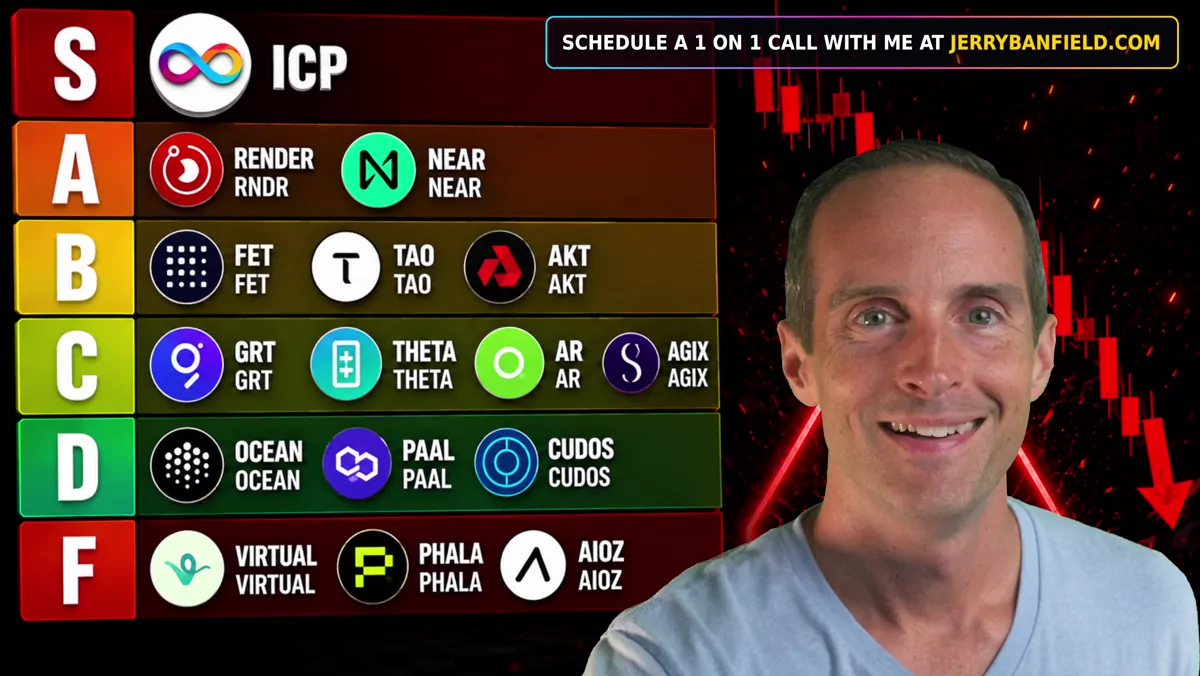
You're about to experience me review every single top 50 AI coin, and I'm aiming to be as long winded as I can get. This research was compiled by ChatGPT Pro, and there's a 67 page document I'm going to go through with an absolutely incredible amount of data. If you're trying to invest in crypto AI coins, this is information you need — we could even film a video together on it. The first thing I need to address: ChatGPT's pro model, which costs a couple hundred a month, came up with all these rankings on its own. I have to say, I personally would put all of these down at least two grades from where they're at. Even the Fs might go to G or H. But here's the thing that's interesting. It researched the top 50 AI coins, and it found that ICP is the one that's superior to all the others.
Just think about that for a second. The AI is not fooled by a price chart, like so many of the people who have commented saying, "you must not know anything about crypto because you like ICP — but look at the price chart." This is the research from some of the most advanced AI regular people have access to, and this is what it came up with: ICP is S tier and gives the most real exposure to AI and crypto. And Render and NEAR are both valued more than ICP, I believe, off the top of my head. A couple of mentions before we go straight into this document: it put TAO in B tier — I'd put TAO down in D or F personally, and the same thing with Fetch. I've done my videos on those. But let's look through this incredible amount of research it compiled.
The Executive Finding: ICP Is the Structural Outlier
Here's the executive findings — this is the most important point. I asked it to find an outlier in this category, something that's not like the others, that represents the best AI investment. The headline: ICP is the structural outlier for sovereign replicated on-chain application execution and direct compute burn. It is not the only project with real AI infrastructure — several others provide off-chain compute. The brutal truth is that most tokens provide much weaker exposure than their projects do. ICP is the one exception to that, because of its on-chain application execution and direct compute burn.
You've got to think about it: if the AI can come up with this, then who else is going to use the AI, ask these kinds of questions, and get the same answer — especially when they go to CoinGecko and see that the number one isn't ranked number one in the category? That's going to trigger people with money who think deeply and critically, and they're going to think, "hmm, I'm going to buy that one." Not financial advice, and I'm all in on this one. The AI is cutting through BS in crypto, and that's very bad for the rest of the space — because if AI can cut through the BS of all the price narratives around ICP, then why can't hardly any of the other crypto influencers, but the AI can?
The Ten Hard Truths About the AI Coin Category
Let's look at the top ten truths. These cover the whole category of all 50 coins, and then we'll go through the total methodology and the scores — and it scored very generously; I would not give Render an 82 — and then we'll go deeper and deeper into this. We'll try to at least mention every coin.
First: the AI category is not an investment thesis. CoinGecko is not an investment thesis. CoinGecko mixes base chains like ICP, Oracle networks like Chainlink, storage like Arweave, and GPU marketplaces like Render — see, I do know a lot of this stuff off the top of my head; this document helps me learn even more — plus agent launchpads, consumer apps, data labeling networks, and derivative subnet assets, all under one tag. That's extremely problematic, and it puts the whole thing into question. Why is Chainlink labeled AI? It doesn't make any sense.
Token does not mean equity. This is one of the biggest things you need to understand, especially when projects are talking about off-chain compute and off-chain GPUs: buying the token gives no ownership of the company, which means whatever they have off chain, the token does not actually own that.
Here again, ICP is the on-chain execution outlier — that's in one of the ten hard truths. This information is sitting there in plain sight. It's extremely important, and I'm not the only deep thinker who thought to ask AI these questions and got these answers. I have close to the least ICP out of almost anyone who schedules a call with me. One guy gets more ICP in maturity every year than I have in total currently. I was like, damn. And there are people like that with that kind of money. "ICP is the on-chain execution outlier" — that's what a smart investor in AI is looking for. An outlier. Not a bunch of coins hoping and talking like they could do something. They're looking for an outlier. On-chain execution outlier — those are three very powerful words together. Its canisters run replicated application logic and state, and ICP is converted to cycles and consumed for compute. That is structurally different than settling payments around off-chain AI. That is the most important phrase in here, and the AI came up with it. I certainly prompted it to make sure it looked properly, but it overrode some of the stuff I said — it wouldn't say some of the things I said, like how I roasted Bittensor TAO so hard in my prompt.
Now, there is real off-chain infrastructure. Livepeer, Golem, Akash, io.net, Render, and Aethir all provide actual GPUs or cloud resources. They're not totally fake. But the work is still off chain and not trustlessly reproduced, which defeats any real claim of decentralization.
Economic consensus is not model correctness. Here's where Bittensor TAO and Allora come in. They create incentive and ranking markets, yet validator and reputation scores are judgments, not cryptographic proof that the AI answer is true. To me, this eliminates serious usage of these products, because you might as well use centralized AI. From what I see, Bittensor and Allora offer no real value compared to using centralized AI or ICP. You either want the on-chain execution outlier, or you just want the most raw power, and that's going to be centralized AI. Bittensor TAO is massively inefficient compared to centralized AI and is capable of producing way less. The only theoretical value is decentralization, which is not provable at all there — and in my view only ICP can deliver that.
TEEs are a different trust model, not magic decentralization. These are trusted execution environments, and I've seen Dominic and the people from DFINITY absolutely destroy these, because they looked at using them and they don't work. NEAR, Kite, Pieverse, and Venice use hardware enclaves for confidentiality and attestation. But you still have to trust hardware, firmware, and operators — and that's not decentralized.
Another big one: real products can have weak tokens. Sentient may do genuine AI research. Chutes may sell genuine inference. Livepeer may process real AI video. Here's the kicker — none of that guarantees the listed token captures proportional value. They're basically all extremely speculative.
A Category Full of Duplicates and Misclassifications
Then the category itself is even more questionable. On CoinGecko — the same place that removed ICP from the category before, even though it is the on-chain execution outlier — they're allowing Bittensor TAO to appear multiple times through several different projects and subnets. Theta appears twice through Theta and Theta Fuel TFUEL. Venice has two different tokens as well. This is ridiculous, especially from the same entity that removed ICP from the category. That's how bad this space is. ICP is an outlier, so the thing to do is to take it off so it doesn't make everything else look bad. If the AI can cut through the lies, the price chart, and the zombie narratives for why nobody should look at the tech ICP has — and why the best tech that solves huge problems supposedly won't get adopted even when it looks like it is getting adopted — then more crypto retail is going to be able to see through it too.
And then there's a bunch of misclassified entries. There's absolutely no reason MultiversX, ZIGChain, and Chainlink should be in the AI category. It makes no sense. Here's ChatGPT responding to my prompt about that: "Brutality requires precision. Calling weak exposure fraud without evidence makes the analysis easier to dismiss." It suggested saying misclassified, narrative heavy, unverified, or token value disconnect instead. All right, fine — ChatGPT will talk how you want it to.
The Outlier on the Chart
Look at the scoring chart and you'll see your outlier right there: ICP, sitting apart, with all the others scattered all over the place. To me, you only need to find the outlier — you don't need to look at all the others. Now, I'm not claiming ICP can just do everything; it has limitations. And you can look at how these were scored if you want. Again, ChatGPT was generous. Under no circumstances would I personally put Render or NEAR in A tier. Absolutely not. But I left it as is, so it's more honest that way.
Here's what it said ranked by actual AI exposure: ICP first. Render — I did a video about Render, and Render is a disaster. Trying to use consumer graphics cards for AI is a nightmare. And for some reason it didn't even put Bittensor TAO on that list, just in case you're wondering. Again — outliers. ICP is featured. Current model size and GPU throughput are current constraints, but here it is again: replicated canister execution plus direct conversion of ICP to consume cycles equals the strongest sovereign AI application and control plane thesis. Somebody with $100 million is going to really care about lines like that, whereas crypto retail throwing in a few thousand may not get beyond the price chart. Somebody with $100 million sees this and thinks, "I'm going to be a billionaire off of this coin." And somebody with $100 million could buy almost all the ICP off of all the exchanges — they could literally 10x their own investment. So it's not going to take very many people with millions and millions of dollars to find ICP, and the AI is sitting right there for the person who gets paid to look stuff up like that.
The other ones? The scoring is way too generous. The GPU marketplaces are a nightmare — selling GPU capacity and hoping the token captures value is a nightmare. And look: Bittensor, "important but oversold." A real market for rewarding off-chain services, but it's not cryptographic proof of intelligence, and subnet quality cannot be inferred from TAO branding, clearly.
Look at how this comes out. Internet Computer, bottom line: the best direct exposure in the top 50 to sovereign on-chain AI-capable infrastructure. Do I need to say it again? Somebody who wants to put in serious money — this is what they're looking for. Now, it's way too generous on Render, calling it top-tier AI infrastructure exposure. It's not, when you look into the details further. But Render is still better than most of the rest on here; the ranking definitely gets that right. And io.net — I hadn't looked into that hardly at all. For being a much smaller market cap, it certainly has potential, but the off-chain trust assumptions and off-chain execution risk mean someday that's not going to work.
Bittensor at 23, NEAR at 32 — The AI Calls Out the Hype
You can see down the list there's a lot more. Arweave does not belong on here. It put Bittensor TAO at rank 23. I said I was critical of Bittensor TAO — the AI put it at rank 23, and it has a higher market cap than ICP. Look at what ChatGPT said about it: meaningful incentive infrastructure, but "materially overstated as decentralized or verifiable AI." All the Bittensor hypers — the AI is literally sitting here calling you out. ChatGPT ranked Bittensor 23rd out of the top 50, and look how big the market cap is: third in the whole category, above ICP.
Then some of the other ones rank even lower. It put NEAR Protocol at 32 — an incredible AI-adjacent chain, but "weak as a pure AI exposure vehicle." The AI is about as unbiased as you can get when you're dealing with humans, and this is its ranking: ICP number one, Render number two — and I own Render; for the market cap it's definitely a promising ranking. It likes Akash Network at 78. But still, I don't see why you'd invest in a 78 when you could just go all in on a 94 — though y'all might not all think how I do. It likes Golem. Livepeer, OriginTrail, Aethir, AIOZ Network, and Grass are all A-tier coins in its scoring.
Now, one thing I have to own: I don't understand what happened with the thumbnail graphic. I told it to use the rankings, and it got sloppy and stuck NEAR down at C tier, and my lazy self couldn't be bothered to fix that before I recorded. Come on, ChatGPT. That's the thing with AI — sometimes it is sloppy in certain areas, and that's why you need humans to double-check it. But what AI does that humans don't do is look through thousands of actual documents covering the technical capabilities of what all this stuff can do.
The Biggest Losers
Let's look at some of the biggest losers. Holozone at rank 42. Staked TAO: derivative exposure, not an AI investment thesis. ZIGChain: F. Law Blocks AI: F. Quack AI: D — does that even sound credible? MultiversX: absolutely ridiculous. Ridiculous that MultiversX is listed in the AI category on CoinGecko. Arkham: it's an analytics business, misclassified for AI exposure. Again — who exactly controls these listings at CoinGecko?
Chainlink, the top coin in the category by market cap: almost no direct AI exposure. And you have people all over crypto who think Chainlink is the top AI coin. This is how screwed up crypto is. Almost no direct AI exposure. Velvet: a real AI-assisted app, weak foundational AI. KAITO: real AI-enabled information, limited AI infrastructure. Do you see a common theme here? Almost all these coins have no real AI infrastructure. ICP has fully on-chain AI infrastructure. Now, it cannot run frontier-tier GPU models yet, and there are still limited resources for performing certain kinds of operations. However, they just added an AI node to cloud engines — and if they can address that and bring AI fully on, that's game changing.
AI Rig Complex: D, narrative heavy, uncertain token. Mantis: a real DeFi protocol, but AI is a feature and a marketing layer, not the value engine. AWE Network: interesting agent simulation, speculative maturity and token economics. This is the research — this is what you need to be thinking about. Holoworld: weak foundational exposure — almost the same thing as almost all of them, limited direct AI and token exposure. Virtuals Protocol: exposure primarily to token agent speculation and commerce, not AI infrastructure.
And to me, if you're investing, you want to invest in the infrastructure, because that's where almost all the options are. The other stuff is dust in the wind — it can come and go super easily. But infrastructure, like the fiber optic internet infrastructure you're using right now, has mostly been in place for 20 years. Think about that. Which coin is going to stay in place for 20 years? Not any of these others at this rate.
Down the Rest of the List
Talus: the trust model and maturity do not support the grandest claims. NEAR Protocol: weak as a pure AI exposure vehicle — and when you look further into what it says about NEAR, it's exactly what I said about NEAR before I did this research with ChatGPT. It said the same thing I said, but it's able to crawl through a whole bunch of documentation much faster and put it all together. Qubic — I roasted this one before: evidence remains too thin for high conviction; interesting experimental AI-native infrastructure, but way, way too little real functionality in anything we can see. Diem — I remember there was a coin about 10 years ago on Poloniex with the same name that got delisted: real AI service entitlements, but a centralized counterparty, not independent infrastructure. Sentient: unclear token exposure. The Graph: weak and indirect AI exposure. Kite: only indirect exposure to AI growth.
What a scammy category this is on CoinGecko, with all these coins listed. Who do you pay off to get listed as an AI coin? I have no proof that that's exactly how it works — but if it doesn't work that way, how does it work? Because why are all of these here? Kite again: layered token economics, and proof of demand remains weak. ChainOpera: evidence and token demand proof lag the scope of the pitch. Arweave: useful to AI but not direct AI exposure — how on earth is Arweave listed in the AI category? It's ridiculous. Just as ridiculous as Bittensor. Bittensor sets up an incentivized blockchain infrastructure, but all the AI stuff is off chain. Watch Bobby O's critique — it is hard to even stomach how somebody could get up on stage and talk about Bittensor being the third big innovation after the internet and Bitcoin. Wow. I feel sad for somebody who buys that and realizes they were lied to.
Venice token: a real AI application, but centralized execution and platform risk. And if you're centralized in crypto, you might as well just use ChatGPT — you don't need to bother buying the token. Chutes: weak proven independent token capture. TAGGER: similar to one of the projects on ICP — genuine AI infrastructure category, but significant quality and demand verification gaps. Artificial Superintelligence Alliance: credible but sprawling AI stacks with real teams, and unresolved integration, verification, and value capture risk. Data Network: credible AI provenance infrastructure with identity, maturity, and evidence gaps. Do you see how weak all these are? Pearl, same story: far too early to treat as proven infrastructure; a high-upside research outlier. And you've got to think — at this point, research alone is worth very little. When you've got something like ICP that delivers real infrastructure, your research had better deliver something better than ICP, and that's a high bar to set. And you'd better hope you don't upset the exchanges so they list your token artificially high and then rug pull it like they did to ICP.
Unibase: credible AI data infrastructure with meaningful potential, but token necessity and scale remain unproven. Theta Fuel: this is the fuel for the Theta network, but diluted by multi-use demand and two-token complexity. Allora: off-chain execution and delayed ground truth limit verifiability. And again — if companies are going to put serious money into AI, they're not going to put it into some quote-unquote decentralized thing where you have to trust the execution on faith. If they want something like that, they'll pay for centralized tech, because if they're going to take something on trust, it's going to be with OpenAI or Anthropic or Google — not with Allora or Bittensor TAO. At least not for any real demand.
Sapien: real token mechanics, but human consensus limits. EigenCloud: strong AI-adjacent verification with real potential, and service adoption risk. Honestly, the document is too bullish on most of these, because it's not taking into account that the best solution is going to eliminate the majority of the others — which is normally how tech works. You don't have 50 different gaming platforms today. You have Xbox, PlayStation, PC gaming, and Nintendo Switch. There were more systems when consoles first came out, but the best eliminated all the rest. In my view, ICP is the one to eliminate all the rest of them.
Grass: unresolved provenance and long-term token questions. AIOZ Network: this is too positive in my opinion, but it still only gets a 73 compared to ICP's 94, with moderate token specificity. Aethir: credible but imperfect token exposure to AI usage. OriginTrail: one of the best real AI data provenance exposures in the category — that sounds a little optimistic to me, but maybe I'll look further into that one specifically and review it. Livepeer LPT: value capture is meaningful but indirect — and I'm not into indirect, as you can tell. Golem: off-chain execution risk, so problematic. Akash: same thing, off-chain execution. If you're doing off-chain execution, you might as well use big tech, because big tech has every advantage compared to doing it this way.
The Final Scoreboard
So I've now been through the whole top 50, and you can see the outlier. Look at them in terms of the big market caps: Chainlink 38 out of 100. NEAR 49. Bittensor 58. Internet Computer 94 out of 100. This is the first and best in the AI category. Render is overrated. Chainlink — the number one coin in the category by market cap — is mislabeled. And the AI is critical of the entire category itself, which is funny, because it's AI and it doesn't agree with how they've defined AI: mixed, unrelated layers. Welcome to crypto, where the categories are either sloppy and poorly done, bribed, or dishonest. Really, all you need to know about is ICP, and maybe take a look at some of the other ones — maybe I'll go deeper into some of them in future reviews.
The document's own opening line is a real summary of this whole thing: CoinGecko calls these the top 50 AI coins, but that doesn't mean they actually run AI, verify AI, own an AI business, or even require a token. I'm here to help you get better information and to inspire you to do your own research. There's a whole lot more information on every single one of these that I'll put on my website.
Wrapping Up
That's the full top 50, and my time's up. I really appreciate you being here. If you want to talk through any of these AI coins with me one on one, the best next step is to schedule a call.
For more of my crypto reviews and everything I'm learning about the Internet Computer, check out my ICP Crypto playlist.
Thank you for reading, and remember — none of this is financial advice, just my honest experience going through the research.