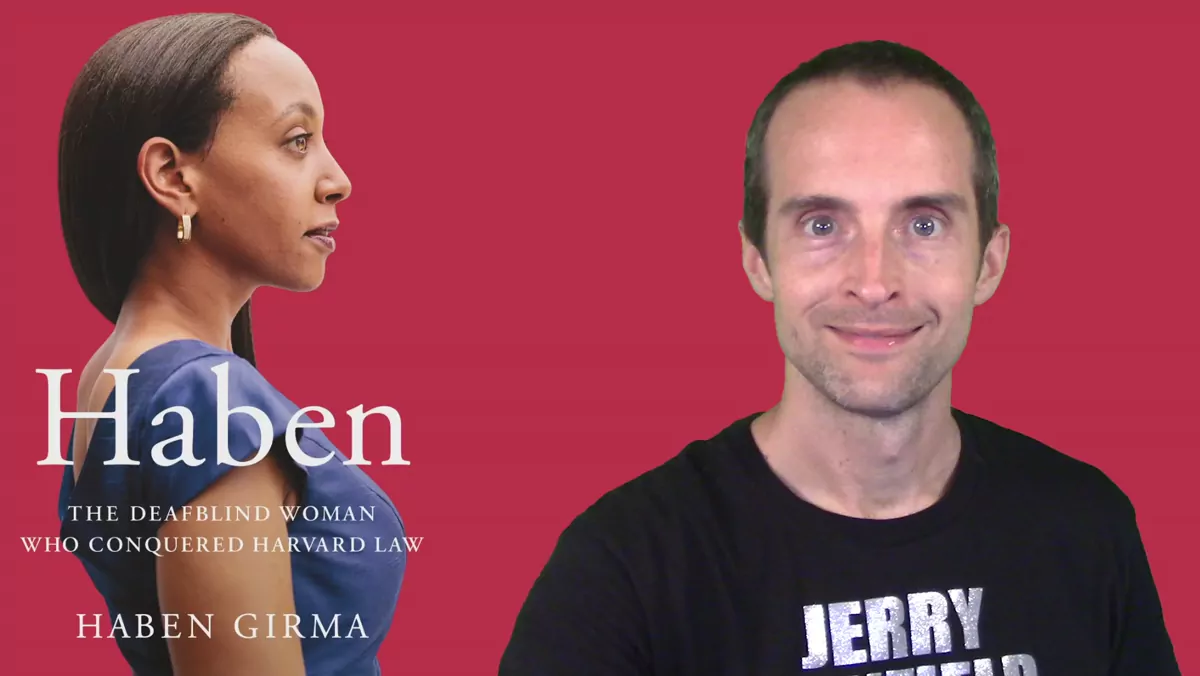
Hi, friends. Today we're going to review a book I just read called Haben: The Deafblind Woman Who Conquered Harvard Law by Haben Girma. I found this book on the Libby app on my iPhone, which was totally free for me to listen to, and I listened to the whole book in less than seven days. I found it very inspirational and mind-expanding, which is exactly why I read books and listen to podcasts and watch videos. I'm constantly expanding my mind. They say leaders are readers, and I'm huge into that. So I invite you, if you're a reader, to give this book a try. And if you're not a reader, consider reading and listening and consuming things that inspire and educate you constantly.
What caught my attention was that I was just browsing through the biographies on the Libby app, and I came across The Deafblind Woman Who Conquered Harvard Law. I saw that and I thought, I bet reading this book will expand my mind, because I've had very little experience with anyone deaf or blind, let alone deaf and blind. I saw the potential to enter into a new world, or a different world, to see something that is genuinely different. And that's exactly what I got out of this book, which was great.
I love how she told the stories of her life in first-person, present tense. She went back to times when she was a kid, all the way up to 2018, and she talked through her life in the present moment with a series of memorable stories. I won't spoil the book by sharing them. What I'll say is that it was really helpful to put myself in her world for the week that I was listening to it.
Taking sight for granted
When you are sighted, when you are used to being able to see, it's very easy to take for granted that you can see. My vision, last time I checked it, is maybe 20/60, or 20/40. Sometimes it might be 20/20, and then I remember it should be 20/60 or whatever. I can see clearly in most cases, most of the time. I wear glasses to drive, and my hearing is pretty good as well. I'm able to hear subtle differences in video games, like footsteps here and there. I can pretty consistently hear people even at an outdoor AA meeting from far away.
For me, it was a drastic difference of experience to put myself in her position, where the world often can feel very closed in. When she's in Harvard Law School, she can't see the professor when he's lecturing, and she can't hear the professor when he's lecturing. The setup, and her figuring out how she can still move through the world, is a core part of the book. When she figures out she can get this Braille keypad and computer set up, so that people could type and she could read the Braille off it, it's like, wow. She ended up meeting President Obama and Joe Biden, and she used that Braille computer to interact with them.
For the week I was reading this book, I took my sight less for granted. It is really awesome to be able to see so much, and to see so clearly. And at the same time, reading Haben, you get a sense that there's much more to the world than seeing and hearing. By being able to see and hear, there are other senses we're not interacting with as much. There's no need to feel sorry for people who are blind or deaf, who are set up differently than us, because there are things they're experiencing that we're not experiencing as much.
For example, she talks about her tactile senses, of being able to tell things based on very subtle movements in people, or in the cane while she's walking. Based on just very small sensations that you and I might not be sensitive enough to even pay attention to, she's able to get a feel of the world around her.
Life as an adventure
I liked the moment when she was at the bar after the exams at Harvard Law, and they asked her if she wanted a drink. She ordered lemonade, and she said she didn't want to be deaf, blind, and drunk. It was an amazing example, because later she's leading one of her friends home from the bar who's drunk. That person may put themselves into a difficult position, and it was very good that she didn't drink, because she was able to help them.
Reading this book, you can see life from her point of view as much more of an adventure. People who aren't able to perceive the world the way many of us do, through sight and through hearing, give us a chance to work together, to help each other, to form meaningful relationships, and to have unique experiences we can share with each other. If we all had the exact same abilities in the exact same way, it'd be very boring, and there'd be a lot less of a need to help each other.
What I picked up on so much in the book is how people were drawn to help her, and to work with her, and how she has just as much to give, and a unique way to give it. She was drawn to go into law to help make sure that people who are deaf and blind, and who have other different abilities or different ways of perceiving life, have equal access to things.
Equal access lifts everyone
She talked about participating in a lawsuit to get a company that made a massive online library to make its material more accessible. I honestly don't remember whether it was for blind or deaf people specifically, but the goal was to get it more easily accessible to people who can't just read it off the screen. And the company was trying hard not to do that. It's like, you have the ability to code stuff so that differently abled people can easily access it, and that should be done. Take the extra time, spend the extra money to make sure that everybody can access it.
As I've said in quite a few of the things I've shared before, the more people have access to resources and education, and the more people are individually empowered, the more we can all lift each other up. She was making the same point: if you have all these people who are differently abled around the world, the better access each of them has to resources and education, the more they can contribute and help the rest of us. As seen in this book, that's actually such a blessing.
It's so obvious how all the help she received in her life, the unique form of help she needed by being deafblind, put her in a position to effectively reach out and help others. She had an older sibling or an older cousin in Africa, and there had been no ability to educate them there. I think they were deafblind also, and they moved to the United States. It's nice to see something like education for a deafblind person as something to be proud of, to look around in our society and say: wow, this is amazing that we can educate someone who can't consume things the way we normally would expect. You can't listen to the teacher and read the writing on the blackboard. It's amazing that they can get an education.
Aim your sights higher
What I found really inspiring about this, and what I hope it is for you too: many of us, and maybe me at previous parts of my life, have looked around and thought about what's possible for me. I know at various points in my life I've had low expectations for myself and small ideas of what was possible. Reading a story like this, if you're telling yourself, "I can't do this because my dad was mean to me in my childhood," or you're making all these excuses for why you can't do anything and can't contribute to life, I think people who are differently abled have an easy ability to inspire us and to show us what's possible.
The average sighted and hearing person has a difficult time completing Harvard Law. If you want to crank the difficulty of that up quite a bit, then try doing Harvard Law deaf and blind, and Haben was able to complete Harvard Law deaf and blind. Now, I'm not saying you need to go to Harvard Law, but I'm saying maybe pick your sights up for yourself. You can improve your life a little bit.
What I've noticed in my own life is that I've often been too quick, and I haven't aimed high enough. I'm not talking high enough in terms of how much money I can make, how big my reputation can get, how impressed people are with me, or how many followers I can get. I've aimed high in that a lot, but that does not equal making a true difference in life. You can get lots of money and followers, as I have in the past, and not be anything more than, in many cases, a passing distraction. You can even essentially sucker people into wasting their time and their money while you get rich and get a big influence.
What I'm saying is: aim your sights high in terms of what kind of difference you could make in this world. You might look at someone that's deafblind and think, what are they going to be able to accomplish in this life? This is why it's so helpful to read and to listen to what other people have done with their lives, making situations that from the outside you might look at and think, well, that's just hopeless, and doing things that make you think, wow, how did you do that? How did you take this and turn it into that? It's easy to feel sorry for ourselves and think, I've been dealt a crappy hand, I'm never going to be anything or do anything or contribute. And that's simply not true. If you will lift your sights up and think, how much can I help other people, and ask for advice.
When you've got someone who's deafblind, it makes such a great example of how much of a difference the little things we do in life can make: paying attention to someone, treating someone as an equal. I remember how she talked in the book about when she was in college, how much of a difference it meant when someone paid attention to her, because she felt, with her very limited sight, barely able to see things very close in front of her.
She also had very limited hearing, not able to hear half the spectrum, only able to hear people speaking clearly, and if there was a bunch of loud noise, not able to hear hardly anything. She often felt like there was this big barrier between her and the world. A lot of us have felt like that too, even though we're sighted and hearing, we feel like there's this big barrier in the world. In this book, in her story, you get how much of a difference it makes, just little bits of attention, little bits of kindness and consideration, like the people who would sit down next to her, and the value of human connection in every day, in every little interaction. It makes a massive difference. Every little thing you do, every little interaction is an opportunity to help someone.
Picking your sights up higher for your life
What I mean by picking your sights up higher for your life is imagining how much you could give and how much you could help through all those little interactions in your life. Instead of just going and sitting by yourself and feeling sorry for yourself, for example, like in a school lunch cafeteria, the way I used to do in high school. Feeling lonely, getting my lunch, going to sit at an empty table, eating real quick, and then getting up and being lonely. Go sit down next to someone else, make friends. And if they don't want to be friends with you, good, go move on to the next group and the next group.
What I've learned to do at AA meetings now is to try and look for a person. At AA meetings I used to often find who I really wanted to talk to and go talk to them, instead of kind of looking around and being like, who would most benefit from me talking to them? Who would really appreciate me going over and saying hi to them?
It's beautiful to see all the people who've helped her, which have empowered her to help others. And to see that just because she's deafblind doesn't mean she needs any more help than the rest of us. Now, the form of her help might be a little different than many of us get. She needs help, for example, using a different way to communicate, different access to technology, having it as text to speech or text to braille. But we can see that all of us need a lot of help in our lives. All of us really depend on each other. Each of us has a need for the help of others, and each of us has a chance to help someone else.
A world we don't pay attention to
Those of us who are sighted and hearing, Haben has a lot to offer us to help us appreciate our world and to understand a world that we often don't pay attention to, like the sensory world. Often, many of us that are sighted and hearing rely on these abilities so much that we don't do physical touch that much with other people. I do. I love hugging. And yet there's an opportunity to expand our understanding of reality.
This is why I love the phrase differently abled, because of how I look at things, and a book like this really points it out. Humility is seeing that we're all equal. If some of us are not able to see or not able to hear, those are areas the rest of us don't use that much and we don't even realize it. If we were in a different kind of world, for example a world totally based on touch, or based on more extrasensory perceptions, we might feel totally disabled in that world. We've just set up the world we're in now based on expecting that everyone can see and that everyone can hear.
It's nice, reading this, to be encouraged with communication to not expect or assume. I remember the Four Agreements book I read. One of the agreements was not to make assumptions. Oftentimes people would say things to her and they would assume she heard them, but she had not heard them. They would assume that because they said something, she must have heard them. Like the story she was telling about not getting her homework. The teacher was giving out this homework and telling people about the homework, and it took her a while, and missing a bunch of assignments, to realize that if the teacher was in front of the class at the blackboard and assigned from the blackboard and spoke from there, she could hear that. But if he was at the back of the room, she wasn't hearing him back there. She didn't know he was assigning homework if he was back at his desk saying that there was going to be an assignment.
That gave her an opportunity, and it was uncomfortable for her, to ask her classmates and say, hey, did the teacher assign any homework today? It's amazing that even though you might look at someone deafblind as having a much different experience of life, without relying on vision and hearing so much, you see how similar life is for each of us. How vulnerable we can feel asking for somebody to help us. You wouldn't need to be deafblind to feel vulnerable asking somebody else in the classroom, hey, did we have homework today? I wasn't listening for a minute. I was texting. I wasn't paying attention.
Why I read a book every week
This is why I love reading books each week. This book was a pretty quick listen. I listened at 1.3 speed, so 30 percent faster, which helps. I listen to lots of things, so I like to put it on 30 percent faster to really consume a book faster. The book was about seven or so hours, and it was a nice, easy one. I've read some books that are 20, 30, 40 hours. This is a nice, easy book to take in and digest, and it left me inspired, which is why I reviewed it, because it left me inspired.
I read this book during a time when I was feeling like a loser. My mind was telling me you're a loser for where you're at today versus where you've been as a creator online. I've been a creator online for 10 years. I haven't had a real job in 10 years. I've relied on the internet and my wife to provide everything I need. Reading this book was a part of taking inventory and reassessing my values, because the world often tells you things, or gives you these expectations. But what if you're differently abled, or what if the things given or said by others, like that success as a creator online is making money and getting views, don't resonate with what your own idea of success is? That's where the conflict comes in. You take on these things from outside that don't really match with you, and then it conflicts with the inside.
Reading her book was a part of my own growth as a creator online, to encourage me to look within. It was evident to me reading her book that when you're deaf and half blind, the inward or internal experience is perhaps much more relevant than it is for a lot of us that are just focused on what we're seeing and what we're hearing all the time. There's much more necessity to go within, or to be aware of what's happening inside, because the perceptions coming from outside are not as overwhelming or distracting.
So I went within, and reading this book this week was a part of a very positive shift that happened for me, where I actually wrote down, what is success? All I do for my career, I'm a creator. That's my whole work life, my professional life. What does success mean for me? What does success mean for you, or somebody else, or me in the past? What does success for me mean today? I share this kind of inner work and reflection all through my Life playlist, because it's the honest process behind everything I make.
I'm really grateful for this book and appreciate the chance to share it with you. I've shared a lot of book reviews in the past, and I've often stopped reviewing books because they didn't get as many views. But success for me as a creator is just talking about whatever's most relevant to me. It doesn't matter if hardly anybody watches this or if a bunch of people watch it, because this was a book I just finished that was very relevant and helpful to me. If you're Haben and you actually listened to or read this review, I really appreciate you being here for all of it. I loved your book. Thanks a lot.