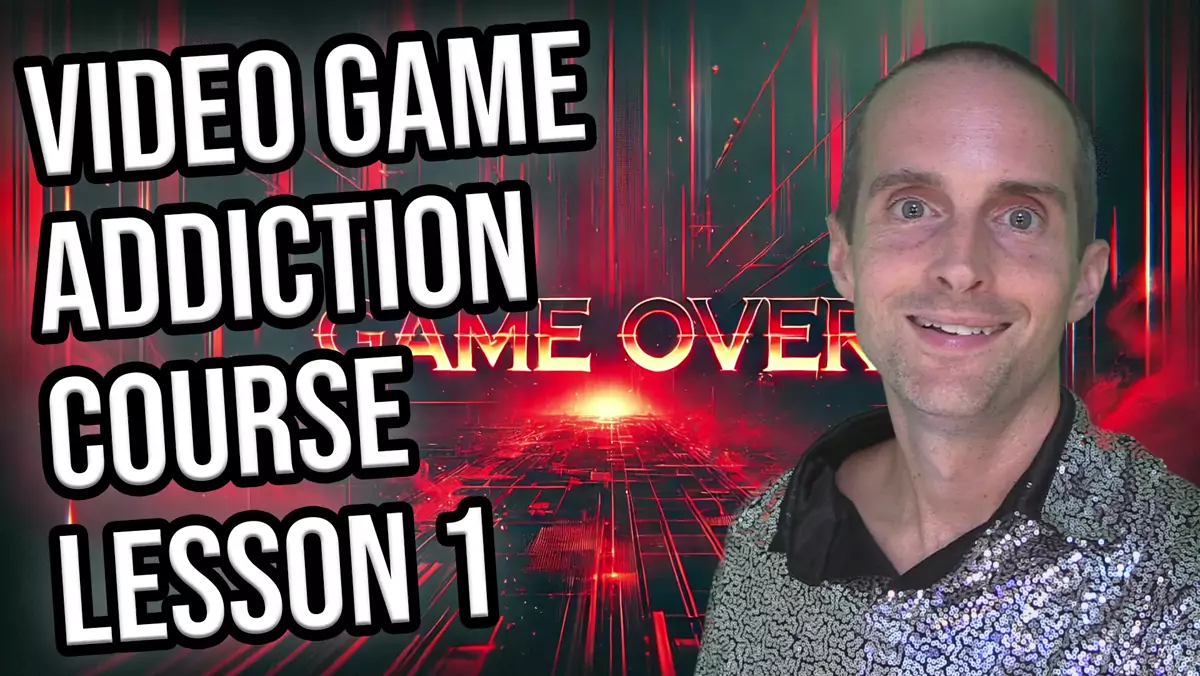
I want to share how I've finally obtained freedom from video game addiction. I'm going to cover the questions I had to keep asking myself: Is gaming a problem for me? Why is it so hard to quit gaming? Are some games worse than others? Can I just play normally? What exactly is a video game addiction? And if you're dealing with other people in your life who are in video game addictions, what you can do about that.
Now, if you're someone like my wife, who was playing too much Candy Crush and just literally deleted the game from her phone and was able to move on, you probably don't need any of this. But this is for you if you've ever quit playing video games and then went back to it. If you're playing more video games now than you ever have before. If you find that video games have often sabotaged your life in the past.
For example, video games crushed my dating life in college. I was playing video games, but I also picked girls up all the time. I got tons of phone numbers. Then, because I'd be playing video games all the time, it was hard to even go out on a date or have a relationship after the initial pickup. If you want more of how I've thought about that side of my life over the years, it runs through my Dating playlist.
And if video games are associated with things like drinking alcohol, smoking weed, getting knocked out, doped up on pills — if those things are happening in your life, there is definitely a video game addiction present. The question is, how are you going to address it?
I've played tens of thousands of hours, and I got paid to do it
I've played tens of thousands of hours of video games in my life. I've even been a professional gamer in 2020, 2021, and 2022. I got paid to play video games. I made over $100,000 in 2021 playing video games, after I had already quit twice for more than a year each time.
Now, you'll go through a lot of the lies you tell yourself. Well, I'll quit playing video games when I have kids. I'll quit playing video games when work gets busy. What you'll often find is that you may do it in the short term, but you'll miss the gaming, and you'll end up going back to it whenever your life gets a little chaotic, or a little open, or a little boring.
The opportunity cost is the real damage
Ultimately, the main thing with video game addiction is the opportunity cost. The video games themselves definitely are destructive. I'm going to talk about how video games warp and screw up your mind and make it harder to interface with reality, and how you don't even see that part of it. But the main thing is the opportunity cost.
I would love to see what my life would look like if I never played video games and never drank alcohol. Those two things — I blew years, tens of thousands of hours. Video games was the number one thing, time-wise, that I would say I just wasted my time on. Think about all the things you could put in there instead. All the girls I could have dated. All the sports I could have played. How great a shape my body could be in. I could have learned and mastered skills like coding, like making music. I could have traveled the world. I literally played enough video games to travel the entire world. I could have probably gone to almost every country.
There are so many amazing experiences I traded for sitting in front of a TV, shooting zombies, trying to get a Warzone solo win. That is what people don't see. Video games set you up in this cycle where, yes, I know it's fun. I know it's fun. Except for me, I've gotten to a point where, at the frequency I'm on now, video games aren't fun for me anymore. They're almost total suffering. I hope you can exit before getting to that point.
Other people helped me out of alcoholism — gaming I had to fight alone, over and over
As with alcoholism — I'm sober over 10 years in Alcoholics Anonymous — other people helped me exit my alcoholism before my life totally went down the drain. But with video game addiction, I've struggled back and forth. I wrote a book with video game addiction stories in 2012 and 2013, when I identified that I had a video game addiction in 2011. And I couldn't stop.
Then I drank, then I tried to stay sober. About a year after identifying that I had a video game addiction, I also faced that I had a problem with alcohol — which had been very obvious back in 2003 and 2004. So after seven years of denial, I was able to get out of the alcohol. But by 2012, I'm gaming and drinking. I quit drinking in 2014, but I kept playing video games up to 2017, when I quit. Then I started back in 2018. Quit again in 2019. Started back up in 2020. And then I've quit several times — in 2020, in 2023, and again in 2024.
So I know this is a difficult subject, and I'm hoping to make it easier for you, because you might not have this much time to waste in your life. I've not been burdened with a full-time job. I haven't had a so-called real job since 2009. I've had a temporary job working for the census. I've been a graduate assistant. But the last real job I had with a paycheck was 2012. If you work, and depending on the rest of your life, you might not have as much time to waste as me. I want you to figure this out sooner than I did, because you might not have that much time left. There are things you can do with your life that, if you play video games, you simply won't do.
What you trade away: a conversation with my friend about Fallout
I was just talking to a guy last night. I said, how much sex would you have with your girlfriend if you stopped playing Fallout every night for two hours? Y'all are only doing it once or twice a week? If you weren't playing Fallout, you might be doing it every day. Come on. You're like 30. Y'all aren't married, don't have kids yet. But you're playing Fallout instead for two hours a night. You're trading this cheap gaming experience for a much more fulfilling and connecting experience.
Video game addiction is hard because I know you'll tell yourself it's not that bad. I was telling myself that earlier this year. It's not that bad. It's not like I'm out drinking. It's not like I'm out doing drugs. It's not like I'm out cheating. It's not like I'm out driving a motorcycle and racing cars. It's not like I'm doing something worse. But what kind of justification is that to live your life by — well, I could be doing something worse?
Why stopping feels scary
Some of you, at this point, don't want to get better. You want to stop being a zombie and going through life on autopilot, but when somebody actually tells you exactly what you need to do, gives you the step-by-step template, and shows you totally for free exactly how to get out of video game addiction, some of you get scared. It's like, well, if I really listen to you, I don't know what my life's going to be like. That's what's really intimidating. If that fear is hitting you right now and you'd rather face it with someone in your corner instead of alone, you can schedule a one-on-one call with me and we'll talk through your own situation honestly.
I remember when I got sober, I thought, if I quit drinking, I don't know what's going to happen to me. I knew what was going to happen if I kept drinking — I was just going to drink myself to death and have this pathetic loser life. But if I stopped drinking, anything was possible. And that was surprisingly scary. The same thing goes with video games. It feels safe to keep playing video games. It feels unsafe to stop and have to face the rest of your life.
Games are like a payday loan
Video games give you this cheap, easy-to-achieve dopamine dump, and sometimes an adrenaline rush, that often you're not getting in the rest of your life. So playing video games absolutely fulfills positive things in your life. I'm not saying games are purely bad. In fact, addiction is hard with video games because they do give you positive things, and they're very easy to achieve.
But it's like a payday loan. Taking a payday loan, or charging up a credit card, does not make you wealthy. It can give you the temporary illusion of wealth as you go out and dump a bunch of stupid expenses, come home with a bunch of stuff from the mall — and you just got poorer. You just got more broke. By taking that payday loan, you just lowered your net worth. Video games do that. They give you something up front. Turn on this game, here's an adrenaline rush, here's a community, here's a little bit of meaning in your otherwise purposeless existence. And you get that. Then you're thinking, if I quit playing video games, now my life is utterly meaningless. Now I don't know what to do with myself. I don't know how to have fun. I don't know how to find people to hang out with. I don't know how to get excited and care about anything. As long as you keep playing video games, you're not going to find that stuff out. This is the same reason I treat video games like alcohol now — I had to put gaming in the same category as the drink I can never go back to.
An instant escape from boredom
Video games offer you an instant escape from boredom. When I was a kid, I look at my kids now and they get so bored if they don't constantly have somewhere to go or something to do. Some days I had 12, 14 hours at home with nothing to do. I'd go play in the backyard. I'd run around, throw the football, do everything I could think of, and then I'm bored.
Instead of reading, instead of asking my dad, hey, can you get me something I can read, something I can learn — I want to read the encyclopedia and be smart and grow up to be a physicist and have really valuable skills and always make great money doing work I love — it was: let me just pick this Game Boy up and play this Star Wars Empire Strikes Back game and see if I can beat it. Most of the time I'd be frustrated, but it would be a bit of an adrenaline rush, because I wanted to beat the game.
I still remember one day I played six hours of that game, and it felt so good because I finally beat it. But what were all the things I wasn't doing in those six hours? I think video games are the key reason I got myopia, nearsightedness, because I was playing so many of them. And all the things I didn't learn, didn't do, and didn't care about. Video games are such a trap, because I know they're fun, but they also make everything else in your life seem less fun.
How they get you: from gaming to loneliness to alcohol
And that is how they get you. You jump in, you play some Fallout, you play some Call of Duty, and it's fun. You get this adrenaline rush. Then you step out of the game and everything else seems flat. I remember thinking in college, I wish I could just put myself in a video game, because regular college life was so boring compared to playing. It was like, I don't even care about college.
So what did I do? I didn't make as many friends. Then I got lonely, and the loneliness got me in the perfect position to pick up an alcohol addiction. When you're lonely from playing a bunch of video games by yourself — because you seek instant gratification instead of doing the little bit of difficult learning, instead of facing your social anxiety — you sit there and play video games by yourself. All of a sudden, you haven't gone out in quite a while, and you have pain from that. Then you drink and play video games, and now you're compounding addictions.
I used to look forward to getting a half gallon of vodka and a case of Diet Dr. Thunder, which is like a crappy Walmart version of Dr. Pepper. I'd dump a couple of shots in with a can of Diet Dr. Thunder and, all night, play Call of Duty zombies, slaying zombies on Origins — 10, 12, sometimes 18-hour binges. And then I'd wonder why my business was failing. I'd wonder why my marriage was failing. I'd wonder why my health was failing. Because the solution was the problem.
The solution is the problem
From my point of view, video games were the solution to my boring life. Drinking alcohol was the solution to my lonely life. But really the problem was that you reach for instant gratification — you reach for the game — instead of just sitting there and being bored. Sit there and be bored. Sit there and be miserable. Sit there and feel what you're feeling, and go into it. Sit there and be miserably bored, and don't do anything about it. Let it happen, and then see what happens.
Because that's what these meditation practices are. It's literally learning to sit there and be disgustingly bored, and face it. Be present. And then you get this transcendent experience. I've done so many different meditation practices, and a lot of them are literally just learning to sit there and be bored. Now I'm almost never bored, because if I'm just sitting somewhere, it's like, cool, I have time to think. I have time to plan. I have time to be present. I have time to look and put things together in my mind. I love it.
This is what our whole society is set up on: this instant gratification trap. And video games are very effective at it. There are other things, like shopping, that aren't instant gratification for me, and a lot of the things other people get that hit from don't satisfy me. But you sell me some Marvel Snap cards, and I get this card and I can go play this game against somebody.
The $2,000 I threw away on Marvel Snap
You know that I dumped $2,000 this year into playing Marvel Snap. And I rationalized it. A big part of video game addiction is rationalizing. Well, I'm going to buy these Marvel Snap cards because I'm a streamer and a content creator and people are watching my videos. And yes, people are still watching my Marvel Snap videos. I made this into a playlist on my channel. I made a video called Get Marvel Snap. I have a brand-new gaming channel — this is the third gaming channel I've made. I deleted the last two of them because I was planning to quit playing video games. So I deleted my last two gaming channels, then I made a third one. Now it's under 200 subs, and this video gets 6,000 views. People are subscribing. They want more Marvel Snap videos.
I hate Marvel Snap. It's disgusting. It's the worst use I've put my time into this year. I threw away $2,000. I threw away hundreds of hours of my time. And look at how much I charge for my time. If you want to have a call with me, I charge $300 an hour. $2,000 for a 10-call coaching package. $3,000 to spend the day with me. And I'm dumping my time into some worthless card game, giving myself meaningless achievements. I went deeper on that exact relapse in the story of spending $2,000 on Marvel Snap and quitting in 2024.
I've already conquered everything there is to conquer in gaming
When I've already conquered it all. I got to the highest rank in Magic: The Gathering — Mythic. I got to the highest rank in Gods Unchained — Mythic. I got to be one of the top Warzone solo players in the world. I beat hard games like Return of the Jedi on Super NES — that wasn't as hard — and Empire Strikes Back on Game Boy, which was brutal. I've been the number one player in the world in Call of Duty Black Ops 3 Zombies on the Revelations map. The day the Revelations map dropped, I got the number one spot in the world on the leaderboard. I've done it. I've done everything there is to do in gaming.
And the last time I played video games, I felt drained. I thought, what did I just do with my time? I dug into whether all that competition was ever worth it in my take on competitive video games as zero-sum self-sabotage.
What if I don't have as much time as I think?
Yes, I was born — this body was born 40 years ago. I think it's got around 70-something years left; I think it's going to pass in 2111, which, if you do the math, is like 90-something years from now. So I think I still have plenty of time. But what if I don't? What if I don't? Can I afford to piss any more of my time away on video games?
I made a video last year saying the biggest regret in my entire life is all the time I played video games — even more than alcoholism, because at least alcoholism got me into AA, a spiritual awakening, and helping other people. Video games have purely been trading my time for nothing. I remember playing poker and being all proud of myself for making $3 an hour. I could have learned how to make $100 an hour instead of pissing away my time for $3 an hour playing poker.
So if you can identify with this, I hope you'll go through everything I'm sharing about video game addiction, because even if you get this a little before you're ready for it, you'll have it there. My friend last night was asking, what should I do? I play a couple of hours of Fallout every single day, and then I binge on the weekend sometimes. This guy's an alcoholic who's sober, and he asked, what should I do? I said, at the point you're at, I want you to pay attention to how you feel when you play games, and I want you to think about what you're not doing because you're playing video games. He's not even ready to stop playing yet. He's just starting to think, do I have a problem? Even if this seems way too soon for you, totally unnecessary for you, maybe you can stop sooner than me.
This journey has been embarrassing — including giving away my PlayStation
To me, this journey with video game addiction has been embarrassing. A year ago, I said the number one regret in my life was how many video games I'd played. A few months after that, I bought a PlayStation 5 after selling my last one. I bought an Xbox Series X. I got back into playing Marvel Snap, made a new gaming channel, and bought $2,000 of Marvel Snap cards.
I gave my PlayStation 5 away last week. I gave it away to drive home a point: you're so done with video games that you need to take the entire loss. You need to take the entire financial loss on that PlayStation and realize what you did — that you sold your last PlayStation when every sign from the universe seemed to be saying, you might as well keep it, because you're going to relapse on your gaming addiction.
I sold it even though it wouldn't sell. People bought it and didn't pay for it. It got to be a joke, a meme — me trying to sell my PlayStation. And then I bought another one, hardly even played it, and felt guilty for not playing it. So I just gave it away. My yoga instructor, who I gave it to, was thrilled. He and his girlfriend were having fun playing — she has a PS5 too, and he had a PS4, so he was thrilled. And the energy of giving it away felt great. It's like, I'm that done with video games, I'm just going to give it away. My kids still have an Xbox, which we use as an entertainment system, and I gave the Nintendo Switch and Xbox to them. I still have a PC with a gaming graphics card, but I make music and do video rendering on it, so I'll keep that.
If you ever want to talk through your own version of this, that's exactly the kind of thing I help people with directly when you schedule a private one-on-one call with me.
What would your life be like if you never played video games again?
The question I'll leave you with is: what would your life be like if you never played video games again? That was how I quit the first time. The first time I quit — and the longest I've quit gaming as an adult, a year and a half — the question that got me there was, what would my life be like if I didn't play video games? And I desperately wanted to find out. I'd love to know what I would do if I didn't dump all those hours into gaming.
And what did I do? I learned how to make music. I now have 200-plus songs I've made, including a dedicated YouTube channel where I crank out one of these songs every day, and people are actually watching and listening to them. I got my Spotify going, where I've put out four albums — even with playing video games this year, I put out four albums. I made three albums in the first year and a half I didn't play video games, with no musical experience at all; I put a ton of time into learning music production. I got into crypto and made a lot of money in crypto because I had all that energy freed up from not playing video games. So I'm really excited about how much more fun I'm going to have — I'm playing tennis tonight because I'm not playing video games.
Some things just don't go together with gaming
What I've noticed is that video games and certain other things don't go together. Maybe when you live with your parents, you just graduated high school, you're starting out in college, you might have time to play five hours of video games a day and go play basketball and work out at the gym and hang out with a girlfriend, because you literally aren't doing anything else.
But at the point I'm at, I have kids I spend hours with every day, a wife, a house to take care of, and money to be made. I go to yoga and I go to Alcoholics Anonymous. I take care of my body and my mind and help others. All I have is three or four hours a day to myself. That's it. That's for work, and that's for play. So I can't play video games and basketball — those two are mutually exclusive. If I'm playing video games, it satisfies me to the point where I won't go through the discomfort to get out there and get on the basketball court. I can't play tennis.
I just got a racket club membership. I'm going to go play tennis tonight, and I love it. It's so much more fun than playing video games, and it's so much better for my body. I'm out there playing with people in person. One of the bottom lines with video games is that you're literally sitting in front of a screen by yourself. And with so many other things on screens in our lives, you can't afford more time doing that.
This is really for me — so I never go back
The guaranteed win, though, is that this is for me. Sharing all of this is so I never, ever go back to video games again. By teaching it, I've got a really good shot at not going back. If you want to think through any of this together, you can book a private call with me.
People have literally paid me to do interventions. A girl paid me to do an intervention with her boyfriend, and I'd love to know how that worked out. I started my business online in 2011 to help people with video game addiction — and then I became a professional gamer in 2020. If that doesn't sound like absolute insanity, I don't know what does. If you enjoyed this and want to watch where I take all of it next, you can find it in my Games playlist.