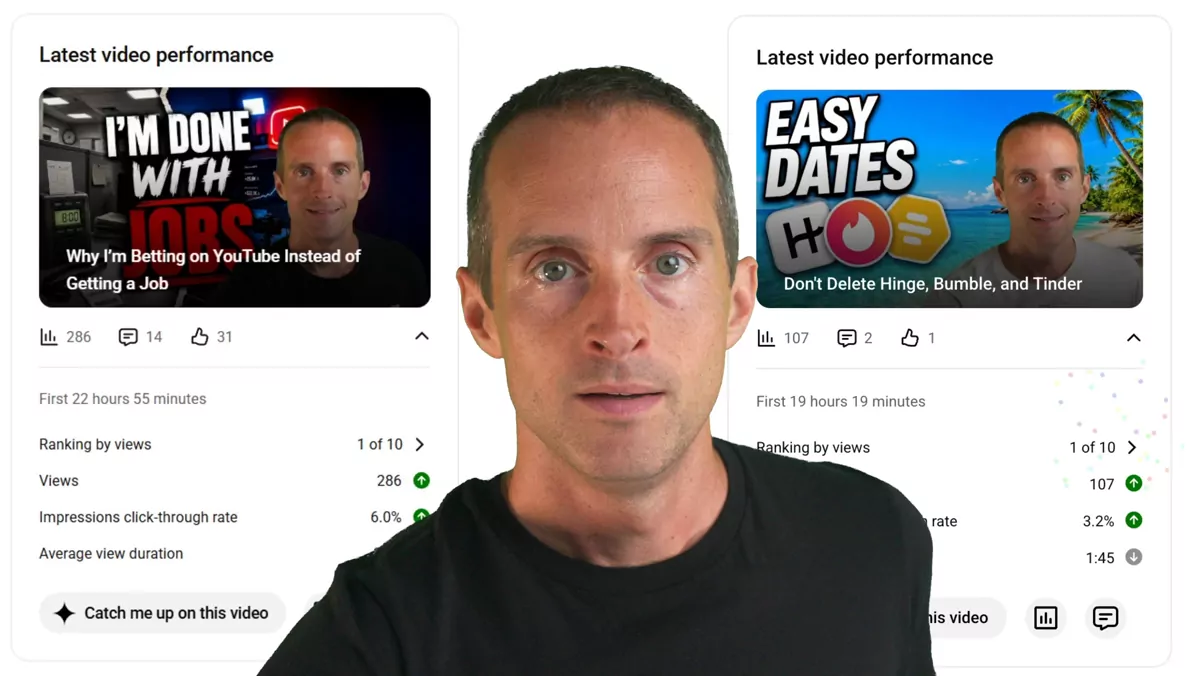
My view now is that a title and thumbnail have one job beyond getting the click: they should give the person something useful even if they never press play. I still watch click-through rate closely, and a 10% click-through rate on cold traffic is a strong result, but I no longer treat the package as a trick for views. People click again when the package was honest and the video paid it off, so satisfaction at the end matters as much as the thumbnail.
The arc runs from my 2023 thinking to my June 2026 thinking. In my 2023 post on five YouTuber skills I argued that a thumbnail only has to be good enough: a big picture of my face, a little relevant text and a background, made in Photoshop or Canva. I said the two stats that matter most are click-through rate and view duration, and I pointed to a video that got a 14% click-through rate with an average view duration of almost five minutes. That was a craft-and-speed view of packaging, and it still holds up as a starting point.
In mid-June 2026 my thinking widened in two directions. In No Title or Thumbnail Will Get Your Small YouTube Channel Views I argued that packaging alone will not carry a small channel. Audience and paid reach matter far more than any title formula, and the more reliable path is a steady grind of videos plus collaborations with other small channels. That same week I wrote How I Increased CTR, Views, and Satisfaction With a Few Small Changes, which is the most practical of the set.
The practical changes in that post are three. The first is a strict five-minute maximum on every video. Someone who sees a short video, especially at double speed, is only risking a couple of minutes, so they click and finish more often. Average view duration dropped compared with my longer videos, but click-through rose, and I think the finished video is what brings people back. The second is telling a story across a series. Instead of one 20-minute video about borrowing $57,000 on credit cards at $1,300 in fees, I split it into a daily series covering why I did it, how I did it and the house I rented. Someone who watched the first few wants the next one. The third is humor. When I make people laugh, satisfaction goes up, and a recent video in that post pulled a 10% click-through rate on about 4,000 people who were already happy with what they had seen before.
The newest piece is about what a click is actually worth. In Most YouTubers Waste Their Impressions I argued that views are tiny and impressions are huge. My top video on one new coaching channel had 242 views in its window, yet the channel had about 77,000 impressions, which means its titles and thumbnails communicated something that many times. Another channel had around 9,000 views and 113,000 impressions. One video titled "How I feel rich while my net worth is plummeting" got only 825 views but reached roughly 6,000 people as an impression. So I now ask what idea each title and thumbnail communicates to people who never click, and I avoid the clickbait that makes a poor long-term impression.
Two things hold across the whole set, and they are what I would tell anyone searching this subject. The package needs to be honest and useful, because the people who see it without clicking decide whether they come back. And the video has to be shaped for a finish: short enough to complete, part of a series when the story allows it, and occasionally funny. The package wins the click once. The video's satisfaction decides whether the next click happens.
Below this opening you will find every member post in full, newest first, with a contents list above them so you can jump to the one you need. If you want the filming and strategy side for short-form, my guide to Shorts, Reels, and TikToks covers it, and Views Are Not Income explains why the impression and click numbers above do not map directly to pay.
If you want a personal video review of your own titles, thumbnails and channel, you can book one at jerrybanfield.com/review.
On this page
Every post I have written on this subject is below in full, newest first, each under its own heading.
- Most YouTubers Waste Their Impressions (June 19, 2026)
- No Title or Thumbnail Will Get Your Small YouTube Channel Views (June 15, 2026)
- YouTube Titles and Thumbnails: What Actually Gets Clicks (June 15, 2026)
- 5 Essential Skills Every YouTuber Will Learn (May 17, 2023)
Most YouTubers Waste Their Impressions
From my video published June 19, 2026.
The most powerful idea I've ever heard on YouTube, and I've never heard anybody else say this, is to make every impression you have count. Almost everybody on YouTube only thinks about views, about getting somebody to actually click the video and watch it, and they'll often waste their impressions trying to get someone to click. For example, if you make a title that says, "I did this with my YouTube channel and that happened," you're basically wasting your impressions, because you're not communicating any genuinely useful idea directly in your title or thumbnail. My philosophy is the opposite: every single time my thumbnail goes out there and my title is seen by someone, I want to communicate value to them, even if they never click my video.
Views are tiny. Impressions are huge.
Here's a great example of how this plays out. I started a new YouTube coaching channel, and in the last 28 days it got a couple thousand views on regular videos, and once I started putting out shorts it climbed to around 6,800 views on shorts and 2,700 on long-form. On the surface, you might think a couple thousand views on a small channel is worthless. Why even bother? My top video in that window has 242 views, and the next one has 196. You'd look at that and think it's pretty worthless.
But here's the number nobody pays attention to: I've had 77,000 impressions. That means my titles and thumbnails communicated something to people 77,000 times. This is why, to me, your YouTube impressions need to carry a message. So when I'm making a long-form video, the question I ask is: how can I communicate a valuable idea to people directly in my thumbnail and title? Like this video, where I'm communicating the idea that on YouTube you need to make every impression count, instead of building titles and thumbnails purely to chase views. Make it so that every time somebody sees your thumbnail and your title, it could change their life.
I've had ideas land on me from videos I never even watched, because the title and the thumbnail communicated something useful on their own. I've seen videos talking about how dating is a humiliation ritual. I didn't watch them, but I thought about what the title and thumbnail communicated, and I could identify with it. I'm like, yeah, it does feel like that a lot of the time. That's the power of an impression.
Long-form videos are the easiest way to communicate ideas
This is why, when you're doing long-format videos, they're the easiest way to communicate the ideas you have. If you start thinking, "how can I communicate my ideas to people?", you'll find that almost every single channel, no matter how small, gives you an abundant opportunity to communicate in the raw impressions that get served. Even if your videos don't seem like they're getting many actual views, the chance for impressions is huge.
Look at another one of my small channels. I started all my channels within the last 90 days, because I deleted everything last year. This one isn't even monetized, and someone might pass right by it thinking, "it's got 9,000 views, not much happening here." And that's with me putting up videos most days throughout the month and starting to test shorts, even though for some reason shorts haven't worked that well on this channel. But it has 113,000 impressions. No individual video has more than about a thousand views, yet I'm communicating ideas 113,000 times.
One video on that channel is a perfect example. The thumbnail says my net worth is negative $200,000, and then it says I'm rich, and the title is "How I feel rich while my net worth is plummeting." What a valuable idea to hand somebody. It only got 825 views, but I communicated that idea 6,000 times. That's what you really want to think about on YouTube: what idea can I communicate to people, even if they never click the video? I'd encourage you to start making your videos with that in mind.
Hiding value to force a click is self-centered
It's pretty self-centered to hide things in your videos, trick people into clicking, and demand that they pour their time and energy into watching your specific video. What builds goodwill is communicating valuable ideas. Most people who see this are never actually going to watch my video, but if I communicated a useful idea, then the next time one of my videos shows up, they're more likely to click it. This is how you build a reputation with people before they ever click. A lot of the time people have to see your videos several times first, unless you've got some clickbait garbage title, and those are usually difficult to deliver on anyway.
I see so many people in the YouTube coaching space with absolute clickbait garbage titles and useless information in the video, the kind of tips Google Gemini could have given me in 10 minutes. I'm like, come on, man, you're literally just copying and pasting crap, slapping a clickbait title on it, and I leave your channel thinking you totally wasted my time. That's exactly what you don't want to do. Clickbait titles do work to get people to watch, but they don't make a good long-term impression. This is why you see YouTube coaches come and go so much. Somebody gets one video that goes up, they suddenly seem like an authority, more people start watching, but over time nobody keeps engaging because it's pretty useless. And then they're gone. There have been so many YouTube coaches who came and went over the last 10 years, people who had hundreds of thousands of views on every video and were selling courses, who are nowhere today. A lot of them were a fraud the whole time, just using paid ads to push their channels, with every video trying to sell them as an authority. If you want the longer version of why those view counts mean so little, I broke it down in why 99% of YouTube views are worthless.
Give the information away in the title and thumbnail
This is a different mindset. When you give people actual, useful information in every title and thumbnail first and foremost, you lay the foundation to build an audience that loves and respects you over time. Every time they see your videos it's like, "oh, Jerry gave me a valuable idea in that title and thumbnail. Even if I didn't watch it, Jerry cares enough about me to not hide the information inside the video, but to just give me the information directly."
If you look at most of my titles, this is exactly what I'm doing. In the short term you might write it off. I did one called "Solve the biggest problem for content creators," and sadly, while I get a few more views in the short term, that one didn't communicate a very important idea. But here's a better example: "The only YouTube strategy you need: upload daily." I got maybe 48 views on it, but I communicated that idea to almost a thousand people. Another one said to just upload a hundred videos even with bad titles and worse thumbnails, and that message reached one and a half thousand people. I've communicated ideas like how old videos can become a searchable content archive, getting AI to sell for you, and that your old videos are worth more than your next upload, and I intend to do this more.
Sometimes I've gotten into the clickbait crap myself. But here's one: "YouTube is for pros, Instagram is for amateurs," communicating the value of YouTube to 2,000 people. Another, "Stop making long-form videos, build a series," communicated that to 2,000 people. On every one of my videos, first and foremost, I think about the idea. For this kind of video I use the first frame as my YouTube thumbnail, which itself gives people a totally new way to think about the thumbnail, and that earned about 4,500 impressions. Here's another: "How Google Ads poisoned my YouTube organic traffic," which communicated that to a thousand people, and which I dug into fully in that post on how Google Ads poisoned my organic traffic.
Turn silent impressions into lifelong fans
So if you can make every impression count, you can stop obsessing over your views and your watch time in the short term and start thinking about how to communicate value to people. If you keep communicating value over and over again, at some point somebody comes in already excited to watch your videos, because you've already helped them five times in videos they didn't even watch. You gave them an idea they remembered, and when they finally do come in and watch one, you're likely to have a lifelong super fan instead of some casual viewer who got trapped in a clickbait title and can't wait to get out of your funnel.
That's the whole shift. Make every impression count, and you build an audience that respects you before they ever press play. If you want more of this thinking, I put my best YouTube videos together in my YouTube Coaching playlist.
No Title or Thumbnail Will Get Your Small YouTube Channel Views
From my video published June 15, 2026.
The Bad News Most Small YouTubers Need to Hear
If you're a small YouTuber, which most are, I got bad news for you. No title and no thumbnail is going to work for you to really get the success that everyone's promising you. Almost all the YouTube advice people are giving you is garbage. And the one direction of trying to make these videos and be the next Mr. Beast, that's not going to work for you at all. And the second direction, trying to niche down and just make money off selling people coaching. Most of the time, that's not going to work either. And even if it does, you're going to get bored. And I'm inviting you to actually get pretty hopeless about creating on YouTube because I've been on YouTube since 2011.
I've uploaded thousands of videos. I got so hopeless on YouTube, I literally deleted all my hundreds of thousands of subs and deleted all my channels. I had 15 channels. I deleted all of them. I deleted all of them in 2025. And yet I started back. I now have two monetized YouTube channels and all my channels are on the way to getting monetized. So this one, this Jerry Banfield ICP channel is monetized. This one is monetized and is going to get ads soon. My YouTube coach channel here is on the way to getting monetized. And I have a couple other channels. But monetization is not the main way I even make income.
If you want to watch me walk through exactly how I rebuilt these channels, I keep all of it together in my my YouTube Coaching playlist.
I offer collaborations on my website because this to me is the main thing. YouTube. Actually need to do to go beyond the titles, the thumbnails and things like that. But let me step back for a minute. I just wanted to give you my very own personal history and keep this real and raw and give you authentically where I'm sharing from, because I see so many people that are misleading you with what they're saying on YouTube. And one, there's two basic reasons they're doing that. One, they don't understand YouTube that well themselves. And or two, they do. They do understand YouTube. All they care about is taking money from you.
That is probably going to be the number one case. All these YouTube coaches. Why do you think they make channels? They make channels so they can sell you courses and make as much money as possible off of you. And that's in many cases, some will say whatever they need to say to sell you on their course. And then you'll consistently be disappointed when you take the course. But they've made their money already.
The Hard Reality: Audience and Pay to Play
I'm going to give you the hard reality here. The hard reality is this. YouTube has. Three main things you should know about, and this totally defeats the vast majority of small YouTubers. One, if you already have an audience, it is very easy to get people to continue watching your videos. I just make a video about anything. Now, I was frustrated that I wasn't ever going anywhere in the algorithm because my audience was so garbaged up, but I would always just get guaranteed impressions and guaranteed views. Second thing, if you really want to grow and get to be on the top on YouTube, I hate to tell you it's pay to play.
Did you not already know that? It's pay to play. Devin Nash did a great video about this and I've seen it myself too. I ran over a hundred thousand dollars of paid ads and I built myself up like so many of these other YouTube coaches and I built myself up in a bunch of different niches all on one channel. I sold millions of dollars of online courses and how did I do it? I just spent a whole bunch of money and created a flywheel where I paid money to advertise, Google sent traffic to my videos, I sent people to sell online courses and buy those online courses.
Then I took the money I made from online courses and put it back into ads and then Google gave me more people and then I sent those people to courses. You see what I did? And I blew up. And you know what happened? When I stopped putting money into my ads and I stopped constantly fueling and I stopped selling online courses, my whole viewership collapsed because the two main things on YouTube is do you already have an audience and if you want to grow, are you paying to grow? I think it's incredibly naive. They think you're going to grow on YouTube just by putting up thumbnails and titles that you've researched really well.
Now did that and see this is survivorship bias. So you can look at Mr. Beast and say, well, he, did really well growing like that. Yes. And Brad Pitt did well going and waiting tables and trying to be an actor in LA, but most people have tried to wait tables and be an actor in LA you've never heard of because it didn't go well for them. Maybe. Maybe it went well enough and they had a regular life, but they didn't get to the celebrity dream or whatever. And I don't think most of you'd want to have a life like Mr. Beast anyway. The point is if you start getting hopeless that you're not going to crack the perfect title and thumbnail, because I am going somewhere with this.
I do have very clear advice that actually works. I've got two YouTube channels monetized in just, a little over a month, two out of five already with organic traffic, all on those channels. No ads at all on those channels. There are real opportunities on YouTube, but you need to get hopeless that what everybody else is telling you is going to work at all. And then I'll just tell you for free. And you know what? I'm actually doing it myself. And even if you do crack one viral video, you're often never going to get it. You're going to get those highs again, and it's going to just trend back downwards afterwards.
I've seen people crack videos, with, hundreds of thousands, millions of views. And you check their channel a year later, they're getting about the same amount of views they were before that video. Sometimes maybe a few hundred more, maybe a few thousand more, but there's so many people already have an audience. It's difficult to keep an audience once you even get it. And most of the top. Top positions, you can just, if you have enough money or somebody else has enough money, or you know somebody that has money, you can just pay and do a whole bunch of ads and sponsorships and collaborations. You can just pay your way to the top.
So from the point of view that people already have established audiences and YouTube, and this is not just YouTube specifically, but content creation platforms generally are just mostly pay to play and establish audiences. So how are you going to break into that with your thumbnail and title? It's ridiculous. It's ridiculous to think that you're going to do that for, 99 out of a hundred of you.
There Is a Way That Actually Works
Now there is a way though, where you can create on YouTube and it can be fun and you can monetize. And the bad news with that is it's just a grind. You get hopeless that you're ever going to crank out this viral video. You get hopeless that you can ever stick to one niche and just create content on that. You get hopeless about. Yeah. You're going to create this perfect YouTube course and sell it. Now that stuff can work, but I think it's exploitive. It tends to not work over time. And a lot of the YouTube gurus I've seen have done just like me. They built all this up with all these paid ads and then they crashed and burned at some point and it was all revealed as, a charlatan or you're not some YouTube guru.
Look at your destroyed channel. Now that you stopped your, I'd spend thousands of dollars a month in paid ads. Once you stop all that, it's like now where'd all your traffic go? And even if even Mr. Beast has had, his videos have been drastically dropped in the last few months by, hundreds of millions of views down from what he's used to. This is a, YouTube is a rough environment. And some of you are right to comment on my videos and say, this is an awful environment. To me, the reason to do YouTube is because you love it and then show up to help somebody every day and then set up a monetization that gives someone genuine value rather than, and and that's, that's good for you.
Why Collaborations Beat Courses Every Time
To me, the number one thing to do is to offer a collaboration. I would love to see more YouTubers offering a collaboration. I would pop in with all kinds of small YouTubers, even if you have a hundred subs, because collaborations on YouTube, they've now made it so that you can tag both channels. It's one of the easiest ways to get people to discover you. And here's the thing. When you're paying for courses, most of the time you're wasting your money. I know because I've sold people millions. I've sold, I've got hundreds of thousands of students in my courses, millions of dollars in sales. And most of them didn't go anywhere with the courses they bought.
I go deeper into how small channels can lift each other up in How to Use Niche YouTube Channels to Promote Each Other.
And I, I've had other YouTubers tell me like, Jerry, people buy my $300 course. Most of them don't even watch one video and almost nobody finishes the course. With most courses, you're just getting tricked into buying something, thinking you're doing something. You're wasting your money. So everybody telling you to create courses is almost all of them are just ripping you off. Almost everybody telling you to maximize your thumbnails and titles, just wasting your time and telling you, trying to give you hope. It's just not going to happen. You will not win. To me, the guaranteed way you can win is collaborating with other people. When you have a real conversation with a real person and you record that and put that up, then you've got something that added value to both of you, even if nobody watches it.
And I have paid collaborations because, well, I'm the one who's filmed thousands of videos. I can do videos by myself easily every day, and I'm not going to cold message people, trying to do collaborations and work out on schedules and calendars and all that. I'm here, and I make collaborations super easy. And I think that's the best way forward on YouTube for most of us as small YouTubers collectively is to work with each other. And somebody's got to kind of get the ball rolling.
The Brightest Future for Small YouTubers
But the more collaborations I have, the more you'll see other people doing collaborations with me, and you can message them, like, hey, I saw you do a video with Jerry. Let's do one together with us. The future to me that's brightest for small YouTubers, and I've never heard anybody say this before, is imagine. Imagine if each of us as small YouTubers does videos with like 100 other small YouTubers and all of us, because it's actually hard to discover small YouTubers. That's the silly thing, like actually even finding a small YouTuber is hard. Most small YouTubers quit before they even get monetized. Most small YouTubers quit after 20 videos.
And you want to prove you're different, like me. I created five new YouTube channels. This YouTube coach channel has 12 videos. I have 25 videos on it. My new Jerry Banfield channel has 25 videos on it. That's 37 videos. This gaming channel has 20 videos. That's 57 videos. This ICP channel has 38 videos, 57 plus 38. What is that going to be? 95, that's 95 videos. And this reviews channel has 27 videos. So to do more math for more fun. I have 122 videos that I've cranked out in a little over a month. If you look at this, the Jerry Banfield YouTube coach, the first channel I created, I created this on March 21st, 2026, it's May 2nd, 2026, just a little bit over a month, I've cranked out 122 videos.
If that pace sounds impossible, I broke down the routine that makes it doable in One Video a Day: The Simple YouTube Strategy Nobody Wants to Hear.
That's the bad news for you.
Crank Out Videos as Fast as Possible
If you want to be YouTuber, you need to crank out videos. And one of the easiest ways to crank out videos. Is to work with somebody else and make a video together and get in the habit of just cranking out videos because the one area you can help as a small YouTuber is you can make videos that are in demand. And you often are not even going, you're just going to stumble into in demand videos. The videos you watch, you can just make videos. And so my suggestion is to make videos as fast as possible. I just did a video with a YouTuber as two subs.
And they're both. My channels. And he's just starting out on YouTube and I told him, I want you to make 100 videos as fast as possible. Because most people quit on YouTube after 20 videos. So you make 100 videos, you've done five times, you're five times past the point where most people quit. And if you make your videos as fast as possible, you don't have to put as much time into your videos. And when you don't put as much time into your videos, then effective dollars per hour you make goes up drastically out of monetize. Like right now, I'm on pace to start getting thousands of dollars a month in ad revenue by making taking an hour or so a day to make videos.
So that comes out to a reasonable income. And then when people actually schedule videos with me, then my income shoots up. And I have videos that now help people find another small YouTuber. I then get a lot of value by having a real human conversation on a variety of different topics. And then I've helped somebody else on YouTube as well. That's why I love doing this because the thing is, I end up feeling like I did something useful every day. I've seen YouTubers absolutely brokenhearted when they've spent a month researching a title and a thumbnail and scripting and putting everything together and their video gets 300 views. If that's been you, schedule a private call with me and we'll pull up your channel together privately and figure out where your effort is actually getting wasted.
But you see, when I make a video. And I'm advertising some of my videos on my YouTube coach channel. Because here's the truth. When I put 30 000 views on this video of ads, all my videos get more views organically. Because even when somebody watches my video in an ad, YouTube is more likely to show them the rest of my videos. You see how this works? So I'm testing ads on my channels. This video got 5 000 views and no ads. And so did this inauthentic content one. And these were videos I just cranked out rapidly. This is a 13 minute video. The whole thing probably took me less than 30 minutes to make.
Same thing with this video, about 30 minutes. So imagine if you can just rapidly crank out a video and then upload it and help somebody. And then you feel good because you tried to help somebody. Like I did this last video talking about YouTube gurus profit when their advice fails. Like the advice people are giving you mostly fails. And then you figure, well, it's you, not them. They're the expert. They got the quantity of views on their channel. They must know what they're doing. So I should buy their $6 000 course. Then you take their $6 000 course, which I've never done because I know better because I taught the courses.
I know they don't have any information in their course that's that good. I know because I've been in this environment. I know the deal. And the people who've taken those courses have came back and told me, yep, that course sucked. It was worthless. They tricked me into buying it. And I could got information that was just as good by watching YouTube videos. And I put a video like this out and I feel good filming this and having this discussion. I get 45 organic views based on thousands of organic impressions. And I've helped somebody and I've set myself up to then make a full time living off of it by doing collaborations.
And then with the, ad revenue and any potential sponsorships. Yeah.
Coaching That Happens in Public
And this to me, if you want to get coaching, your coaching should be public. Like I see people offering coaching, but the only way I'd pay for somebody else's coaching is if I could record it and upload it to YouTube. That's what's great with me. You can record a video with me and have me look at your channel and give them give feedback in real time. And my perspective is different because I've been here and I've done this longer than almost anybody else. And the cool thing is, some people have dissed me that like you only have a couple under subs. What do you know?
Well, I got a couple hundred subs on a YouTube advice channel, which is a hard niche to build from scratch with no subs because people often don't respect a lack of quantity, but I'm building a YouTube coach channel from scratch in 2026 and I'm, I feel good about it. I'm getting out there and helping people. I've got tens of thousands of organic views already, and I've got, tens of thousands of paid views on this channel as well. I have helped people in the comments. I've seen people in the comments who said no. I thought this, I thought that the YouTube crews were profiting when their advice fails.
Nobody else ever said this. Thank you. I've seen people on my videos saying, thank you. This video really helped me. Thank you for showing me, what you did to monetize this channel. So I hope this helped you today. Now I know lots of times in life where I was trying to talk, hope and be positive, but I find the best change comes. Actually. I get hopeless. Like doing YouTube, trying to go viral is hopeless. Doing YouTube, trying to coach and be a niche and an authority expert is useless. Now sure. You could argue my YouTube coach is a little bit of a niche, but this is a passion project.
If you want to keep this conversation going and go deeper on your own channel, you can schedule a one-on-one call with me.
I want to help you do better on YouTube. So this is kind of a niche, but I'm also, all I'm selling is collaborations. Like I'm not selling a course, all my stuff's up here for free. And I have a, like my Jerry Beats. Danfield channel is not a niche. I can do whatever I want on that. I guess I have some little layers of niching, but it's sustainable and I don't have to have the same conversations with people do the same collaborations. So if this is helpful, I'd love to hear your feedback in the comments. I'd love to hear your questions. I answer consistently. I provide answers wherever I can.
And I invite you try, try doing a video with me. You'll feel good. You'll get a video out of it. You'll get your channel tagged. If I can advertise it in Google ads, I absolutely will. Google ads terms are hella restrictive, but if I can advertise in Google ads, I will. I don't advertise all my videos in Google ads, but the ones I make that can get advertised in Google, I put them in there and I get those Google views. Hope to do a video with you soon.
YouTube Titles and Thumbnails: What Actually Gets Clicks
Originally published June 15, 2026.
My view now is that a title and thumbnail have one job beyond getting the click: they should give the person something useful even if they never press play. I still watch click-through rate closely, and a 10% click-through rate on cold traffic is a strong result, but I no longer treat the package as a trick for views. People click again when the package was honest and the video paid it off, so satisfaction at the end matters as much as the thumbnail.
The arc runs from my 2023 thinking to my June 2026 thinking. In my 2023 post on five YouTuber skills I argued that a thumbnail only has to be good enough: a big picture of my face, a little relevant text and a background, made in Photoshop or Canva. I said the two stats that matter most are click-through rate and view duration, and I pointed to a video that got a 14% click-through rate with an average view duration of almost five minutes. That was a craft-and-speed view of packaging, and it still holds up as a starting point.
In mid-June 2026 my thinking widened in two directions. In No Title or Thumbnail Will Get Your Small YouTube Channel Views I argued that packaging alone will not carry a small channel. Audience and paid reach matter far more than any title formula, and the more reliable path is a steady grind of videos plus collaborations with other small channels. That same week I wrote How I Increased CTR, Views, and Satisfaction With a Few Small Changes, which is the most practical of the set.
The practical changes in that post are three. The first is a strict five-minute maximum on every video. Someone who sees a short video, especially at double speed, is only risking a couple of minutes, so they click and finish more often. Average view duration dropped compared with my longer videos, but click-through rose, and I think the finished video is what brings people back. The second is telling a story across a series. Instead of one 20-minute video about borrowing $57,000 on credit cards at $1,300 in fees, I split it into a daily series covering why I did it, how I did it and the house I rented. Someone who watched the first few wants the next one. The third is humor. When I make people laugh, satisfaction goes up, and a recent video in that post pulled a 10% click-through rate on about 4,000 people who were already happy with what they had seen before.
The newest piece is about what a click is actually worth. In Most YouTubers Waste Their Impressions I argued that views are tiny and impressions are huge. My top video on one new coaching channel had 242 views in its window, yet the channel had about 77,000 impressions, which means its titles and thumbnails communicated something that many times. Another channel had around 9,000 views and 113,000 impressions. One video titled "How I feel rich while my net worth is plummeting" got only 825 views but reached roughly 6,000 people as an impression. So I now ask what idea each title and thumbnail communicates to people who never click, and I avoid the clickbait that makes a poor long-term impression.
Two things hold across the whole set, and they are what I would tell anyone searching this subject. The package needs to be honest and useful, because the people who see it without clicking decide whether they come back. And the video has to be shaped for a finish: short enough to complete, part of a series when the story allows it, and occasionally funny. The package wins the click once. The video's satisfaction decides whether the next click happens.
Below this opening you will find every member post in full, newest first, with a contents list above them so you can jump to the one you need. If you want the filming and strategy side for short-form, my guide to Shorts, Reels, and TikToks covers it, and Views Are Not Income explains why the impression and click numbers above do not map directly to pay.
If you want a personal video review of your own titles, thumbnails and channel, you can book one at jerrybanfield.com/review.
On this page
Every post I have written on this subject is below in full, newest first, each under its own heading.
- Most YouTubers Waste Their Impressions (June 19, 2026)
- No Title or Thumbnail Will Get Your Small YouTube Channel Views (June 15, 2026)
Most YouTubers Waste Their Impressions
From my video published June 19, 2026.
The most powerful idea I've ever heard on YouTube, and I've never heard anybody else say this, is to make every impression you have count. Almost everybody on YouTube only thinks about views, about getting somebody to actually click the video and watch it, and they'll often waste their impressions trying to get someone to click. For example, if you make a title that says, "I did this with my YouTube channel and that happened," you're basically wasting your impressions, because you're not communicating any genuinely useful idea directly in your title or thumbnail. My philosophy is the opposite: every single time my thumbnail goes out there and my title is seen by someone, I want to communicate value to them, even if they never click my video.
Views are tiny. Impressions are huge.
Here's a great example of how this plays out. I started a new YouTube coaching channel, and in the last 28 days it got a couple thousand views on regular videos, and once I started putting out shorts it climbed to around 6,800 views on shorts and 2,700 on long-form. On the surface, you might think a couple thousand views on a small channel is worthless. Why even bother? My top video in that window has 242 views, and the next one has 196. You'd look at that and think it's pretty worthless.
But here's the number nobody pays attention to: I've had 77,000 impressions. That means my titles and thumbnails communicated something to people 77,000 times. This is why, to me, your YouTube impressions need to carry a message. So when I'm making a long-form video, the question I ask is: how can I communicate a valuable idea to people directly in my thumbnail and title? Like this video, where I'm communicating the idea that on YouTube you need to make every impression count, instead of building titles and thumbnails purely to chase views. Make it so that every time somebody sees your thumbnail and your title, it could change their life.
I've had ideas land on me from videos I never even watched, because the title and the thumbnail communicated something useful on their own. I've seen videos talking about how dating is a humiliation ritual. I didn't watch them, but I thought about what the title and thumbnail communicated, and I could identify with it. I'm like, yeah, it does feel like that a lot of the time. That's the power of an impression.
Long-form videos are the easiest way to communicate ideas
This is why, when you're doing long-format videos, they're the easiest way to communicate the ideas you have. If you start thinking, "how can I communicate my ideas to people?", you'll find that almost every single channel, no matter how small, gives you an abundant opportunity to communicate in the raw impressions that get served. Even if your videos don't seem like they're getting many actual views, the chance for impressions is huge.
Look at another one of my small channels. I started all my channels within the last 90 days, because I deleted everything last year. This one isn't even monetized, and someone might pass right by it thinking, "it's got 9,000 views, not much happening here." And that's with me putting up videos most days throughout the month and starting to test shorts, even though for some reason shorts haven't worked that well on this channel. But it has 113,000 impressions. No individual video has more than about a thousand views, yet I'm communicating ideas 113,000 times.
One video on that channel is a perfect example. The thumbnail says my net worth is negative $200,000, and then it says I'm rich, and the title is "How I feel rich while my net worth is plummeting." What a valuable idea to hand somebody. It only got 825 views, but I communicated that idea 6,000 times. That's what you really want to think about on YouTube: what idea can I communicate to people, even if they never click the video? I'd encourage you to start making your videos with that in mind.
Hiding value to force a click is self-centered
It's pretty self-centered to hide things in your videos, trick people into clicking, and demand that they pour their time and energy into watching your specific video. What builds goodwill is communicating valuable ideas. Most people who see this are never actually going to watch my video, but if I communicated a useful idea, then the next time one of my videos shows up, they're more likely to click it. This is how you build a reputation with people before they ever click. A lot of the time people have to see your videos several times first, unless you've got some clickbait garbage title, and those are usually difficult to deliver on anyway.
I see so many people in the YouTube coaching space with absolute clickbait garbage titles and useless information in the video, the kind of tips Google Gemini could have given me in 10 minutes. I'm like, come on, man, you're literally just copying and pasting crap, slapping a clickbait title on it, and I leave your channel thinking you totally wasted my time. That's exactly what you don't want to do. Clickbait titles do work to get people to watch, but they don't make a good long-term impression. This is why you see YouTube coaches come and go so much. Somebody gets one video that goes up, they suddenly seem like an authority, more people start watching, but over time nobody keeps engaging because it's pretty useless. And then they're gone. There have been so many YouTube coaches who came and went over the last 10 years, people who had hundreds of thousands of views on every video and were selling courses, who are nowhere today. A lot of them were a fraud the whole time, just using paid ads to push their channels, with every video trying to sell them as an authority. If you want the longer version of why those view counts mean so little, I broke it down in why 99% of YouTube views are worthless.
Give the information away in the title and thumbnail
This is a different mindset. When you give people actual, useful information in every title and thumbnail first and foremost, you lay the foundation to build an audience that loves and respects you over time. Every time they see your videos it's like, "oh, Jerry gave me a valuable idea in that title and thumbnail. Even if I didn't watch it, Jerry cares enough about me to not hide the information inside the video, but to just give me the information directly."
If you look at most of my titles, this is exactly what I'm doing. In the short term you might write it off. I did one called "Solve the biggest problem for content creators," and sadly, while I get a few more views in the short term, that one didn't communicate a very important idea. But here's a better example: "The only YouTube strategy you need: upload daily." I got maybe 48 views on it, but I communicated that idea to almost a thousand people. Another one said to just upload a hundred videos even with bad titles and worse thumbnails, and that message reached one and a half thousand people. I've communicated ideas like how old videos can become a searchable content archive, getting AI to sell for you, and that your old videos are worth more than your next upload, and I intend to do this more.
Sometimes I've gotten into the clickbait crap myself. But here's one: "YouTube is for pros, Instagram is for amateurs," communicating the value of YouTube to 2,000 people. Another, "Stop making long-form videos, build a series," communicated that to 2,000 people. On every one of my videos, first and foremost, I think about the idea. For this kind of video I use the first frame as my YouTube thumbnail, which itself gives people a totally new way to think about the thumbnail, and that earned about 4,500 impressions. Here's another: "How Google Ads poisoned my YouTube organic traffic," which communicated that to a thousand people, and which I dug into fully in that post on how Google Ads poisoned my organic traffic.
Turn silent impressions into lifelong fans
So if you can make every impression count, you can stop obsessing over your views and your watch time in the short term and start thinking about how to communicate value to people. If you keep communicating value over and over again, at some point somebody comes in already excited to watch your videos, because you've already helped them five times in videos they didn't even watch. You gave them an idea they remembered, and when they finally do come in and watch one, you're likely to have a lifelong super fan instead of some casual viewer who got trapped in a clickbait title and can't wait to get out of your funnel.
That's the whole shift. Make every impression count, and you build an audience that respects you before they ever press play. If you want more of this thinking, I put my best YouTube videos together in my YouTube Coaching playlist.
No Title or Thumbnail Will Get Your Small YouTube Channel Views
From my video published June 15, 2026.
The Bad News Most Small YouTubers Need to Hear
If you're a small YouTuber, which most are, I got bad news for you. No title and no thumbnail is going to work for you to really get the success that everyone's promising you. Almost all the YouTube advice people are giving you is garbage. And the one direction of trying to make these videos and be the next Mr. Beast, that's not going to work for you at all. And the second direction, trying to niche down and just make money off selling people coaching. Most of the time, that's not going to work either. And even if it does, you're going to get bored. And I'm inviting you to actually get pretty hopeless about creating on YouTube because I've been on YouTube since 2011.
I've uploaded thousands of videos. I got so hopeless on YouTube, I literally deleted all my hundreds of thousands of subs and deleted all my channels. I had 15 channels. I deleted all of them. I deleted all of them in 2025. And yet I started back. I now have two monetized YouTube channels and all my channels are on the way to getting monetized. So this one, this Jerry Banfield ICP channel is monetized. This one is monetized and is going to get ads soon. My YouTube coach channel here is on the way to getting monetized. And I have a couple other channels. But monetization is not the main way I even make income.
If you want to watch me walk through exactly how I rebuilt these channels, I keep all of it together in my my YouTube Coaching playlist.
I offer collaborations on my website because this to me is the main thing. YouTube. Actually need to do to go beyond the titles, the thumbnails and things like that. But let me step back for a minute. I just wanted to give you my very own personal history and keep this real and raw and give you authentically where I'm sharing from, because I see so many people that are misleading you with what they're saying on YouTube. And one, there's two basic reasons they're doing that. One, they don't understand YouTube that well themselves. And or two, they do. They do understand YouTube. All they care about is taking money from you.
That is probably going to be the number one case. All these YouTube coaches. Why do you think they make channels? They make channels so they can sell you courses and make as much money as possible off of you. And that's in many cases, some will say whatever they need to say to sell you on their course. And then you'll consistently be disappointed when you take the course. But they've made their money already.
The Hard Reality: Audience and Pay to Play
I'm going to give you the hard reality here. The hard reality is this. YouTube has. Three main things you should know about, and this totally defeats the vast majority of small YouTubers. One, if you already have an audience, it is very easy to get people to continue watching your videos. I just make a video about anything. Now, I was frustrated that I wasn't ever going anywhere in the algorithm because my audience was so garbaged up, but I would always just get guaranteed impressions and guaranteed views. Second thing, if you really want to grow and get to be on the top on YouTube, I hate to tell you it's pay to play.
Did you not already know that? It's pay to play. Devin Nash did a great video about this and I've seen it myself too. I ran over a hundred thousand dollars of paid ads and I built myself up like so many of these other YouTube coaches and I built myself up in a bunch of different niches all on one channel. I sold millions of dollars of online courses and how did I do it? I just spent a whole bunch of money and created a flywheel where I paid money to advertise, Google sent traffic to my videos, I sent people to sell online courses and buy those online courses.
Then I took the money I made from online courses and put it back into ads and then Google gave me more people and then I sent those people to courses. You see what I did? And I blew up. And you know what happened? When I stopped putting money into my ads and I stopped constantly fueling and I stopped selling online courses, my whole viewership collapsed because the two main things on YouTube is do you already have an audience and if you want to grow, are you paying to grow? I think it's incredibly naive. They think you're going to grow on YouTube just by putting up thumbnails and titles that you've researched really well.
Now did that and see this is survivorship bias. So you can look at Mr. Beast and say, well, he, did really well growing like that. Yes. And Brad Pitt did well going and waiting tables and trying to be an actor in LA, but most people have tried to wait tables and be an actor in LA you've never heard of because it didn't go well for them. Maybe. Maybe it went well enough and they had a regular life, but they didn't get to the celebrity dream or whatever. And I don't think most of you'd want to have a life like Mr. Beast anyway. The point is if you start getting hopeless that you're not going to crack the perfect title and thumbnail, because I am going somewhere with this.
I do have very clear advice that actually works. I've got two YouTube channels monetized in just, a little over a month, two out of five already with organic traffic, all on those channels. No ads at all on those channels. There are real opportunities on YouTube, but you need to get hopeless that what everybody else is telling you is going to work at all. And then I'll just tell you for free. And you know what? I'm actually doing it myself. And even if you do crack one viral video, you're often never going to get it. You're going to get those highs again, and it's going to just trend back downwards afterwards.
I've seen people crack videos, with, hundreds of thousands, millions of views. And you check their channel a year later, they're getting about the same amount of views they were before that video. Sometimes maybe a few hundred more, maybe a few thousand more, but there's so many people already have an audience. It's difficult to keep an audience once you even get it. And most of the top. Top positions, you can just, if you have enough money or somebody else has enough money, or you know somebody that has money, you can just pay and do a whole bunch of ads and sponsorships and collaborations. You can just pay your way to the top.
So from the point of view that people already have established audiences and YouTube, and this is not just YouTube specifically, but content creation platforms generally are just mostly pay to play and establish audiences. So how are you going to break into that with your thumbnail and title? It's ridiculous. It's ridiculous to think that you're going to do that for, 99 out of a hundred of you.
There Is a Way That Actually Works
Now there is a way though, where you can create on YouTube and it can be fun and you can monetize. And the bad news with that is it's just a grind. You get hopeless that you're ever going to crank out this viral video. You get hopeless that you can ever stick to one niche and just create content on that. You get hopeless about. Yeah. You're going to create this perfect YouTube course and sell it. Now that stuff can work, but I think it's exploitive. It tends to not work over time. And a lot of the YouTube gurus I've seen have done just like me. They built all this up with all these paid ads and then they crashed and burned at some point and it was all revealed as, a charlatan or you're not some YouTube guru.
Look at your destroyed channel. Now that you stopped your, I'd spend thousands of dollars a month in paid ads. Once you stop all that, it's like now where'd all your traffic go? And even if even Mr. Beast has had, his videos have been drastically dropped in the last few months by, hundreds of millions of views down from what he's used to. This is a, YouTube is a rough environment. And some of you are right to comment on my videos and say, this is an awful environment. To me, the reason to do YouTube is because you love it and then show up to help somebody every day and then set up a monetization that gives someone genuine value rather than, and and that's, that's good for you.
Why Collaborations Beat Courses Every Time
To me, the number one thing to do is to offer a collaboration. I would love to see more YouTubers offering a collaboration. I would pop in with all kinds of small YouTubers, even if you have a hundred subs, because collaborations on YouTube, they've now made it so that you can tag both channels. It's one of the easiest ways to get people to discover you. And here's the thing. When you're paying for courses, most of the time you're wasting your money. I know because I've sold people millions. I've sold, I've got hundreds of thousands of students in my courses, millions of dollars in sales. And most of them didn't go anywhere with the courses they bought.
I go deeper into how small channels can lift each other up in How to Use Niche YouTube Channels to Promote Each Other.
And I, I've had other YouTubers tell me like, Jerry, people buy my $300 course. Most of them don't even watch one video and almost nobody finishes the course. With most courses, you're just getting tricked into buying something, thinking you're doing something. You're wasting your money. So everybody telling you to create courses is almost all of them are just ripping you off. Almost everybody telling you to maximize your thumbnails and titles, just wasting your time and telling you, trying to give you hope. It's just not going to happen. You will not win. To me, the guaranteed way you can win is collaborating with other people. When you have a real conversation with a real person and you record that and put that up, then you've got something that added value to both of you, even if nobody watches it.
And I have paid collaborations because, well, I'm the one who's filmed thousands of videos. I can do videos by myself easily every day, and I'm not going to cold message people, trying to do collaborations and work out on schedules and calendars and all that. I'm here, and I make collaborations super easy. And I think that's the best way forward on YouTube for most of us as small YouTubers collectively is to work with each other. And somebody's got to kind of get the ball rolling.
The Brightest Future for Small YouTubers
But the more collaborations I have, the more you'll see other people doing collaborations with me, and you can message them, like, hey, I saw you do a video with Jerry. Let's do one together with us. The future to me that's brightest for small YouTubers, and I've never heard anybody say this before, is imagine. Imagine if each of us as small YouTubers does videos with like 100 other small YouTubers and all of us, because it's actually hard to discover small YouTubers. That's the silly thing, like actually even finding a small YouTuber is hard. Most small YouTubers quit before they even get monetized. Most small YouTubers quit after 20 videos.
And you want to prove you're different, like me. I created five new YouTube channels. This YouTube coach channel has 12 videos. I have 25 videos on it. My new Jerry Banfield channel has 25 videos on it. That's 37 videos. This gaming channel has 20 videos. That's 57 videos. This ICP channel has 38 videos, 57 plus 38. What is that going to be? 95, that's 95 videos. And this reviews channel has 27 videos. So to do more math for more fun. I have 122 videos that I've cranked out in a little over a month. If you look at this, the Jerry Banfield YouTube coach, the first channel I created, I created this on March 21st, 2026, it's May 2nd, 2026, just a little bit over a month, I've cranked out 122 videos.
If that pace sounds impossible, I broke down the routine that makes it doable in One Video a Day: The Simple YouTube Strategy Nobody Wants to Hear.
That's the bad news for you.
Crank Out Videos as Fast as Possible
If you want to be YouTuber, you need to crank out videos. And one of the easiest ways to crank out videos. Is to work with somebody else and make a video together and get in the habit of just cranking out videos because the one area you can help as a small YouTuber is you can make videos that are in demand. And you often are not even going, you're just going to stumble into in demand videos. The videos you watch, you can just make videos. And so my suggestion is to make videos as fast as possible. I just did a video with a YouTuber as two subs.
And they're both. My channels. And he's just starting out on YouTube and I told him, I want you to make 100 videos as fast as possible. Because most people quit on YouTube after 20 videos. So you make 100 videos, you've done five times, you're five times past the point where most people quit. And if you make your videos as fast as possible, you don't have to put as much time into your videos. And when you don't put as much time into your videos, then effective dollars per hour you make goes up drastically out of monetize. Like right now, I'm on pace to start getting thousands of dollars a month in ad revenue by making taking an hour or so a day to make videos.
So that comes out to a reasonable income. And then when people actually schedule videos with me, then my income shoots up. And I have videos that now help people find another small YouTuber. I then get a lot of value by having a real human conversation on a variety of different topics. And then I've helped somebody else on YouTube as well. That's why I love doing this because the thing is, I end up feeling like I did something useful every day. I've seen YouTubers absolutely brokenhearted when they've spent a month researching a title and a thumbnail and scripting and putting everything together and their video gets 300 views. If that's been you, schedule a private call with me and we'll pull up your channel together privately and figure out where your effort is actually getting wasted.
But you see, when I make a video. And I'm advertising some of my videos on my YouTube coach channel. Because here's the truth. When I put 30 000 views on this video of ads, all my videos get more views organically. Because even when somebody watches my video in an ad, YouTube is more likely to show them the rest of my videos. You see how this works? So I'm testing ads on my channels. This video got 5 000 views and no ads. And so did this inauthentic content one. And these were videos I just cranked out rapidly. This is a 13 minute video. The whole thing probably took me less than 30 minutes to make.
Same thing with this video, about 30 minutes. So imagine if you can just rapidly crank out a video and then upload it and help somebody. And then you feel good because you tried to help somebody. Like I did this last video talking about YouTube gurus profit when their advice fails. Like the advice people are giving you mostly fails. And then you figure, well, it's you, not them. They're the expert. They got the quantity of views on their channel. They must know what they're doing. So I should buy their $6 000 course. Then you take their $6 000 course, which I've never done because I know better because I taught the courses.
I know they don't have any information in their course that's that good. I know because I've been in this environment. I know the deal. And the people who've taken those courses have came back and told me, yep, that course sucked. It was worthless. They tricked me into buying it. And I could got information that was just as good by watching YouTube videos. And I put a video like this out and I feel good filming this and having this discussion. I get 45 organic views based on thousands of organic impressions. And I've helped somebody and I've set myself up to then make a full time living off of it by doing collaborations.
And then with the, ad revenue and any potential sponsorships. Yeah.
Coaching That Happens in Public
And this to me, if you want to get coaching, your coaching should be public. Like I see people offering coaching, but the only way I'd pay for somebody else's coaching is if I could record it and upload it to YouTube. That's what's great with me. You can record a video with me and have me look at your channel and give them give feedback in real time. And my perspective is different because I've been here and I've done this longer than almost anybody else. And the cool thing is, some people have dissed me that like you only have a couple under subs. What do you know?
Well, I got a couple hundred subs on a YouTube advice channel, which is a hard niche to build from scratch with no subs because people often don't respect a lack of quantity, but I'm building a YouTube coach channel from scratch in 2026 and I'm, I feel good about it. I'm getting out there and helping people. I've got tens of thousands of organic views already, and I've got, tens of thousands of paid views on this channel as well. I have helped people in the comments. I've seen people in the comments who said no. I thought this, I thought that the YouTube crews were profiting when their advice fails.
Nobody else ever said this. Thank you. I've seen people on my videos saying, thank you. This video really helped me. Thank you for showing me, what you did to monetize this channel. So I hope this helped you today. Now I know lots of times in life where I was trying to talk, hope and be positive, but I find the best change comes. Actually. I get hopeless. Like doing YouTube, trying to go viral is hopeless. Doing YouTube, trying to coach and be a niche and an authority expert is useless. Now sure. You could argue my YouTube coach is a little bit of a niche, but this is a passion project.
If you want to keep this conversation going and go deeper on your own channel, you can schedule a one-on-one call with me.
I want to help you do better on YouTube. So this is kind of a niche, but I'm also, all I'm selling is collaborations. Like I'm not selling a course, all my stuff's up here for free. And I have a, like my Jerry Beats. Danfield channel is not a niche. I can do whatever I want on that. I guess I have some little layers of niching, but it's sustainable and I don't have to have the same conversations with people do the same collaborations. So if this is helpful, I'd love to hear your feedback in the comments. I'd love to hear your questions. I answer consistently. I provide answers wherever I can.
And I invite you try, try doing a video with me. You'll feel good. You'll get a video out of it. You'll get your channel tagged. If I can advertise it in Google ads, I absolutely will. Google ads terms are hella restrictive, but if I can advertise in Google ads, I will. I don't advertise all my videos in Google ads, but the ones I make that can get advertised in Google, I put them in there and I get those Google views. Hope to do a video with you soon.
5 Essential Skills Every YouTuber Will Learn
From my video published May 17, 2023.
Do you want to be a YouTuber like me? If so, there are five basic skills that you will want to learn that will make it very easy to create YouTube videos, like it is for me. I've uploaded over 4,000 videos since 2011 on more than six different channels, and I dragged my feet on one of these skills, which slowed my progress down and cost me a lot of money. So you're going to want to know each one of these skills from start to finish.
Skill 1: Public Speaking
The first skill I'm going to talk about is public speaking, because talking to a camera in my studio is about the same as speaking to other people, at least it is for me. If you want to be great at YouTube and have it be easy, the best way to do that is to practice your public speaking, because talking in front of other people is the exact same way you talk to the camera. Toastmasters is a great place where you can practice your public speaking, meet some new people, and get up and speak in front of others on a regular basis.
For me, I've actually practiced my public speaking the most at Alcoholics Anonymous. When I got sober in 2014, I started going to AA meetings, and I share in front of anywhere from 2 to 20, 30, sometimes 50-plus people for a minute to three minutes almost every day. I've been to over 3,000 Alcoholics Anonymous meetings since 2014, which means over 3,000 times I've practiced speaking in front of an audience — and I also did Toastmasters. This, plus all the time filming my videos, makes it so I can just come up with an idea real quick, step into the studio, throw up a few slides, start talking, and very quickly and easily make videos.
What you want to do as a YouTuber is cut down on the time it takes you to make a video, and being practiced at public speaking will allow you to very quickly deliver your message. Then what I do is talk almost all the time as if I'm making a video. Just having regular conversation with my wife and my family and my friends is the same way I talk to the camera. That way I don't have to try and put on a persona — I just talk to the camera the same as I talk anywhere else. If you're struggling with public speaking, Toastmasters or recovery meetings are a great way to get out of that.
Skill 2: OBS Studio
The second skill I have learned that's been really helpful for being a YouTuber is learning how to use OBS Studio. This is the software I use to film my videos. It allows me to just bring up a background on my computer and set up my cameras. I've got four different cameras: one I don't usually use for filming, my main camera in the center, a side camera which is an iPhone 8 that I've plugged in, a webcam I've hooked up in the back, and another camera I use for Zoom calls so I can use both at the same time.
You want to learn OBS Studio because you can use it to film your videos for free, and you can also use it for live streaming. What OBS Studio allows me to do is just go into the studio — I have an Elgato Stream Deck, which works with OBS Studio — get a video idea, bring up a quick background, hit record, talk, hit record, upload. I have six channels, and I put out multiple videos every day. Some days, I put a video up on five or six of my channels in as little as two or three hours of real time. As a YouTuber, being able to quickly crank out videos is just like a superpower, because most people spend so much time and energy on their videos. I love how fast I can produce videos, and learning how to use OBS Studio is a key skill that's allowed me to do that.
Skill 3: Adobe Photoshop — the One I Dragged My Feet On
Now, the skill I dragged my feet on the most, the third skill, is learning Adobe Photoshop. On this one, I spent thousands and thousands of dollars and a bunch of hours of time, and what I learned is that it's a great tool. I waited to release my videos, all because I wouldn't take five or ten hours to learn Adobe Photoshop, learn a bit of graphic design, and watch some videos showing how to design thumbnails. All you really need to be able to do as a YouTuber is use Photoshop to design a thumbnail.
Now, if you listen to a lot of the YouTube help advice that I've listened to, at least, they make it sound hard. Like you need to have this thumbnail that's so perfect, and here's how Mr. Beast does his thumbnails, and here's how I created this thumbnail. They go through it fast and make it look difficult, especially if you've never used Photoshop. But really, if you are going to be a creator on YouTube, it saves so much money and time to be able to design your own thumbnails. And guess what? You don't have to try that hard on your thumbnails. I've started multiple brand new channels recently, and the thing is, your thumbnails just have to be good enough.
Take the last two thumbnails on my crypto videos — I didn't even use Photoshop for either of those. I went even faster and cheaper by using Canva. But on a lot of my thumbnails, I use Photoshop to make my fonts and colors and icons look better. My Jerry Banfield Crypto channel, which I started in December 2022, has made tens of thousands of dollars of income and has about a half million views out of 124 videos. Most of those videos were pretty quick to create, and the thumbnails are just Photoshop thumbnails that I made very quickly. One of them I actually paid somebody to do — and I only paid 10 bucks for that one — but I had to go back and forth with the editor to try and get the thumbnail done just right. As I keep doing the thumbnails, I am getting better at them.
Among my very top videos, yes, a designer made one of the thumbnails. But another one I made myself: I literally took the XRP logo, put it on there, added a little bit of text, and pointed to it. On another, I grabbed a stock photo and put it in the background. Another I made myself with a stock photo, and another with a stock photo too. Are you getting the point? You don't need to hire a designer. All you need to keep your thumbnail really simple is a big picture of your face, a little bit of very relevant text, and some kind of a background. You don't have to try that hard, and it's not that hard to learn Photoshop. I realized this after seeing so many other people with thumbnails that don't even look that great — and they're growing, and they're getting views.
So you want to do your own Photoshop. It sucks to pay somebody to do something you can easily learn, especially if you crank videos out like I do. I just hit record, hit record again, and then do a thumbnail and an upload. It sucks waiting for someone to do thumbnails, and doing your own saves so much time. So once you get Photoshop down, public speaking down, and OBS down, you are nearly there.
Skill 4: Adobe Premiere Pro
Once you've got your Photoshop down, the other thing you will want to learn is Adobe Premiere Pro. I have an Adobe Creative Cloud subscription for like 30 or 40 bucks a month, and this gives me access to Photoshop, Premiere Pro, and the whole rest of the Adobe Creative Suite. If you do need to edit your videos — and I do not edit most of mine — I use Premiere Pro when I do. I try not to edit my videos because not editing is so much faster and easier for me, and in my experience, editing the videos generally doesn't make that big of a difference for me personally. It's better if I just film five videos and put them out on five channels instead of filming one video and trying to edit it.
And I hate paying a video editor. What's obnoxious about paying a video editor is that I have an idea of how I want the video to be, I try and communicate that to them, and invariably they get some of it right and some of it I don't like. Then I think, why didn't I just edit the video to start with? You see some videos that people are watching where the editing is not even that good, if there's any at all. You can easily do it yourself if you take a few hours to learn Adobe Premiere Pro plus Photoshop. Then you can do all your own YouTube.
Run Your Channel with No Expenses
The key that I'm showing you here is to run your YouTube channel with no expenses. Toastmasters is very affordable. Alcoholics Anonymous and recovery meetings are free, but you do need to have some kind of addiction or problem to go to those — if you're a friend or a family member of an alcoholic, you can go to Al-Anon. Toastmasters will cost you a little bit. OBS Studio is free. Photoshop and Premiere Pro will cost you maybe 30 or 40 a month, especially if you get the Black Friday special in November. What you can do then is make videos with almost no cost. That's what I do, and that's why I make lots of profit every month — because I have almost no expenses.
Skill 5: Analyzing Your Analytics
Now, the final skill you're going to need, after you've already learned these other four, is how to go into your YouTube Studio and analyze the analytics. What I've noticed in the past is that I've put way too much time into my analytics and over-analyzed them. The main thing you need to check out in the analytics is where your traffic is coming from. On my brand new channel, I've just instantly created traffic, and the key with getting traffic is creating videos that are actually needed. There's no substitute for testing, but if you make videos that are actually needed on YouTube, you can get instant traffic.
For example, I have a crypto reviews channel that I just launched because I know people need honest negative reviews of all these altcoins — alternative cryptos to things like Bitcoin and Ethereum. So I put up videos saying this altcoin sucks, that altcoin sucks. Simple title, simple picture in the background, instant views. I don't even care that much or look at whether this one got 200, this one got 1,000, this one got 3,000. I'm just putting out videos that I think are useful, and then YouTube is cranking these out in search results.
The Two Stats That Matter Most: Click-Through Rate and View Duration
If you want to understand the key things on your video, the main things are right in your overview in YouTube Studio. On your latest video, your click-through rate and your average view duration are the most important statistics. There are three main things that drive your click-through rate. One, your thumbnail. Two, your title. And three, any past experiences people have had with you. If people have seen you before and enjoyed a video, there's going to be a higher likelihood of a click on almost anything. If people saw your video before and didn't like it, there's going to be a lower click-through rate and lower view duration, no matter what it is.
So the goal is to make a title and a thumbnail that people actually want to watch, that's going to give them something useful, and then offer that in a package people can understand that will ideally get search traffic — and then, when people click on it, deliver. On one of my videos, a 10% click-through rate is awesome when you're on cold traffic — people who have maybe never seen you before — and a view duration of about three minutes on a brand new channel that people haven't even seen is great. Another video got a 14% click-through rate and almost a five-minute average view duration. And keep in mind, I didn't edit that video. I used Photoshop to throw a thumbnail together really quick. I didn't even need Premiere Pro. I hit record, talked to it, and recorded. If you put up something that's actually needed, it will come into YouTube search.
You can analyze your videos really quickly in your analytics, but don't get stuck analyzing your videos there. Ultimately, if you make videos that are useful to people, and you think about how each video is going to help someone, and then just do that over and over again, you're going to get the views and the traffic you deserve in time.
Know Where Your Traffic Comes From
Here's one of the main things you want to see with your YouTube views: where are you getting your traffic from? One of the easiest ways to get traffic starting out is from YouTube search. You'll notice 75% of my traffic on my new channel is from YouTube search. This helps you understand what context people are finding you in. I knew this ahead of time because I've been on YouTube 12 years, since 2011, and I also know the space. I know crypto YouTube. I know if you go search for most cryptos, all there are is a bunch of videos saying this is going to pump, this is going to 100x, this is going to 1000x, this is so great. So I know if I make a video with a thumbnail that says this crypto sucks, and a title that says Hex is an obvious scam, PulseChain is an awful crypto investment, Sui is a horrible crypto investment, Quant is a horrible crypto investment — if I take kind of that extreme position with it and talk about why it sucks, well, that's probably going to do well in YouTube search traffic. And this is an amazing click-through rate to have on cold traffic. It shows I'm offering something that people are interested in. To be clear, those titles reflect my opinions as a creator — none of this is financial advice.
Returning Viewers vs. New Viewers
Another key stat is whether you actually get returning viewers or not, and this depends on the setup of your channel. I've made a channel that's here to get YouTube organic search traffic as the main place I'm offering people value, and the data is a little bit behind on this. But you'll know how you get returning viewers if you can get somebody to find you in search or browse features and then come back for your future videos. That's where you can really grow your channel. You want to see in your stats how many people are returning viewers versus new viewers, and think about how you can make videos that will go out to search traffic where the people who watch your videos in search will want to come back and watch more videos.
That's why I have a more general crypto channel. But you've got to think about who's watching. On Jerry Banfield Crypto, I have more general options and more audience-type content. One video from yesterday got almost 3,000 views, which on 13,000 subscribers is awesome. That's more general educational content — the kind everyone in crypto YouTube could benefit from seeing. Whereas my other videos are very specific: they're aimed at YouTube search. What happens with those videos is that if you find me on some altcoin review, you may not care about my other altcoin reviews, so it's often more difficult to get returning viewers from them. These are the things you can pick up on in your analytics.
The Fastest Way to Make This Easier: Get a Mentor
If this sounds like a lot to you, and you're wondering how to make this way easier, the easiest thing you can do is get a mentor. I've been doing YouTube for 12 years. I have not had a real job since 2012, and I've been a full-time content creator since then. I've been through a lot of ups and downs and successes, and the two things I do best are making video tutorials and entertaining videos on YouTube, and coaching and mentoring people. I love doing both of those. Today, the best way to work with me on your channel is to join the Jerry Banfield Family, my community for YouTubers, streamers, and content creators, where you can message me and get feedback on exactly what you're doing — and that's where the magic happens.
If you want to make your journey on YouTube way easier than mine was, get a mentor. One reason I've been able to grow brand new channels so quickly is, one, my own experience. But two, I got a crypto-specific mentor who has a bigger crypto channel — one of the biggest crypto channels on YouTube — and he walked me through getting my channel off the ground. A mentor will make everything so much easier. For more on growing your channel, you can also watch my YouTube Coaching playlist.
I really appreciate you reading this. I have six channels on YouTube, and this one came from my Jerry Banfield business channel, where I put videos on how to be a content creator and entrepreneur online. I appreciate you sticking with me to the end. This is also on the Jerry Banfield Show podcast, and I'll put it up in some other places too to take those additional views.