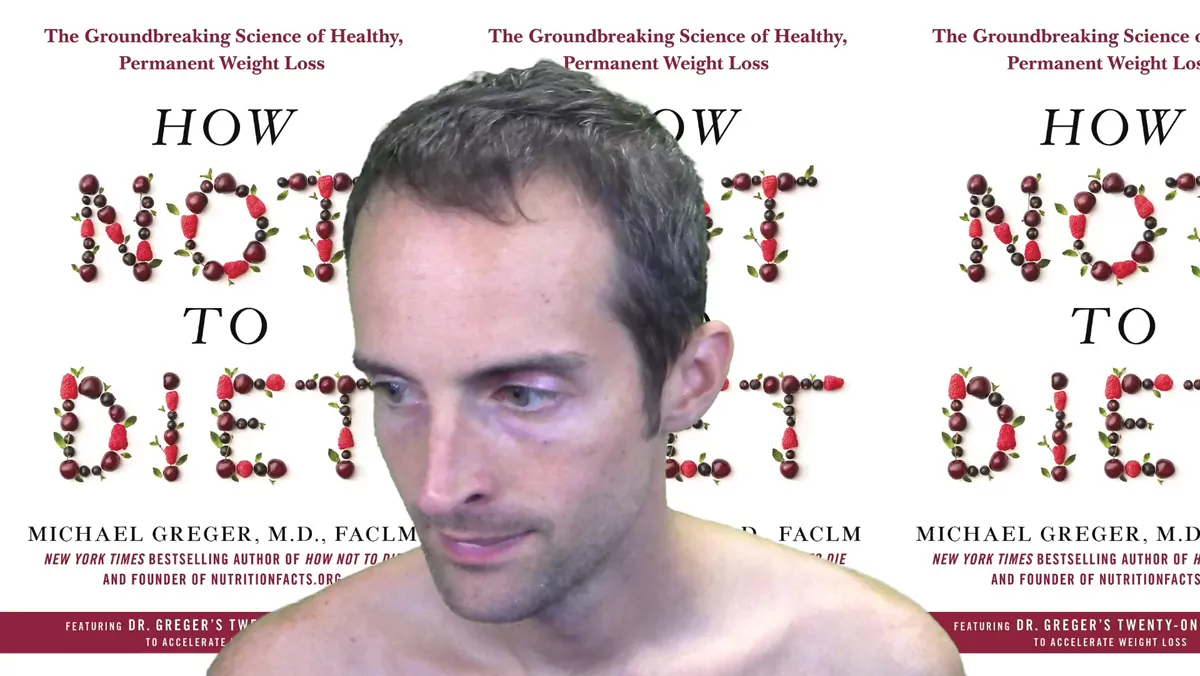
How Not to Diet by Dr. Michael Greger is the groundbreaking science of healthy and permanent weight loss. If you want to remain at a healthy weight for the rest of your life, prevent many of the top causes of death, feel great about yourself, look great, and be in the best shape of your life, this is the best book I recommend you read. I'm Jerry Banfield, and I used to weigh 80 more pounds than I do now. I like to get my shirt off because I'm very proud of how I look now. I weigh about 160 pounds at 5 foot 11, and if I could guide you to one single book that contains the very best information I've put together from lots of different books over the years, this is it.
How Not to Diet has a ton of science in it. In fact, Dr. Greger says he and his team collectively went through tens of thousands of studies to put this book together. This book has the best information, way better than anything I've seen before. The closest thing I'd found previously was How Not to Die, also by Michael Greger. That's where I originally found this author, and I've been following the diet shared in these books for five years now. It's left me feeling better, it's eliminated a lot of weight, and it's eliminated a lot of depression, and it leaves me feeling the best I've ever felt about myself.
The one key idea, summarized
If I could summarize it for you very quickly, here's the key thing. If you want to lose weight and stay at your ideal weight for the rest of your life, in my experience the number one way to do it is to eat primarily, mostly, whole plant foods: fruits, vegetables, nuts, grains, and beans. At the same time you minimize or completely eliminate processed foods, especially ultra-processed foods that don't have hardly any real food left in them. And you eliminate or minimize meat and animal products. I keep saying "eliminate or minimize" because you can customize this to what works for you.
Meat and animal products contribute very heavily to weight gain. I love the studies Dr. Greger cited in the book showing that you could eat the same number of calories of non-meat foods versus meat, and you would still put on weight from eating the meat. It's incredible, and it works. I've been mostly whole-plant vegan following this diet. Very occasionally I've had some meat, and honestly it's more like rarely over the last five years. Once in a while I'll have some animal products, and only in the smallest amounts.
From 80 pounds heavier to a healthy weight
I weighed 80 pounds more seven years ago. When I got sober, I lost like 20 or 30 pounds through effort, through tracking, through a bunch of strategies that were nowhere near as effective. Then I put this diet into practice for myself. For the first time ever, you can actually see a little bit of my ribs, I've got some abs, and I'm at a very healthy weight. Based on Dr. Greger's work, I believe I'm preventing all 15 of the top causes of death with this diet.
One question he addresses is: well, if it's this simple, this clear, and this effective, why does every single person not know about it? Why do people try so many other diets, and why is there so much misinformation around nutritional science? The way Dr. Greger explains it is that there's a lot of profit to be made by selling you on some particular diet, regardless of whether it actually works for you or not. There's a lot of profit to be made by selling you drugs and medical treatments, like bariatric surgery, that can kill you and has killed lots of people, and caused a lot of other non-lethal discomfort. It's profitable to sell you all of that stuff. It's not nearly as profitable to tell you, look, you need to figure out a way that you can actually love and enjoy eating a diet of mostly fruits, vegetables, nuts, whole grains, and beans.
You see the difference in how much money can be made by selling you a prescription, then selling you a medical treatment, versus selling you this diet. And a lot of what gets sold doesn't work, so then you have to keep going back for more treatments and more drugs. Whereas if, like me, you follow this diet, you may find, as I did, that I'm not on any medication, I don't need any medical treatments, and there are no other diet books I'll probably ever buy again. That's just not as profitable, is it?
Dr. Greger also points out some things that shocked me. The meat and animal product industry has very heavy subsidies from the government. At one point that might have made sense somehow, but now it basically means that a plant-based burger, which is constructed relatively easily from plants, can somehow cost the same or even more than a burger made from raising an animal, killing it, processing it, and getting it to you.
Health, immunity, and how I feel now
The point of sharing this information is so that you can be so healthy and so vibrant, with such strong immunity, that you don't have to be afraid of what's going on out there. I'm grateful. This diet has been one of the biggest things I've done in my life. I read about it first from the same author in How Not to Die, and then he deepened it in How Not to Diet, focused specifically on weight loss. This diet has been so effective for me that I've been the healthiest I've been in my entire life. I've gotten sick the least amount of times, and now, often, if there's some virus going around, I either won't have any symptoms at all or I'll get a minor version of it. It's just amazing what being in great shape can do.
Another thing that stuck out to me in this book: Dr. Greger said that, according to surveys he saw, people would rather face almost any other form of discrimination or bias than being overweight. Being overweight is often a very acceptable bias in many of our own minds. I personally have to admit this must be going on in my life, because I make a point of not having overweight friends, since the odds are that if you have overweight friends, the odds of you being overweight are higher as well. I also made a point in dating to avoid dating overweight girls. For me personally, I find it really attractive and healthy to be at a body mass that Dr. Greger identifies as being between 20 and 25. I'm currently sitting at about 22 and a half or 23, and to me that's very attractive, and I want people around me who are on that same wavelength.
I share this with the hope that, if you're above a body mass of 25, it's very important to lose some weight. According to the book, based on a whole lot of science, the more overweight you are, the more it's taking all kinds of aspects of your health down. It's increasing your chance for all kinds of diseases, and it's lowering your quality of life in terms of movement, in terms of your energy, and in terms of how people treat you.
The surprising tips inside the book
This book has the answers on exactly how to lose weight, and it has some incredible tips I'm surprised I've never heard anywhere else. For example, Dr. Greger found studies showing that when you eat something in the morning it has a very different impact on your blood sugar than when you eat it at night. I know diabetics, and none of them ever told me this, and I'd never heard it before. If you want to eat something that's going to spike your blood sugar and you eat it in the morning, it won't make that big of a difference, whereas if you eat it at night you'll get the full blood sugar spike. There are so many little tips like that in this book.
If I were dictator, every single person would have to read at least the first half of this book. It's so long that I'm still about two thirds or three quarters of the way through it right now, but the key information is absolutely in the first half. And there are so many more tips. If you're overweight, you want to take in the whole thing and try every single tip. There are tips like certain spices you eat that can contribute to weight loss as much as drugs do, as much as diets do. There's very good information in this book showing that there's almost no need for something like bariatric surgery, and in fact having it is a very bad idea. The risk of harm to you from surgeries like that is very significant, whereas you can lose all the weight you want to lose and keep it off forever just by modifying your diet.
This book will appear to be repetitive at times, because over and over again the science points to the exact same solution: eat a whole-plant-based diet, and minimize or eliminate meat, animal products, oils and added oils, and salt, along with processed junk like food coloring and all these things you don't need that are thrown into your food to try to make it taste better, and added sugars too.
Making it sustainable
Now, it's key to make a diet like this sustainable. I did this diet at first being ultra-hardcore about it, like absolutely no birthday cake because it has a little bit of milk and eggs in it, and absolutely nothing with dairy or meat at all. What I found is that for the long-term sustainability, it's ideal if I'm willing to compromise a little bit and indulge a little bit and stick with my diet. For example, if I go to a birthday party and there's an ice cream cake, I'll have a piece of ice cream cake. You know why? Because I'm at my ideal weight and I can afford to. Then when I go home I continue eating my diet, and before I got to the party I ate my diet too. That's mostly fruits and mostly things like roasted vegetables dipped in hummus, which gets you both vegetables and beans, plus nuts with a little bit of sweetener. I used to use honey, but Dr. Greger and this book got me onto yacon syrup, which is the root of a vegetable. I'm just trying it, and apparently it's way better than honey in terms of calories and is the best sweetener Dr. Greger has found.
If you want to get started with this diet, the easiest thing to do is buy some hummus and buy some vegetables you can dip in it: celery, carrots, peppers, broccoli. Buy some fruits that you'll enjoy. Buy some nut butters, or get some nuts roasted with a little sugar on them. You don't want to go overboard with those, but that's a good thing to have on hand. Then get whatever whole grains you like. Oatmeal, for example, is a really good whole grain. If you want to get started, get up and have a big bowl of oatmeal in the morning.
You need to throw some fruit in there or a little bit of sugar to sweeten it up so you'll actually eat it, so go ahead and do that. Then, maybe around lunchtime or even earlier, you get the hummus out and start dipping your vegetables in: carrots, celery sticks, broccoli, peppers, whatever other vegetables you can dip into hummus. Then for dinner you throw down some of those nuts that you bought as well, and you are going to be very full. If you want a snack, you use an air popper and pop some popcorn, and if you want to make that a little more enjoyable, throw a little bit more oil and salt on it, but not too much. That's what I do. That's what I normally eat in a day, and it works.
I effortlessly dropped 30 pounds with this diet, and I've kept it off for years now. Earlier, dropping the first 50 pounds took a bunch of effort: tracking calories, going to Alcoholics Anonymous to stay sober, and literally monitoring every single thing I ate. What I'm saying is that if I had used this diet the entire way, I could have dropped all 80 pounds with almost no effort, because your body naturally wants to get back to its ideal weight. Dr. Greger had some great studies in this book showing that if you made food completely bland, you could have dropped all 80 pounds just based on calories, because people who are overweight would have their bodies naturally correct and eat very little of the food in order to drop weight, whereas people who were at an ideal weight would eat the right number of calories to sustain that weight. Very cool information.
I hope this book takes away any of the shame or guilt, because I know I felt so bad about myself when I was overweight, and there's no need to be ashamed of it. I'm not going to be ashamed of it. If you feel bad about yourself, understand that you've been advertised to, promoted to, and marketed to, told tens of thousands of times, suggested to and programmed to crave foods that often make you fat.
Calorie density: carrots versus milkshakes
One of the helpful concepts in this book is the concept of calorie density. In my experience, the key is to eat foods that are not calorie dense, meaning foods that don't have a lot of calories per weight or per volume. I love some of the little facts Dr. Greger throws in. For example, to eat 2,000 calories of a milkshake or chocolate milk, you could down that many calories in about four minutes, or maybe it was 10 or 20 minutes, but relatively quickly you could take in 2,000 calories via milkshakes. I used to do exactly that in high school. I would get these thousand-calorie milkshakes at Burger King and drink them with a double Whopper with cheese and a large order of fries, and then be frustrated that I was overweight despite a lot of physical activity, which I'll talk about in just a minute.
If you compare that with something like a chocolate milkshake or ice cream, you could eat 2,000 calories, which is enough for the whole day, in a matter of minutes. Compare that to carrots: if you wanted to eat 2,000 calories of carrots, it would take you six hours. Can you imagine sitting at the table? You couldn't even physically stand to eat six hours of carrots. Your stomach would fill up and it wouldn't drain fast enough for you to even sit there and eat six hours of carrots. That's what we're going for. If you want to be at an ideal weight and prevent all of the top 15 causes of death, which Dr. Greger goes into in a lot of detail in how not to die, you want foods that are more like carrots.
I know your mind will say things like, "Jerry, carrots are disgusting, broccoli is disgusting, I don't like vegetables." That may be the story you're telling yourself, because I used to have all those stories myself too: that I like meat, that I have to have meat. There's more to it. You've been programmed to crave certain things, and by looking at and eating certain foods and focusing on them, you get an idea of "this is who I am and this is how I eat." With a little bit of what I gave you, that's what I'm doing. I'm giving you what I'm eating and how I eat. If you open your mind and go, "oh my god, there are other possibilities," you will discover you can love and enjoy eating vegetables and fruits and nuts and whole grains and beans, like I have loved doing over the last five years following Dr. Greger's advice.
Why I really switched: my sobriety and my mind
The only reason I did this is because I could see it would help me with my sobriety and my mindset. I noticed that when I was eating these meals full of a bunch of meat and animal products and added oils, sugars, and salt, all at one single meal and in a huge portion, I was getting depressed afterwards. I noticed I could be in a really good mood beforehand, and I could literally be having thoughts all the way at the bottom of self-harm depression within a few minutes after the meal set in. That's what convinced me of the necessity to switch my diet, more than the weight loss. Of course I wanted to lose more weight, but the necessity was seeing that my diet could lead to a relapse on my alcoholism. I'm grateful I've got seven years sober now. If you're interested in that, you can search "Jerry Banfield AA speaker meeting" and you'll find my full talks on that.
I'd also suggest that if you struggle with your diet, you may need to get off any mind-altering substance first. If you're like me, I needed to get off any "I'm gonna try this diet and I'm gonna do this" plan that kept colliding with intaking a mind-altering substance. For me it was liquor, especially vodka and rum. I'd have a few drinks and stick to my diet, but then after six or seven drinks I'd think, "screw it, I'm gonna order this large pizza," eat the whole pizza, wake up the next day feeling miserable and desperate to feel better. Then I'd throw down some pain medication, take in whatever comfort food would help me feel better, have soup with a bunch of meat and animal products in it, throw down a steak for dinner, something greasy. Then the day after that I'd be like, "well, I just ate so bad the last two days, why even try?"
Dr. Greger says that many of these diets are, in fact, built on failure: you'll try to lose weight, you'll try the diet, and you'll fail at it, and you'll attribute the failure to yourself rather than realizing it's the diet. If you follow a diet and health regimen that is actually good for you, it will work for you. But if you are using mind-altering substances like I was, and then making big mess-ups on your diet, you may need to get that fixed or address it first before you can actually stick to a diet. I know some people who are very overweight, and honestly, if you're getting all liquored up and drunk several days a week, in my experience there's no point in even working on your diet until you can stay sober. Dr. Greger doesn't address that in the book; I throw that in based on my personal experience. Until I could get sober and stay sober, which I only was able to do and continue to do by going to Alcoholics Anonymous five days a week, I couldn't put the weight of my diet to work. I would never have successfully done this diet while I was drinking.
You can't out-exercise your diet
Now, talking about physical exercise. If somehow you've made it to this point and you're still thinking, "well, Jerry, I can just work out more," let me tell you what happened to me. I got a personal trainer when I was in the morbidly obese body mass index range, all the while telling myself, "I'm not fat, I just have lots of muscle, I've got big bones, who cares about this BMI anyway." My personal trainer told me, "you know, 80 percent of your body and how you look is what you eat, and 20 percent is exercise." I'm like, "well, why am I here then? Why am I paying hundreds of dollars a month to get personal training with you a couple of times a week if you're telling me I can just adjust my diet and that will do much more than exercise?"
Dr. Greger goes into a lot of research on that topic, and that's exactly what he says: while exercise can help a little bit, if you just try to approach your body from an exercise point of view, guess what your body does. Have you ever noticed that if you crank up your exercise, your appetite seems to go up with it? That's because your body is often much smarter than you are. You think, "huh, I'll exercise more, burn more calories, and lose weight." Your body's like, "huh, I see you're exercising more. Good. Why don't you eat some more to make up for it?"
I was getting frustrated because after I got sober I was tracking every single one of my calories. I was burning thousands of calories working out every week. I'd often go to the gym and burn five hundred to a thousand calories on the elliptical and the Stairmaster and doing these personal training workouts, and my appetite would be ferocious. Then I'd have to work on self-discipline: "let's try not to eat too many calories." But then I would eat more calories, and whenever there was a little slip-up, whenever my will was not at maximum, "let's have these extra calories, I'm working out a lot."
Dr. Greger showed clearly that exercise-based weight loss intervention programs, while they can work a tiny bit, are far less effective than adjusting your diet. Adjusting your diet is so much more effective that you could sit around and do almost nothing, adjust your diet, and lose a whole bunch of weight, way more weight than somebody else who starts working out and running and doing an exercise regime but does not make a significant change in their diet. In fact, Dr. Greger put some funny statistics in here. He said that world-class athletes and people eating a diet similar to what I'm eating who were couch potatoes would often have the same size bodies, at least. Now yes, the athletes might have a bit more muscle, but still, the athletes eating all kinds of animal products and meat and processed foods and doing tremendous amounts of exercise, you could get that same kind of body just by eating mostly whole plants: fruits, vegetables, nuts, grains, and beans. Very little effort, almost the same result.
Exercise helps, but diet does the heavy lifting
So you could either go run marathons or just make some slight adjustments to your diet, and you'll turn out about the same in terms of your body weight and body fat. Now exercise is definitely helpful. Exercise can help raise your non-exercise activity level, and I just heard Dr. Greger talk about that. Dr. Greger mentions that with exercise, the amount of energy you expend when you're not exercising is often a big factor in how many calories you burn, and that's another way your body gets you. So, for example, you start exercising more, and your body will try to correct for that by increasing your appetite and decreasing your physical activity the rest of the time.
Like when I did those heavy workouts before, where I burned all these extra calories, I would end up sitting around a whole lot the rest of the day to make up for it. Whereas now I do mostly light workouts, and my body is just energetic and active almost all day. I'm standing up most of the day, or I'm walking, I'm moving. Even if I'm standing somewhere, I'm often just keeping my energy moving and flowing. I'm not doing any of those heavy exercises that I used to do before, and yet I have energy all day. You'll learn as you get older that you can just apply a little more exercise on top of your diet, and I've come to look at it literally as a lesson.
What I've learned about supplements and your gut
From the research, and in my experience, almost every single supplement I've taken has had a negative effect on my health. Multiple supplements have actually led to me being physically ill. Dr. Greger talks about how inside you, you have a lot of bacteria and microbiome in your gut. There are two basic types of gut bacteria. In terms of the overall composition of it, there's the plant-based, primarily gut bacteria, and then there's the meat and animal-products, primarily based gut bacteria. Naturally, it's based on what you eat: if you eat mostly plants versus if you eat a whole bunch of meat, your gut bacteria change. And that contributes to your cravings and your health.
Your taste buds live for only 10 days
There's good news if you think this all sounds too hard. Dr. Greger said your taste buds only live for 10 days, which means, based on my experience, this is exactly what happened. Within about 10 days, when you change your diet, the first 10 days can be a little challenging. But here's what happens. After all your old taste buds are dead, and you've adjusted what you're used to eating, your taste buds will actually start to taste things like fruits, vegetables, whole grains, nuts, and beans differently, and better, versus the foods you were used to eating.
If you cut back on things like animal foods, and you cut back on things like added oils and salts and sugars, and you cut back on processed foods, you don't even have to completely eliminate them. If you just cut drastically back and focus on the majority of what you eat as whole plant foods, the taste buds become more sensitive. And what I've found is I can't even stand to eat some of these rich foods anymore, because it's too much. It's like your ears: if you're used to hearing normal volumes, you can go into a rock concert and think, God, that's terrible, it's way too loud, it's so loud it's unpleasant. Your taste buds will adjust to a new way of eating fairly quickly, and your microbiome, or your gut bacteria, will adjust fairly quickly as well.
Which means it's not as hard as you might think to go from the way I used to eat, which was meat and animal products at every single meal, very few whole plant fruits, vegetables, nuts, whole grains, and beans, very little of that, mostly processed foods, mostly animal products, and mostly useless nutrition. Dr. Greger says if you eat the whole-food, plant-based way, the only supplement you really need is B12. And I found a year's supply of B12 for like $50. You don't need any of these other vitamins or supplements if you eat this way, because the food has all this nutrition in it. But if you're eating things like white bread and a bunch of animal products and all these processed foods, they don't have all the nutrition in them that a peach has, or an apple, a zucchini, some beans, some nuts, some whole grains. These already have all the vitamins, fiber, and minerals you need in them, especially when you vary what you eat and don't just eat the same exact thing all the time.
Why I share this
I've shared this book today with the hope that, even if I just remember and learn this stuff on a deeper level and can be an example of it for the rest of my life, I can help more people achieve such a high level of health that you don't have to be looking around scared, scrolling scared of what might come at you. You'll be so healthy you'll be able to handle anything that comes at you from the outside, and you'll be able to thoroughly enjoy the time you have inside your body. You will love looking in the mirror. You'll be proud to have your shirt off and show off your muscle tone, show off a healthy amount of fat while not being overboard with it. You'll be able to run faster. It's so easy for me to run now, 80 pounds lighter. It's kind of ridiculous how easy it is, and how much I love being at a healthy weight. And my hope is that this is useful for you in your journey as well.
This has been great to present to you, and I appreciate you being here. If you've got any questions, the best way to have a real two-way conversation with me is to schedule a private call with me. I'll give you everything I know for free, and when you're inside the community, you can ask me any questions you want, and I'll respond. I highly recommend you read the book itself. What I've given you is a teaser, a tiny bit, the tip of the iceberg. You need repetition on something like this. You need to hear it over and over again before it really sinks in.
I also suggest you read How Not to Die as well. If you read the two of those books, you're going to be looking at living at a healthy body weight the rest of your life, no matter where you're at now. You're going to be looking at preventing all the bad things, all the top 15 causes of death. You're going to be feeling better each day, looking better, and enjoying your life more. If you want to follow along with more of this journey, you can watch my Life playlist.
And that's why I do what I do, with the hope of doing whatever I can here to help you have the best, most fulfilled, healthiest life you can have. I love you. You're awesome. I'll see you soon.