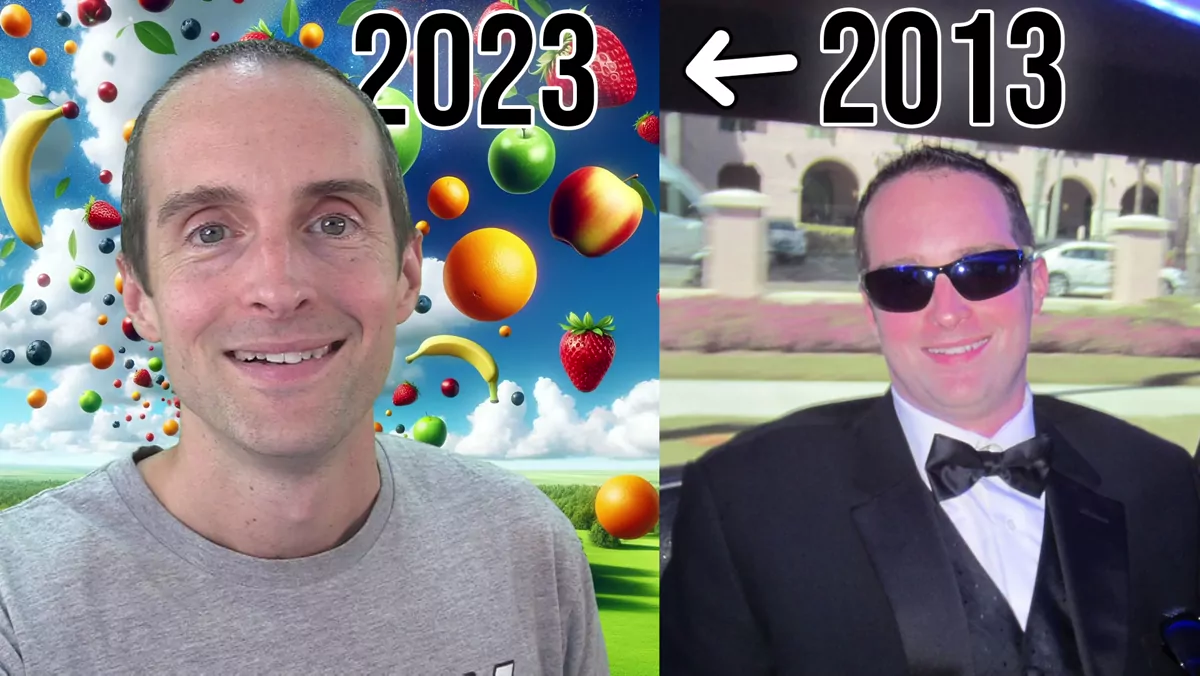
My friends, I'm grateful I've lost more than 80 pounds and I've kept it off since 2014. I want to give you an honest account of my journey here. I'm a full time YouTuber, and I'm so grateful to share this experience with you, because one of the things I felt so powerless and helpless over was my weight. If you see the before and after picture, back in 2013 I weighed almost 250 pounds at my highest, and I weigh about 170 pounds today. I got down as low as 160 pounds, and I've recently put back on 10 pounds, which is one of the big reasons I wanted to make this. I never, ever will put that weight back on again. It's very easy, when you've put on 10 pounds, to start backtracking a bit, but there can be a huge amount of motivation when you're really overweight to make some changes.
And I've got great news today: it's very simple to get down to a healthy weight. I did it all naturally, and it was not hard. There were little points that were a little challenging, but getting sober and going to Alcoholics Anonymous was so much harder than losing weight. And there are huge rewards. I've read surveys where people said they would rather face racial discrimination than weight-based discrimination. In a world where there are so many people who are overweight, I can tell you, I used to be overweight, and I get treated way better now that I'm not. It's definitely blatantly unfair, but at the same time, it's how things are. Sure, some people will treat you wonderfully no matter how you look, but a lot of people won't. What I've found is that at a healthy weight, people are so much nicer and more likely to smile at me.
I also love being in the body I'm in. One thing that makes all of this easier is to picture how you would feel being in a body you loved being in, one that ran fast and felt good. I love how my body feels today. So I tried to get a vision for what's possible for you, because I know many of you feel hopeless about your weight. You feel like you've tried so many things, that it's out of control, and as I'm recording this over the holiday season, you might be asking why even bother. Well, it's worth it. It's worth it to be in a body you love being in every day, a body that people treat you better in. It's worth the effort.
Getting Sober Came First
Let me start back in 2014, when I weighed 250 pounds. I was drinking a liter of vodka every day or two. I had tried all these diets. I felt totally hopeless about my weight, about my sobriety and my alcoholism, and I felt hopeless in a lot of other areas of my life too. The first thing I did that made it possible to get control of my weight was getting sober. What I found is that if I drink alcohol, I am totally powerless over my whole life. Once I take that first drink, my diet's out the window. Not every single time, but at some point the diet always goes out the window from drinking. Drinking has tons of calories and no nutrition, which makes it very hard to be at the weight I want to be, and it leads to so many other negative consequences. So for me there was no hope of losing weight. I'd have some success temporarily, but there was no long-term, sustainable weight loss as long as I drank.
I found I could not stop drinking alcohol just by trying to. I tried so many different ways to just stop, and what would happen is I was never happy being sober over the long term. I'd get sober and my body would feel better, but my mind would progressively feel worse, and that led me back to drinking. So I went to Alcoholics Anonymous. I learned how to stay sober and actually like it. And I lost 20 pounds just from not drinking. I was sad to discover, though, that I wasn't losing any more weight just from being sober. I had this fantasy that if I just didn't drink, I'd lose all the rest of the weight and I wouldn't have to do anything else.
But I also felt empowered. I knew that getting sober was so hard that if I could get sober, stay sober, and like it, then I could learn to adjust my lifestyle and my diet to get my body looking the way I wanted it to look too. From there, I started trying all these different things to lose weight, and I hope that by sharing my story, it helps you do it faster than I did. In my experience, you do not have a chance to maintain a healthy body if you're poisoning it with alcohol or other substances. I use the word substances very broadly. I do not take any kind of medication at all, because to me those things often poison my body: you trade one symptom for another and you lose control of yourself. I take no medications, and my body feels fantastic. As long as I was taking all these other things, it felt like there was no chance to really address the weight.
Tracking Every Single Thing I Ate
So once I got off alcohol and everything else, the first thing that was really successful is that I used an app to look at everything I was eating. After I plateaued on my weight loss from just being sober, I started to look honestly at what I was eating, and I realized I was eating so much crap. I remember one day sitting at a fast food restaurant and looking around. Keep in mind, I was probably about 25 percent body fat, which is obese, but I tried desperately not to think of myself as fat. I looked around and everybody there was way more overweight than I was, and this little thought came to mind: if you're eating here with these people, you are on your way to looking like them. And I thought, no, that's totally unreasonable, look how big they are. But then I realized it was true. You keep eating like they eat, you're going to look like they look. And I realized I didn't even know where to start with dieting.
So for one year I did the first thing I thought could help. I'm also a big believer in not dieting. The way I eat today is sustainable. The way you eat needs to be a way you enjoy, that feels good, and that can be sustainable. Diets don't work, because they're so often based on mistreating yourself, and you need to eat in a way that's loving. At that point, I could not stomach the idea of a diet. So I remembered my Alcoholics Anonymous experience of getting honest and being transparent and accountable. I thought, what I can do is use this app. I think it was called MyFitnessPal. I made a deal with myself that I was going to put every single thing I ate into that app every day. And for one year, every single day, I put every single bit of food I ate into the app. I put in what it was and how much of it I ate, and it told me how many calories I had eaten. For example, on Thanksgiving that year, I ate about 3,800 calories of food, which, shockingly, I later saw a statistic saying is roughly how much the average American eats every day. Oh my God, what?
I was working out, doing hundreds of calories of exercise every day, and being active in the rest of my life too, teaching and helping out with the baby. I wasn't just sitting around all day. So I set a target of 2,500 calories, which seemed like plenty for me. And I gave myself the freedom: look, you can eat whatever you want, just put it in the app and aim for 2,500. Some days I ate 2,000. Other days I ate 3,000. It stopped me from overeating to a certain extent, because when you've already had 2,800 calories in a day and you can see you've already had ice cream, cookies, and all this other stuff, it's like, okay, I think I'll stop now. You just look at it and think, I don't want to put this in the app, so I'm just not going to eat it. From there, I lost another 30 pounds.
No More Excuses
The other thing I'll address is no excuses. When I drank, I had all these excuses all the time, and I had delusion. When I weighed 240-plus pounds and the scale said I had 25 percent body fat measuring my actual body fat with electrodes, it said on the chart that that's obese. I deluded myself into thinking I'm not obese, I just have muscle. Lies. 25 percent body fat is obese. It's way more than you need, according to the charts, at least as a man. Women often have a bit more body fat than men, generally, so it's about figuring out what is right for me. When I finally got honest, it was, oh, I'm fat, this is the truth, I'm fat, and I don't want to be fat. I'll do whatever it takes to be at a healthy weight, because I don't want to be super skinny and thin either. I want to be at a healthy weight where my body is nourished and feels good and looks good. That's what I set my intention to. I'll do anything it takes.
So it was sobering up and dropping the excuses. No excuses. Almost always, when people are dealing with any problem in life, the first thing you get is excuses. And it doesn't really matter what your excuse is, whether it's something from your past or something somebody told you. Stop the excuses. Your body can be extremely flexible and can make some amazing changes if you'll let go of the excuses. Set your intention for where you want to go, and get the help you need to get there. If you want that kind of honest accountability, one of the best ways to work on it with me today is to set up a call with me.
Yes, I was definitely eating plenty of treats while I was counting my calories, but I was eating fewer treats because I was counting them. There were many days I'd have about 2,200 calories, and some of those would have been sweets and stuff. So I lost 30 more pounds just tracking my calories, and I went down to 190. But again, I found a hard plateau at about 190. I wasn't losing any more weight. And after a year of looking at everything I was eating and the ingredients in it, this was 2016, two years after I got sober. At this point I'd gone from about 250 to 190, which was 60 pounds, and that was awesome.
But I knew there was further to go, and that I had to do something else to get the rest of the way there. At the same time, I had this rash, which might have been yeast in my body. No matter what I did, I was hoping my diet would affect the rash, and it didn't. However, I noticed certain things I ate, like processed sugar, seemed to flare the rash up. I finally asked my uncle, who's a doctor, for advice, and he gave me a book called How Not to Die. That book is like the Bible for eating to me. It's written by a medical doctor who has dedicated his life to giving the best information he could find about nutrition. He saw the power of nutrition in his own life, and he wrote How Not to Die, which was extremely helpful. That's the book my uncle gave me: How Not to Die by Dr. Michael Greger.
The meal that changed how I eat
The thing that really sold me on it was the last time I had a huge meal. Right before I switched to a mostly whole plant vegan diet, I was eating all kinds of meat and animal products kind of thoughtlessly. On this particular day, I was in the airport in Detroit with my wife and daughter. We were all having a wonderful morning. The plane was on time. Everything was going great. There was nothing going wrong. I had this massive meal filled with five different kinds of meat, like they'd just slaughtered all kinds of animals and thrown them in there. Tons of oil, tons of salt, added sugar, a huge portion. Any of those things single-handedly might have been okay, but you put all that together, and I noticed my thinking went from very happy and feeling great to feeling miserable and depressed within 30 minutes of finishing the meal. That's when I realized how I ate affected how I was thinking.
That's when I became willing. I thought, wow, how I eat affects how I'm thinking and how I'm feeling, my moods. I'll do anything to eat in a way that gives me better moods and better thoughts. And then I plowed myself into How Not to Die. According to his research, which seems true to me, and I'm decent at assessing truth, he said that eating a whole plant-based diet, mostly vegan, will help prevent, stop the progression of, and in some cases reverse all of the top 15 causes of death. Every single one of them. I thought, wow, this is like cheat codes. How does everybody not know about this? It's crazy how effective that is, and how clear the research is.
Getting severe with the diet and intermittent fasting
I immediately started following the book, and the first year especially I was severe. Eventually I combined the whole plant, mostly vegan diet with intermittent fasting. The most severe I ever did was noon to 4 p.m. I would only eat between noon and 4 p.m., and most of what I ate was fruits, vegetables, nuts, grains, and beans with minimal or no processing. That was extremely effective. I was very full, I was getting nutrition, and I was getting calories. I dropped all the way down to 160 pounds. At the time I wasn't exercising much other than walking. I'd say I have about a similar amount of body fat today as I did then, but I have a bit more muscle. I've gone to yoga every day for the last two months, and about five days a week for most of the year, so I have a bit more muscle than I did back when I was so severe.
Since then, I've relaxed slightly on the diet. Maybe three times a year, maybe six times a year at most, I'll have a very small portion of meat, like a bite or two or a few small bites, and only if I really feel like it, and it's eaten with other people. My wife got this sushi that had bacon on top of it, and I had a couple of pieces of it the other day. So very occasionally I'll have very small quantities of meat. Since 2017, the highest my weight has gotten is about 170, maybe 178. Where I'm at today, I've got maybe 50 more visceral fat around my belly than I need, and about 30 more in some other parts of my body like the thighs. I think the ideal weight for this body is about the same muscle I have now minus about 10 pounds of fat. I've got about 18 to 20 body fat now, and I'm aiming to get that down to 15 in a way that's sustainable and enjoyable.
Here's where I'm at today. Knowing I was going to talk about this really helped me, because I've been overeating things like sweets and eating more food than I need. Because it's a whole plant vegan diet, it doesn't put on much weight.
Why the same calories put on different weight
One of the craziest things I've seen with eating is in another book the same doctor wrote, called How Not to Diet. The most amazing thing in this book is that there are studies showing that eating the same calories of meat versus eating the same calories in plants, like beans, vegetables, and fruits, the meat calories will put on weight and the vegetable calories will not. I'm like, wow. And the vegetables, the fruits, the nuts, the grains, and the beans will be much more filling than the same portion of meat. You can see how it's very easy to put on weight and to be overweight if you eat meat.
It's important to lean into what your own body needs. All our bodies aren't the same. My body personally does not need meat hardly ever, and it thrives on whole plant foods: fruits, vegetables, nuts, grains, and beans. It works very well on that.
The mental and emotional side of weight
Now there's another important component which is worthy of an entire video itself. There's also a mental and emotional connection to weight, and there's a book on this that really goes into it, called Hunger by Roxane Gay. This really looks at the mental and emotional component of weight gain. The basic thing described in the book is that when you feel unsafe, when you feel dis-ease in your body, when you hate being in your body, this often will trigger a relentless hunger. Hence the name of the book.
In my experience, the more I felt safe in my body and loved my body, the more I was able to apply what I'd learned in books like How Not to Die and How Not to Diet. What I've found is that if you just work on the physical, but you feel unsafe in your body, on some level you've put on weight to keep people away from you mentally and emotionally, often from things that happened in childhood as Roxane Gay describes in Hunger. Often nothing you do physically will work. What I've found is that I needed to address all those mental, emotional, and spiritual pains, and from there I was able to successfully apply the physical practices.
The process of getting sober really helped me with that. I also did hypnotherapy, and I find the practice of yoga very helpful too, because at yoga you tend to wear minimal clothing. I just wear shorts and underwear to go to yoga, and when I've got my belly hanging out, I'm accountable to other people. Everybody can see exactly how my body looks, and it leaves me wanting to have my body in the best health and best shape it can be in. I want my body to look beautiful and function well indefinitely, and having extra fat slows that down and takes me out of having things as good as they can be. I love how fast my body runs today. I haven't been able to run like this even as a kid, when I had more weight on than now. I feel like I'm just flowing when I'm running. My body just goes so fast and easy now, and it's amazing. Think about that: I'm as old as I've ever been, and my body feels better when it runs than it's ever felt, even as a kid.
So it helps to get accountable, to get a support group, to read, and to know that you can change things that seem unchangeable. My practice right now is that I go to yoga every day. I go to Alcoholics Anonymous five days a week. I eat a mostly whole plant, mostly vegan diet.
The one change left: stop eating at night
I realize the only thing I need to do to drop off 10 pounds of fat from where I'm at is stop eating at night. Again, How Not to Diet had some amazing information in it. Eating in the morning and afternoon tends to help you have energy, and your body will tend to rip through the calories you eat in the morning and afternoon. The calories you eat at night will tend to be stored as fat and will often interrupt your sleep, which I can attest to. You eat a bunch of food at night, you won't sleep as well, and it puts on fat. Some of the people I've known who are most overweight would often starve themselves in the morning and afternoon and have massive portions of food at night. They'd struggle to sleep, put on weight, and do the same thing the next day.
So the challenge I've had recently is turning to not eating at night. For me it's flexible, but anywhere after 4 p.m. especially, I generally don't need to eat, because by that point I've eaten enough to sustain and nutritionally support me. It really helps to have a period of at least 12 hours, with most of it being asleep, where my digestive system can take a rest and stop doing anything. If I cut my eating off by about 4 p.m., I'm getting a little hungry right now, and that's fine. Essentially it's intermittent fasting. I have from about 7 a.m. till 4 p.m., which is nine hours to eat, and then after that, that's enough for the day.
That, to me, is a system I know will work. Just thinking about talking about this last night, I've finally, after months of losing my discipline and eating at night, taking 20 minutes to eat at night when I'd already eaten plenty the rest of the day, done it. Just one night of not eating at night, and I weighed 2 pounds less the next day. The scale said 1 percent lower body fat. Your body can make adjustments really fast.
Give Your Body a Chance to Adjust
My biggest takeaway from all of this is patience. Whatever change you are making, give your body a chance to make those adjustments. It does not happen all at once, and in my experience the results come when I stop forcing things and let my body catch up to what I am asking of it. So give yourself that room to adapt, and trust that the shifts are happening even when you cannot feel them yet.
I hope this has been helpful for you. If you want to see more of how I work through this kind of thing day to day, you can follow along with my Life playlist, where I share the ups and downs of what I am learning as I go.