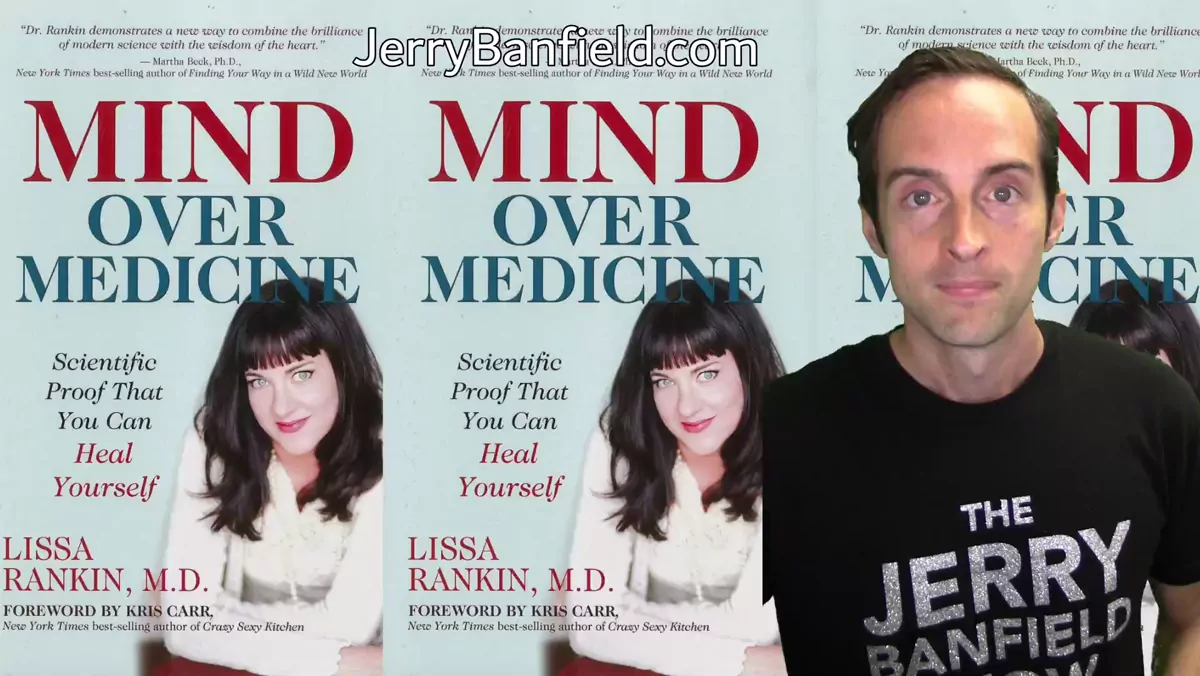
Today we're having a discussion. The book we're talking about is Mind Over Medicine: Scientific Proof That You Can Heal Yourself. It's by Dr. Lissa Rankin, a medical doctor who has spent and dedicated her life to helping people truly heal and live at their best health. I'll give you a quick summary of the book and some of the big takeaways here, and then use this as a jumping-off point for a deeper conversation. You can expect me to consistently talk about the books I'm listening to and reading going forward.
If you get one idea from the book, it's that your mind drives what happens in your body, and that the mind and body are a very powerful unit together. It's not just a separate body and a separate mind. You can't separate how much the mind and the body influence each other. That's the argument Dr. Lissa Rankin makes, and it's the thing I keep coming back to.
Dr. Lissa Rankin's story
Let me give you a little bit of Dr. Lissa Rankin's story to begin. She jumped into being a medical doctor and found herself practicing medicine the typical way it's practiced in the United States right now, where she was at a practice and she would get a couple of minutes with a patient, quickly prescribe something or give some quick diagnosis, and then move on to the next patient. She wasn't getting much time to actually get to know any of her patients. She wasn't able to feel consistently satisfied in that kind of medical practice. She found herself frequently stressed out, which led her to leave the medical field completely and start doing art. She was drawing, and she took a sabbatical from medicine entirely, totally burnt out herself.
And then she was kind of attracted back into it. She was attracted back into researching and looking all these things up, and she realized she wanted to come back to medicine after taking a significant amount of time completely away, not even planning to come back. She realized she wanted to come back and help people truly be healthy, and not just be a servant in an industrial system that mostly focused on mindless medicine, dispensing prescriptions and not really connecting with patients. She wanted to come back and truly help people reach their highest health, really get to know her patients, and give her patients the very best chance to succeed in reaching their health goals. She's done an amazing amount of research, and she shares a lot of wisdom in the book about her experience.
I read this book months ago, and I don't take any notes when I read a book, because if it's really powerful and worth remembering, I'll remember it. Those are the things I most get from a book.
What Dr. Lissa Rankin argues about community and health
One of the most powerful things she talks about in the book is the value of community on health. She argues that if you are part of a supportive community, that is so powerful in terms of your good health that it actually makes up the same difference as some bad habits. I'm not sure exactly which ones she quoted in the book, but the example that stuck with me was a supportive community she looked at — an Italian community where people would work, then come home, hang out, and have these big dinners and gatherings where people had a very strong sense of connectedness, where they knew lots of different people and saw them in person.
Think of how things used to be, where people went to work and worked alongside other people all day. There are people working next door to me, building a house right now, and they're all working and hanging out together. They're not in their cubicles, hunched down at a computer, isolated. They're listening to music, they're dancing, they're building a house together, they're talking to each other, and they're in a community. Some of them will probably go home and have big community dinners and enjoy time together, and they won't be isolated at all.
Dr. Lissa Rankin found, through her research and study, that in these really supportive communities, even if the people were smoking and drinking and not eating a very good diet, their community made such a big difference in their lives in terms of health that — she argues — they were able to live longer than people who didn't have those bad habits but who weren't part of a community. That was an amazing discovery that has continued to stick out to me: communities are very important for health.
I've found that personally. With going to Alcoholics Anonymous, I've found that all the worst health points in my life were also when I was the most isolated. And all of the highest health points in my life were when I was the most surrounded by other people, the most connected into community. I see that sharing this knowledge is absolutely essential in what seems to me like a pandemic of isolation, of people being cut off from communities. In my experience, it's essential for your health to be among your community almost all day, almost every day. One of the worst things I believe you can do for your health is to isolate yourself and be cut off from other people. That's because, the way I see it, communities stimulate our minds and connect us with other people, and that is a very powerful healing energy. It allows us to relax. Whereas when we're by ourselves, we often get stuck in our own heads, we think the same thoughts over and over again, and we get stressed out. In my experience that has a huge negative toll on the body.
Someone in the discussion pointed out that our current model of healthcare in the West tends to be biomedically focused. Yes — our current model of health in the USA, Canada, and similar countries is driven strongly by profit. And I believe that's problematic when you consider how it all fits together.
A system that profits when people stay sick
Think about doctors, health insurance, hospitals, nurse practitioners, pharmaceutical companies, and even advertisers and TV corporations — they get paid when people are sick. If you're not sick, like me, if you're healthy, you don't go to the doctor hardly ever. You don't need to take any prescription medications, and you can't sell me any prescription medications almost ever. In my own life I spend almost no money in the healthcare system. I even went without health insurance for a while, until my wife got us a family plan. Before she put us on a plan, I had dropped myself from health insurance.
When sick people go to the doctor, that generates income for everybody, and there's a bias, a self-interest in the whole system that aims everybody at profit. Now, there's a counter self-interest where people individually want to be healthy, and companies want healthy workers. So you have these competing interests, where the health insurance and all these different elements in the healthcare system have a profit motive to keep people sick and to make people sicker, because it's profitable. If you are sick and you go to the doctor and the doctor gives you something, they've all just made money off of you being sick. People who are chronically sick are chronically profitable, which means there often can be a self-interest in terms of business growth and survival that conflicts with a desire to help people. If you go to your doctor and they give you a book that tells you how to be healthy and never need to visit them again, they've annihilated all of the money you would have brought in from being sick into their practice.
Now, I don't think most doctors, like Dr. Lissa Rankin, went into practicing intending to support a system that makes huge profits off of people being sick. But what she realized is that going to work, seeing patients for a couple of minutes, and dispensing medications was not making a significant positive difference in people's health, and was leaving her feeling stressed out. She's taken a step back and written a book about a more holistic approach. A holistic approach looks at the entire mind-body-lifestyle picture. It looks at all of it together, instead of looking at each thing separately. It looks at the entire picture of someone's life instead of just treating the symptoms.
Here's an example from my own experience. The last time I went to a doctor — a year and a half, almost two years ago — I told them I often had frequent gas. They suggested I probably wasn't digesting my food right and gave me some supplements, which ended up making me feel sick and ended up making them a profit. I'm amazed they didn't ask a very simple question, or investigate: well, how do you chew your food? How fast do you eat your food? Because in my experience, chewing your food well matters. Quickly eating and swallowing your food without chewing it much, eating fast, and stuffing your belly — for me, all I needed to do to correct some of the gas and a lot of my gastrointestinal discomfort was to slow down my eating and chew my food more and eat less. I didn't need any supplements. All I needed to do, in my experience, was chew my food more. And yes, if I eat beans and garlic hummus, I'm going to have more gas; and if I chew my food up, eat slower, and don't eat so much, it cuts down all kinds of gastrointestinal issues. But the doctor doesn't make any money if they tell you that, and there's not an incentive to look for that. There's an incentive to look for things that are profitable.
That's why a book like this — books that essentially show you how to be your own doctor — are so valuable to me. They're so valuable. You want to be your own doctor and read books that help you learn about your own health.
What about when your community falls apart?
Someone in the discussion said they completely agreed about what community can do for you, but asked: what about when your community falls apart? What about when people start to become unhealthy? They felt like they'd gotten too reliant and lost the ability to be comfortable alone.
Yes, there is definitely a value to being alone. You definitely want to be able to spend some time in isolation. Some of our greatest spiritual teachers — think Jesus, Buddha, Mohammed, people who've had whole religions developed around their teachings — often took a time of being completely separate from other people. Life is about balance. There certainly is value in taking some time to isolate, as long as you're looking within and intending to really get to know yourself. I hope what we've seen in the world over the last year is that people are using this time to reflect and look inward. It can be valuable to take some time to go within, to look at yourself, and to isolate from other people.
However, for the long term and the majority of your life, in my experience it's essential to be part of a community. For most of us — maybe not all of us, but most of us — we're designed and wired and expecting and joyful in communities. And if your community falls apart, whose responsibility do you think it is to find another community? I've had communities around me fall apart, and sometimes when you change your community, you need a different community. When I was a kid, when I used to drink alcohol, I had a community of people to drink with. When I got sober, I needed to find a community of people to be sober with. That's what I got going to Alcoholics Anonymous.
Sometimes it's not obvious how to replace the community that fell apart. That's where things like prayer and meditation and asking other people for help come in. You can say, "Hey, I'm not sure what kind of community I could go to," and you ask other people for help, and other people will often say, "Well, why don't you talk to this person?" What I've noticed is that whenever I'm looking for something, I find it. Whenever I'm aware of a need, it gets fulfilled. A year ago, I realized I wanted to quit filming online courses and get connected with my local community. I just asked everybody around me for help and feedback. My massage therapist got me connected with a bunch of her community. I made a whole bunch of new friends, blew my community up, made a bunch of new connections, and tried a bunch of new health practices. That's when I got into yoga. That's when I tried some more meditation practices. Right in the middle of many people in the world being scared and isolated and alone, I was out meeting more new people and going more new places than ever. In May, June, and July of 2020, I was out making all kinds of new connections.
Once you know what you need internally, the external world will be considered, but not the primary driver. I know that if I want to live, I need community. I need to be connected to other people. In my experience, meeting new people, getting connected with new communities, and seeing people over and over again, especially face to face, is very good for my health. So much so that there was a week where it was actually illegal where I lived in Florida to go out to gatherings like AA meetings, and I went every day anyway, until somebody got it turned around. I know what's good for me today, and I don't care who tries to tell me anything besides that. This book really emphasized the value of having a supportive community, and if you need to change communities or rearrange your communities, it's up to you to ask for help to do that.
I love doing these just-chatting conversations so we can really focus on the discussion. Someone mentioned that connecting with other people is the biggest thing in life, but that they needed some heavy self-reflection right now. There's certainly a time for self-reflection. What I find is that the time that's right is whatever I desire to do. For example, I've been going to AA meetings almost every day for the last six and a half years. Right now there are four meetings a week that I love going to, and on the other three days I'm feeling a strong desire to take more time at home to just do things around the house. I have these pads to make my studio sound better that I've been meaning to put up for five or six months, and I'm so busy out doing other things, like AA meetings, that often the dishes haven't been washed, the pads still aren't up, and I walk my dog less. There's a place to balance everything.
One of the big points of emphasis in this book is balance. It's about having a balanced lifestyle, because your mind is driving your body, and what you ultimately want for health is to have your body in balance. A lot of the health problems we experience, the way I see it, are because our bodies get out of balance, and the solution is to get ourselves back in balance.
Someone said the best medicine is talking to others. In my experience, connecting with others is by far the best medicine I've ever found. I don't take any kind of medications or supplements, and I feel I'm in the best health of my life. I still occasionally have things come up. I have some spots on my back and chest — some red spots that I've been to the doctor for, and they said it's a fungus, just put this cream on and wash off with Selsun Blue or something. But it's come up again. So now I'm going to see an herbalist, because I see that my body is slightly out of balance. If I just wipe a cream over the external symptoms, like the dermatologist had me do, that was effective at dampening the external symptoms for a while, but then they came back.
Doctors can save you, and medical errors can kill you
What I want is assistance, or some insight, on how to balance the inside of my body, and any adjustments I need to make in my mind to assist with that adjustment. So I look at it today that doctors can absolutely be lifesaving and helpful. At the same time, doctors can also kill you. In fact, one of the leading causes of death, as I understand it, is medical errors — things where you go into the hospital for some kind of surgery, they mess something up, and it kills you. That's one of the top causes of death; a lot of people die every year because of medical mistakes. The way I see it, the way to avoid that is to avoid being in the medical system except when you really need it. It's a delicate balance: take what you need and make something like the medical system your ally, and also refrain from it whenever you don't need it. Take exactly what you do need, then step back and go elsewhere.
Dr. Lissa Rankin talks a lot in the book about the value of these alternative approaches, and about the nocebo effect. A placebo effect is where you think something works, and therefore it does. A lot of studies on things like massage, as I understand them, show it's a placebo effect — and that's fine, because in my experience the placebo effect is so strong that it produces a very positive result. Even if researchers can't find evidence separating the physical from the result — even if they've done studies showing that getting a massage is "just a placebo," like there's nothing to it — it doesn't matter to me, because I know that massage helps me fantastically. I've read stories of people's blood counts changing. I'm not sure if it was in this book or another, but Dr. Lissa Rankin has a bunch of stories of all kinds of what she presents as scientific proof that you can heal yourself — good stories of things people have done that, she argues, healed themselves, and ways that can work for you to be very healthy. I've come to believe in this kind of self-healing so strongly that I've written about how my dog healed herself of a terminal disease.
There's also the nocebo effect. A placebo is when an idea is given to you that's helpful, even if in physical reality someone can't figure out exactly how it works, and it appears to be only in the mind. The opposite of that is a nocebo, where somebody gives you a hurtful idea, and there was essentially no physical problem until you got the idea that there was. That's kind of like the thinking behind hypochondria, where people think they're sick all the time. One of the cool things Dr. Lissa Rankin mentions in the book is that medical students would often come down with all kinds of weird symptoms of the diseases they were studying. It's because they were thinking about, focusing on, and becoming afraid of having these diseases. They'd get symptoms of all kinds of rare diseases, and sometimes more common ones — there's even a term for it, something like "medical student-itis," where you're studying and thinking about all this stuff and it manifests in your body, even just a little bit, sometimes more significantly, because you're focused on it. That, she argues, is how powerful the mind is to suggestion.
Being grateful for the problem
Someone in the discussion asked whether my red spots could be a food I don't eat often and am sensitive to, or a different soap or laundry detergent. They've come up and gone away for about eight years. I've looked at so many different things and I'm not sure. This is where it does help to ask people for help and get some suggestions. I've changed soap, I've changed so many different things. And I've actually been grateful for these spots on my chest and back, because they've been a catalyst. They inspired me to change my diet — that's when I went whole-plant vegan. I've made drastic changes to my diet. I've tried eating every single different way, and in my experience it doesn't seem to matter too much what I eat. I've never had a low-sugar diet; I also love sugar. So there is a place for things to challenge you and encourage growth, and then to reach out and ask for help — because one of the things that gives defining meaning to our lives is reaching out, needing, and connecting with other people for help. If there's something you've been wrestling with on your own and you want to reach out, you can schedule a private call with me — not as medical advice, just my own experience and a real conversation about what you're going through.
Someone else said they have a weird rash on their chest that comes and goes randomly. That's whatever I've been dealing with — it's been off and on for eight years. The cream the dermatologist gave me, plus using some Selsun Blue, worked for me for a while, but I stopped doing it and it came back. So I'm going to see an herbalist on Wednesday. I trust that whatever's right for me today is based on something I'm excited about — whatever I think is fun, or trying something new. I'm looking forward to going to this herbalist, having a consultation, and trying something new, because going to the dermatologist and just rubbing a cream on myself didn't do anything on an ongoing basis. What I want is to make a kind of change that lasts indefinitely, where I'm not having to rub a cream on myself or wash myself with something forever. I believe there's a change that can be made.
Someone mentioned being on a four-week lockdown again. I see the value of where I'm at. I'm out, I'm connected, I'm with people who are outside, I'm outside my house every day, I'm hugging people, I'm shaking hands. Life is going on very normally for me. And everyone I know around me is in some of the best health they've been in for a while. I personally see that it's very important to get out and connect with others, and that, in my belief, isolation and being afraid of things only brings more of the same. I'm looking constantly to live my life at my highest health. I have no interest in trying to hide and avoid being sick, in that "oh my God, what if that happened" energy. No — I'm going to be out there, I'm going to live my life, and I'm going to do whatever I can to have my body at its very highest health. From there, I'm going to trust that everything will be fine — that if anything comes into my energy field, it will be peacefully assimilated into the whole. It's not like I'm thinking, "Oh my God, I need to stay away from these threats, these little things can hurt me." No.
I've never gotten sick without it happening first in my mind
I've never once, that I remember, gotten physically sick without it happening first in my mind. Never once in my life do I remember getting physically sick where something related wasn't going on in my mind. I've even seen the power of my own mind for getting sick. I've had canker sores, and the more I would pay attention to them, the more they'd grow. I'd bite my lip again and dread getting another one. And the more I ignored the canker sores and focused on how grateful the rest of my mouth felt — the rest of my mouth felt great — the faster the canker sore would heal up and go away. I sprained my ankle on the trampoline at the beginning of 2021. I was just having a great day, and all of a sudden — whoops — sprained my ankle. That hurt. And I didn't ice it, I didn't do anything with it, because I believe it will fix itself.
Skin is super weird. Most biology is super weird in general. The skin is the biggest single organ in the body. One thing I've been doing is getting a lot more sun, and in my experience that's been great for me.
Someone mentioned that there's true chemistry, too, in how certain chemicals work with or against you. Someone else said they have a problem with not wanting to go out much because of epilepsy, and that it's really annoying. I think all the problems we have are opportunities to ask for help and connect with each other, and that's what I'm doing. This little rash I've had off and on for years has been one of the things that drove me to get out, try new things, and ask for help. I think what our souls are ultimately seeking is growth and new experiences. That means if we sit at home, don't have new experiences, aren't growing, get rigid, and get bored, then to me that seems like a formula to die. How to live: get out there, love your life, connect with other people, stay active, be part of a community, ask for help when something's challenging, grow, learn, try new things. That seems like what kids do, what comes naturally, and — in my belief — how people stay healthy. What people tend to do at the end of their lives is get rigid, not try new things, not ask for help, and often isolate and die alone or with very few people around them.
I had a friend from AA, in her eighties, who went into lockdown. She was told to go into lockdown and avoid being around anybody. I think for her, the last thing that had meaning in her life was the community of people she got out and saw at AA and at her work. Within a month or two of staying in her house alone, she died. To me it doesn't matter what you call what she died from. The way I see it, she died from isolation and from not having meaning in her life anymore.
Our communities, the people in our lives, give a lot of meaning to our lives. It's good to have meaning in your life that's independent of the people in your life, but almost everything in our lives is given meaning by the people around us. My wife, my children, my mother and siblings and aunts and uncles, the people I see at AA meetings — these are my compass. If all of them were wiped out, yes, there's definitely still something in me that wants to live and will press on. But most of the meaning in my life on a daily basis comes from the people around me. The way I see it, if you really want to stay healthy, you actually want strong connections and social gatherings. From what I see, the world has been giving us a powerful example of what not to do — isolate and separate — and what to do — be strongly gathered together.
Everyone I know who passed away recently was isolated
Everyone I know that I see on a regular basis is doing very well with their health. And every single person I know who's passed away recently was isolated. Every one of them. It's an example of how, in life, lots of times the solution becomes the problem. When I used to drink, drinking alcohol was my solution to a boring sober life that wasn't fun and was painful. And very soon the solution became the problem. Suddenly my problem was drinking, that all these bad things were happening when I was drinking.
I think we've seen the tip of the iceberg, if what Dr. Lissa Rankin says in this book about how powerful community is for health is accurate. With all the people who've had their communities wrecked and who've not put their communities back together, I think we may be seeing a trajectory in the world where there's a percentage of ultra-healthy people, like me, who are full functioning members of all kinds of communities and take great care of ourselves, and another trajectory of people whose path just goes downhill, who get sicker and sicker, have a miserable quality of life, and then die. So I'm focused completely, every single day, on maximizing my health. One of the core things she talks about in the book, too, is the value of exercise and diet and all these little things, and, of course, not living a stressed-out lifestyle but being able to truly relax. If you're stressed out, isolated, not eating well, drinking alcohol, and smoking cigarettes, the way I see it you are on the way out. And from the way I look at it, we're all immortal souls — so if you die, and you have the chance to come back anywhere you want to, I see that I really like this experience, and I want to stick with this one until I don't. If you want my fuller take on what makes a life worth staying in, I get into it in what a quality life actually is.
Someone noted that sunshine and vitamin D are essential for health. It was beautiful that day, and yes, I took a nice long walk, maybe 30 minutes, out in the sun with my shirt off to get lots of sun.
Someone said I took a weird path, and that they'd followed me for a few years. To some it'll look weird. What you want to do is have as many different kinds of experiences as you can, so that nothing looks weird anymore. The path I'm on certainly would have looked weird to me seven years ago, when I was 70 or 80 pounds heavier than I am now, when I was very isolated, when I was in frequent physical pain, when I was in almost constant mental pain, when I was drinking a gallon-plus of vodka or other hard liquor every week. Where I'm at now certainly would have looked weird to me then. That's often an indication that there's an opportunity to learn something, an opportunity to grow. Today it's difficult for me to find things that look weird, because I've looked, I've listened, I've lived in so many places, and I've done so much myself that I have a pretty open mind to what's possible. I understand it, and I love my lifestyle today. My lifestyle is so healthy.
Whatever you have inside is what you have to give. That's why I encourage all of you to go out and connect with people in person as much as possible where you live, if that feels right and exciting for you.
When feeling good feels wrong
There is a little trick, though. One of the tricky things is that when we're used to feeling bad, the things that will help us feel good often feel wrong or unnatural. I'm very sensitive, so I very easily detect when I'm starting to feel bad, and that's one of the things that helps me feel good so often. Yesterday, I was sending some text messages instead of spending quality time with my son. Even just a little bit of doing something like that leaves me starting to feel bad, which wakes me up to: whoa, if you want to feel better, you need to change what you're doing. My son asked if I'd read him a book, and my first response was, "No, I don't want to read you a book." But I realized in that moment to consciously override that response, because often, if you're in the habit of feeling bad, the things that will help you feel better will look wrong, or weird, or you won't want to do them.
A lot of the stuff I do today — massages, yoga, meditation, all the prayers, going to AA meetings — would have looked real weird, and would have looked wrong, seven years ago. When you consciously are honest with yourself, you see that all you do is keep finding more things to make yourself suffer, and that the things that seem right to you and make you feel bad — like drinking, smoking, isolating, playing a video game where you're raging and yelling, going to a job you hate — the things that seem right and normal to you are often the exact things that are taking your health downhill. And when somebody actually gives you a suggestion of something that might help you feel better, it'll often look wrong. Like, "No, I don't want to go to a meeting with a bunch of weird people who are going to tell me about why they're losers and how they got sober."
That's where you can use the power of your consciousness to override whatever your mind is saying. Yesterday I said to myself, "What action will I take that will help me feel better?" And I saw that if I read a book to my son, I'm going to feel better. That is an action to help myself feel better. And if I take an action several times that helps me feel better, then the next thing I want to do will also naturally help me feel better. It's the law of attraction. When you feel good, you keep attracting more things to help you feel good. When you feel bad, you keep attracting more things that make you feel bad. That's why, in these conversations, when I'm feeling good, it doesn't matter if somebody says something that wouldn't make me feel good, because I'm not on a wavelength to care about it. But if I show up feeling bad, and somebody says something sent from a place of feeling bad, then since I'm in that place, I'll recognize it.
If you can honestly appraise your situation and say, "You know what, if I get real, I'm in a place where my behavior indicates that I keep doing things to make myself feel bad" — I keep drinking alcohol even though I suffer, I keep saying nasty things to people even though I know I suffer because of it, I keep going to a job I hate, I keep sitting at home alone and I suffer, and I keep doing things that I know are not making me feel better, and I keep rejecting things that would make me feel better. Somebody asks, "Hey, you want to go out and do something?" and your first response is no, because you're in a place of not wanting to feel better. But the best part about feeling bad is you can get a very strong desire to feel good. The last time I drank, I felt so bad that I had a massive desire to feel good — that I wanted to be sober. I don't want to ever feel like this again. I want to feel good. I want to feel God. I want to be healthy. I want to be at a weight where my body feels light. And all of that is possible.
A doctor is just one person with an opinion
Someone in the discussion shared that they were diagnosed with bipolar at 16, after their dad killed himself, and were told it would only get worse, never better — and that the doctors "don't know shit." Exactly. A doctor is just one person with an opinion. If they've been trained that bipolar always gets worse, and they're just blindly spitting out what they've been trained, then they don't know at all what else is possible. I was so happy to hear that this person, at 34, has a career and hasn't taken any medication.
I'm sure that at many points when I was drinking, if I had gone to a doctor, they would have diagnosed me with bipolar as well. I have family members who've been diagnosed with bipolar. Thankfully, I had a sense like this: if I'm going to go somewhere and somebody's going to tell me something bad about myself, then why go there at all? Why would I go to the doctor, tell them the truth, and have them tell me something's wrong with me? Let's just skip that whole process. That's why I never got diagnosed with anything — because I avoided going to any doctors to get any opinions about my mental health. I knew my mental health was a disaster, but I figured if nobody else labels me that way, then it doesn't count. And I also put myself in the best light anytime somebody asked.
For example, I had a lot of bipolar-type stuff going on when I was applying to be a police officer, and I just answered the questions strategically. They'd have questions like, "When I get upset, I want to hurt people." At the time, that was the truth. But I figured, if I were them, I wouldn't want to hire somebody who said that when they get upset, they want to hurt people. I wouldn't want to give a gun to somebody who says they want to hurt people when they get upset. So I'd put no on that. And it didn't matter how many times they asked a similar question — I would always see what they were getting at. If they asked it a different way, like "people deserve bad things that happen to them," I'd think, "I see what you're doing, you're trying to call me out," and I'd put no on that one too. I consistently talked about myself in the best positive light. And that was helpful to get me to a place where I then felt I could discover people I could talk to honestly about what I experienced — people who would help me and give me real solutions, instead of just giving me things.
Most of the sickest people I know take a lot of medications
Maybe medications could help a transition. But from what I see, most of the time medications make things worse — like the supplements the doctor gave me, which they gave me to fix something, and then the supplements created more problems. What I see a lot of people doing is getting a medication. Most of the sickest people I know in my life take a lot of medications. Most of the healthiest people I know in my life, like me, take very few or no medications. Most of the people I know who are the healthiest very rarely go to the doctor, and if they do, it's something more holistic, or it's something where they're basically getting validation that they're in great health — like me. And most of the people I know who are the sickest go to the doctor all the time.
If you're able to be honest and say, "I'm taking all these meds and I go to the doctor a bunch," the best thing you can do is get a powerful desire out to ask, "Well, how do you want your life to be? Do you want to spend 10 or 20 hours a week at the doctor?" My dad, the last year or two of his life, all he did was go to the doctor. I refuse to live that way. That's not a possible way to live, in my mind. I don't even consider that as a possibility for myself. I picture living a fully healthy life, and then, when I'm ready, just laying in my bed and dying peacefully at home. That's what I picture. I have a very powerful desire to stay active and to think preventatively.
A book like Mind Over Medicine is big on thinking preventatively, because once you have acute symptoms, once you're struggling with something — and Dr. Lissa Rankin makes this very clear — yes, go to the doctor if you need help with something. But also make sure you're thinking holistically and preventatively. And if you're going to go to the doctor, make the doctor your ally. You don't need to just blindly do whatever the doctor says. If you don't agree, or it doesn't feel right what the doctor said, go see a different one.
Be your own doctor, and go to others as an equal
I'm encouraging you, and the books I'm reading like Mind Over Medicine encourage you, to learn and master being your own doctor. Then, if you go to another doctor, you're going to an equal. If you're going to an herbalist or a psychologist, this is somebody who's an equal to you, who maybe can help you with your own practice. This is not somebody who's God over you, who knows how long you're going to live and has some miraculous training that gives them magic powers to know how life works that somehow you don't have access to.
Someone said they feel meds make you socially acceptable but not healthy. To me, alcohol was like a medication. I drank for 11 years. Yes, meds often take the edge off discomfort. But really, in my experience, you can do the work to make that happen yourself, completely naturally, most of the time. I'm sure there are cases where — like my wife says — the epidural they gave her was very helpful for having a successful childbirth. That's why it's important to check your own expectations. My wife expected the epidural would work successfully for her, and it did. She believed it was a gift from God to make childbirth easier, and she was happy to receive it. If you believe something is going to be good for you and help you, then it's definitely worth trying.
Someone said, "You know it works for your body. No doctor knows what is right for you but you." Exactly. Someone else wished doctors would listen to what's said instead of thinking they know everything. As Dr. Lissa Rankin talks about in Mind Over Medicine, doctors who go to med school and want to help people are often put in situations like she was — where the system she was working in was not supporting her as a doctor to truly connect with her patients. She'd see so many patients every day, and had so much work to do for the health industry, so much insurance paperwork for her practice, that she'd only actually get a few minutes with a patient. So what I've taken from her book is that she's telling other doctors and health practitioners: make sure you put yourself in a situation where you're supported by the system you're working in. If you're a doctor and you choose to work at some practice that's just a churn-and-burn — get them in, get them out, make that money — that may not suit your needs internally, and you may not do much for the patients externally. You may need to start your own practice.
I go to a practice in St. Petersburg where an Eastern medicine and a Western medicine doctor both team up to give you their opinion. For me, they said, "You're in amazing health. Biologically, you haven't aged at all in 18 years. If we look at your signs, your blood pressure and blood counts, you look just like we'd expect a healthy 18-year-old to look. You haven't aged at all in terms of what we look for, which is miraculous." According to the doctor's charts, in my experience I've literally aged backwards, because of the lifestyle. If you need some ideas, this book will give you a whole bunch of specific lifestyle things — specific practices and behaviors you can use to, as Dr. Lissa Rankin argues, drastically increase your health, and to ask for help in a way that you can get the help you truly need. That's why it starts from within. If you go around believing something's wrong with you, and that people are wrong and the world's wrong, you're going to get help with that. But if you believe everything is right where it's supposed to be with you right now, and "this is where I want to go, and I'm going to look for somebody who can help me go there" — that's a different starting point.
Someone asked, doesn't it cost money to see different doctors? It's not always about seeing doctors. I see a massage therapist every week, and in my experience that's one of the best things I do in terms of spending money on my health. It makes a huge positive difference, and my massage therapist is who referred me to an herbalist. You don't need to go see a doctor about everything.
Getting a wide range of viewpoints
I believe Dr. Lissa Rankin encourages getting a wide range of viewpoints. For example, if you had something like cancer, I believe in her book she suggested you might see a doctor — maybe a couple of doctors. You might see someone like a natural-medicine or holistic practitioner. You might see your massage therapist and get their viewpoint. You might read a couple of different books about it. You might talk to a psychologist. You might see a counselor about it. The idea is to get a wide range of views about the exact same thing. If you go see an oncologist, they're going to tell you, "Well, these cells went bad, and you need chemo and radiation." If you see a counselor, they might say, "This cancer is manifested because of your resentment against your father, and you need to do the work on that." And if you go see an herbalist, they might say, "Well, this is manifested because of an imbalance in your body — here, try this, and maybe this."
The way Dr. Lissa Rankin frames it, the secret is to figure out what feels exciting and feels right for you specifically, and to avoid doing anything that doesn't. If you go to the doctor and they tell you you've got cancer and you need these treatments, and you just think that's the most horrible thing in the world, and you think they're going to poison you and you're going to be sick — that's probably an indication that you want to go seek a different kind of help. If you go to the doctor and they say you've got cancer and you treat this and do this chemo, and you think, "This is going to save my life, I'm so grateful for it, this is exactly what I need, the chemo's not even going to bother me, and I'm really looking forward to doing this and feeling better" — then that might be the right course of action. That's why it's all about checking into how you feel, and also getting some feedback from other people who know you.
Someone said their doctor wants them on uppers, which slows them down, while downers help them physically and mentally. That's why it's important to really check in and get to know yourself. If you've been in isolation, it can be a good time to look at how you feel the best. But that's also where community can help, because sometimes how we're thinking of ourselves is really skewed. How I think of myself versus how other people see me can be very different. Sometimes I think, "Man, I talk a lot, good Lord," and other people are like, "Man, I love hearing what you have to say, it's so inspirational, it helps." We need that outside perspective.
The fifth step: seeing yourself from someone else's eyes
At Alcoholics Anonymous there's the fifth step, where you talk to somebody else about some of the worst things you've done in your life, things you would never want to tell anybody about. The real help from that act of confession is getting somebody else's point of view. I thought I'd done these awful things that proved I was a horrible person, because I'd never heard anybody else talk honestly about some of the darkest parts of their life. When I talked with somebody else honestly about the darkest parts of my life, and they shared about the darkest parts of their life, I suddenly realized, "Hey, I fit right in." The sexual experiences, the things I'd seen, the violent thoughts I'd had in my head — these are fairly common things that people go through in life, and many of us just don't talk about this stuff. But if you feel bad often, it's talking about those deep-down reasons you think you're so awful that can actually help you see, from somebody else's point of view, that you're not awful.
In fact, from somebody else's point of view, you're very lovable, you're very normal. That's where community comes in, because you probably don't want to just unload your most intimate secrets, ones you've never told anybody, on a stranger. Maybe you do, maybe that's appropriate. But you often need a very supportive, trusting, loving community. And you probably don't want to unload all that stuff immediately on your partner or your children or your parents — that's why community is so helpful.
My conversation with Ty
I had a guy named Ty that I talk about a lot, who passed away. He was like a father figure to me. He's the one I sat with and talked to for the first time about every reason I hated myself, every bad thing I'd done and seen. Then he shared some of the things he'd been through in his life, and suddenly it's like I could see myself from Ty's point of view. I could see that I was a wonderful young man, that there was nothing wrong with me, that I was on my way to having a fantastic sober life. I could see, from his point of view, that I was okay. And never again have I felt that horrible about myself since having that conversation with him. I've had a bunch of conversations with people since then. I've even published an entire book called Speaker Meeting 2017 where I go into detail about all the stuff I talked with Ty about, and I have a book, Officer Banfield, where I talk a lot about that stuff too. This is why community is so important.
Someone said, "With age and life experience comes wisdom." Sometimes — if we're open to letting the experience teach us, then it does come in. If we block it and fight it and say, "This is wrong, I don't want it, I don't like it," then we can get to 70, 80, 90 years old and somehow not seem to be very wise. That's why you see such differences. Ty was in his 70s, and I gravitated toward Ty because he had so much life experience. I'm like, "I want your life experience. I want to understand what you understand as best I can. I want to be at your level. Whatever you can tell me to help me be at your level of experience and wisdom." A lot of the people my age, I'm not even thinking about the same things. I often feel most comfortable and most on the same wavelength with people in their 50s, 60s, and 70s who are very healthy and vibrant. To me, those are my people. We're on kind of the same level of understanding. A lot of the people I run into who aren't on the spiritual path I'm on — like going out drinking — we don't have anything to talk about, because, the way I see it, people who really love themselves don't consistently poison themselves. Maybe occasionally, for a little bit of contrast.
Where I've done my best work in feeling better has been having conversations, often after AA meetings, with people like Ty. If I can point to one of the biggest changes that happened in my life, it was the day all these memories came up that I'd never talked about with anybody as an adult — some from childhood, some from being a young adult, things I felt ashamed of, things I felt were proof I was a horrible person. When I sat down and talked with Ty for an hour after the AA meeting, the key was that I got all those things out. I withheld nothing from Ty. Ty was like God to me — like you might imagine when you die and your guardian angel or God is sitting there saying, "Hey, tell me about your life," and you just unload absolutely everything, you hold nothing back out of fear, you lay it all on them. That's what I did with Ty. Just a regular conversation, sitting outside after an AA meeting, brutally honest — anything I was thinking about, things I'd been told to never talk about again that happened in childhood, all the violent thoughts I had as an adult, all the things I saw, from things I watched online to things I saw as a police officer, all the stuff that bothered me, that I hated the world over, that I hated myself over. I just got all that out with Ty.
That's often not something you're going to want to do with your partner, because you'll often need to talk with somebody else before your partner. That's why it helps to have so many different kinds of friends. The goal of a community is not to have everybody be the same. That's why Alcoholics Anonymous has been so helpful — there are men and women in their 70s, 80s, and 90s who've been sober forever, there are people in their teens and 20s coming in trying to get sober, there are parents, people who've never had kids, grandparents, great-grandparents. You need all these different perspectives to really help you live at the best health. If you're just watching TV and looking at stuff on social media, and you have friends just like you, and you see a counselor or doctor who tells you there's something wrong with you, there are a lot more perspectives out there. If you had those perspectives, you might see it differently. Having a small circle of people who actually get this is exactly the kind of honest connection I'm describing here, and if you'd like some of that, you can schedule a one-on-one call with me — this connection is exactly what I want more of in my life.
Some days I feel like a loser, and I can relate
Someone shared that his girl is sober and he's trying, that it's the hardest thing he's done in his life, and that some days he wants to blow his brains out because of feeling like a loser. I can relate with that so much. Seven years ago I stopped even telling people when I was trying to be sober, because I didn't want to tell them I was getting drunk again and deal with their feelings of disappointment. If you feel like you're dying, you are dying, one way or another. The question is: are you going to die and keep getting to live in this body, or are you going to shed this body completely? I was 29 years old, and I knew it was time for me to die. I either was going to drink myself to death, or I was going to become somebody totally new. I couldn't handle a middle-of-the-road option, like, "I'm just going to not drink and be the same person." I hated who I was, and that's why I drank. Going to Alcoholics Anonymous, having those conversations with Ty, reading the book, and trying all these new things felt like dying.
And what I can say is that dying is awesome. Dying is about letting go, because you are immortal. You don't die — you are immortal. I used to think being immortal was the worst possible thing. I remember watching a movie where the people in it were immortal, and I remember screaming in my bed at night, thinking, "I'm immortal, and this suffering will never end." That was the worst thing I could think. But really, dying is just a letting go, and when you let go of this body, you will continue to live. I've remembered dying in several different forms in different lifetimes — in dreams, in hypnotherapy, in memories that come while I'm awake. You are going to die one way or another, and the question is, how do you want it to look? Do you want to completely let go of this life and this body, or do you want to continue in this experience as a new person? Do you want to become somebody new?
Someone shared that 14 years ago they thought they were nothing, kept everything inside, were deep in a hole, and attempted suicide; now they're happy to be alive, married with three kids, and love being here, even though in 2019 they lost more of their hearing and got depressed again, but they talk about it. Yes. I've had — I can't even tell you exactly, it was thousands of times — that I contemplated taking my own life. There were many times where I set things up. I had the gun to my head and tried to pull the trigger. I stood over the edge of a building, thinking about it and trying to goad myself into jumping. I would drive my car fast and think about hitting a phone pole. I've been there, I've done that. And today I absolutely treasure this lifetime, because I realize that everything I've done for 36 years has got me here. I can drive, I can talk, I can go to the bathroom, I have a community, I love my life. I've worked hard for this. I love where I'm at, and I love that I've seen the miracle happen in my own life.
Seven years ago I weighed 70 or 80 more pounds than I do right now. If the doctors had appraised my health at the time, they probably would have said biologically I was 40 or 50 years old, with my blood pressure and all my blood counts. I consistently felt all kinds of physical and mental pain — things like nausea from hangovers and drinking too much, things like anxiety. I was consistently depressed. I'm sure somebody would have been happy to diagnose me with bipolar and give me some meds. I would go from one day feeling like I was on top of the world to the next day wanting to end everything. I had violent thoughts very frequently — not toward myself, toward others — and I had constant fear that I was going to act out on them.
The desire that comes from feeling your worst
The best thing about all of those negative states is that you can come out with a very strong desire for what you do want, and that will take you anywhere. If you're feeling physical pain today, there's a corresponding desire there — you want to feel no physical pain, you want to feel total health, total joy, total peace, balance, and serenity in your body. The last day I had that hangover, I had a massive desire. I'm like, "God, please, I'll do anything, anything to get sober." I had a huge desire to get sober. The key was that I then immediately took action on that, figured out an AA meeting to go to, and started taking the action. Because what a lot of us do is — like I'd done with drinking a thousand times before — I'd have a desire to get sober, and then quickly there wasn't a strong enough desire to really make a miracle possible. So the worse you feel, the more a miraculous level of desire is inside you to feel better. One of the worst situations to get in is where you feel just bad enough to not do anything about it. One of the best situations to get in is where you've been to the absolute hole of misery and suffering, you've had a massive desire to get out of there, and now you're out of there and you can show other people by example: "This is where I was seven years ago, and this is where you can be today."
We need communities of people around us, because when you're just living for you, it can be difficult to value your own life. But when you see yourself through the eyes of your partner and your friends — the last time I tried to drink, I thought about how it would look from my wife's point of view, and I'd never once contemplated that before. Every time before I drank, I only thought, "I want to feel better." I never thought, "Well, how's this going to look to my father, or my mother, or my wife when they have to deal with this relapse?" The last time I went to drink, I thought, "When my wife comes home from work, how's she going to feel when she finds this? How's my mother going to feel when she hears I'm drinking again?"
Sometimes you can connect with somebody online who could help you out a whole lot. I hope that if you feel excited to connect with somebody and they're excited to connect with you, that can happen, or that this conversation leaves you feeling safe to get out and find some people you can connect with in person. I didn't get sober on my first try. I got sober for three months in 2008, for a few weeks in 2009, for almost five months in 2012. Often you'll need to fail the lesson over and over again until you have a strong enough desire to pass it. If you'd like one of those people to be me, you can book a private call with me and we can keep talking, as many times as it takes.
Someone said the worst pain ever is detoxing — no sleep for four or five days straight, that it drove them nuts and they're scared to go through it again. That's where help comes in. You can ask somebody else who's detoxed for some suggestions, because it doesn't have to be as bad as it was before. I detoxed a bunch of times from alcohol, and for some reason I thought the best way to drink was to get really drunk, go on a hell of a bender, then deal with the hangover — sometimes it would last two days — and then do it all over again.
Someone shared that they stream to promote recovery and are six years clean from heroin and everything else. I'm so happy to hear all of you who've gotten clean. And you can know also that just because you get clean and sober doesn't mean you become boring. I think some of us look to things like alcohol and drugs to give us courage, to deepen our personality, to give us creativity — that if we get sober and clean, we'll just have to be some boring person who conforms and does what they're told. What I can say is that I'm better prepared to live my life on my terms when I'm sober and have a clear mind. I'm better prepared to be a rebel and disregard a law, and to encourage others to do the same, when the law is not appropriate and is not supporting you in having a healthy, meaningful life. I'm in a much better situation to encourage living life on your own terms and being a rebel than I am when I'm drinking and just mindlessly fighting anything. Now I can consciously focus on what really matters. I find I have as much courage, if not more, to take the right kinds of leaps of faith, instead of blindly doing dumb-ass things. I find I have much more fun sober, because I actually remember it and get to fully experience it. Sex, for example — much better sober, way better sober. Almost all the best sex I've had has been sober. Drinking and drugs do nothing but take your life downhill overall. What's tricky is that they seem to provide some temporary relief, but temporary relief is not what you're looking for. If you want to have your greatest health, you want to avoid anything that can take you down. And yes, I've heard you can die from DTs, and there's lots of help available to detox — a treatment center might be appropriate, depending on whether that feels right for you. I never went to a treatment center; I laid in bed and detoxed hundreds of times alone at home with some chicken noodle soup and water and throwing up.
Someone said substances trick our thinking into believing we do better with them, when we most often do not. Yes — I used to think I was a better gamer when I drank, and the reason is I was not accurately appraising the evidence. I would hold on to one good play I made in one night of drinking, and then disregard the last three hours of the night where I went 0 for 6 in half of the Search and Destroy games. The point is how alcohol distorted my own scorekeeping.
Listening to Brené Brown with a hangover
This is what really makes a difference. I believe one of the reasons I got desperate enough to pray to God to do anything is that I listened to stuff like this. Brené Brown had a show called The Power of Vulnerability, and I listened to that in bed with a hangover, and it helped me get more honest. Just listening — even if you're listening to this and you're drinking and using drugs and thinking about ending it — just listening will help lift you up a little bit. And if you can accept a little bit of help to lift yourself up, and ask for a little bit more help, you'd be amazed what repeating that over and over can do for you. I listened to a lot of self-help stuff laying in bed with a hangover, wishing, and that helped spark my desire for a better life. Listening to Brené Brown's honesty in front of a workshop full of people helped me be honest with myself and say, "Look, man, you're laying in bed with a hangover while your wife's at work, you're on the edge of committing suicide soon, especially if your wife leaves — which she ought to. You need help, man, and clearly whatever you're doing is not working. You need help."
One of my friends, thankfully, in a drunken bit of honesty — I told him, "I'm getting drunk, I'm watching porn even though my wife's sleeping in another room, and I've got a hangover, and I'm thinking about all these violent thoughts, and I'm drinking all these beers tonight" — and the one guy said, "Man, you need God." At the time I thought that was the stupidest thing. "I do not need God. What is God going to do for me?" But then, when I had that hangover a few days after that, I went to God, even though I was agnostic at the time. I'm like, "I don't know about this whole God thing," and I laid in my bed and said, "God, please, I'll do anything, anything to get sober." That moment of being honest with my friend, and then being honest with God, came straight out of letting other people's honesty reach me first.
The thought that came: maybe an AA meeting
And that's when the thought came: well, maybe going to one of those AA meetings would be a part of the "anything" I just offered. Then I took action, and I went, and I still keep going to AA meetings. Now my entire life is about this. My entire life is about how I can lift someone else up today and be a person who lives in a way I'm proud of, that I love, that I enjoy. I do really care about you all. Every one of you, I want you to have the best life you can, in your own judgment. And what's cool is that what's right for me is not necessarily right for you. I personally don't use cannabis. Some of you find that cannabis helps you a lot. I have some friends locally in my community who love cannabis, who are all about it, and who think this would be something great for everybody to use. What's great is to see that there are different ways we can live our lives and be happy. I don't know what's right for your life. You might be a person wired to sit at home and be alone and be at your maximum health. I don't know what's right for your life. All I can do is share my own experience, and these wide-ranging conversations are where I do that — if you enjoy them, you can watch more of them in my Life playlist.
Letting people heal me
For me, being with other people is what helps. Someone said it well: because he healed, he wants to help others heal. Yes. And what I've done is let people heal me. I lay on the massage table and pay a hundred-plus dollars every week, even though I'm putting my money as much as I can toward paying down debt and minimizing expenses. I pay a hundred-plus dollars a week to lay on a table for an hour and a half and accept physical, hands-on care, because in my experience that helps my body stay young — it's part of what's helped me actually age backwards, the way I see it, and helped my body repair.
There's nothing wrong with weed; it's just the abuse of it. I think there are a lot of things in life that, if done in balance or moderation, can be helpful. If you can use cannabis in a way that supports a healthy lifestyle, where you don't feel dependent on it — like you could easily do without it — it's a positive part of your life that you enjoy. But if you couldn't get any for a while, it wouldn't be a huge deal. Massage is like that for me. I really appreciate it, and yet I know I could do without it. I'm not dependent on it. I love getting massages and I'm very happy, but if I was in an environment where I couldn't get massages, I would figure something out and I'd be okay. To me, that's a positive relationship — where I can do without it, and yet I do it consistently because I believe it helps me.
Too much of anything can be bad for you. I've heard you can actually kill yourself by drinking too much water — isn't that silly? I've drunk a hell of a lot of water and it's never happened, but too much food can cause a lot of problems, as can too much of almost anything. And I realize some of you may be able to have a drink, or occasionally get drunk, and that can be a good part of your life — that might be part of what you and your community do, and I love that. People who drink, smoke, and do a lot of things I don't do are able to listen to this and feel something helpful, and that shows that I've got a lot of love and acceptance for myself and others.
Someone said, "Never get too comfortable and attached to any drug," and I can say that's true for most of the rest of life. This reality is all about balance. We want to balance health, but we also want to balance enjoyment. When I think about my eating, I think in a way that balances my desire to just eat whatever I want and enjoy my food, against an awareness that everything I eat does impact how I feel. At one point I kind of overbalanced in terms of health and didn't care at all about enjoyment. I was going to eat like a robot — no processed or added sugars, nothing but whole foods, grinding up fruits and vegetables into smoothies, making my own hummus, not having any birthday cakes, not eating anything other people had cooked for me. I went pretty hard on my diet for a while. What I realized is that's not in balance. Your diet should be set up to support your health, but it should also be enjoyable. Your life is meant to be enjoyed, and it's easier to enjoy life when you're healthy. And yet, if you're honestly appraising yourself and you find that you're unhealthy, the good part is that you can come out with a very powerful desire to say, "Hey, I want to be healthy," and get curious and ask, "How healthy can I be? How good can I feel?" You'd be amazed what's possible and what can change quickly. When I first got sober, I remember some nights staying up all night, just sending emails and doing things online and playing video games. You'd be amazed how quickly your body can adjust to things, and that you're going to go through discomfort one way or another. The more you can be aware of how strong you are, the more you get into your own power and realize, "I can go through discomfort."
The ice bath
I did an ice bath that kind of terrified me and was pretty uncomfortable. I'd done a few ice baths that maybe were 50 or 60 degrees, hadn't been that cold, and then I did one that must have been like the low 40s. In two minutes, my ass went numb. You take for granted that you can feel your ass — that's kind of a core part of your body that, no matter how cold I've been in any other ice bath at any other time in my life, my ass I could always feel. It was very strange for it to go numb. We had just been out in the hot sun for like 20 minutes and then got in the ice bath, and my nerves sent out every damn signal my brain could handle: "Oh, this is cold." I'm like, "Oh my God, this is cold, I'm scared." And the guy doing the ice bath looked me right in the eyes and said, "Just slow your breathing down. Slow your breathing down." I slowed my breathing down, and I felt my body going numb, and yet I knew I was safe. My legs went numb, my ass went numb, and the numbness started to get even closer into the chest, and then after two minutes — "All right, that's enough, get on out, good job."
That level of discomfort has made a lot of things easier. I know I can get uncomfortable and be okay, and I'm grateful for getting sober, because I know I can be real uncomfortable and not only be okay but be better coming out the other side. A lot of us will do whatever we can to avoid a minor discomfort, and yet we'll put ourselves through predictable misery to avoid a little bit of discomfort. I was afraid to go get a massage because I didn't know what happened in there — I was afraid of being a little uncomfortable — and my alternative was drinking again, and the certain misery that came with drinking somehow looked about as bad as trying something new. Today I'm grateful that I just try something new. Someone said it well: we grow outside of our comfort zone. And another person said the first two minutes suck in an ice bath, but the next ten minutes are wonderful. It's true. In some ice baths that weren't as cold, I've spent like ten minutes in there, and it's just fabulous to see how strong you are and what you can deal with.
Sometimes I'm doing these workout classes outside, and I think, "Man, I'm glad I'm not in a prison or a war camp or something." But then I also think, "How much would I grow if I was in a prison or a war camp? How much depth would I discover?" You hear some of these concentration camp survivors, and they've discovered the depths of their soul. Lots of times they go through life with this massive peace, this high level of consciousness, because they grew so much in that concentration camp. It could be looked at as a blessing that it forced them to either die or grow so much that they could not only survive but thrive afterward. Someone said people don't give themselves enough credit for what they're capable of. Exactly.
Whatever challenges you most is the tool to make life easier
I'm so glad I went through the discomfort of getting sober, because by comparison, changing my diet was easy. Stopping watching porn was easy compared to getting sober. Adjusting my finances and my spending was much easier than getting sober — it took a while just to get to the first step of clearly wanting things to be different. Trying all kinds of new things and new practices was much easier than getting sober. Today, whatever is challenging you the most is also the same tool you need to use to make the rest of your life easier. Stick with it.
One thing I saw in the first 90 days of getting sober is: how long have I been trying to do this? My great-grandfather died driving drunk. My grandfather almost drank himself to death. My dad almost killed himself with alcohol. How long collectively have we been doing this? If I get sober at 29, instead of 40 like my dad did, maybe my kids will have an easier time staying sober than me. What I see is that I'm going to have a chance at any lesson I want to master. The only question is how many times I'm going to have to take that test. You can absolutely do things today that you wouldn't even think are possible for you.
What becomes possible
That's where I'm at today. My current thing is, I love the idea, and I have a very strong desire, to levitate. I want to just float off the ground, even if it's just a little tiny bit. I can jump in the air, but I want to lay on the floor and float myself up off the ground. You might look at that and think, "I don't know if that's even possible," but I know it's possible. I've talked to other people who've either done it or seen somebody do it. I want to levitate — that's where I'm at. What's so cool is that the more you master your basic health and basic relationships, the more you can get into some advanced, really cool, amazing stuff. The way I experience it, you can project your soul to other places. You can watch other things going on. This is something I'm dabbling with — I can close my eyes and be anywhere I want to, and the more I quiet external stuff down and focus inward, the more powerful it is. I've been able to remember past lives. I've been able to remember things like birthing a star. If you want an amazing experience, picture, in 360-degree vision, trillions of energy bodies and atoms flying around as a star is born. That is some cool stuff. These are things I've been able to experience because, the way I see it, the more you take care of your basic health and mental health and keep growing, the more you're able to have these experiences. You get a supportive community, eat healthy, stop doing things that take you downhill, replace those things with healthy behaviors, and then you can really go into some amazing stuff. That's where life just gets so exciting. Maybe in seven years I'll be like, "Yeah, I levitate every day, I just float up a little bit, float down a little bit, and move around." You have no idea what's possible until you start thinking about it. Today I also want to stand on water. If you want to walk on water, I believe you absolutely can. I believe we all have a third eye — an eye in our brain that allows us to see things — and that this is how we dream.
A lot of us go around barely aware of our outside surroundings, thinking all the time. Someone said it feels like taking back control of our reality when we do the healing process. Yes — the way I see it, when we do the healing process, we get out of being a victim, we get out of that kind of lack of responsibility, and we go back into "I'm here because I'm choosing to be here. I chose to be here, and I still want to keep being here. Things are, on the deepest level, the way I've decided I wanted them to be." By the law of attraction, the way I understand it, every single experience I've had in my life has been what I've wanted to experience at the deepest level. So I've got a lot to look forward to, because even if something is difficult, I'm going to come out on the other side of it every time. That's the same belief I keep coming back to when I say I am creating every experience in my body. And if you can get just one thing — getting good sleep makes a huge difference.
That's the heart of what I took from Mind Over Medicine: that your mind and your body are one powerful unit, that community might be the strongest medicine there is, and that, in my experience, so much of healing starts from within. I don't share any of this as medical advice — it's my own belief and my own experience, and Dr. Lissa Rankin's argument from her book. What's right for me may not be what's right for you, and only you can really know that. If this conversation gave you even a little lift, take that lift and ask for a little more help. That's been the whole pattern of my life — because connecting with other people, in my experience, is the best medicine I've ever found.