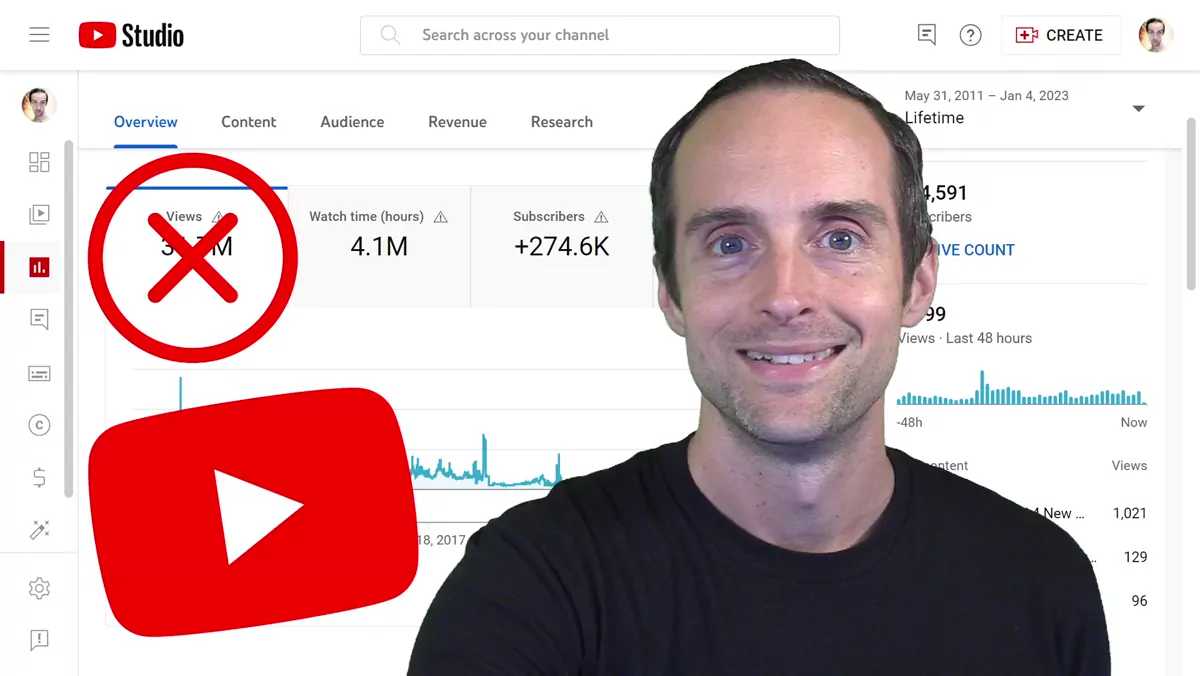
This cost me at least 31 million views, and I made the same mistake repeatedly for six years. I tried to stop making it and then went right back to what I was doing before. I had people tell me a better way, but I didn't listen. If you're a YouTuber, you will want to hear every minute of this, especially if you've been struggling to grow your channel. I have found exactly what kills YouTube channels, and I've done it. I've also found exactly how easy it is to grow a channel. It's ridiculous how easy it is to just start a channel and grow it.
If you haven't seen my work before, I'm Jerry Banfield. I've been a YouTuber since 2011. I've made over $80,000 in ad revenue, and I've made millions in sales online since I started my YouTube channel. I've got over 31 million views on my main channel, but my recent views are terrible. What is the one mistake? Really, I have less than 2,000 organic views on my main YouTube channel, and I've uploaded over 4,000 videos to it since 2011.
Now let me show you. This is my brand new Jerry Banfield crypto channel. I literally just made this about a week ago. This brand new channel is getting almost the same amount of views as my 11-year-old, now 12-year-old YouTube channel with almost 4,000 videos on it. And this is the mistake: not segmenting. It's making videos out of your content across too many topics. Playlists don't work, and you get absolutely punished on YouTube for putting out significantly different kinds of content. This is nuts. A brand new channel, and it only has six videos on it. Six videos. And I was putting up the same kinds of videos on my main channel the whole time, so let me take you deep into the analytics and help you understand exactly what happens.
What the analytics actually show
On my brand new Jerry Banfield crypto channel, you can see all of these views are organic. Here's a recent video I did with a 13.9% click-through rate. The very basics of YouTube are your title and thumbnail. From your title and thumbnail comes your click-through rate, and then your estimated or average watch time. Now look at this: a 13.9% click-through rate, a five-minute average watch time, and most of these people have never seen a video from me before. At least half of them have never seen a video from me, and the other crypto videos have very similar statistics.
Now look at where people are finding me. This is cold traffic. People who have never found me before are finding me on a brand new channel through YouTube search and YouTube recommendations. Only about 10 to 20% of the traffic is traffic I've driven myself by sharing on Facebook, Twitter, and my other YouTube channel.
If I could go back in time six years ago when my YouTube started blowing up, I would have been able to make a Jerry Banfield crypto channel, the same kind of niche channels I have today. Look at my current main channel. Here's a video I made that's almost identical to that Gala Games review video. This one actually did way better than average on my main channel, yet look at the click-through rate and average watch time. If you have an audience that doesn't love the kind of video you're making, YouTube looks at that and asks: why would we show a Jerry Banfield crypto video to anybody else if your existing audience won't click it and won't watch it? YouTube figures, well, this must not be a good video, so there's no reason we should show it to other people.
So my variety audience on my main channel was destroying every kind of video I put out. Because I did gaming videos and crypto videos and business videos and recovery videos, my variety audience was killing every single video I put out, and it frustrated me for years. Here's another similar video that did better than average on my main channel, and yet look at the click-through rate and the watch rate. I'm the same person, literally the same person making the same kind of videos. The only difference is who YouTube is showing them to. This crypto video on my crypto channel, YouTube is showing to the right people, whereas these videos on my main channel, YouTube is showing to the wrong people.
The algorithm is not as smart as I thought
The algorithm is unfortunately really stupid. I thought the algorithm was much smarter than it was. The YouTube algorithm is pretty dumb. It does not have a very good idea, especially on a variety channel, whether you've watched from a creator before, and it's not good at predicting whether you'll like anything except the exact same kind of content you already watch. So on YouTube, you have to have a focused channel.
Now there's a balance. I don't want to make 50 different YouTube channels for every single topic I might want to talk about, because that gets to be too difficult to manage. But for me, I've created five. I have five YouTube channels now: four niche channels, and then my main channel, which is basically a throwaway channel at this point. In my experience, if you want a channel to grow, this focus is what does it, and if you'd like help applying this to your own channel, the best way to work with me on it today is to schedule a private call with me.
Comparing my gaming channel to my main channel
I just made a gaming channel too, so let me give you a comparison. Here's a video I made that is dead. It doesn't matter that the video is great, and sure, the thumbnail isn't that great either, but this video might have had a chance on a strictly gaming channel to go out to people who actually like that game. Because a bunch of people who don't like gaming saw it on my main channel, it's dead.
Now look at this video I thought was kind of crappy. I almost didn't even upload it, because it's me playing Superman 64, which is actually pretty terrible. It has a 7% click-through rate on my gaming channel because these are people who just want gaming videos. This video now has a chance to get more views indefinitely, because with a 7% click-through rate and an average watch time of about five minutes, anyone searching for or watching something about Superman 64 might end up seeing it. The exact same video on my main channel would have been dead, and nobody else would have ended up watching it.
I have two videos that are almost exactly the same. I played Call of Duty Warzone on my main channel, and it got a 2% click-through rate. The average watch time was 13 minutes if somebody clicked, but YouTube's not going to push a video around with a 2 to 3% click-through rate. Now look at the almost identical video on my gaming channel: a 7% click-through rate, with the average watch time about the same. The point is that it matters where you publish your videos on YouTube. You could be an awesome YouTuber, but if you've junked up a variety channel over the years by putting up all kinds of different content, your potential could be getting totally stifled by the algorithm.
The featured-channels trick
If you have a variety channel, the easiest thing to do is don't put up a featured video on your channel. What I have on all my channels now, at the very top, is this: I go into customization in YouTube Studio and I put a featured channels block on each of my YouTube channels. That way, every one of my channels shows the others. So when somebody finds one of my channels on YouTube, they can then see the other four. If you're on my business channel and somebody is just crazy about me and loves every video, if they find a business video and they like crypto, I might get them over to that channel too.
This is the mistake I made for so long, and I'm embarrassed to even admit it today, but I want everybody who does YouTube to know: do not run a variety channel, and feel free to start a new one. Here's an example from my friend Joe Paris. Years ago he had this Joe Paris Academy channel that he'd grown the same way I'd grown mine, with all these different video tutorials. We both sold a lot of courses, and we had a formula that worked to use YouTube to sell. But it created a junked-up, garbaged-up channel with viewers who wouldn't click on your new videos, because all they were looking for were tutorials. So Joe Paris made a new channel, and his new channel has taken off. If I had done the same thing, oh my god, the amount of views and money I would have made is ridiculous. I literally could have made the exact same videos I put on my main channel, and YouTube would have done a better job showing them to the right people.
How to promote a brand new channel
So if you're on one channel now and want to get your content out there, and you're going to start a new channel, you need to promote your existing videos on the new channel. You need to get maybe a hundred or so views initially on a video, because then you'll have a chance to kick out to the algorithm. It's unreasonable to create a brand new channel and expect YouTube to just show it around with zero views.
So here's what I'm doing to promote my new channels. On my main channel, I put out posts in my community tab, and these drive a few views to my video. Not a lot, but it catches some of those people who love my crypto videos on my main channel. They wander over to my new channel, and I can come in and just say, "I love you." That's all I need to say. Then I publish on Facebook. I have the same situation on my Facebook page, so I put the video out there to get people over. Then I put it out on my Twitter as well to get it over there too.
Then I get that initial little amount of views on the video, so that you get the action I showed you earlier. It gets enough momentum to get the video rolling, so that YouTube will show it in search and browse features and bring even more people in. And when every video I put out is very similar, YouTube can accurately predict who will want to watch, so it just puts the videos out more and more. So in one week of starting a new channel and putting out the exact same kind of content that was going nowhere on my main channel, look at this. I haven't seen numbers like this on my YouTube channel in a long time. I actually started a crypto channel and a gaming channel before, but the one thing that got me every time was instant gratification.
Why thinking long term beats chasing short-term views
For a long time I kept thinking short term, because in the short term you often will get more views on one main channel than if you make a bunch of niche channels. But you have to think long term. You also want to be able to see which of your content people really love and enjoy the most. When you have all kinds of different content spread across dedicated channels, you can see clearly where you should put your energy. From where I sit now, I can see that I want to keep cranking crypto videos out. My gaming, recovery, and business channels might be more of a once-a-week thing. But the crypto channel is hot, so I hit that one once a day, and then I can crank the rest out appropriate to how they are each growing.
On my main channel, it was completely different. I wouldn't even want to publish a gaming video, because I knew people weren't going to watch it. And then if I did publish it anyway, I got punished for it. So separating everything out has given me a much clearer read on what is actually working.
Using ads to bring your old fans back
If you have a big channel, there is one thing you can do to get a lot more views over to your other channels. What I have done to help get more views on my new channels is set up a remarketing ad in Google Ads. The ad is just an in-feed ad, and it is targeted to people who have watched my main YouTube channel in the last year and a half. It tells them that I created four new YouTube channels. If you already have an existing variety channel, this is a cost-effective way to do it. I am getting six- and seven-cent views each in the USA and Canada.
Here is why this matters so much: people scroll past five or ten of your videos in a row and don't even see them anymore, lots of times. So many of my top fans had gotten to the point where they forgot about me. Now I am bringing them back and re-engaging them on the new channels, which is a perfect formula for growth. This is actually my first video on my Jerry Banfield business channel.
How much should you segment your channels?
I want to address the last big question: shouldn't you make a Jerry Banfield YouTube Tutorials channel, a Jerry Banfield Facebook Tutorials channel, a Jerry Banfield Entrepreneurship channel, and so on? How much should you segment your videos? In my experience, you don't want to segment too much, because each new channel is a different segment and each new channel is somewhat of a commitment. Every channel you start, you have to go set it all up again and get it monetized. So you don't want to split yourself up so much that you are only able to upload maybe one video a month on each of your channels.
I would say I want to be able to put out at least a video a week on each of my channels. It is better to put out a video a week on one channel consistently than a video a month on five or ten different channels. So for me, having five channels is manageable. With the business channel, I don't want to be too specific on it, because I want to be able to keep creating on that subject indefinitely. What you don't want to do is start a YouTube channel that you then stop posting on.
That is why I set mine up on topics that I have consistently tested. I know I can post on crypto, gaming, recovery, and business indefinitely, and that gives me flexibility. Crypto is a huge subject, so I want to be able to create a new video every day and never run out. Gaming and recovery are pretty specific, but there are lots of ways I can go with them. In business, if I were to split up into five more channels all with niche business subjects, some of those I would be at risk of not posting on anymore. For example, if I made a Jerry Banfield TikTok Tutorials channel, what happens if I stop using TikTok? I might not have any new content for it. You want to have an engaged, active audience and post at least once a week.
Test on a variety channel, then split it off
If you have started out on a variety channel, that is a gift, because you can test different content and then just split off part of that content into its own home. If I could go back six years ago and split my channels up like this, oh man, it would have changed everything. But thankfully, today I have this experience to share with you, and I have gathered more lessons like these in my YouTube Coaching playlist. If you want to go deeper on any of this with me, I would love for you to schedule a one-on-one call with me, where we work through this kind of thing together.
I appreciate you being one of the few to read all the way to the end. I prioritize my creations now, and this structure gives me a clear path. I've got crypto dialed in, so if the business channel turns out to be the hottest one, I can put a video on it every day too. Thank you very much. I love you, you're awesome, and I'll see you on the next Jerry Banfield business video.