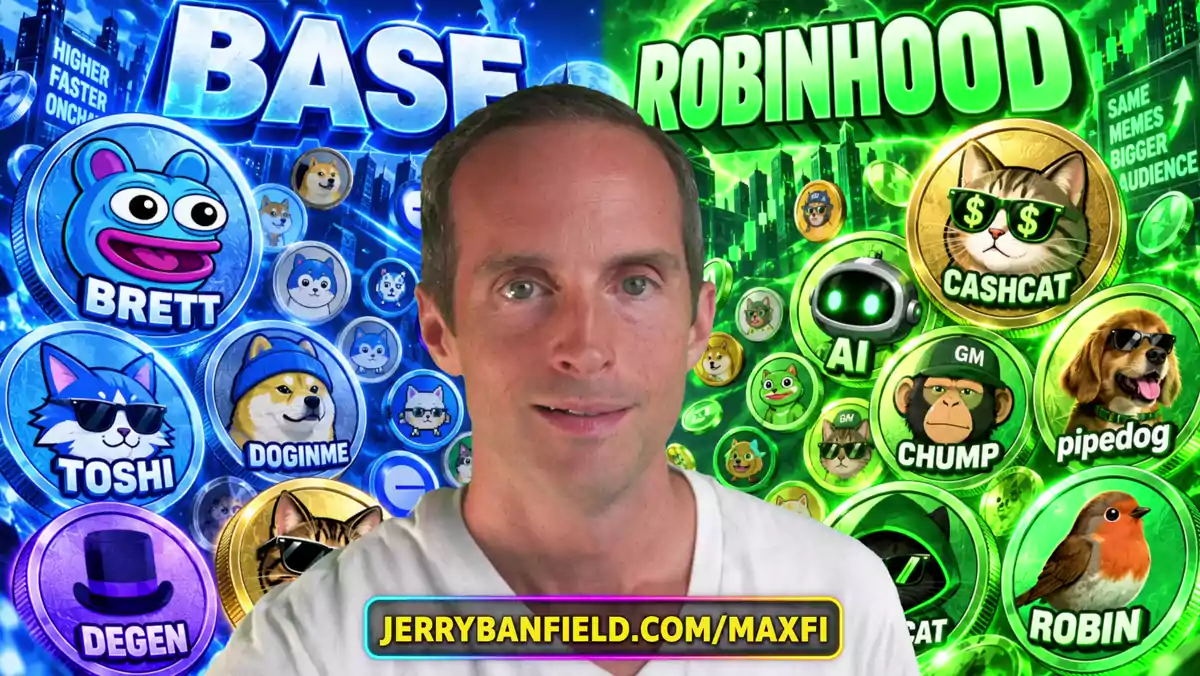
I've recently gotten into meme coins on Robinhood, and I'm making nice money, hundreds of dollars a day, providing liquidity. Meme coins on Robinhood are brand new, because the chain has only been out two months. Today I thought, what I ought to do is look back at the history of Base meme coins, because Base and Robinhood's chain have a lot in common. Both are Ethereum Layer 2s, and both are pushed by big, centralized institutions. Base, meanwhile, has a few years of history. So I imagine that what's going to happen with meme coins on Robinhood going forward will have a lot in common with what happened with meme coins on Base, although there are obviously going to be some key differences.
If you want to make money providing liquidity for these meme coins, I've just been printing hundreds of dollars a day, and you can join me on MaxFi. It's not financial advice. Providing liquidity for meme coins can be risky if you pick the wrong ones, or they go to zero, or they go down 99 percent. That's why I'm researching this: I want to make the most money I can off these meme coins, but I also want to avoid getting wrecked and wasting my time.
The biggest lesson: the survivors still fall 90 to 99 percent
The biggest lesson that Robinhood Chain meme coin holders, creators, and liquidity providers can learn from Base meme coins is that the meme coins that survive can remain the biggest coins on a chain while still falling 90 to 99 percent from their peaks. The hottest meme coins in the first few weeks are not necessarily the eventual winners, which means it's very risky being in any of the Robinhood meme coins that have significant market caps right now, because they can easily go to zero. Although they are doing some really creative things by pairing stock tokens with the meme coins, so there are some differences here. Let's look at Base meme coin history to get an idea of what has happened there over the last couple of years.
In 2023 on Base, you had BALD, the original Base meme coin mania, before Brett, before DEGEN, before Toshi became huge. BALD was a meme coin everyone was talking about. It went up thousands of percent and became the center of Base speculation. Then the deployer removed liquidity and it collapsed 92 percent. Just because you were first does not mean you're going to be a long-term winner.
Meanwhile, look at the coins that survived long term. Brett survived, roughly 276 times up from all-time low to all-time high, with a market cap over $2 billion. I expressed serious concerns about it when it was near all-time highs, and now it's roughly 98 percent below the all-time high. Brett became the defining meme coin on Base, but it can be the winner of the ecosystem and still destroy a bunch of people who bought near the top. Toshi, I remember when this was hitting. Joe Parys was talking about it before it really hit, and he was holding it before that. It started small and eventually approached a billion-dollar valuation, and now it's down to $50 million, 95 percent below the all-time high. Everybody who bought, even in the hundreds of millions, has gotten wrecked by now. DEGEN did 2,800x from all-time low to all-time high and exploded with the Farcaster and Base growth, but it's now 98 percent below its all-time high. It survived because it developed a real community beyond being just another dog or cat meme.
The later Base winners and the graveyard
Then you've got other Base winners that came along later, like DOGINME. The branding on these is big. I'm providing liquidity in Down to Finance, or DTF, right now, and a lot of the coins I like to pick are just good branding that people will buy. Some coins with weaker branding still did well. DOGINME is funny, and you can see how it did a big run from all-time low to all-time high, but it's still down 94 percent. Keycat is down 95 percent. All of these are not down as much as ICP, sadly, despite ICP having the best technology in crypto, whether the price chart is manipulated or whatever. It's hard to buy stuff when it's down so much from all-time highs. Meme coins often don't age well. Ski Mask Dog did 890x and is down 99 percent. Lots of people made money, but there were all kinds of people trading these who lost money and wasted time.
Base has a huge meme coin graveyard: MFER, Basenji, Normie, all down huge percentages. Normie is especially interesting because it has 90,000 holders and previously exceeded a $40 million market cap, but a smart contract exploit devastated it. That's why I'm only providing liquidity for the coins the MaxFi team goes through and verifies. They have high standards for the smart contracts before they put a meme coin into liquidity, so I don't mess with any coins in liquidity outside of MaxFi. That makes it easier, because they've done that due diligence on my behalf. I generally only put $100 or $200 into a pool, so that's the maximum I can lose on any one meme coin, unless I really like a particular one, like DTF. I've got about $500 in DTF, because the branding, the positioning, and the market cap all look good, and it just went up about 50 percent.
The leaderboard keeps changing
Here's the crazy part, though. Base's leaderboard is still changing. It's years old, and you've got new meme coins suddenly challenging the old ones. It's really difficult for meme coins to last the test of time, because you have BaseCat and StonkX making big moves, competing, and stealing market share from the existing top coins. For Robinhood Chain right now, it's CashCat, Artificial Inu, Chump, PipeDog, Robin, and RobinCat. I have liquidity in CashCat, a couple hundred there, a couple hundred in Artificial Inu, and I just put $100 in Chump. Robin and RobinCat are not on MaxFi yet, so I'm not providing liquidity in those. These are some of the top ones now, but they might all be gone within a few months, and we may not even have seen the Robinhood equivalent of Brett yet.
Robinhood Chain launched in July. What's crazy is these meme coins are so big that they're 79 percent of the DEX volume, bigger than all the stocks and everything else being traded. The Robinhood Chain meme coins have a $900 million market cap. They're doing creative things with the stocks to deserve a somewhat higher market cap, but on Base the meme coins are only around $300 million right now. So Robinhood Chain has a dangerous amount of money in meme coins. Even though I've had days earning hundreds providing liquidity in these meme coins, I've lost several hundred dollars in some of the ones that dumped 50 percent. If you jump into providing liquidity or buying a meme coin at the wrong time, it is very easy to lose half or more in a day or two. But you could also make more than that.
Robinhood memes are not necessarily cheap
That said, Robinhood memes are not necessarily cheap. Just because Brett hit $2 billion and CashCat is at $200 million doesn't mean CashCat is going to hit $2 billion. I both hope it does, for my own profits, and hope it doesn't, because I imagine anyone buying it at this point and pushing it higher is just throwing their money away. Robinhood already has some Base-like winners. CashCat has already done 196x, which means the best profits are most likely behind you. Artificial Inu has already done 300x, so the best profits are probably behind that as well. Although liquidity providing allows you to capture profits while taking less risk, getting consistent fees regardless of what the price does.
These are the lessons I'm applying to Robinhood Chain. First, just because you're first does not mean you're a winner. Just because CashCat is super early in the game with hundreds of millions in market cap does not mean it's going to dominate the meme game long term, and survival matters more than that. You don't have to be trading in and out of coins all the time. I just want to park my liquidity positions and print money. I don't want to go in every day wondering which meme coin just rugged and change my positions. Ideally, I prefer diversified positions, with less in any single one, but more if I think something's going to do better over time. If you can pick the right meme coin that survives, has volume up and down, and has the liquidity behind it, that's lucrative and there's a lot of money to make. These are printing thousands of percent APR. So I'd rather see meme coins that are older. Some of the best profits are in the tiny ones, but the tiny ones get rugged the easiest, and it takes a lot of effort. I'm going to research more, because I'd much rather catch some of these 100x and 300x runs. I've had 300x gains in crypto before, and I'm interested to see what I can do playing with these meme coins to make some 300x gains myself. I'm interested in finding those multipliers before they crash, and you've got to survive the volatile ups and downs.
Winning branding is not a good price
Winning branding is not necessarily a good price, either. Brett is a clear winner at this point on Base, but it's still down 98 percent, which means the vast majority of people who bought Brett more than likely lost money or are sitting in losses. So yes, some of these Robinhood memes could go much higher, and the content creators out there will certainly tell you that. They can also go down very easily. Something as big as CashCat could easily go down 90 percent from where it's at now, but it could also go up 10x from here. The strongest memes develop an identity. Brett became connected with Base. Toshi became connected with the Base and Coinbase culture, because off the top of my head, Toshi is Brian Armstrong's cat, and he's the CEO of Coinbase. DEGEN is obviously good branding. I look for memes that become naturally associated with the chain, like DTF, Down to Finance, which is such obvious branding. But a good name is not necessarily enough.
The easiest thing to do is start with liquidity pools, find memes that look sustainable over time, and then sit in those and collect fees. The liquidity can dry up and the meme coin can drop a whole bunch, so there's risk, but liquidity pools are more predictable and less work. Finding the tiny coins and getting those multipliers is more work and less predictable, with bigger results and more fun.
Security comes before the meme
One of the big themes is that security comes before the meme, and that's why I use MaxFi. I invite you to use my link to sign up on MaxFi. I get 3 percent of MaxFi's trading fees, which they give me out of their earnings as a thank-you for bringing people over there. This is the best system I've seen in DeFi to provide liquidity and make awesome APRs. I had the team on for an hour-long interview on my channel recently, so I've talked to them myself, I've used it myself, and it's outstanding. There are a ton of opportunities on there, and you're invited to get in on that if you want to. It does take some time, there is a learning curve to set it up, and you can lose money. To me, the big way you lose money is with coins like BALD, through liquidity risk, or through a contract exploit like Normie. That's why the MaxFi team looks at these factors before they put a coin in their pools: they don't want their holders getting rugged by a liquidity risk or a contract exploit.
As I said before, liquidity pools where you provide the tokens versus buying the tokens are two vastly different strategies. I like to use tighter ranges, generate insane trading volume, and rebalance constantly. I prefer not to pull positions if I can, unless it looks like the whole thing is finished. The danger is that I've got positions that have lost 20 or 30 percent by rebalancing downward. You rebalance downward, it goes down again, and you rebalance downward again. But MaxFi makes all of that super easy.
How I look at the major Robinhood memes right now
Here's how I currently look at the major Robinhood memes. CashCat is the current benchmark, the closest thing to Brett, with a big valuation, but that doesn't mean it's cheap right now. It has proven survival. Artificial Inu, which I'm also providing liquidity in, gives me some stable returns. PipeDog is more interesting, but it's not on MaxFi yet. Chump, I believe I just put into today. They run together after a while when you look at so many of these, so I checked my positions to confirm exactly what I've got, and I consistently show those in most of my videos. Yes, based on my positions, I just put $100 into Chump today. It's out of range because I like to start with a wrapped ETH position, so I'm not paying any swap fees to get in. Generally, when the coin pumps, I get in right there. If it dumps, I rebalance lower and chase it down, and when it pumps, I come into range. This one pumped, went into range, and printed some money really quickly. Now it's back down out of range, so I'll swing it over to a lower price and get back into it. Robin and RobinCat, I'm interested to see if the MaxFi team adds them, because they're definitely looking promising.
If you're going to buy, it looks like you really have to hit the new memes when they're active. The new launches, if they're trustworthy, you can liquidity farm, and the survivors are nice for liquidity farming as well. Ideally, I want some history. I want it to be one of the top coins, I want it to survive, and I want strong holder counts and all the stuff you would usually expect. These are the key takeaways I've learned from researching meme coins on Base versus Robinhood. Don't just chase what's hot. You need a strategy that's going to print money no matter what, one that also considers how much time you're putting into it. I'm keeping an eye out for when Robinhood's chain definitively gets its own version of Brett. I don't know if it exists yet. If I think it does, I'll certainly call it out and do a dedicated video in my Crypto Reviews playlist.
If you enjoyed this, I am a full-time YouTuber and content creator, and I invite you to join me at jerrybanfield.com. If you want in on the action I'm showing, use my MaxFi referral link and make your deposit directly on the same device.
Thanks for watching. I hope to see you again soon.