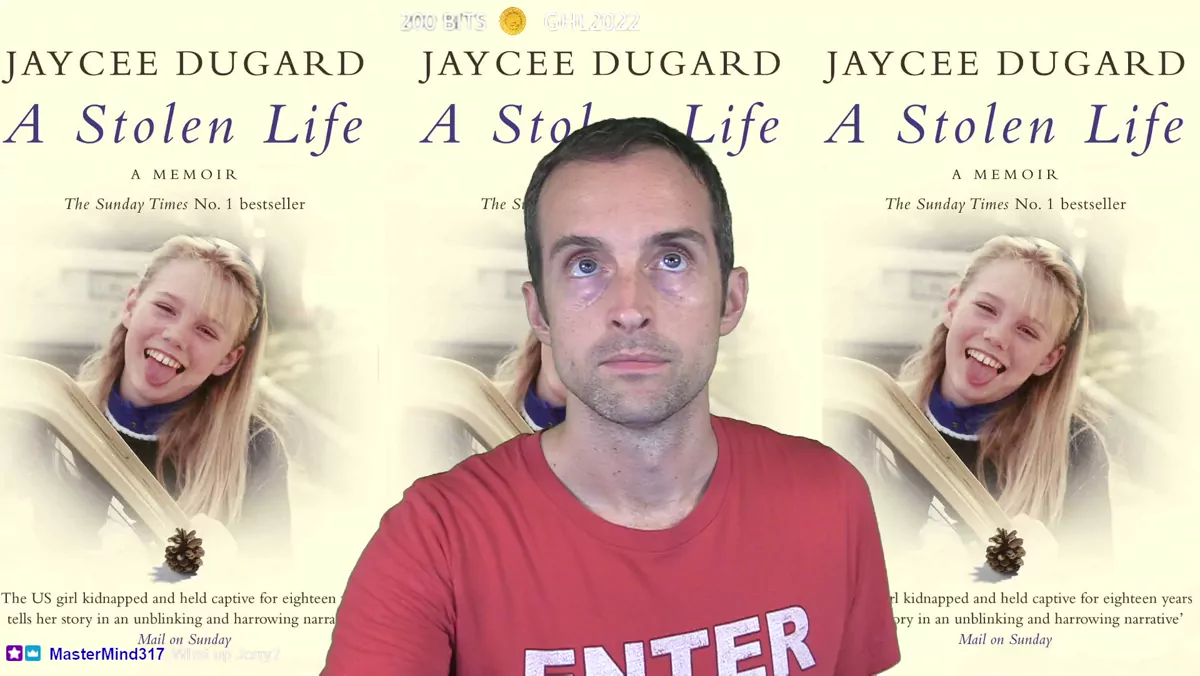
My friends, I just finished reading Jaycee Dugard's A Stolen Life, and it was a tough read. I've spent most of the last day listening to her book on Audible, published around 2010 or so. I haven't listened to her newer one yet. But what I want to do here is have a discussion about this book. To paraphrase the value of reading books, leaders are readers. I'm constantly reading books because reading books is greatly expanding my mind. This book was very painful. I haven't given birth, so I'm not going to relate it to that, but it was kind of like growing pains, like expanding my mind.
Her basic story is that she was kidnapped on her way to school at 11 years old and held as a captive for 18 years. As a father of a seven-year-old girl and a four-year-old boy, and a person who's very filled with love and compassion, this was a brutal book to read. I cried all over the place. I had a nice messy cry. I cried before doing this fairly recently. I've clearly cried a lot in the last 24 hours.
I was more attentive while I took this in. I was mowing the lawn between listening to it, and if I'm taking in something like this, a lot of my mind and my body is saying, this is not good, it hurts, I don't want it, ouch. So I'm more attentive to slow down. When you're consuming something like this, you have to be careful, because it's easier to be clumsy or to hurt yourself. So I was extra careful mowing the lawn yesterday.
Why read a book this painful
You might wonder, well, why would you do this to yourself? Why would you read this book? I want to grow and expand my mind, especially when it comes to having an open heart and love and compassion for my fellow human beings on this planet. What I've found is that hearing a very difficult story like this, I put out a lot of love for the people on this planet and wherever else people are. Maybe other planets. I prayed really hard and thought, can we please be nice to each other? Can we please treat each other with some love and with some understanding?
Because it's horrible to listen to how selfish and self-centered human beings are capable of being, of thinking only of satisfying your own needs in whatever we're talking about, whether it's being right in an argument all the way to taking someone else, like in this book, just to use occasionally. It's horrible. And I've known a lot of selfishness in my own life by being an alcoholic. You don't get to be an alcoholic, or in any kind of addiction, without being very selfish. It's all about you and how you feel and your pain and you're alone.
The voices the kidnapper described
Now, one thing she said in this book I don't know how many other people picked up on. The guy who took her said that he was hearing voices of angels that came from men in the inner earth. If you've seen anything I've made before, I'm big into what you would call conspiracy theories. These stories we've been given by our governments about how various things have happened. Think like the JFK assassination. Oh, it was a lone crazy gunman. No, it wasn't. That's a lie. It's a blatant, in-your-face lie. It was not. I'm not going to mention anything more recent specifically, but it seems to me that at the highest levels there's a lot of lying and cheating and corruption.
From my research, it seems that things like extraterrestrials have been kept secret. Not only kept secret, but even worse than secret, made a subject of ridicule. And I think the guy is telling the truth. Which brings the question, what if he's a victim too? This is something most of us wouldn't stop to consider, and this is why I read books like this, because it expanded my mind. What if this guy is a victim of some reptilian and mind control, as other people that are obviously completely unrelated to this story have described?
I just put out a list of the best secret space program videos to listen to. There's a bunch of people who've testified that there are these reptilian aliens that are very advanced, and that they are dominant on this planet. They are trying to subjugate humans, and they feed off us and look at humans as just dogs, less than you would look at a dog, like cows, something you could just pay someone to raise and kill for you. We are nothing to them, and they have control over this planet. Or they're fighting for control with some other more positive, human, and benevolent extraterrestrials, who, for some reason, I think could step their game up a little bit. It seems the reptilians have been doing very good on this planet for a long time, and they've controlled royal bloodlines.
So it's interesting, with all the conspiracy world, the secret space program, and stuff that I've watched and taken in so much of. The guy who is the perpetrator of this book, not the author but the man who took the author when she was 11, said that he was hearing voices from men, from angels, that were men who lived inside the earth. That's a very specific description, and it matches very closely with what all these other sources have been saying. It begs the question: what is really going on on this planet?
It's kind of easy to just look at the guy who essentially made this book happen. This book would not have happened without him, just like Harry Potter wouldn't have happened without Lord Voldemort. This guy, I think his name is Phillip, I'm not sure how to say his last name, says he was being mind controlled, or talked to, or hearing these voices from these angels. What if that's true? That's what the secret space program people are also saying, that there are these reptilians who are controlling, and they want people to hurt each other. They want people to be divided so we can't work together to take them on. Because if we work together and we love each other, we can easily expel them from this planet.
Trying to understand instead of putting up walls
To be clear, I'm not justifying the kidnapping. Obviously not. I have a seven-year-old girl and a four-year-old boy. To me, it's just confusing as to how people can be so horrible. And yet what I find a lot of us are scared of or unwilling to do is to try to understand better. We put up these walls and say, well, that's just a horrible monster, and we put the walls up. But because I have a four-year-old son, what I think of is that the guy who did this was a four-year-old boy at some point too. What happened to him in his life to put him in this situation?
What to me was the most shocking thing in this book is that this guy, Phillip, had a wife who actually fully participated. She was there. She helped take the girl. That breaks down a lot of our ideas. We have this kind of cultural subconscious programming, like men are perpetrators and women are victims. It's kind of unthinkable. I found myself swearing out loud at her. I'm like, you've got to be freaking kidding me. It breaks down all the definitions of what you'd think of women as protectors. You would think a woman would look out for a little girl instinctively, but she actually helped in every step of the way. It's like, oh my god, this is horrible at a level that's hard to comprehend.
That's exactly what I was thinking. What happened to her? What happened to her that this was acceptable to her? Because what's crazy is the wife participated every single step of the way, right up to the very end, and for 18 years. This book expanded my mind, and I'm grateful that I have the courage to try to understand everybody.
The ordinary cruelties, too
There were neighbors that lived next door to these people. There was a parole officer who came to the house. This guy was already on parole for doing things like this multiple times, and there were parole officers who came to the house who couldn't be bothered to look around thoroughly enough to see that this was going on. I understand they were probably busy. I was a corrections officer, and I considered being a parole officer. If you're a parole officer in a lot of places, you have a lot of people to check on. You have a busy work day, and you often think of them all as scumbags.
A lot of times it's easy to think of graphic awful things, but a lot of the ordinary cruelties we do to each other are just because of being in a hurry. Too busy to stop and listen to somebody who's having a hard time. Too much of a hurry to drive safely, scaring people in the car. Potentially, lots of people are hurt and killed in car accidents because of people who are in a hurry.
This was hard to read. Once I started it, I said, I've just got to get this over with. I listened to this just as much as I could. The book was about seven hours. I listen to most books on 1.3 speed, so 30 percent faster, because I've listened to a lot of books. Listening helps me do other things. I washed the dishes, folded the laundry, was doing lawn maintenance, and driving. I did a ton of things while I read this book. This was a tough one. My heart feels tired after listening to it.
And yet this story is very inspiring also. It's very inspiring to hear how resilient people are, of what horrible things people can go through and still come out of it with love. To me, it promotes an absolute need for transparency. We need to be able to be honest about exactly what we're doing and what's going on in our lives. One of the most protective things I've found for myself is that I will not harbor thoughts that I am not willing to tell everybody about. Things like this only can happen because people are private and secret. I've personally gotten into arguments with people that it's privacy and secrecy that are destroying the human world.
Secrets are what let the worst things happen
It is people keeping things compartmentalized. Secret, unacknowledged government, military, and industrial programs that nobody even knows about, and the people who do know about them can't tell anybody. It is people keeping secrets that allow all the most horrible things to happen. In my experience, you have no need for privacy if you are doing things you would be comfortable with everybody knowing about. My mind is very clean today, because I have a commitment through Alcoholics Anonymous, through working the steps, through getting out there all the worst parts of my life.
My own sexual trauma: you listen to something like this and my experience was nothing. It was a moment of rain on a stretch of nice days. I was at just enough sexual trauma in my own childhood, the tiniest little bit, and thankfully my parents were there. I immediately told my parents and they immediately were able to intervene. It has helped me have much more compassion and understanding for other people, and gratitude that I can speak about my own life openly, and a desire to help others.
When you read a book like this, it is really sad. Everything in it is sad. The husband in this book is just sad. At some point, this guy was a beautiful baby whose mother loved him. And his mother did love him, and his mother was staying with him. So what happened? I am grateful now, but I am also asking, what happened in his life? He almost certainly was a victim first himself. I wish you could hear his story too, because it is nice to have the whole picture on things. In our society, we have a lot of stories from victims, but we don't have very many stories from perpetrators.
I would rather be a victim than a perpetrator
Reading a book like this leaves me thinking I would much rather be a victim than a perpetrator. A victim gets lots of help and love and understanding and compassion. She acknowledged that there were tons of people there to support her, who gave her money and gave her a place to live when she got out of it. Being a victim is a much better deal overall, because victims can be loved and healed. When you end up perpetrating something, that is rough.
I have compassion and love for every human being. To me, if we want a better world, we need to have compassion for all human beings and see that every one of them has a story. I have a boy and a girl at home, and my son is statistically likely to have a much rougher life than my daughter. My son is much more likely to be a victim and to perpetrate violence on somebody else. My son is much more likely to end his life early, or to end someone else's. My son is more likely to be a victim of addiction. My son is more likely to go off and fight a war somewhere. It is funny how, as dads, you are often programmed to protect your daughter, but my son is the one, statistically, who is in much more danger. My son is in danger of going to the very worst places you can go.
I loved that she talked about the things he said, the husband and the wife who were holding her. What a sad, miserable, loveless existence. My God. I just want to love everybody. I want everybody to feel loved, because people who feel loved don't do horrible things to other people. People who feel alone and miserable and scared are the people who do horrible things to other people. So in every moment of my life, I am always trying to love people as much as I can, because you never know what people are going through.
A book that puts your own life in perspective
A book like this really puts your own life in perspective. Several times I cried, because it is amazing when reading something this tragic to realize that life is normally so good. This is a good point she made in the book. She said what happened to her is extremely rare, and thank God it is, because how could we endure in a world where it wasn't? And yet, even though it is extremely rare, it gives us good perspective, because it gets to be easy to take your life for granted.
I was drawn to read this book because I have been getting really comfortable lately. My life is fantastic. My life is full of love. People love me and I love others. People take great care of me, almost everyone is nice to me, and almost everything works out good. I am very good at getting my needs met. So it is important for me to remember to put out love for those who are not in such a good situation, because I was very lonely and struggled a lot.
I used to be scared that I would hurt somebody, and I used to think that I should just kill myself before I hurt anybody else, in all kinds of different ways. Like drunk driving: I was scared I would kill somebody driving my car. I was scared I would get in a fight with somebody and hurt them. I used to think the best thing I could do was to end my own life.
This is a pretty extreme, rare example. Stranger abduction is very rare. Most children are hurt by themselves, by their parents, and by their immediate family members. That covers about 98% of what happens. It is good that I can read a book like this and not be paranoid about something happening to my kids, and at the same time remain vigilant. They have never had a babysitter besides my family, never. I had a babysitter, and that is how something happened to me when I was a kid, so I have been very strict on who can watch my children.
Reading, gratitude, and being loved enough
To me, reading is one thing that helps me constantly learn and expand my mind and be grateful for what I do have. Listening to a horror story like this, which is also inspiring, left me feeling so grateful to just have my family around. It kind of felt unreal. How is my life so nice? I have a wonderful wife, wonderful kids, wonderful in-laws, and all kinds of people in my community who love and support me. It was kind of unbelievable to me, because I have been to dark places myself. Like I said, I have thought the best thing I could do would be to take myself out before I hurt anybody else. I bet a lot of people who end their own life think the exact same way.
I know that the reason I didn't end up hurting myself or anybody else is because I was loved enough. My parents and my family and my friends and my community loved me enough, and that kept me safe from whatever influence it was, whether reptilians or just the dark sides of humanity or the devil or whatever you want to call it. I have come to believe love keeps us safe from perpetrating horrible things on other human beings. Where there is love, these kinds of things will not happen. The more love we can share, the more we can protect everybody, and then help those who have been to the worst places.
What criminology taught me about deviance
Someone raised the point that people who harm animals are more likely to harm humans. I was a police officer before, and I have a bachelor's and a master's in criminology. Out of all the stuff I talk about, criminology is my actual area of education, so yes, I am very familiar. In my own study as a graduate student, I found that people who are deviant online are more likely to be deviant offline too. People who are willing to download music and movies illegally are willing to break small laws, and people willing to break big laws online are also willing to break small laws in person. It is difficult to get data on people willing to break big laws, like stealing money or committing felonies online, and whether they are more likely to commit felonies offline as well, but I would imagine so.
This book was so challenging to read. I kept thinking, this is too much to even talk about. But I have set an intention to live my life based on intuition, and intuition often guides me through feelings and passion, and this book came to me that way. I was not looking for it. I was actually listening to a secret space program podcast, and for some reason they named it the exact same thing that she named her book. They call the podcast A Stolen Life, and it was by someone named Penny, talking about how she was abducted as a kid and put into the secret space program. I found this book by accident on Audible. My first thought was, no, no, no, this is not it. But what I find is that the areas my heart or intuition is guiding me toward often come up repeatedly, and they come up with some feeling too. My first thought seeing this was, hell no, I have kids. I try not to picture bad things happening to my kids. I try to keep these ideas out of my head, which I know some parents are plagued with all the time.
The thing to keep in mind is that most people, most of the time, are what you would think of as good, nice, caring, loving, trustworthy, and considerate. The awful things humans do to each other are not that common. It was important to me to remember some of these statistics while reading this book, because you read something like this and it can be easy to start thinking that everybody is doing this. But as she said in the book, this is very rare. Something like 1% or less of child abductions are by strangers. It is almost all people the child knows.
What I have found in my life is the opposite of stranger danger. Going to AA meetings, a bunch of strangers saved my life. I work with all kinds of strangers and people I barely know at AA meetings to help them get their life back. Some of the people at Alcoholics Anonymous, I imagine, are like the guy and his wife who took her, who were also drug addicts. From my experience as an alcoholic, you definitely want to stay away from alcohol and drugs. The guy in the book, as she described, said he was being influenced by angels, men from the inside of the earth, maybe reptilians, maybe the devil, or maybe just him making up a story to try to explain his behavior. You can't be certain with these kinds of things.
Alcohol, drugs, and the slow slide into dark places
What you can be certain of is that using alcohol and using drugs will put you in a position where something bad is more likely to work on you, or to influence you. Whether it is making a dumb decision to ride in the car with somebody, drunk driving, or saying something nasty to somebody you love, whatever it is. This book gave me a lot of clarity on why you want to stay away from alcohol and drugs. What I found is that using alcohol, for me personally, took me to places mentally that I had not been to before. Dark places of wanting to end my own life. And you do not get there rapidly. It is one drink at a time.
The man in this book and his wife were drug addicts, and that is part of what took her. You want to keep away from people who are alcoholics and drug addicts too. If somebody relapses in AA, I keep my distance. Unless somebody has been sober quite a while and I know them really well, I generally do not have them over to my house or introduce them to my family. And it seems, in my experience, that the people in Alcoholics Anonymous who have the best chances of recovering are people like me who did not have it that bad.
I have shared all of my deepest, darkest, worst secrets. I put them all out online. I made the mistake of putting them in a blog post, and the police came over describing my exact thoughts that I used to have in high school. I have learned since then that we need to use some discretion, because some people are unwell. She talks about Phillip, the man who held her captive, and he was very paranoid. To me, one sign of people being sick is paranoia, and it is often one of the most obvious signs. In my opinion, people who are very paranoid usually have a reason to be paranoid. Of course the man who abducted her and his wife were paranoid, because they were doing things they did not want anybody to find out about. So I stay away from people who are paranoid too. Paranoid people are quick to see things, or to put a really crazy spin on things, because that is how they normally think.
Why some people cannot get sober
Listening to this book, I have gotten a better understanding of why some people struggle at Alcoholics Anonymous. I was able to easily do my fifth step and talk about my life with another alcoholic, to lay it all out in front of someone, because I was not afraid. I had lots of fear, but there are some things you can do that you just know if you tell anybody about them, you are going to prison. I have not done anything like that. I imagine there are people in Alcoholics Anonymous and in recovery who have done things they know they cannot tell anybody about, or they are going away. My advice is that you should come clean with it, deal with it, and go through the healing.
But what I see is a lot of people who just will not get sober. They will not open up about their life. I imagine they have some really dark secrets that they know they cannot tell anybody without serious consequences. And then they end their own life. So I would imagine that in a lot of situations, a lot of people who end their own life are actually protecting other people. This book got me into an unexpected side of that. I struggled a lot with self-harm thoughts in my own life. And what if some of the people who are harming themselves are actually protecting the rest of us? I would encourage the opposite. I am glad I opened up and talked to everybody. To me, talking and connecting with people is what we need. We do not need people out there hurting themselves. We need people who are open and honest, even when it is horribly difficult.
What I learned as a correction officer
I am so grateful that I have been able to be where I am today. I was a correction officer and a police officer, and I worked firsthand with people like the perpetrators in this book. I was a correction officer in the sexual violence unit. Everybody in there had raped and murdered. Everybody in there had done something like that, and I was in there with them. One of the things that was shocking to me was that I had imagined, when I went in there, there would be this huge difference between us. These are horrible, disgusting monsters, and I am this white knight, or black knight, however you want to look at it. I am this angel who is going to keep these monsters locked up and do some good for society.
The amazing, humbling thing I came out of there with is this: there was one huge difference between me and the people locked up in there. I was loved. I was treated with respect. My parents and other people collectively took great care of me. I had little traumas here and there. My dad spanked me and put me in my room and I got scared. Sure, I had my minor sufferings; nobody comes through this life without a drop of suffering. But overall, people loved me and took good care of me. And the people I was keeping locked up in there as a correction officer had been severely mistreated. I do not think any of them in there had just been raised in a nice, loving family, in a culture that helped them meet all their needs and see how to talk about things, and then gone and done horrible things to somebody else.
Collective responsibility
This can be hard for some of us, but there is such a thing as shared responsibility. It is nice to just put people in a box and say, well, this person is just a monster and they are responsible for all of it. But no. The people who did this to her were raised in a culture, and were raised by people, and somehow everybody else involved had some kind of impact and bears some kind of collective responsibility too. Just like we all can collectively help each other. I think this is what pains us when we see the worst things happen. We know at the deepest levels that we are all connected. We know that we are all a part of each other. And we know on some level that we bear a collective responsibility for everything any individual does to others.
To me, when we bear in mind our collective responsibility, that encourages openness, love, transparency, and communication with everybody. I never know who I might lift up and who I might help. Someone shared with me that they were going through a hard breakup, having to move out to find their own place five days before Christmas and no longer live with their son, and that it took all their strength not to turn to Valium and overdose, but that they had to stay strong for their son. I am proud of you. It is not just for your son. It is for everybody else you impact, and it is for yourself.
Listening to this book, which was filled with so much horror, I kept thinking: if this were a movie and you had to pick a role to play, the main perpetrator, Phillip, would be the worst, most miserable role to play. At least JC got to have a pretty nice childhood, then eighteen years of utter hell and misery, and then she gets to have her own life now. To me, the worst thing we can be is somebody who hurts ourselves, because by hurting ourselves we set ourselves up to hurt other people. The worst thing we can be is somebody who is not taking good care of themselves. So staying sober is not just for me, even though I benefit the most. Staying sober is not just for my family. I benefit the most from taking good care of myself.
Loneliness is the real pain
One thing I loved about reading this book, even though it hurt so much to read, is what it taught me about pain. I am very empathic, and things have a certain energy, and this book had a powerful energy, both big negative and big positive. I am proud of how strong I am now and how much I can handle. It is brutal, as a father who is sober and who has had my own relatable struggles with feeling lonely. What is interesting is that a lot of times we think about somebody being abducted and assume the physical pain and abuse would be the worst. But if I accurately heard what she said, it was the loneliness. The loneliness and the powerlessness were the worst part of the experience. The physical pain was nothing compared to the mental pain of feeling alone and invisible.
I read a book just before this one called Hunger, written by a woman who had a similar experience, and she identified the same thing: loneliness. I remember feeling very lonely myself as well. This is where collective responsibility comes into play. We have a culture that promotes and facilitates loneliness, and that is a collective thing we are doing. I read a book by a doctor called Mind Over Medicine, and she said the absolute worst thing for your health is isolation. I am sure that applies to physical and mental health both. Loneliness is one of the worst things for us physically and mentally. The worst pain she describes in this book is not the physical abuse, which was awful but relatively short in terms of time, but the mental anguish of being alone.
We live in a culture that facilitates loneliness, and this is why one of the best things we can do is help other people feel connected. The opposite of loneliness is connection. Often, to help other people feel connected, we need to be real, we need to be raw, and we really need to love from our heart. I feel so completely connected that even when I go places where I do not know anybody, I feel instant connections to people. This morning I felt so connected to the people I did yoga with, even though I did not speak to hardly any of them and did not make eye contact with most of them, and yet I felt very connected.
If you are reading this or listening to me, there is a high likelihood that you have experienced some severe loneliness at some point. One, because it is a very common experience. Two, because like tends to attract like. I get on every day hoping I can help somebody get some relief from being lonely, and one of the best ways I have found to do that is to bring people together, which is exactly why I love doing one-on-one calls where we can connect directly. You can get relief from being lonely when you really openly connect with other people. You also have to connect with people who want to connect with you, and that can be a bit difficult to find. The man in this book and his wife were just so sad and lonely. I pray that people who are sad and lonely can find some connection, because I feel very connected to everybody.
I lay in yoga today, and in the shavasana I had this feeling of all of us in the room being like blue balls of soul energy, forming this net together. And that's connection: knowing that your life is not really separate from all other lives. One of the interesting thoughts this book challenged me with is that there'd be no story without the bad. There'd be no Harry Potter without Lord Voldemort. There'd be no Star Wars without the Empire.
Feeling like a star being
Sometimes it's very confusing to me, because in addition to identifying as all the other stuff I do, I identify as a star being. I don't feel I'm from this planet. I feel I've incarnated here to assist this planet. In my experience I'm not natively human. I'm not from here, I'm not even in the reincarnational cycle here. I came here to help out from another planet. And the way people operate here is just weird to me. The horrible things people do to each other are just kind of confusing to me. It doesn't make sense. Why would you do that? It's more confusing than anything else. And that's part of my work here: to understand better. Because in order for me to help, I need to understand better.
Some people feel so different-minded from others, and feel they can't connect to the things we do or say. I felt lonely for a long time because it seemed like no one really liked me, and it made me feel down. I noticed there were points in my life where I felt like no one liked me, and I was very lonely and very down. But I also noticed something about those points: if I came back to them with what I know now, I would have a completely different experience.
I was very lonely in middle school and high school. If I went back there now, with what I am now, there'd be all kinds of people who liked me and were friendly. I would be very well connected. It was not the school or the environment I was in. It was my interpretation and my beliefs that gave that rise. There are people who went to the same school I did who had a great time and felt really connected, and they were almost indistinguishable from me in external characteristics. So how is it that I went into the same place other people thought was awesome, where they made lifelong friends, and I walked in there feeling lonely and feeling like people didn't like me?
And here's one thing: if you think you came here from somewhere else, a star being, you can kind of feel like you don't really belong here. Because to some degree you don't. It's like a hurricane. When a place gets hit really bad, people from all over, out of love and generosity, go to volunteer to help clean the place up and stand it back up. So I look at it this way: my soul came and volunteered here to help clean the place up. And part of doing that is feeling out of place, because you're not really from here. When you go clean up some other country that was hit by a disaster, you know you're not from there. The places and the people and the customs are foreign. You can find things you relate to, but you know you're not from there. That's not where you belong. That's not what you know.
Opening and closing the heart
I'm sure we all have the opportunity to connect if we will open our hearts. What I find I need constant attention to is: is my heart open right now, or is my heart closed? Because it's up to me whether I open my heart or not. And I felt with this book my heart opening and closing a bunch of times. As soon as I start listening to the book, my heart starts closing, and I open it back up. I tell myself, you are safe, this is a book, and I open my heart back up. Usually it takes crying to open a heart that's closed back up.
And what's amazing: she cried so many times in this book. It's amazing that her heart, after so much brutality, could stay open. I would say the mental isolation and loneliness and powerlessness were the worst part of the brutality, worse than the hours and the uncertainty. And she still is able to have an open heart and love. That's amazing to see, how resilient human beings, and really our souls, are. So it's up to each of us to open our hearts. And you can tell that the perpetrators, their hearts were very closed.
What's amazing is she talked about the kind of multiple personalities they'd have: very aggressive and perpetrating and hurting her, and then remorseful and sorry, and not going to do it again. It's like, wow. And that's what's hard too: to feel empathy. Because almost all of us have done something in our lives that we felt remorseful about afterward. Yes, most of us have done things that were nothing compared to the violence in this book, but all of us have said something to somebody. Have any of you not said something to somebody that you immediately regretted?
We have more in common than we have different
What can be tough in this book is seeing that we have more in common than we have different. All of us have said something, or done something, or been remorseful about something, and wondered, how did I do that? I've had fights with my wife where I'm like, how did I do that? In one of the last fights I had with my wife, I said a bunch of nasty stuff, and I felt so remorseful afterward. I'm like, how did I do this again? And I realized what I really felt bad about was not what she said. It was what I said. I said that she was selfish, and other nasty things.
If you saw us from the outside, it didn't look like much. We weren't swearing at each other. We were out at a restaurant. You might not have even noticed us fighting. In calm tones of voice, in regular conversational speech, I said things that were nasty to her. And it doesn't even matter what she said, because what she said didn't hurt me at all compared to what I said that I felt bad about. So I think almost all of us can relate to getting ourselves into a state where we do something we regret.
Thankfully, very few people are as nasty or as selfish and unloving and lonely and sick as Phillip and Nancy were in this book, and in real life. And the trick is: can we have some love and compassion for everybody? That, to me, is my task. As a gift I have to offer the world, as a capability, is to love and understand everybody.
Understanding is a superpower
Now, some people get scared of understanding. They think understanding means agreement. Like, if you can understand how somebody could be this horrible monster, if you're capable of understanding that, then you must agree with it. And that is absolutely not the case. In fact, understanding to me is a mental strength. Understanding is like a superpower, because through understanding come things like forgiveness. When you can understand how somebody could be horrible to another human being, you have compassion for everybody involved. And that can truly change the world.
I have love for everybody involved in this story. Obviously, I hope Phillip and Nancy are in a safe place where they can't hurt anybody else, safe for them and for us. That said, God, that would suck to be them. If you look at life as a big theater production or movie role, if you picture all of us as souls beforehand coming into this life like a movie, the way actors and actresses pick out roles they would play, who among us would want to volunteer to be the villain? I sure as hell don't want to be the villain. I really like being one of the good people. In Harry Potter, I like the idea of being Harry, or Ron, or Ginny, or Neville. Hell, I'll take one of the random Ravenclaw kids that nobody even knows the name of, or one of the Hufflepuffs. As long as I'm not Lord Voldemort, or one of the Slytherins. My wife says I'd be a Slytherin.
However, if you look at most of the movies we watch, everything's not going well. Often it's the drama, it's the awful things in life, that actually make it interesting. And that's been one of my big learning points. We often look at things and say, this is horrible, and it shouldn't happen. And that's true. At the same time, why do all these bad things happen in life? The answer I've got is: so we can help each other. After she got released from captivity, she needed a lot of help, and it gave a lot of people the chance to help her. I'm interested to read her next book.
Judging the people who don't want to be seen
I've struggled recently with being judgmental of people who aren't all happy and fantastic, or transparent all the time, like me. Because I'm very open and transparent. If I'm feeling a bit down, I'll tell you. Or I'll be crying. How I am here is just like how I am in the rest of my life. I love that there's no hidden version of me. Who I am now is who I am all over the place.
And sometimes I judge other people who don't want to make eye contact, who just have their head down, who don't want to really get to know you or have any real conversations. Sometimes I get a bit judgmental, and I immediately start to project the worst on them. Like, here's a sex offender, look at this guy, won't make eye contact, doesn't want to. What's he hiding? And reading this book, it's like, well, one, maybe you don't want to know what somebody else is hiding. Or two, can you love somebody as they are?
Because she talks a lot about how, after she had kids with this guy, the wife would take her and the kids out, and she said she didn't want to make eye contact with anybody. She didn't want anybody to see her, because she was afraid of the questions they might ask. And that's been something really good for me to internalize. In the last eight and a half years, where I've become so transparent and everybody can see me, I tend to spot the people who don't want to be seen. So I'm looking for people to help, and I'm like, aha, this person doesn't want anybody to notice, let me go over and notice them. And I've gotten frustrated at various points because people won't let me help them. I'm like, look, it's love and light.
They're Not Ready for the Love and Light
Aren't you ready for all this love and light coming your way? And they're not. They're not ready for all that love and light. They're in the darkness, and they're scared of coming out of the darkness. What was amazing to me is that she was talking about being in her twenties, and at the point she was at in her twenties, she simply could have taken her kids and walked straight out the door. She was no longer in handcuffs. Physically, for the majority of the time she was in captivity, she had the ability to just walk out. Especially for the last half of it, there were lots of times she literally could have just walked out the front door, gone to a neighbor's house, and said, "Hey, call the police." At least nine years she was in captivity, and she literally could have just walked out. And she didn't.
This is where my own mental growth and compassion comes in. When you've been conditioned to live in fear and in shame, and you're used to being alone, some bright bastard like me coming along can look scary, because it looks different. It ironically looks unsafe. Like, how are you going to be safe telling everybody everything about your life? You're so vulnerable. I'm very vulnerable. I went to yoga today, and I'm just used to being so vulnerable that I was crying on my yoga mat. I don't care what anybody thinks. I even think maybe some of the people who are a little more in the light themselves would be proud of me. Like, look at this guy, crying on his yoga mat. That's a man that's full of love right there, isn't it? I thought some people might even pat me on the back. Good job. Cry it out, buddy.
This book really helped me expand and remember that if people have the chance to leave their darkness at some point, they can. Sometimes you may be in a spot where there's just no way out. But often there is a way out. For at least half of it, from what I gathered from reading the book, there was. I didn't live it, so I don't know. But from what she said, it sounds like at least half the time she was in captivity, she at least physically could have easily gotten out.
How My Compassion Changed
I used to have very little compassion on the subject of human trafficking. When my wife and I first started dating, we went to Busch Gardens for the first time. I said something about how human trafficking didn't really matter that much, because compared to all the other things that happened, it was a minority, and we needed to work on much bigger problems than that. I said we should focus on bigger problems like poverty and people starving, and that human trafficking was way down the list, not even worth mentioning. My wife got all upset at that, and we had some quiet, uncomfortable moments getting into Busch Gardens. Because in my mind, I was thinking, if you're physically not being held somewhere, then what's the deal? Then it's like you're choosing to be in that. If you physically aren't being held down, and you mentally don't choose to leave, then that's on you. That's how I used to look at it.
Clearly I've never been in that. Being a kid is kind of like being in captivity to some degree. You're not free to go. But I was planning on leaving the house as soon as I could get out, I'll tell you that. And now I have much more compassion for the mental traps and abusive spots and sick places a lot of us can get into.
Most People, Most of the Time, Just Want to Be Loved
I want to wrap up on what to me is very important to remember. Especially, some of us get these rules like men are perpetrators, women are victims, and all these other things. Most men have not perpetrated any kind of assault on a woman. Most women, unfortunately, it may be just over fifty percent, but most women have never been the victim of a violent assault. Maybe a slap or something, but something very violent, most women have not been the victim of. Most men have not been the perpetrator. And there are many men who are victims, and there are many women who are perpetrators. It's nice to not think in terms of boxes, and to remember that most people, most of the time, are not hurting someone. Most people, most of the time, just want to be loved and are trying to love and are doing their best.
If you're struggling, please give somebody else the chance to help you. I love going to Alcoholics Anonymous almost every day, because I love helping the sickest, most disturbed people at the meetings. Usually the ones that are fresh off of drinking in their first year. Their minds are sick, their bodies are sick, and I love to help them. So if you're struggling, please let somebody else have the gift of helping you. Your mind will tell you, "I'm lonely. I'm sad. I don't deserve it." And her mind was telling her all the same stuff. But from outside you can clearly tell this: when she was taken, this was a little girl and a young adult who was worthy of a whole lot of help. All of us are worthy of love and help and support. But we've got to open our hearts to it. That's on us. We've got to open our hearts to it and let it happen. Let the light in.
Pray for the Light and Keep Trying
I find that if I'm in the dark, if I pray for the light to come, knowing that it will come, and I'm open to letting it in, it often comes pretty quickly. Sometimes it doesn't seem like it. I remember when I used to date, I felt like I was going to be alone forever. Maybe I just liked being alone and miserable. And I met my wife right after that. I said, you know what, if I don't get out there and try, I'm going to keep trying, even if I fail over and over again. I'm going to keep trying.
So I love each of you. I hope this was a helpful conversation. This is not a beginner book. I prepared to read a book like this by reading a lot of other books that were not as tough to take in. This was a tough book. And yet, when you take classes, when you go to school, you take progressively harder lessons. I'm a little intimidated at the quality of lessons I seem to be ready to handle. This was a tough one. Maybe I'm going to just read some nice, gentle books next. Or I'll probably get into some other crazy thing, and I'll tell you what it is.
This kind of conversation is what I really am here to talk about. I've got this studio set up so I can have conversations like this. I played some video games last night, just played some Returnal by myself with the lights off, and it was really nice. But this stuff, some of us really don't want to look at these things, and we need to. If you want more of these honest, personal conversations, you'll find plenty of them over on my Life playlist.
In the Saint Francis prayer, which I was thinking of a lot in the last day, it says: "Lord, where there is darkness, let me bring light." So let's bring the light, my friends. I'm here to bring light. I know what I'm here to do. What are you here to do? I love you each. Have a wonderful day. I hope I haven't ruined anybody's day. Let's bring light where there is darkness, my friends.