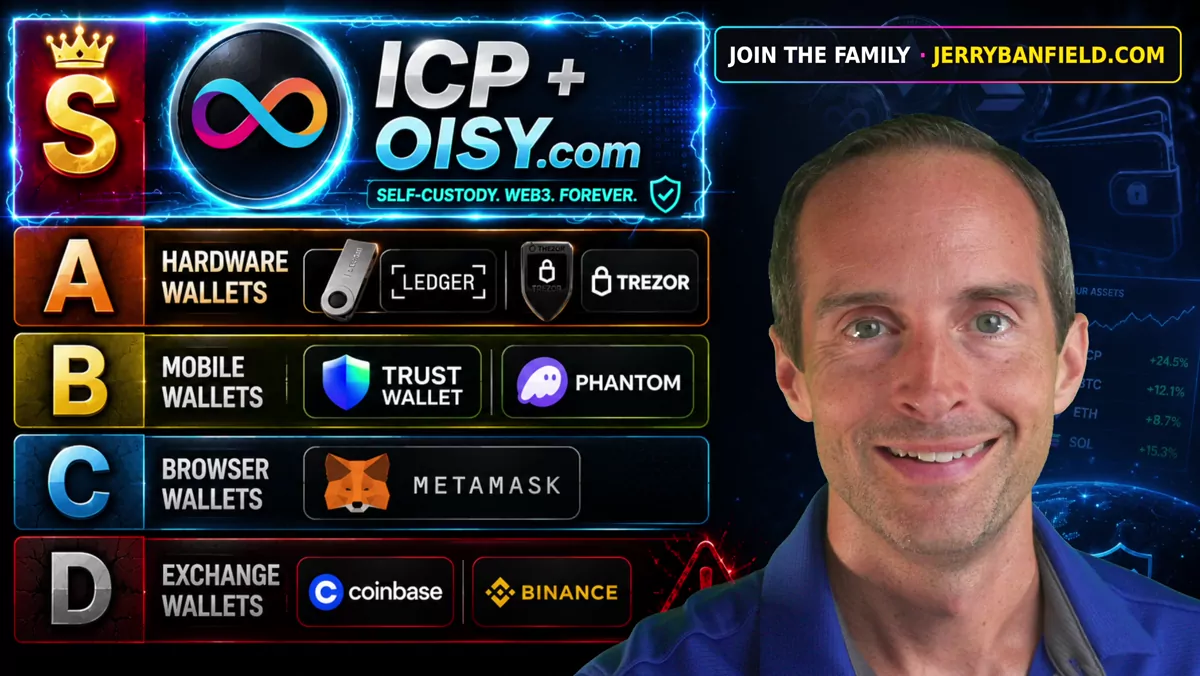
You're about to experience the deepest discussion I've heard on crypto wallets, with a very clear call to action. It's based on a 27-page research document I've got going over crypto wallets and exchanges, the biggest custody risks, and the best user experience, with one clear conclusion: out of all the wallet systems I'm aware of — hardware wallets, mobile wallets, browser wallets, having your money on an exchange — there's one system that is ideal for me and for the masses. And that's ICP via OISY.com and/or the Network Nervous System, which, based on everything I know after 12 years in crypto, is where I actually hold my crypto.
Hardware wallets — I'm going to give you a lot of information in this report about how problematic hardware wallets are. And yes, I will acknowledge: if you are an expert, and you want the absolute highest security guarantees, and you can deal with all kinds of complexity, then perhaps hardware wallets might make sense for you as the top choice. That said, 99% of you are not experts comfortable with complexity, and hardware wallets have a lot more risks and big problems in using them compared to a simpler setup. So I'm going to roll through this report, and my goal is to help you really understand what I believe is the best way to hold crypto. Now, I'm not a financial advisor. This isn't financial advice. What I'm showing you is why I hold all my crypto on ICP, and why the wallet I'd use is OISY.com if I had anything besides ICP. So let me show you.
Why I Hold My Crypto on ICP and OISY
OISY.com is a wallet that is directly hosted on the blockchain, allowing you to go straight into the ICP blockchain — which nothing besides ICP can do. And then you can hold your Ethereum, your Bitcoin, your ICP, BNB, Solana, Polygon (if anybody's still doing that), USDC, USDT, and huge amounts of other tokens — Arbitrum, Bob (nobody knows what Bob is), Chainlink, all these coins, just tons of coins. You can pick a network: if you want Ethereum, you've got 1inch, Euros, Shiba, Render, Pepe. You can select another network like Base and put a few of your Base coins on there. You have Solana, and you've got all these options on Solana.
So what's amazing about this wallet — and by the way, while I was recording this I heard some weird sound in my wall. I'm not sure what's going on with that. Is that a rat, bro? I need to get pest control out here, but I'm not refilming because it's funny. What's special about this wallet is that it combines ease of use — this is easy for a regular person to use — with cutting out, or absolutely minimizing, third-party trust. It's difficult to lose access to, and it's much more simple than a hardware wallet. Now, I personally actually have my money on the Network Nervous System, which is the ideal place to hold your crypto if you only hold ICP. And for those of you who don't just have ICP, then OISY.com. This report is going to dive deep into why.
I know this is different than what other people are telling you, and you'll see why as we go through it. I used ChatGPT Pro with a long prompt to generate this report. So it certainly has some of my ideas in it, but this is also the AI doing its own research, reading a ton of actual documentation, and then reaching its conclusions in combination with me. I asked it to find the very best overall custody architecture for the average person. I asked it: what is the best for mass adoption? Not what is best for crypto nerds in their mom's basement, or full-time YouTubers like me, but what is the best for an average person?
The AI concluded, based on reading through all the documentation and doing an hour of research, that this is the best for an average person. It says the mass-adoption framework — ICP/OISY, meaning the Network Nervous System, or the OISY wallet from DFINITY for things besides ICP — is the strongest overall custody architecture surveyed, because it combines distributed threshold signing, passkey-based identity and recovery, a browser-accessible on-chain wallet, and no exchange solvency claim or mandatory hardware device. This is the best setup for an average person. The defensible claim is that it minimizes concentrated custody dependencies better than the alternatives — not that it eliminates every dependency, or that it's the only system capable. What this means in practice is that it's easy for the average person to use, it's difficult for the average person to lose access to, and it minimizes all third-party trust while holding a bunch of different assets. That is extremely valuable.
I'm grateful we had five new members join yesterday, and I had a one-on-one call for an hour with a member who joined and scheduled a call with me. So if you want to talk, look at your portfolio, and work all this stuff out together — if you'd rather do that than try to do a whole bunch of research yourself — I'm here. Just join the Jerry Banfield Family and then DM me for a one-on-one call.
Slogans Hide Risks: The Executive Summary
This report has a huge amount of information, and if you're sitting there with tens of thousands of dollars in crypto, you should know all this stuff. The report goes into more detail in some areas than I would, but I know most of what's in here because I've been in crypto 12 years and I do a ton of research. That's how I was able to have this report generated in the first place — I already know what needs to be in a report like this.
So let's look at the executive summary. Crypto custody is often ultra-simplified, but you need to think about it deeper than slogans like "not your keys, not your coins," or "hardware wallets are the gold standard." A hardware wallet may be appropriate for an expert, but in my view hardware wallets are not the gold standard for most people. And "exchanges are safe for beginners" is great until the exchange goes down and you lose all your funds. Each of these slogans captures one risk and hides several others. To me, one thing that's totally unacceptable in crypto is a third party holding my coins, whether it's an exchange or some hardware wallet company having control. The best setup, therefore, is one where I'm directly accessing the blockchain itself.
If you do a deeper analysis into wallets, your wallet is your single biggest point of failure. Where you're actually holding your crypto is your biggest potential weakness. So I asked the AI to score all the different wallet setups, and it came up with this: ICP/OISY — ICP via the Network Nervous System, and OISY built on ICP by DFINITY — ranks first out of all the wallets for mass-market custody. And most people in crypto fall into mass-market custody, not expert-level hardware-wallet territory, even though some people might think otherwise. If you're not a technology geek, mass-market custody is what you should be thinking of.
Here's the bottom-line version: the advantage is architectural. That means it's about how it's built on the back end — how it actually functions, the things you can't see that it does. Those matter. The user does not depend on an exchange balance sheet, a single exported private key, a browser extension, or one hardware device. OISY has Internet Identity, which is a robust, fully on-chain identity, access, and recovery system. The threshold signer creates external chain signatures which are never assembled into one private key. And the wallet front end and back end are both hosted on ICP. So out of all the custody architectures, OISY on ICP if you have a bunch of coins — or the Network Nervous System if you just have ICP — is, in my opinion, the strongest combination, and that's what you need to think about.
Well-Rounded Custody: The Four Things That Matter
A lot of these videos talking about crypto wallets are just shilling the wallet, and they're making money shilling it. I'm not getting any money for telling you about this. They also only look at one thing — they don't look at something well-rounded. With a crypto wallet, you need well-rounded, because if there's one weak point that costs you everything, it doesn't matter how good the other stuff was. So to have a well-rounded solution, you need to balance four things.
First, third-party risk reduction. Let me explain this a little simpler: third party means somebody else could cause a problem — like your Ledger hardware wallet, where Ledger having a back door is a third-party risk. We want to reduce third-party risk.
Second, recovery resilience — meaning you don't lose your own crypto. I don't know where my Ledger wallet is right now. I took all the crypto out of it, but if I couldn't find my Ledger wallet, I'm not sure where my Ledger recovery phrase is either. So if I had any crypto in there — and technically I think I have a little bit of XRP that I couldn't take off because of the minimum account balance — then I lose that. In crypto, you need to think recovery resilience, because so many people have lost their hardware wallets, and your whole portfolio goes to zero when that happens. I would argue it's worse to lose your wallet than to have never bought crypto at all, or to go to zero on a coin you invested in. I would much rather go to zero on a coin I invested in than lose my damn wallet.
Third, cross-device usability. Very important. Taking a hardware wallet around the world when you travel is not a good idea, especially if you get stopped at gunpoint by some malicious authorities and they take it from you — all your security features are gone at that point. This is why you need something that can operate on any device you download to, hence ICP via OISY.
Fourth, multi-chain functionality for ordinary users, which OISY has built in. This solution on ICP transforms custody from trust in one company, one device, one seed, or one browser into trust distributed across a protocol, governed canisters, user authentication, and asset networks. That is extremely powerful. Now, I'm not saying ICP is the only network that can do threshold signing. There are others — Near can do chain signatures, a much more basic version of the stuff ICP can do, and Ethereum can implement passkeys and recovery policies. But what's special is that ICP offers a combination nobody else offers, and it's much more user-friendly than anything else. These are things that are true about OISY, and we're going to dig into more of this in a minute.
What's Actually True About OISY
So let's go through the basics of what's true about OISY. The front end and the back end are hosted on ICP. This is huge, because this is what's not happening with these other wallets you're using. OISY uses a governance-controlled Chain Fusion signer as a back end. So you are dependent on the ICP blockchain itself, but not on OISY possessing a conventional private key database — which is a very strong security setup. And Internet Identity supports OISY, so you don't have to worry about OISY itself for access: it supports all different kinds of devices and recovery methods, including verified email and recovery phrases if you want them. It's very difficult to lose your wallet in this case. And it's audited, reporting zero high-severity findings.
Now, to be fair about the limits: "only dependent on ICP" is true just for ICP itself. Other assets still remain on their own networks, which is powerful, but it means you also have to depend on the target chain. The recovery phrase is not exportable to others. "Fully on chain" does not mean absolutely immutable or ungoverned. And email recovery is not trustless either, if your email gets compromised.
Where the Other Wallet Options Fall Short
All right, let's talk about where all these other wallet alternatives fall short, so you can understand how bad the existing system is for most of the wallets people have.
Centralized exchanges — where most people hold their crypto — are nice because you can just reset your password and you can easily trade. But the exchange is basically giving you an IOU. When you look in your account and it says you have crypto, they're essentially handing you an IOU. You don't know if they actually have the crypto that's in your account or not, or if there are two, three, five, maybe even ten people who supposedly all have that same crypto — where really the exchange has that crypto once and has given a bunch of people IOUs, betting that you all won't try to withdraw at once. That's the absolute worst part about centralized exchanges. Although, to be fair, centralized exchanges are arguably the hardest place to lose access to your crypto as an individual person. Somebody could sign into your account and steal your crypto, or the exchange itself could lose it — but it's at least more difficult for you to lose access through your own fault.
Then there are the very popular browser-extension seed wallets like MetaMask. These are portable, but they're concentrated in the browser — the big ones being MetaMask and Phantom. In my experience these are extremely dangerous. There's all kinds of phishing surface, token approvals, and one recovery phrase. There are all kinds of ways to lose your money messing with these browser-extension seed wallets. I've stopped using MetaMask and Phantom and any of those other wallets. They're extremely easy to phish. It's very easy to have some code injected, go to a malicious website, and get your whole wallet drained — even if everything you're signing looks correct. And there's a physical angle too: if you've got the MetaMask app sitting on your phone and a malicious authority gets in there and looks at it, they know it's a wallet app, and they can make you send them all the crypto out of your wallet. Not something a lot of people in first-world countries are thinking about, but in other places it is a very serious concern.
Single hardware wallets are often held up as the gold standard, and they are excellent in some scenarios. You're not going to get your keys extracted remotely like you could with a browser wallet, or lose everything to a centralized exchange going to zero. But there's a bunch of dependencies — Bobby O laid this out and motivated me to make this video looking at the bigger picture of all the wallets. There are a bunch of trust assumptions in hardware wallets, including the manufacturer (i.e., device authenticity), the firmware, the secure element's RNG — the random number generation implementation — the transaction interpretation, the physical backup, and user recovery discipline. So yes, it protects the key better, but you're trusting the entire process around it. There's a ton of built-in trust assumptions with single hardware wallets.
And a huge risk with these is that you lose the wallet, or the wallet breaks and you can't get another one. You have to have a recovery phrase for it anyway — whereas you could use OISY.com on ICP without a recovery phrase at all, with just an email recovery setup, or simply by having it on a bunch of different devices. With a hardware wallet, you've got to have that recovery phrase. And if someone knows you have a hardware wallet with a recovery phrase, that's a liability, because all they have to do is steal your recovery phrase — or in some cases, steal your hardware wallet along with the PIN you wrote down right next to it — and you lose all your crypto. So in some cases, these are actually easier for people to rip off and steal from you than a browser extension or a centralized exchange.
Then you have hardware multi-sig, which is the strongest expert cold storage — when you have devices, vendors, locations, coordinators, and backups all diversified. But this is not mass-adoption ready. This is the kind of setup exchanges have to do, and even still, some things can go wrong there.
Then you've got the smart-account passkey wallet, where you've got on-chain policy and passkeys — but you need blockchain infrastructure like ICP to really be able to do all of this fully on chain. With a passkey, in theory, Google or Microsoft or someone could set up their own little crypto wallet pretty easily with a passkey and a smart account — but to interface it with everything else, you'd have to get that set up with every different blockchain. ICP has the only fully on-chain solution we have right now for the smart-account passkey wallet: OISY.com on ICP, ICP wallets like the Network Nervous System, or other wallets you can build on ICP. This, to me, is the most mass-adoption, user-friendly wallet architecture, and I imagine we're going to see more of these come out in the future.
And then you have vendor-assisted MPC wallets. These remove the seed and support conventional recovery, but they introduce a company-operated signing share, a cloud account, biometrics, and service-continuity questions. Not very mass-adoption friendly — unless, say, everybody at your company is getting one — and again, it kind of defeats the point of crypto in a lot of ways.
So here's the core thing for this whole post: the future of custody is not making every human guard one perfect device and one recovery phrase. It's giving the human recoverable access while the blockchain network holds the signing power, in a way that no company, device, or employer database possesses. And in my view, only ICP has this set up right now.
The Mass-Adoption Weighting: What Really Matters
There's a lot more information in the report, so I'm going to zoom in on some of the most important parts. And one of the most important parts is the mass-adoption weighting. As a guy who creates videos that people actually watch, my thought is that my content should be mass-adoption friendly, not targeted just at an expert niche. A lot of the people who have calls with me and join my community are following me and are in crypto, but they're not tech enthusiasts like me — and mass adoption is what you really need to be thinking of. So here are the things that are really important for mass adoption.
First, counterparty and solvency independence. This means: are you dependent on one single company that could have an issue? This is obviously horrible with centralized exchanges, but even if you have a hardware wallet, you could still be totally beholden to that hardware wallet company that's putting out software updates — almost anything can happen when the power is concentrated like that. I prefer to minimize counterparty and solvency dependence.
Then another big one — and this is where hardware wallets fail — is recovery and user-error resilience. Can a regular user survive the loss of a phone, a device, a password, or one backup without having to give a custodian unilateral control? Now, exchanges make this much easier on people: you can just show your driver's license or something if you lose access to your account — but then you've given them total control from there. OISY on ICP has, in my opinion, the best combination here: recovery and user-error resilience while also minimizing counterparty and solvency dependence.
Then there's key-compromise resistance: how many secrets, systems, people, components, and distribution channels must be compromised to authorize theft? You'd have to compromise a significant number of things to steal off the ICP wallets. But with a crypto exchange or a browser-based wallet, there are so many opportunities where individual components can be compromised, and theft becomes possible from there.
Then you have transaction integrity and phishing resistance. Right now, almost nobody even thinks of OISY.com. With so many of these other wallets, people know you're using them, so the phishing attacks are already set up. The one time somebody almost got me with a phishing attack, they were a dummy, because I wasn't even using that wallet — it was something with MetaMask, but I didn't have any money in MetaMask. You can't steal what's not there. So right now OISY is a really nice setup, because hardly anybody's targeting it with phishing attacks, and it would be very difficult to target anyway. Internet Identity logs in and generates new principals wherever you log in with it, so trying to phish somebody on ICP is much harder right now — not just technically, but because almost nobody even thinks to do it. In the future, when everybody has these wallets, there'll be a lot more people trying to phish that angle. But still, because it's on chain, you have to go to the website to actually sign into it on the blockchain. It's way harder to phish.
And then availability, censorship, and physical resistance — I've talked about that a lot already. Can you move funds around the world? Right now, almost no malicious authorities know that you could have all your crypto — your Bitcoin, your Ethereum, your Solana — accessible this way. Now, I keep running my big mouth, so some of them will find out about it. But almost nobody stopping you at gunpoint would think it was possible that you could be sitting there with $100,000 of Bitcoin, Ethereum — hopefully you wouldn't have it mostly in Bitcoin and Ethereum, but in ICP — sitting there in a private browser window on your phone, with no evidence anywhere else on your phone.
Physical Coercion, Death, and the Scenarios Nobody Plans For
And if you told them, "I don't have any crypto," there'd be no way for them to go on your phone and prove otherwise. They wouldn't even know what to ask you to try to sign into. Even if they did ask you to sign into an Internet Identity, you could just have some fake one that signed in and didn't have any money in it. They couldn't even find where your real one was, because it'd be in the phone's cryptographic environment itself. This is really important in some parts of the world.
Then the report goes through ease of use for mass adoption, and maturity and auditability. The weighting doesn't favor pure convenience or pure cold storage. You've got to figure in all the different scenarios that could cause you to lose your crypto: lost phone or laptop, stolen device, malware, fake wallet UI, supply-chain theft, custodian insolvency or fraud, governance compromise, physical coercion, death or incapacity.
What's nice with ICP is this: let's say you have it sitting in the OISY wallet, and you have email recovery set up with a relative, or it's just on the device and you've got a PIN. It should be pretty easy for a relative — especially if you've provided simple instructions in a will — to sign in and get hold of it. But with hardware wallets, you've got to make sure somebody has access to the device, and can get in there and use your PIN or your recovery phrase, if you pass away. At least on a crypto exchange, your relatives would have a chance to try to recover those funds. But if you're holding crypto in MetaMask, there's a very good chance your relative may not even know you've got it in MetaMask, and might not be able to access it without finding your recovery phrase. Ironically, it's probably easier for somebody to steal the money from your MetaMask than it is for your relative to go in and get hold of it.
On the methodology: the AI doesn't say every exchange double- or triple-sells every coin. What it says is that the customer cannot independently verify the exchange actually has what they say they have — and almost everybody will agree on that. And yes, proof of reserves is very incomplete. Exchanges do score well for mass adoption in terms of simplicity, but they're horrible in terms of defeating the whole point of crypto. So to me, you never want to have your crypto sitting on an exchange. I don't have any of my crypto sitting on an exchange today.
Why My Setup Is Not Even Worth Stealing
Now, ideally you don't want everyone knowing where all your crypto is. I'll probably have to get a bodyguard when ICP goes up to some serious money, because everybody will know about my ICP stash. But until then, here's what's nice with ICP: if you have it locked, there's no point in even trying to steal it. I don't have anything you can take that you can get hold of in this setup. I've got a couple thousand dollars of ICP liquid, and somebody trying to steal that would have to sell it on an exchange where they're KYC'd, and everybody would see publicly exactly where the transaction went — which is easy to report. Whereas if you've got a whole bunch of liquid Bitcoin or Ethereum, that's a lot more tempting to steal. All my ICP is locked up, so there's no point in even trying to steal it from me at this point. What are you going to do? There's a couple thousand dollars in liquid ICP; the rest is all locked up, and you'd have a hard time selling it and getting away with it.
Compare that to somebody's hardware wallet. They may not even have the addresses on that hardware wallet written down anywhere. If somebody stole your hardware wallet — which you definitely should not do to anyone — there's a very good chance they'd get away with selling all the crypto on it. OISY on ICP is just much harder to steal from, because you can't just grab a physical device plus the PIN somebody wrote down next to it, or the recovery phrase stuck over there by the computer.
Mobile wallets are a little better isolated, but they're seed-centric. They're easy to lose, and easy to steal from if someone gets hold of the seed phrase. And here's the cruel irony: the more careful you are with your seed phrase, the easier it is for you to lose access to it yourself, and the harder it is for your relatives to get to it if you pass on. I once helped a widow look for her husband's Bitcoin, so I know how frustrating that can be. That was one of the first things I ever got paid to do in person in crypto: help a widow try to locate her husband's Bitcoin. It was a lot of signing into exchange accounts and looking through wallets — hours and hours of searching — only to realize she thought he had more Bitcoin than he actually had. She had already found all of it. He was just double-tracking it, recording it separately in another place, and it was all in one exchange she'd already located.
The Hardware Wallet Trust Assumptions Nobody Talks About
Hardware wallets do have a real strength: the private key remaining inside a dedicated signing device is ideal for security — if you can handle all the other stuff. But did you pick the exact right hardware wallet? There are still trust assumptions, and this is why picking a hardware wallet is much more difficult than it looks. Here's something I'd never thought of before that Bobby O talked about in his video: when you're getting a hardware wallet, you're depending on it actually using a sufficient degree of randomness to create the root secret. Ledger and Trezor document their designs, but you're still relying on the device using enough randomness to generate something that actually is random. Because if, in theory, somebody used AI to crack some of these randomness algorithms, they could isolate seed phrases that were more likely. If some of the randomness wasn't set up just right, in theory you could reverse-engineer it, and there'd be a relatively small set of seed phrases to try to hack, instead of the gigantic number of possible crypto addresses. Now, that's probably not an issue — but it's one single trust assumption, randomness, that most people have never thought of: that you truly are getting a randomly generated seed phrase and not something less random. Less random equals something somebody could potentially replicate much more easily.
And you see all these dependencies stacked up in a hardware wallet: the manufacturer, the firmware, the companion software, the transaction display, the physical backup, the device, and the user procedure — with the recovery phrase at the bottom of all of it. The Ledger Recover service that caused the scandal I mentioned earlier does help address the lost-backup risk. It's not proof that they have a secret back door, but it does demonstrate a trade-off: how much can you count on a wallet's security model if the company can help you recover your funds when you lose access?
There have been lots of incidents you should know about, where devices have had PINs brute-forced and all kinds of things. Here's one: Kraken estimated a mass-produced attack device could cost about $75. The Kraken Security Labs report in 2020 showed an attacker with physical access could use voltage glitching to extract an encrypted seed from affected Trezor One and Model T devices, and then brute-force the PIN. And here's the thing: if attacks like this are ever going to exist in the future, your device is potentially vulnerable to them now, before there's public knowledge of it. So the question is, even if you have a hardware wallet, is there a way to do something like this to it? Maybe, maybe not. Let's hope not, right? There's obviously also physical loss and theft, which we've talked about. And multi-sig is not as relevant for the regular user.
These are the things you should know about if you're holding tens of thousands of dollars in crypto — the scenarios where you could lose it. If you want to go deeper on all of this with me, go ahead and join my Skool community, where you can get in there and talk this through.
The Overall Rankings and the Claims Worth Making
Let's look at the overall rankings for mass adoption. The passkey smart-account wallet has chain-module-specific dependencies, but OISY on ICP is, in my view, the best version of a passkey smart-account wallet in existence. Then further down you can see the regulated centralized exchange — not nearly as good an option. Paper or brain wallets: catastrophic loss risk, low usability — and people are still going around saying you've got to have a paper or brain wallet. Browser extensions: very dangerous, easy to use with some dApps, but very dangerous. Mobile seed wallets, et cetera. You've got to be very careful where you put your money and which crypto you have.
And here are the claims that, according to ChatGPT, I should make: OISY is the best mass-adoption custody architecture that ChatGPT was able to find. It removes the exchange, the extension, and the hardware signer as mandatory bottlenecks. The complete external-chain private keys are never assembled in one place. It separates recovery from a single exportable secret. It doesn't store native Bitcoin, Ethereum, or Solana directly on ICP — they stay on their own chains, and ICP is able to transact them. There are other chains that can do some multi-chain distributed signing, but they can't host the whole wallet on chain. And ChatGPT wanted to make sure of some additional claims: it's not that hardware wallets are unsafe — it's that you should be aware of the problems with them.
So let's finish this part off with the conclusion: after comparing exchanges, browser wallets, hardware wallets, multi-sig, smart accounts, and MPC systems, OISY on ICP is the best mass-market custody architecture I found — and this is after the AI did all of its own research. It doesn't eliminate every dependency. It does something more realistic: it removes the exchange balance sheet, the browser extension, the hardware signer, and the exportable master key as mandatory points of failure, and replaces them with recoverable identity and a blockchain signer. Native assets still depend on their home chains, and ICP governance and canisters still matter. But here's the thing: for an ordinary person trying not to lose everything through one company, one device, or one phrase, this is the best risk balance I found.
Why This Makes Me All In on ICP
So this is what the AI came up with based on its research. I know I make a lot of videos talking about how bullish I am on ICP, and here the AI did its own research and verified it. When you can build the best crypto wallet solution for the masses out of everybody else in crypto, that's a huge sign of how advanced the technology on your blockchain is. It's a huge sign that ICP is an outlier, that something special is happening here, and that it's worth looking deeper and deeper into. And this is why I'm all in on ICP.
If you read all of this, I want to get to know you. I'm tired of not knowing you. I'm very grateful we've got 22 members, with five new members joining yesterday — I just launched this community in the last month or so. You can have a two-way relationship with me: as soon as you join the Jerry Banfield Family, I'll know your name. You can introduce yourself and share your story, and you can message me or post to the group with any questions, comments, or links you want me to look at.
For example, Scouse Will filmed a video today and shared his link with the group. You can ask me for a video specifically on a topic you want, get feedback on your channel, or I'll even give you feedback on a dating profile, an AI workflow, a business idea, a health goal, or your next step. I'm here to support you every day in the Jerry Banfield Family.
I don't read any comments on YouTube. Instead, I make these free videos for everybody to give the best help I can give — and if you want more of my crypto research like this, you'll find it all in my Crypto Reviews playlist. Hope to see you in the Jerry Banfield Family. See you next time.