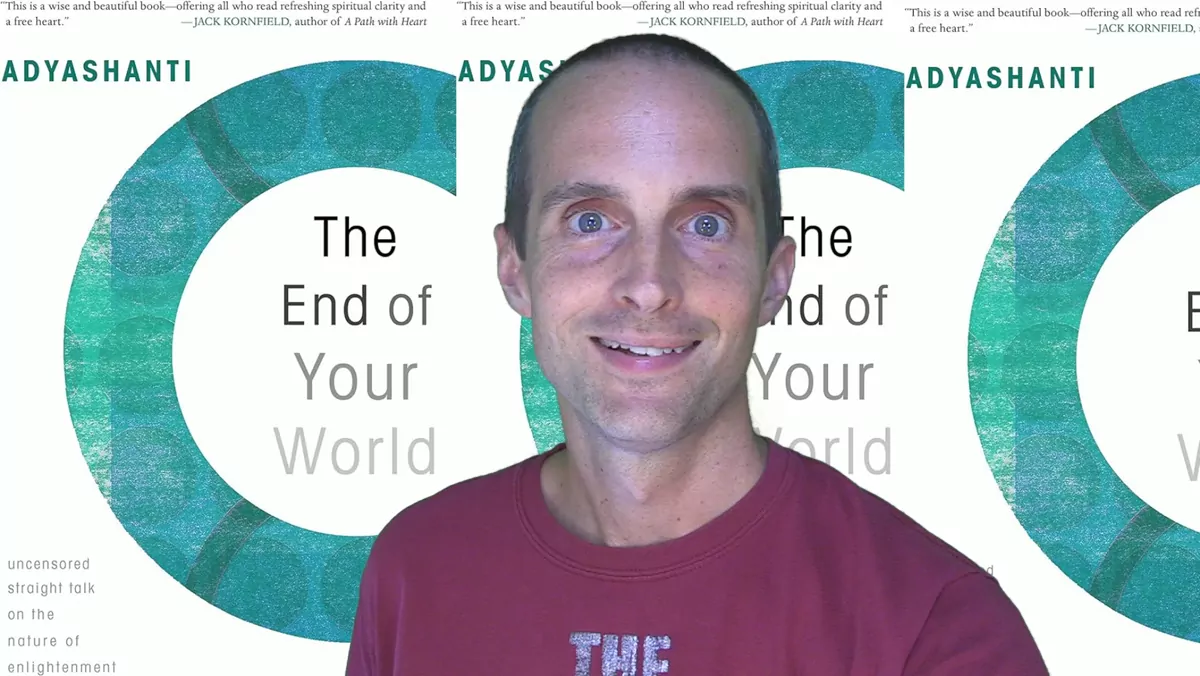
I just finished reading The End of Your World by Adyashanti, which was recommended in my open chat because I've read a lot of books on spiritual awakening and enlightenment, et cetera — The Power of Now, hundreds of hours of Wayne Dyer talks. I think you'll enjoy this book review and summary of what I got out of reading it, because I went through this book pretty quickly. It's uncensored straight talk on the nature of enlightenment. It had some new ideas I hadn't heard before, and there was a lot I could relate to. The author is a spiritual teacher that lots of people come to, though I'd never heard of him before reading his book. He talks about a lot of the questions his students would ask, and he shared some of his own experience.
Moments of awakening, and an ongoing awakened life
One of the more interesting ideas he talked about was that you can have moments of awakening, and then, separately, more of an ongoing awakened life. I can relate to that a lot. You have moments where, in my experience, you see how we're all one, and the world and me aren't separate. As I believe it, God and God's creations are all one, and it's really beautiful. But then often these moments are fleeting. You kind of fall right back asleep into the dream that I'm this body, and I'm what people think of me. I'm my ego, and that's all I am.
He describes that this is actually pretty common and can happen to anybody.
When the ego claims to be enlightened
He says the ego can then build a concept of itself as being enlightened or awakened, and you can get this superiority complex, which I can definitely relate to. You feel this big transformation has happened, and that it makes you better than other people. "I'm awakened, I'm enlightened, I had this experience" — and the experience becomes more of something in the past rather than a present way of living.
When your world ends and nothing seems to matter
He also talks about another thing that can happen if you've had these revelationary moments: you can end up really depressed, feeling that life is totally meaningless. Your world has kind of ended. It's like all of who you thought you were and what you thought your life meant seems meaningless and irrelevant. In the way I've felt it, the thought runs: I am God, I'm this universe, I'm the creator, I'm nothing, I'm consciousness, nothing means anything, all this is passing and temporary. You can get into a depressing place with that, where instead of feeling enlightened and empowered, you feel disconnected and horrified.
I can relate to some of that, too. When I'm depressed, that often can be the form it takes. Like, I'm God and I can't die, and this is horrible and miserable, and it's the worst thing that could possibly be real, and it all doesn't matter, it's all temporary, who cares, it's all pointless. If you have ever sunk into that same dark, nothing-matters place, you don't have to sit in it by yourself; you can book a private call with me and we'll talk through it honestly.
He talked about how the ego always needs to have a meaning for life, a point to life, a purpose for life. But really, in awakening, there's just the experience — it doesn't have to make sense or be understood perfectly by the mind. I found myself nodding a lot reading this book. If you've ever sat with that tension, I dig into it more in facing harsh reality versus healthy fantasy.
Words are just signposts
There were some things I felt were not as alive or accurate, or that were, as he put it, a failure to describe the truth. He says he will fail, as best he can, to describe the truth that must be experienced. It's inevitable when you're talking about things like enlightenment and spirituality and the ultimate truth and reality that you're going to fail — you can't describe it accurately with words. There's a word for a shirt, but the experience of wearing a shirt is something else. I can communicate to other people that I know what a shirt is, I've worn shirts, I understand shirts — but words are just pointing at the truth.
Eckhart Tolle often uses similar language, like this is just a signpost, that is just a signpost. The goal is to have these experiences and to allow these experiences to happen within you. Listening through this book, I found a lot of remembering previous experiences I've had, and questioning, hey, is my life today on purpose?
I'm here to dream a better dream
The one thing I really didn't vibe with in this book is the idea of flow, where you're not in control and you're just going with life. He talks about an enlightenment where there's a letting go and a not caring about controlling anymore, just flowing with the river. He says that if you really want to pursue a spiritual life, you're going to have to go through spiritual development and enlightenment, letting go of control and letting the dream take you wherever it wants to. He's also clear that you can stop short, and that many people are just here to dream a better dream.
And I'm like, yeah, that's me. I'm not trying to just let go of all control and let the world take me wherever it's going to take me. I'm here to dream a better dream. I want to direct the dream how I want to dream it, and I'm lucid dreaming here. Just knowing you're in a dream and lucid dreaming allows you to have a lot of influence over how the dream goes. It was a funny moment listening to this book — yeah, I'm just trying to dream a better dream. I'm not trying to really go all into this thing and totally annihilate the self and stuff. I just want to have a nice dream. That's what we're doing here. To me, that's what's so awesome about enlightenment as lucid dreaming: you get to direct where the dream goes more, instead of being dragged along by life. That same lens is why I keep saying that life is a movie you chose to watch.
But at the same time, I do recognize there does feel like there's a certain flow of life where you're in cooperation with what's happening. So in respecting that flow, I feel we've pretty much covered this book. If you enjoy reflections like this, you can watch my newest videos in my Life playlist.