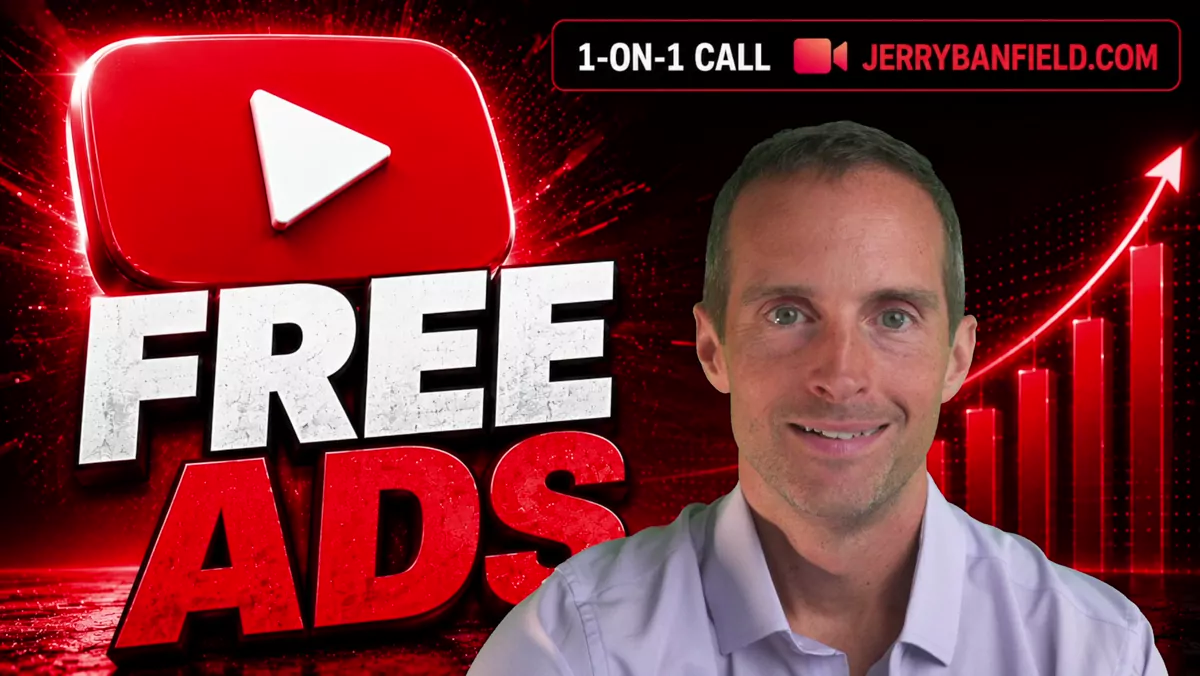
Your Thumbnails Are Free Ads
Your 50-view YouTube video could easily be worth $100 or more. This is an incredible idea, and I've never heard anyone else even mention it on YouTube. It's basically the idea to use your thumbnails as ads. What almost everybody else is teaching you is to do anything with your thumbnails to be as clickbaity as possible — get people to actually watch your video, and then in the video you can sell them on something or make ad revenue. Here's the problem with that, though. In most cases, I hate to break it to you, but it doesn't matter what you do in your video. Should I say that again? It doesn't matter what title you use or what thumbnail you use — your video is still going to get 50, 100 views, maybe 1,000 at best. No matter how clickbait you make the title, no matter what you do on the thumbnail, it's kind of hopeless on YouTube. There's so much content. I watched a couple of MrBeast videos today, and they're so good it makes me not want to create. I'm like, why, with my little $10,000 YouTube studio, filming stuff by myself, should I even bother? Well, I have a system for making a full-time income on YouTube, and it's by monetizing videos that you would think are worthless.
Let me show you a perfect example. If you go to my recent videos on my channel, I'm taking this to the next level. I've shown this on a video called "Small YouTubers Stop Making Videos, Go Live for 30 Minutes Instead" — organic traffic and live streaming is the best formula. But where I just leveled up my game is what I did on the thumbnail itself. This is a hidden opportunity almost everyone is missing on YouTube. I put "make every impression count" right on the thumbnail. I just didn't see how much further I could even go with that until today.
The 38-View Video That Reached 2,000 People
Here's a perfect example. On the surface, you would look at this video and say it's a failure — you wasted your time, it got 38 views, you're not a good YouTube coach, you don't know anything about YouTube, and so on. But look at the reach. This video got 2,000 impressions with a 1.4% click-through rate. I communicated a message on that thumbnail that said make every impression count. What I didn't do on that video is include a call to action. The 38 people who watched had an average view duration of three minutes on a 10-minute video. Some people will tell you my retention graph sucks, but here's the thing: this is what most retention graphs look like on YouTube. It even flattened out pretty well compared to some of the others.
But this is what almost everybody's missing. Those 2,000 impressions — almost everybody's just throwing these away. And I hate to break it to you: most of you are never going to get videos that do much more than this. You'll get a few thousand impressions that get a few views. This YouTube coaching niche especially is pretty brutal. I have some other channels that get tens of thousands of impressions on every video. YouTube coaching is all about authority signaling, but there are hidden opportunities.
And here's the hidden opportunity. What if on every one of my videos, instead of only depending on views, I use the impressions themselves? If somebody didn't click that video and watch it, I still communicated to them the message: make every impression count. Most YouTubers waste their impressions. I successfully communicated that 2,000 times on YouTube, but it didn't have a call to action on it. If a new video has the exact same statistics, it can be expected to go out to 2,000 people also. So what's the difference? On the old one, those 2,000 impressions communicated a message, but there was no way for people to essentially pay me directly without watching the video. Now, all my videos across all my channels have a call to action right on the top of the thumbnail. That allows me to turn those 2,000 impressions into something — even if a single one of those impressions is somebody literally scrolling through YouTube who wasn't even going to watch the video.
What Are the Odds Out of 2,000 People?
Let's pretend I had a call to action on that video. YouTube gave it to the people it thought would most like it — people who are creating content on YouTube, who are YouTubers, who are watching YouTube coaching content. So what if I had a call to action? What are the odds that out of 2,000 impressions, there's one person who is interested in having a one-on-one call with me? I think the odds of that are pretty high, because I'd love to talk to other YouTubers, but I literally don't know a single YouTuber who makes it this clear or this easy. A lot of the YouTubers I watch don't make one-on-one calls available. Or even if they do, you have to click through their link tree and then go find it elsewhere. Most of the people in YouTube coaching have these programs they run, and I would never join a program like that. I'm not going to be in a class in some cohort sitting on Zoom — no, thank you. Part of what I like about YouTube is being able to do my own thing. And they try to create this fake scarcity and all this stuff. That's what everybody else is teaching. So that means there's a bunch of people on YouTube who would love to talk to somebody, but they literally don't know who they could talk to. If you're one of them, you can book a private call with me and talk to me on our call — I make it that clear and that easy.
How Much Would 2,000 Impressions Cost You?
Now, when I look at every single thumbnail as a free ad — that video was literally 2,000 impressions. I just got a free ad on YouTube. I didn't have to pay for those 2,000 impressions. So how much would 2,000 impressions cost if I had to pay for that same reach on YouTube? You'd be looking at a minimum of probably a dollar upwards to $10-plus depending on the niche. So every thumbnail is a free display ad. I want you to start thinking of it like that: every thumbnail on your channel is a free display ad. It's not something to get somebody to click on the video — it's a free display ad. Free. You make your video and you get this display ad in exchange. It's amazing.
And I'll show you some of my other videos. Imagine if I'd had a call to action on them. Believe it or not, on this brand new YouTube coach channel, I've had videos like one that got 4,000 impressions. The YouTube custom AI feed is pretty cool, and if that gets better, everything is going to change. But imagine if 4,000 people saw my thumbnail with an offer on it. And imagine the videos further back that got a few thousand views. This is a live stream I'm working from, by the way — I'm literally talking off the top of my head while I do this, because I know this stuff.
Here's one: "How to Avoid YouTube's Inauthentic Content Flag." On that one, you'll notice I was doing the typical stuff that everybody else teaches with their thumbnails. Did that thumbnail really add any value to the video? The thumbnail did very little. There's no reason I couldn't have stuck a call to action on that thumbnail. I seriously doubt sticking a call to action on it would have significantly dropped the click-through rate. In fact, I'll even tell you that in some scenarios, a well-done call to action might actually increase the click-through rate. Look at this one: I got 61,000 impressions. At the absolute lowest on Google Ads, you're looking at least at $2 — that's hundreds of dollars of free ads on this one video. At $10, you might be looking at $600 in free ads. Now imagine if I had a call to action on this video. I would bet I'd get at least six paid calls out of this one video by itself. Meanwhile, what I actually got instead was 3,000 views and 191 watch hours, which is decent, but I got $0 out of this video. That video probably would have been worth $600 to $1,000, because there might have been some repeat calls also. And putting a call to action on it probably wouldn't have hurt the click-through rate at all — in fact, it could have increased it.
A Call to Action Can Increase Your Click-Through Rate
So let's talk about the scenario where this actually increases the click-through rate. With a call to action, I'm signaling a different kind of person to click on my video. Sure, maybe out of a thousand people, most are not going to be interested in a one-on-one call. Let's say 90% have no interest in ever scheduling a one-on-one call with me. That's fine and that's reasonable. But what if 10% of the people at least start thinking, "Oh, I could have a call with this guy"? Regardless of everything else, it at least puts the idea in their head. What if you get some percentage of people actually clicking to find out about the call? What if there are some people who wouldn't have clicked on the video, but they see there's a one-on-one call available and click to see if they like me? Then I may be attracting people who are actually evaluating whether I'm worth having a call with, based on my call to action.
This, to me, is the ideal call to action for you to put on your videos too. Because a one-on-one call, in this day and age, is one of the easiest things to offer, and it's something I value the most. There are so many people who create content that I would love to talk to, but nobody is this transparent and easy to go about it. Almost everyone else has all this awkward stuff set up where you have to go to their Instagram and DM them, or go to their link tree and maybe they have a call or they have a course. And sure, that could work if you have an audience. But how are you going to get an audience in the first place? Well, if you watch the rest of my videos on this channel, the basic thing to do is just upload a lot of videos. And what will work even better than that, if you can do it, is to go live for 30 minutes instead, like I showed on my recent live stream called "Small YouTubers Stop Making Videos."
Every Video Gets the Call to Action, Every Time
If you can go live, then while you're live, when people ask about the one-on-one call, you can talk about it. Then you promote your website in every single one of your calls to action. And imagine if you get a video that does get a decent amount of views — how many calls you'll get out of it. But here's what's even sweeter. Imagine turning around the videos most people would look at and call a waste. Here's another one of mine: it got 1,900 impressions. That's probably enough for one, maybe two calls. That's $100 to $200 out of a video.
And you've got to think about outliers too. I'm saying on average, if I go through a lot of my recent videos, they got around 50 views — although one got like four, and that was a while back. Another got about 400 views, and one got 19,000 impressions. When you look at it this way, let's say out of every 10 of your videos, you make one that kicks up into the tens of thousands of impressions. Then some of your 50-view videos could get zero one-on-one calls, others could get one, but then you make one that actually gets better traction, and that one might get five or ten calls off that one video. And the trick is, you don't ever have to sit there and try to figure out which video it's going to be in advance, or which live stream it's going to be. You just do the work and put the call to action out there every single time. And sometimes people will see your videos several times — maybe five or ten times even — before they actually click on them. So imagine if you've shown someone five or ten different videos, each one carrying your offer.
Keep the Thumbnail CTA Discreet, Go Bigger Inside
Now, the call to action on the thumbnail should be discreet. I do have a much bigger call to action than the thumbnail one — on the inside of my videos, once you've watched, once you've demonstrated interest in being there, that's where my bigger call to action slide comes in, set up in OBS. And that one tells you what you can get: a channel review, pitch a collaboration, maximize watch time, monetize more, and plan a pivot. Those are things we can work through when you set up a call with me. So you see the system: I put the little teaser on my thumbnail, then I attract people to click on the video who might be interested in a one-on-one call — which might be 10% of the impressions. Now a higher percentage of my actual viewers are people who are more likely to actually want to pay me.
Then imagine the reinforcement loop behind that. If I signal with my videos that I want people who will pay to talk to me — people who want a one-on-one call with me — imagine some of the people who are turned off by that don't click on the video, but others see it and click on the video precisely for that. Then Google gets better data about the people who like watching the video based on the call. The more people who click the video wanting the call, the more that signals to Google the exact right kind of viewer. Even if I get fewer views overall, the viewers who do click are going to have a much higher likelihood of scheduling a call. Those are the viewers I really care about — the ones putting minutes watched on the videos and clicking through. And those are the viewers like whom YouTube is more likely to show the video to next. So I don't believe in having a gigantic call to action on the thumbnail. My thumbnail is still mostly complementing what I'm saying, but it has a gentle call to action. And what I'm going to do on all my videos across all six of my channels is put this exact same call to action.
Answering the Skeptics: Will 50 Views Convert?
One viewer raised a fair objection: it's a very unique theory, but 50 views hints at a skill inability which won't likely convert to a sale. Here's the thing, though. There's a lack of options when it comes to YouTube coaching. I've seen so many people talking about YouTube and coaching, and I literally don't know one that I could pay under $100 to talk to. Actually, maybe I do know one single guy — but his rate is actually too cheap, at $36, and he mostly does YouTube ads. Out of everybody, I've only seen one person actually making it clear you can have a one-on-one call with them for an affordable rate. I saw another woman with a Linktree charging $600 an hour; she got a lot of views on her shorts.
Now, this is not going to work perfectly for every niche. YouTube coaching especially is a really crappy niche in the sense that it's all about authority. It's one of the worst niches, because if you pile views on a video — however that happens — people think you must know something, even if most of what you made is nothing special. Most of the YouTube coaching content I see is absolute garbage, and I can tell that from my deep experience on YouTube: starting six new channels and getting four and a half million impressions, getting two of the channels monetized, all organic traffic. That's a serious level of YouTube skill I personally have from being on YouTube since 2011. I've got over a billion impressions or views, depending on which platform and how you define that — the things I've created, like videos, posts, and podcast ads, have been seen over a billion times online. And what I did not do in the vast majority of those billion impressions is have a nice, smooth, clear, simple call to action on all of them. That, to me, is one of the most powerful changes I'm making right now.
Now sure, in YouTube coaching, will somebody see a 50-view video and schedule a call? We're going to find out, because I'm testing that now. However, what happens when I get a few videos that get some traffic, and then my other videos get some traffic? I may go from no calls to two or three calls a day all of a sudden. A live stream like this has such powerful information — so far beyond the depth that anyone else I see is teaching on YouTube. And it's different. Almost everybody else is teaching you to make the most clickbait stuff you can, and almost none of you are going to do that successfully, so you shouldn't even try. You need to think differently. I'm one of the only people teaching you how to think differently from actual experience, and I'm doing all of it clearly myself. So this might not take off today, but my YouTube coach channel might bring in two or three calls a day at some point off this strategy that I'm starting right now. And then I'll be able to point back and say, this is the day I started this strategy. When I have videos showing how I made $500 in a day from these one-on-one calls, some of those may get more serious views because they'll have that clickbait hook — but I can point back and say, this is where I started the strategy.
Niches Where People Are Desperate to Talk to Someone
On other channels where I have more views, like my ICP and crypto channels, those videos go out to tens of thousands, sometimes hundreds of thousands of people. When those have a call to action, how many calls am I going to get from that? I'm an authority who's recognized — people watched me for years on other channels, and after I deleted them, they found me again on my new channels. And what happens when I'm doing a dating video and people don't care how many views I have? They're so desperate to talk to someone about dating and don't know who else to talk to that they'll schedule a call with me off a 50- or 100-view video. There are some niches where there's such a desperate need, but people don't know you're available. There are some niches where you can get a small number of views and people will not care at all, because they desperately want to talk to somebody. I'm really excited to start showing off how this is going to work. I've been looking for the absolute best ideas on YouTube, far past what anyone else is teaching, and this is next level: gentle call to action on the thumbnail, then bigger call to action inside the video.
The same viewer also said that 99% of YouTubers can't present well and aren't likely to be respected enough to charge. Well, that's something each YouTuber can work on themselves. What I see is that there are so many people who, if they had a clear call to action, would be earning far more. There are a few people who just do vlogs and get a few thousand views per video, and they're probably making just less than I am in ad revenue off my ICP channel — I get around $400 to $500 a month off brand new crypto channels in ad revenue, because my watch time is pretty high and crypto monetizes pretty well. So these are channels where people are getting thousands of views on every video, they upload one a day, but they're probably only making a few hundred dollars a month. They're leaving thousands of dollars on the table, and literally all they'd have to do is something like this.
There are YouTubers I would absolutely schedule a call with — and these are beginner, entry-level, newbie YouTubers. If they had something like this, I'd pop in on a call, ask, "Hey, can I record this and put it out as a video on my channel?" I'd happily pay them $100 or $200, schedule a call with them, and just get the content, because it would be interesting. There are tiny dating channels out there, for example, trying to sell dating coaching, and they're throwing away all their impressions because they don't have the call to action on the thumbnail. Then there are some that put big, huge calls to action on the thumbnail — but that's too much of a call to action for a thumbnail. Mine is an appropriate call to action: it's in space that didn't really matter to start with. The main thing is free ads. The thumbnail version is the smaller thing; the in-video version is bigger. And I'm rolling this out everywhere: I have one of these set up and ready to go on my gaming channel, one for my crypto reviews channel — where I had the Zoom logo on it, though I'd rather take the Zoom logo off — one for my ICP channel, one for my main channel, and one for my dating channel.
Small YouTubers Are Leaving Money on the Table
So you see, I've got these gigantic calls to action set up now, and especially on a talking-head video, I can just leave them up in the background for a significant portion of the video. But for getting people in the door, we're not going to go that hard. There are a lot of YouTubers leaving a lot of money on the table because nobody's taught them this. They're not an authority — they're just doing vlogs. They have a presentation style, an engaging audience, and personality, but they're not big enough to get sponsorships. They're not an authority on anything. They're just making videos to get people to watch. And some of them could be making several hundred dollars a day, probably, just selling one-on-one calls — especially since some of them are literally sitting in their bedroom, and they could easily have something like this slapped on the top of the thumbnail and it wouldn't make any difference to the thumbnail itself.
Yes, I am a seasoned YouTuber and live streamer, so this is how I'm doing it today. But I think there are a lot of YouTubers whose videos are hardly making any money, and to me this is a guaranteed win. Because even if people don't actually book, every impression somebody sees on the video — even if it's subconscious — means they've subconsciously registered: that's a guy I can talk to. That's what I'm communicating. On every thumbnail from now on, I'm communicating that this is a guy you can talk to. Then I have a website with long-form sales copy that backs it up, and it sells one thing: book a one-on-one call with me. I could easily take five of those a day and make hundreds of dollars daily doing two and a half hours of calls. Then I can offer my Skool community on the back end and say: if you found this call helpful, join my community, stay accountable, and you can direct message me anytime.
Why One-on-One Calls Are the Foundation of My Business
I figured this out in conjunction with using ChatGPT Pro. I gave it so much dictation, so much overview of my business, and between some of the ideas it gave me and some of the ideas I put out before, I was blown away. ChatGPT encouraged me that one-on-one calls should be the foundation of my business. Because in an age of AI, where you can get instant answers and instant knowledge, the most precious thing is actually to talk to a real human being. Nobody lets you talk to a real human being anywhere these days — AI supports everything now, and talking to a real human being is super valuable. So to me, one-on-one calls are the number one way to monetize. There are so many creators I watch that I would easily drop $100 to talk to for 30 minutes, just to get some attention from them. Literally, they don't even need to say anything — they could just listen to me talk for 30 minutes. And that's what some of these calls can be. That's what some of my calls are. Somebody will just say, "Jerry, I've watched your videos for years. Now I'm going to tell you my story for 30 minutes." Do you see the brilliance of this?
I'm really excited, because I've been looking at this thinking: I have four and a half million impressions on YouTube — that should be worth a lot of money, not $1,500 a month. But I've been monetizing the way a lot of YouTubers monetize, and there's always a better way to do something. It'll be funny if you see this trend in the future: I started it. I came up with it. And yes, other people put calls to action on their thumbnails, but they do it in a way that's kind of tacky — too big of a call to action, as I said. You don't want to make it tacky. You want to make it tasteful, where it's kind of discreet but visible on mobile. To me, mine is the perfect size. It's big enough to clearly be seen and understood, out of the way of any of the interface, but small enough that it doesn't really detract from the rest of the thumbnail. And sure, if you're MrBeast trying to maximize your click-through and getting 100 million views a video, you probably don't need this — MrBeast isn't going to offer a one-on-one call, but if you ever saw something like that on his thumbnail, you'd know Jerry started it. In cases where you're trying to go viral, a call to action could lower certain clicks — maybe. But even there, I bet it doesn't matter that much. How often do you really not click on a thumbnail because of some little part of it?
A 200x Increase in Communicating My Offer
A viewer affirmed that I have an effective presentation style, previous social proof, and an existing fan base — yes. My ability to convert older, longer-term fans who have followed me for a while is higher. But what I also haven't been doing is communicating how easy it is to have a one-on-one call with me directly in my thumbnails, which means I've missed the majority of my opportunities. Based on my earlier stats, I could have had 50 times as many people know about my one-on-one calls. At a 2% click-through rate, only 2% of people click on the video — and then I'd mention calls five minutes into the video, and out of 38 views, only 10 made it to the end where I talked about one-on-one calls. Compare that to every single person who sees my thumbnail knowing that I do one-on-one calls. Put those metrics together: 10 people watching to the end of the video where I talk about calls, versus 2,000 people who see it directly on the thumbnail. That's a 200x increase in the effectiveness of communicating that I offer one-on-one calls. That's nuts.
I'm really excited. I'm just starting this today, and there will be many more videos hammering this as I see it work. I think there's a very high probability of this going very well — that I start getting one, two, three calls a day consistently booked. And here's what's cool: some people will book two or three calls in a row. So if one person comes in and books three 30-minute calls back to back, that's a few hundred dollars I just made. And I could easily make that off somebody who didn't even watch my video, or who saw several thumbnails — by the fifth thumbnail, they'd seen five times that I have one-on-one calls, then they clicked and scheduled a call. A viewer said they think it's a novel idea and they hope it'll be effective. Me too. We're going to test this out thoroughly. I think this is one of the best ideas I've had, and I will let you know how it goes.
Making YouTube Your Whole Life — at Human Scale
On staying motivated to post daily: live streaming is one of the best ways to do that, because of the live interaction. What I also do is clear out anything else I'm doing. I don't have any other job — this is all I do, YouTube. And I take care of myself; my whole lifestyle is arranged so that I have enough energy and creativity, my mind is working, and my body's feeling great. Then I'm interacting with people, reading all my comments, engaging live. For me, my whole life is about doing YouTube. And while sometimes, compared to MrBeast's life being all about YouTube, mine feels kind of small — well, there's not a lot of room in the world for a lot of people to be MrBeast. But there is enough room for lots of people to do exactly what I'm doing and to be very genuinely helpful as well.
I'll probably go live again soon — I've got a great idea for a live stream on my dating channel, and that one will have a call to action on it too. I can't wait to show the data. I can already picture it: whenever I do have a video that gets tens of thousands of views and hundreds of thousands of impressions, I may get 20, 30, 40 calls. I may get an entire week booked up at once from one single video. I'll let you know when that happens. If you want to go deeper on strategies like this, you can watch my YouTube Coaching playlist.