1,200 videos, six brand new channels, 1.5 million views
I've uploaded over 1,200 videos this year on YouTube on six brand new channels that I started from scratch. I had no other YouTube channels, absolutely nothing. And I've gotten over 1.5 million views on these channels. What's even more remarkable is that I've done that off a quantity approach. None of my videos went viral. None of my videos got a bunch of views. I've literally just worked hard and gotten 1.5 million views.
I've been on YouTube since 2011, though. I deleted everything last year because I was so frustrated and because I was trying to make my marriage better. My wife didn't like me doing YouTube. I ended up divorcing her anyway and then going back to YouTube this year. I wrote down what the first run taught me in What I Learned After Uploading 5,000 Videos to YouTube, and this post is the sequel to that one: the same lessons, re-tested from zero with nothing carried over.
If you want help on YouTube, I've got the most accessible coaching program I know of. It comes with four one-hour calls plus support between the calls. I've coached a number of people to YouTube channels that have hundreds of thousands of subs and have made millions of dollars, and I'm here to help you.
You can see every one of my channels. If you go to any one of them, I have a list of all my other channels highlighted so you can easily find them. My most watched channel currently is my @JerryBanfield channel, The Jerry Banfield Show, even though it has fewer subs than some of the other channels. The watch time there is up to 10,000 hours in the last month, from scratch, on a brand new channel. Then I have a Dating channel, a Gaming channel, and a music channel, which I didn't even include in any of the analytics here because that's the one channel I didn't delete. I have a Content Creators channel for YouTubers, which is the channel this video is from. And then I have an ICP Crypto channel and a Crypto Reviews channel.
So I'm going to show you all the data for these channels, because I've learned some very valuable lessons. I've tested live streams. I've tested five-minute videos. I've tested hour-long videos. I've tested all kinds of different Shorts: Shorts that I filmed in one session, 120 at a time; Shorts cut from longer videos; Shorts filmed on my phone. To me this is one of the most impressive and transparent YouTube experiments that anyone has done in 2026. This is some of the absolute best information anyone is offering, because almost everyone else is just telling you what they would do, and they already had views. Once you already have an audience, it's easy to just get more. I published an early version of this experiment when the first channel was three months old in How I Got 340K YouTube Views in 90 Days on My New Channel, and this is what six channels and six more months of data look like.
The numbers behind the headline
Let's look at the data. I've published over 1,200 pieces of content, and not one of them is a major viral long-form video. I've gotten 1,530,000 views, over 1 million engaged views, and 11.8 million thumbnail impressions. That means my thumbnails have been seen almost 12 million times. And 84,000 hours watched. So we're not talking about a bunch of people who just scrolled by my videos. 84,000 hours is a lot of hours.
I want to put that into context on a calculator. There are 24 hours a day times 365 days a year, which is 8,760 hours in a year. So 84,000 hours is essentially 10 years of people watching my content in the last six months. That means there are about 20 people, at all times of day, every single day, all day long, watching my content. And that's starting from scratch. That's something that theoretically could be replicated. On top of that, there are thousands of net subscriptions, including the ones lost, attributed to individual videos. I think I've got around 10,000 subs on all my channels combined.
So here's the key thing that stands out about what I'm saying versus what everybody else is saying. Not a single one of my regular videos reached 10,000 views. Not one of my long-form videos or live streams, not one of them, reached 10,000 views. Only four of my Shorts exceeded 10,000 views, and none of them exceeded 100,000.
Why I think YouTube is getting wider, not narrower
To put this in perspective, I think the future of YouTube is going to be much more wide. YouTube lately, especially since MrBeast, has been narrow. You've got a relatively small number of channels soaking up the majority of views. But the more AI can differentiate content and get to know viewers better and better, the more viewers are wanting weirder and weirder stuff. Viewers are increasingly unsatisfied with a broad MrBeast video. Even MrBeast has been falling off a bit, as YouTube content goes wider and wider into more random kinds of videos and people segment themselves.
That's why, to me, a quantity-based approach is not quite guaranteed to win, but it gives me the most chances. If I can do dating videos and crypto videos and gaming videos and videos for YouTubers and vlogs, if I can do all of those, then I've got so many different chances to reach different audiences that are in demand instead of just doing one thing. I asked whether a fresh start even makes sense right now in Is Starting a New YouTube Channel in 2026 Worth It?, and the answer this data gives me is yes, as long as you spread your bets.
92% of my views came from everything else. My top 10 most viewed uploads only accounted for 8% of my views. And this has been a point of frustration for me as a YouTuber, feeling like I just can't get a viral video. I've accepted it. Look, don't even bother trying to get a viral video. Just grind out videos in a way that's fast and that will get you those 92% of views. I've tried to replicate my most viewed uploads and I can't even do it.
So here's the lesson. You don't need a viral video to build a channel. Consistent, reasonably successful uploads can add up to substantial results. And my key way to do this is to minimize the time it takes to make videos and upload them. That's one of the most brilliant things I do.
I borrowed $90,000 on credit cards this year, since I was making no money at the beginning of the year. I deleted everything. I got divorced. I'm very serious about this, because I know from my own experience that I can make tens of thousands a month on YouTube. I just have to upload those first thousand videos to get my baseline. And then from there, I can sell YouTube coaching, I can sell all kinds of stuff. If you're willing to upload a thousand videos to YouTube, in my experience you've got a good shot at being full time. And the goal is to upload those as fast as possible, at the highest quality possible.
Long form versus Shorts: watch hours are what actually count
So let's look at my long-form views. To me, what's more substantial is this. So many people have gotten so many views on short form, but short-form videos generate relatively few watch hours compared to views on long form. I've gotten over a million views on long-form videos and 70,000 watch hours. That accounts for the vast majority of my direct video-attributed subscriptions, the ones that aren't people coming in from my website who found me somewhere else or heard about me through word-of-mouth marketing. So the main thing that's grown me on YouTube is long-form videos.
Basically, YouTube is two different platforms right now. There's short form, where people are mostly on mobile, scrolling, getting quick dopamine hits, not that loyal to one particular creator. Occasionally they'll find a creator they like and watch a whole bunch of their Shorts. But a lot of those short-form views will not turn into long-form viewers, and a lot of those views don't pay very well. A million views with 70,000 watch hours is thousands and thousands of dollars in ad revenue, and now I'm sending people to my website on top of that, where I've sold things like Cameo, Skool, one-on-one calls, merch, and so on.
82% of all my watch time and approximately 90% of my net subscriptions are from long videos. Meanwhile, I have 400,000 views on Shorts, and I don't even know which one of my Shorts got 25,000, because I've uploaded so many of them that I don't even look. I did see a couple of the crypto Shorts I did that were at 10 or 15,000 views. So I have 400-some thousand Shorts views. I've gotten hundreds of thousands of views in both Shorts and longs, and almost 100,000 on live streams.
The Shorts have only got 1,891 watch hours, though, which sucks. To me, if you could boil your whole YouTube channel down to one metric, the most important metric is watch hours. 400,000 views versus a million sounds like the million is twice as good, right? But really you're talking 35 times more watch hours on my regular videos compared to Shorts. That's where you're going to really monetize. YouTube ad revenue is introductory-level monetization. You need to have your own website. If you want to be full time, you can go full time on an audience like mine just by grinding out videos, but you've got to have the long-form views.
If you notice, the longs got 20 times as many subscriptions and 35 times as many watch hours as the Shorts, but only twice as many views. So these Shorts views are not very helpful on their own, but they still do help add momentum to the regular videos and the live streams, especially when you live stream vertical and horizontal at the same time in a dual stream, which I do.
Live streams: the hardest views to get, the best to monetize
Live streams: 81,000 live stream views. These are generally the hardest views to get on YouTube, because who wants to watch some random person's live streams? You usually need to get Shorts views and/or regular video views first, and then people come through to your live streams. But live streams are some of the absolute best ways to monetize. I'm skipping ahead a bit here, but I've had live streams where I've earned $200 or $300 in a few hours. Whereas with the ad revenue on my videos, I'm lucky to get $10 or $20 on most of my long-form videos. Or not lucky; that's kind of average.
You can think of Shorts like ads for your channel. Shorts are free ads. It takes me about one minute per Short. I film videos vertical and horizontal at the same time in OBS. I take the vertical version and dump it into Claude, where I have a whole set of instructions I've custom built, and it cuts out the Shorts. Then all I have to do is watch a Short, which takes less than a minute, especially since I watch on double speed. Then I just drag it into a folder and it fires out to TikTok, Instagram, Facebook, and YouTube Shorts. And it's just like an ad.
I value my time at maybe $5 or $6 a minute. So essentially, every Short is a $5 ad. It takes one minute of my time, which is effectively five dollars, and here you go, here's another one, and that adds up. I try to publish something like 15 Shorts a day, and those are just free reach that gets tens of thousands of views.
Occasionally the Shorts get subs who watch long form, who go to my website, who come to live streams. The live streams, though, are the best earning. So the next question is video length.
How long should a video be? What the watch-hour data says
One thing I've been wondering about a lot is video length. How long should a video be? I tested all the different formats. For a while I tested just five-minute videos. For another while I tested just 10-minute videos. Then I tested trying to keep it just a little over 10. So here are my videos that are at least 30 days old, sorted by their watch hours, and I remember I tested a lot of five- and 10-minute videos.
The average watch time on a five-minute video: 13 hours median. There were some outliers, but median means the normal one, basically the middle of the data set, not the average that counts outliers. So five- to 10-minute videos: 13 watch hours. 10 to 15 minutes: 40 watch hours. 15 to 20 minutes: 75 watch hours. 20 to 30 minutes: 156 watch hours. And 30 to 40 minutes: 176 watch hours.
What we can see is that the 20-to-30-minute category generated more accumulated watch time per upload than the shorter categories combined. Now, these are across different channels and different topics, and they don't prove that making a video longer causes it to perform better. But in terms of time, it's only a little bit more work for me to film a 20-to-30-minute video, and I can expect to get 10 times as much watch time. So in most cases, for me, it's better to film a longer, more in-depth video and film fewer of those than to grind out shorter uploads. There are some exceptions, like my ICP videos, which performed extremely well being shorter.
So 20 to 30 minutes is a useful length to target, because the people who just want short content and clips are going into Shorts, and then people are watching longer videos longer on TVs and tablets and listening on mobile phones. The goal is to make the video long enough to deliver the value without unnecessary filler. I hope this one doesn't have unnecessary filler, except for the stuff that makes it entertaining.
The hidden cost of uploading more videos
Here's the sneaky thing that most beginner YouTubers especially don't consider: the hidden cost of uploading more videos. This has become very apparent to me, because the most limited thing you have is your time, much more limited than money. There are all kinds of ways you can get money, but you have 24 hours a day, and you should be sleeping (not medical advice) eight hours a day. I'm sleeping eight hours a day. If I go one day with six or seven hours, I'll go another day with nine or 10 hours. I sleep my ass off, so I'm rested and have a full amount of energy.
The big thing, though, is that it takes time to upload every single video. It's great that I can upload Shorts across four platforms in just a minute, but each individual Short doesn't get much of a return either. Meanwhile, every regular video requires choosing a title, selecting a thumbnail, uploading and processing, writing the description, setting and scheduling it, and checking to finish production. On average, I've calculated that it takes me between five and 10 minutes, so about seven and a half minutes, per video. Whether it's a five-minute video or a 50-minute video, it takes me about seven and a half minutes to upload it.
That means three eight-minute videos take 24 minutes of raw recording and 22 and a half minutes of uploading. And that's not to mention the research time and the setup. Often a video like this one only takes me a tiny bit more work to research and set up than an eight-minute video does. Research, setup, getting a thumbnail and the background ready, all of that means it takes much more time per minute of content to do a shorter video.
So three eight-minute videos take me about 46 minutes of real time, not even including prep time, and the prep time is generally going to be similar to that of one 24-minute video. It takes 50% more time to put the same 24 minutes on YouTube if it's in three videos instead of one. That's 15 minutes of real time I can save by doing one 24-minute video instead of three eight-minute ones. This is what you really need to be thinking about as a content creator: where every single minute of your time is going. I wrote a whole post on this way of thinking, Maximize YouTube Views Generated per Hour of Time, and the upload-cost math is the biggest reason it holds up.
So more uploads are not automatically more productive. I see so many of these channels just grinding out one-minute videos, five-minute videos, 10-minute videos. And while they do get views, having a thousand views with an average view duration of one minute is pretty worthless. But my video with a thousand views, when the average view duration is 10 minutes, is 10 times as valuable, if not 20 or 50 times more valuable. I explained why a small view count can still be worth real money in Your 50-View YouTube Video Might Be Worth $100, and minutes watched is the reason. You've got to look mainly at minutes watched; that's one of the best things to track.
So a complete, thoughtfully structured episode can be a better use of time than several short fragments. That's why, in the past, I would have turned this into three or four videos, but right now I'm doing one single video to capture this entire data analysis. And think about it: if you're asking people to share your work, is it easier to ask people to share three different videos or one single video? Generally, you want to dump as much value as you can into one single video and do fewer of them. But quantity still matters also.
Hour-long videos are not necessarily too long
Next point: hour-long videos are not necessarily too long, which I thought they were in the past. I've had several recent vlogs that earned hundreds of watch hours. And if you're on YouTube getting hundreds of watch hours, especially on a newer channel, that's getting monetized. Look at this one: "I spent $2,000 to be lonely at VidSummit." That got 420 watch hours. You realize if I do 20 videos like that, that's enough to be monetized. And literally, that's just me talking off the top of my head. In theory, with this kind of data, you could get your channel monetized in a single month doing 20 videos, literally talking off the top of your head for an hour.
That's exactly what I did. I have 10,000 watch hours on my Jerry Banfield channel, The Jerry Banfield Show, the vlogs. So people talk about how it's so hard to get monetized. Nah. You need to think watch time. If you do hour-long videos, it doesn't take very many views to get that many watch hours.
Here are some other titles I did. "I borrowed my ex-wife's suitcase for my first trip alone": 358 watch hours. "I met Mark Manson, then I forgot how to talk": 351 watch hours. And at the same time, I did a 32-minute vlog about how I got hacked, and that got 588 watch hours. So the ideal video duration depends on the length of the story. If you've got a compelling 60-minute story, you can totally do that. A 25-minute story can totally work too. But you're generally going to want to be ready to go longer and put more into fewer videos. And at the same time, that doesn't mean you have to edit them and make everything retention-perfect.
Channel by channel: the ICP Crypto channel
Now let's break this down channel by channel, by different topics, because this is something almost nobody does either. They'll show one channel or one niche. I'm going to show you six different channels' analytics here.
First, my Jerry Banfield ICP channel. My vlogs channel now has five times as many minutes watched as this channel, but this channel helped generate some of the views for the Jerry Banfield channel that got it going. So what you want to do with niching is pick different subjects you can talk about, test all of them, and then whichever ones work, you can push your other channels on those. That will help all your channels build. I laid out how I pick those subjects in How to Pick a YouTube Channel Topic, and the short version is: test several and let the data choose.
The YouTube algorithm is smart enough these days to know that's Jerry Banfield on the ICP channel, and that's Jerry Banfield on the vlogs, and that's Jerry Banfield on the other channels. And if somebody liked Jerry Banfield on this channel, they might like another channel. But don't put a bunch of different crap all on the same channel. I've learned that the hard way.
This channel has 532,000 views and 38,000 watch hours. Some of the best-performing subjects involve personal experience and investing decisions. For example, "Is buying 550 ICP today like owning 21 Bitcoin?" That got out to a nice general audience, and it's a lot of different subjects pulled together. But notice: that one got a lot more views, but in terms of watch hours, I could just go on in a vlog and get about that many watch hours. Then there's "ICP: ugly crypto price, beautiful technology."
Telling people what they want to hear
I recently got a bit toxic about ICP. So one thing you need to realize is that often you're going to be in an environment where people want to hear what they expect to hear, where you're going to need to tell people what they want to hear. And if you don't do that, you will often have people not watch you anymore. If you start making videos like I did about ICP, where I say "ICP is awesome, ICP is awesome" for months, and then I say, "Well, here's the problem," half the audience just leaves immediately. Now, at the same time, the audience that remains is much stronger.
But one big problem is that you're going to get more views telling people what they want to hear. Often, telling people something they don't want to hear can make you go viral, which I certainly know how that goes, and it can get you canceled, which I know how that goes too, though thankfully not on YouTube, on other platforms. Sometimes controversial opinions can get you tons of views, but they will often not attract people who actually want to listen to you every day. So you don't want to confuse getting views and getting attention with having people who actually want to listen to you. Those are the people who will actually buy something, like my YouTube coaching. And I'm going to have a new YouTube course, too. I've filmed a bunch of courses in the past, and I'm not going to put the old ones up; I'm going to film a new one.
Here's my next top channel, Jerry Banfield Crypto Reviews. A lot of people have thought that I should have put these channels together, and in the past I did. I just had one channel, Jerry Banfield Crypto. But when half your videos are saying ICP is awesome and the other half of your videos are saying these cryptos suck, those are two different audiences.
The Crypto Reviews channel: getting found by people who never heard of me
This Crypto Reviews channel got a lot of people who'd never heard of me to find me when they were looking for a channel. They were looking for videos saying why a coin sucked, and they found my videos. For example, "Hedera HBAR: a crypto built for institutions, not for you." Or "Bittensor TAO looks strong, too; you ask better questions." A lot of the people who came from the Crypto Reviews channel found me in YouTube search on those review videos, or they found me from my ICP videos.
The vlogs channel: now my top performer and my number one income
But the Jerry Banfield vlogs channel, which is normally difficult to start from scratch, because who wants to watch a random-ass person talk about their life, is currently my top performing channel. It's actually performing as well as the Crypto Reviews and the ICP channel combined, times two, in terms of watch hours. The revenue is times three right now. So this channel is my much more mass-media, bigger-audience, very enthusiastic-audience channel. But it got a foundation from people finding me in YouTube search and recommended on the crypto channels, and then YouTube's algorithm showing them this channel, which is just @JerryBanfield, even though it is the vlogs.
This channel, even though it has fewer views, has 10,000 watch hours in the last month. That's half the entire watch hours of the Crypto Reviews channel, which has had six months to accumulate that. This channel, even though it has a lot fewer views, and a lot fewer Shorts views especially, is going to catch up.
Now, this channel grew off of dates and painful dating experiences and personal setbacks and talking about my financial challenges. It talked about a lot of things that people could relate to. And this channel is right now my number one income. This channel has brought in the majority of income across all my channels in the last two months, quickly passing the crypto channels. Although those crypto channels ought to be making some more money, and we're going to see about how to do that.
So the lesson from this channel is that specific personal experiences with real consequences give viewers a reason to follow the story. This is the channel that will be easiest for most of you to start, but it's not generally the channel you're going to start with.
Use niche channels to feed the general one
I realize you may not do crypto, but these crypto channels are an example of this: if there's a lot of traffic in a certain niche, and you can make videos for that niche, you can get discovered immediately. And then if you have a channel that's more general, you can bring people over to that. Once you get a foundational audience, that more general channel will have a much bigger chance to take off than your specific niche channels. Your niche channels will be easy to start and to make money on, but your niche channels will often get boring over time.
This is what people consistently overlook in YouTube coaching. Almost everyone in YouTube coaching tries to tell you to just do one thing: be an authority, get people to respect you, do the same niche over and over again, charge for coaching programs, have people apply. And what they miss is that it turns into a job. And when it turns into a job, your passion goes out. You get stressed out. Even if you make a lot of money, you won't appreciate it; you'll be all stressed out. I've seen so many people talk about how they got all these views on YouTube, they started coaching, niching, and they got stressed out. They can't stand it. And then at some point, because they're stressed out and can't stand it, the quality of their content tanks, their viewers leave, and all of a sudden nobody respects them anymore. They don't even like what they're doing anymore. And they're like, why did I do this? I wrote about that trap in The Content Creator Delusion, because I fell into it myself.
So to me, the key is: do not go all in on niching. Do not go all in on just being seen as the crypto guy. I know, because I've done that. I've been the crypto guy, the gaming guy, the marketing guy. And what I know today is that as a creator, I need to create lots of different kinds of content. I need to create dating content and gaming content and content for YouTube creators, crypto content, vlogs, music. I need to create all of it, because the one thing that can't happen is I can't get bored. If I just do crypto every day, I don't care if it makes tens of thousands a month, I literally will delete my channels. That's what I've done. My crypto content was printing money, and I deleted the channels because I got so tired of doing it.
And then, because I got tired of doing it, my content got to where it really sucked. I was just saying the same crap every single day. I had nothing new to offer, so my audience got tired of it. But at that point, I had put everything into just niching, and I had nothing left. And when I tried to do anything else, starting it up was miserable. So that's why this time I started everything at the same time.
So I encourage you: anything you want to create, start a dedicated channel for it. Even if you only post once a month to that channel, just try every different channel you could think of, whatever is fun to create, and see where you get traction.
The Dating channel: born from the vlogs, feeding the vlogs
This Dating channel was the last channel I created, because on my vlogs channel I got a bunch of views on my dating videos. So I made an entirely separate Dating channel. Notice this Dating channel has brought in thousands and thousands of watch hours and hundreds of thousands of views. And this Dating channel has funneled people to my vlogs channel, and the vlogs channel has funneled people to the Dating channel. I told the same story on several vlogs and on several dating videos. And this one video that captures it, with the title "I paid $625 to argue with a woman for 30 minutes," not only got 9,500 views on my channel, but several other channels reacted to it, and their videos got tens of thousands of views also and brought more people to my channels.
Speaking of reaction videos: I always have a watermark on my videos from now on. That way, people who steal my content, which I don't go after (I never go after anybody with copyright strikes; anybody is welcome to do anything with my content), are still carrying my watermark, because usually people are not going to spend enough time to take it off. So on that reaction video, my watermark was sitting there on tens of thousands of views. Same with the other one.
I'm not just creating; I tell really personal stories. What's difficult is that most people are teaching you to be an authority on YouTube and to make money and get views that way. But the problem is that when you start a new YouTube channel, or even if you only have a few thousand subs, it's generally going to be difficult to be an authority. Almost nobody is going to respect you without a whole bunch of views. And then the problem there is: what did people do to even get those views? By the time you get a lot of views, what did you do to get them? How burnt out are you? Do you even have anything original to add to the conversation? Do you even understand a regular person anymore?
Like with dating channels: so much dating advice comes from people who don't even understand a regular person. They've optimized to make money. They've optimized to get people a bunch of hookups and to make better dating profiles. And a lot of times these are guys you're not even going to be able to replicate. They're essentially ripping people off, but they are the biggest voices. And on top of that, with AI today, people are going in and making all this nonfiction content with fake podcasters and fake experts, and YouTube's cracking down on it, but these AI videos of fake experts are getting tons of views. So the way to counter that is to tell real human stories.
Three of these channels have ad revenue now, with the Dating channel being the next one, and then my Gaming and Content Creators channels are close to being monetized also. I would love to have all six of these channels monetized by the end of the year. You'll notice with these titles, I'm just telling stories. I just told stories. And a bigger view count does not always mean better results, either.
The Content Creators channel: the authority problem
Now, this channel, Jerry Banfield for Creators, my Content Creators channel, has actually been the most difficult channel for me, because I've run into the authority problem. When I put a video up, almost nobody cares, because they see a small number of views and they've never heard of me before. So almost nobody thinks I have any business talking about YouTube, even though I've gotten over a billion impressions online, even though I've gotten 11 million impressions this year and one and a half million views this year on brand new channels. The average person looking for authority-based content just scrolls by my videos.
So this has actually been the most annoying channel for me all year, because I feel like every video I do is just pointless. Almost everybody is just going to scroll by, and they'll watch these other people who have much lower-quality information for the most part, just saying generic updates and repeating things that other channels have said. But over time, this channel will continue. To me it has some huge potential, because there are a lot of YouTubers, and because I'm actually putting out so much better information than most of these other channels, because I'm actually doing this and showing everything myself. That's the case I made in Why I'm the Right YouTube Coach for Experienced Creators, and every month of data on these six channels makes it stronger.
This channel has gotten a bit of momentum at various points, like when I did a video on how I got 51,000 organic views in 19 days and how to avoid YouTube's inauthentic content flag. And what's cool is that the bigger I grow on YouTube on the other channels, the better I'll be able to do case studies on this channel. The better the rest of my channels do, the better my content gets in terms of people thinking I'm an authority. And then the more I can actually sell some YouTube coaching. As I sell YouTube coaching, I'm going to try YouTube channel reviews, and I'm going to try all kinds of different products. If you get my YouTube coaching, you will get a complete channel review with it as well.
So this channel has fantastic monetization potential going forward for selling YouTube coaching. But ironically, it's one of the hardest channels to start, because you're stuck with that authority-bias problem. And that's one thing people often don't want to mention.
Often some of the best information is on smaller channels, and it stays hidden there.
The Gaming channel: a hobby channel that still taught me something
The last channel we'll look at is my Jerry Banfield Games channel. This one has gotten the least amount of action. And to be fair, I put the least amount of effort into it. I've done this one as more of a hobby channel, just playing around, mostly putting out clips from my old gaming streams and doing a few gaming live streams. This is a channel to test out, again, a totally different niche. Because if you really want to be great at YouTube, you want to do lots of different kinds of content. What works on gaming and crypto and YouTube creators and vlogs will have some things in common, but in other areas it will be drastically different.
On this channel, one specific entertaining concept worked. I literally loaded the game up, hit record, talked about how bad I was at Hearts of Iron, and uploaded a five-minute video. That got 6,000 views and 61 subscriptions, from one single video under five minutes. So this is an example of where just a quick video works. Whereas I did a live stream of Hearts of Iron, same kind of idea, and it did not perform nearly as well. That's interesting, because each audience is different, and on YouTube you need to be thinking about where there's an audience of people that YouTube wants videos for.
Most people think about what is already big and what people are already watching. Instead, you want to think: what do people want to watch? What do people wish they could see? Gaming's been a great example. Damn near any Hearts of Iron IV video you make is going to get more views than covering something like Fortnite, because there are already a ton of Fortnite videos and a ton of people creating Fortnite content. Whereas Hearts of Iron is a specific topic on YouTube that not a lot of people are creating content for, and there's a hungry audience. So anyone who creates Hearts of Iron content is going to have an easier time than with a lot of other things.
Why this is one long video and not two
So we're halfway through this already. And based on my research, I know it's better to just finish this up and keep going, because then this is one long, massive video with a ton of value instead of breaking it up into a second video. It'd be better for me to upload this one video than to split it into two and upload both of those, because I've got all this information and this brings all of it together. You need to put all this information together to really transform on YouTube. If you're just breaking it up, according to my data, it's generally not going to do as well. The easiest thing to do for me, and what takes the least time, is to put all of this in one video and upload it.
So I want to optimize for my time first and foremost, even before I optimize for the viewer's time. Because if I'm obsessing over every detail, but I don't know which details are important to you specifically, then I'm doing the wrong work. Which means, for the average creator, it doesn't make sense to even edit your videos, because you don't know what you should and shouldn't be editing. You don't know what's really important and not important to the viewer. You don't know how to make your videos really satisfy viewers. So you should just optimize your time.
Now, when you get to where Jimmy is with MrBeast, and some of these other YouTubers who already have huge followings, then sure, it makes sense to optimize for every second of the viewer's time, because you have so many people watching. But when you don't have that many people watching, it's ineffective, because your time is more scarce than the viewer's time. Plus, these days, people on YouTube really want a more authentic experience, and editing can strip out some of what makes a video great: the random outtakes and tangents and so on.
Titles that worked, and the one thing they share
Let's look at some of my best titles. One from the vlogs: "I got reported at my yoga studio, so I quit." One on dating: "She canceled again seven minutes before our date. Here are the texts." A crypto one: "I review every top crypto in 26 minutes." And on the creators channel: "How I got organic views." What's the common quality? Each one makes you ask a question: what happened? How did he get this many views? Curiosity is the main thing you need to trigger with your videos.
Shorts give you cheap discovery
I already talked about this a good bit. Shorts have given me 28% of my views but only 2% of my watch time and 4% of my subscriptions. Still, I haven't had that many Shorts take off, and my Shorts are distributed on all these other platforms too. Right now I'm putting three a day out, because a video like this can probably be clipped into about 20 Shorts. Each one of the Shorts it gets clipped into is a chance for the original long-form video to get discovered. So that's a bunch of opportunities to essentially run an ad for my video. The distribution side is the easy part now, which is why I wrote Every Content Creator Needs Repurpose.io; the hard part is the hook.
One thing I'm doing is trying to optimize my AI to pick the best opening hook, because just publishing something randomly clipped from a live stream is not getting more than a few hundred to a thousand or so views. But if I can help Claude figure out exactly where the points are, give it a formula where it knows what to look for and starts the clip with that, then the better I can get the initial hooks into the Shorts, the more opportunities there are.
I also tested filming 120 Shorts at once, all with hooks researched using AI to dig through millions of words in my videos and my stories. And what I can say is that didn't perform better than just randomly clipping live streams, except when I reviewed individual crypto coins. Randomly clipping live streams, or videos like this one, performs just as well as me standing there trying to film a dedicated Short on a dedicated topic. So we don't want to manufacture weak clips to meet a posting quota. But if I'm standing here filming an hour-long video, there's definitely going to be 10 or 15 minutes that's clippable and worth putting in Shorts.
Live streams: community first, and only once you're monetized
Another big area of YouTube monetization and learning for me has been live streams. I've tested live streaming only. I've tested doing longer streams and shorter streams. And this goes by niche. For gaming, you really want to do something like eight-hour gaming streams: just get on and stay on for a long period of time. For some of the other live streams on my main channel, it's ideal if you can pick the best time and stream three or four hours, scheduled in advance. People don't watch live streams after the fact very well. Live streams need to be optimized for engagement. I know a lot of people do live streams to try to do a show, but I put my chat directly on the screen so that it can be a very highly interactive experience for the people who are there. If it's not supposed to be interactive, I don't see the point in live streaming it.
I could have live streamed this video very easily, but I don't see the point. In fact, this would be worse to watch after the fact, because I'd have all kinds of people distracting me with other comments and taking me off topic. So now I think what I'm going to do on every channel is live stream at least one time a month.
But there's no point in live streaming on a channel that's not monetized, because one of the best things about live streaming is having a community, and then you get Super Chats and channel memberships. If you don't have your channel monetized, there's no reason to live stream. You need to be building a monetized channel first with videos and Shorts. Don't waste your time live streaming, because you'd be better off making videos that build an audience and build a community.
Then, just like me, you could be making thousands of dollars a month going live for maybe three or four hours a week. Just once a week, go live, sit there and accept the Super Chats and the memberships, and you've made a thousand-plus dollars a month going live for 10 hours. That's a hundred dollars an hour. In my experience that's pretty normal if you can get at least about a hundred people watching, which gets you thousands of watch hours. My live streams on my vlog channel get a hundred concurrent viewers with 1,700 subs. So if you can get a few thousand subs, you can live stream. But don't waste time live streaming if you're not monetized.
I already talked about live streams versus regular videos; the longer version of that comparison is in I Tested Every YouTube Format. Live Streams Won. But here's a fresh example. I did a live stream yesterday, and it was so bad, because the chat was just sitting there being critical. I wanted to do a vlog and talk about my day, and people wanted to watch a vlog, but the chat pulled me so far off topic and onto tangents that it ruined my mood. So if I really want to communicate something, it needs to be a video. If I want to interact with the community, it needs to be a live stream. But there's no point in doing a live stream until you've got the community.
The YouTube content funnel
Next, the YouTube content funnel. I actually already talked about this quite a bit. For discovery, you need Shorts and regular videos. Regular videos are the best to start with in most cases, unless you're great at creating Shorts. You need to get those first thousand, few thousand subs off of just Shorts and regular videos. Then deeper long-form videos and/or live streams really make the community and the business. And that business side is the area I'm building the most in currently.
The difference between a hobby and a business
I've got getting views on YouTube locked down. One and a half million views. If you're getting the kind of views I've been getting, which divided by six channels is hundreds of thousands of views every month and millions of impressions every month, then the difference between going full time and doing YouTube as a hobby is having a business behind what you do. And that's the one area I have not been optimizing well: the business aspect of what I do.
At the same time, I also feel like I've been throwing away most of my thumbnails by using AI-generated thumbnails and random backgrounds. A lot of channels I've seen have built up just doing vlogs in their bedrooms, and they're throwing away the chance to have a real business. Instead they have a hobby, where if I was them, I'd have a real business. And I'm already there. I went from $0 a month in March 2026 to, now that it's October, making thousands of dollars every month. By the end of the year, I intend to have tens of thousands of dollars a month coming in. But most of that money is going to come from having a business off YouTube.
I've tested Skool. I had Udemy courses back in the day. I've tested Cameo and so many different ways of monetizing. The ideal formula, for me, is to use AI, Claude, to build a website that you control. I host mine on the ICP blockchain, so it can't be taken down or censored, it's resilient to hacks, it's got secure sign-ins, and all of that is built in. Then I build this website out. I turn my videos into blog posts so that they're indexed in Google, and then I get additional Google search impressions and traffic.
The missing piece of my business has been that I've tried sending people to Skool, to Cameo, and to one-on-one calls. What I need to do, and what I'm now doing, is make every single one of my videos sell something on my website. Ideally, it will sell it directly in the thumbnail, because the thumbnail will often get 10-plus times as many impressions as the actual video itself.
The title offers the value, the thumbnail sells
If people already love my videos, and if I'm making a promise and making it clear, like the title for this one, which I'll use AI to help me optimize, something like "I uploaded 1,200 videos on YouTube in 2026. Here's what I learned," then the title is offering the value, but the thumbnail is a chance to sell.
Picture this. Even if I get fewer views, I've already shown that almost no matter what I do, every video could be considered a lottery ticket, and you're not going to win most of the time. But I don't have to have a ton of views if what I'm selling is extremely obvious. So in my vlogs, I wear a shirt that I have on my website; I'm selling clothes and merchandise and stuff on my vlog channel. On my Content Creators channel, I'm going to make products you can see right in the video. What I'm selling here is YouTube coaching: one month, or it can be spread out over two months, but the ideal format is a call every week plus support between, and that lasts a month.
I have a lot of proven experience on YouTube. I've helped a lot of other people build YouTube channels. And I was doing this back before people like MrBeast were even famous; I had more subs than him until about halfway through 2016. So I've been doing this a long time. And yet one thing I often missed was having a business that's not totally dependent on YouTube. YouTube is the discovery engine for my business. But the main way to monetize is to have something, a business, that you are selling. Even MrBeast right now is making a lot of his money selling chocolate bars and clothing and sponsorships, and he's helping people buy things. That's one of the few pieces of his playbook that did translate to my channels; most of the rest didn't, as I wrote in I Tried MrBeast's YouTube Advice But It Didn't Work for My Channel.
So I realized I need to have one thing I'm selling in every single video, and it needs to be super obvious. Instead of having a picture, like one of my recent vlog backgrounds, which is the front of my house, which is nice because you can see my kids' artwork and my books and stuff, why bother with a random background like that? Instead, I should always be selling something. I've tested videos where I was blatantly selling something, and it generated a lot of interest. I had people bid tens of thousands of dollars, which ended up being fraudulent bids, but there were some people who were willing to pay hundreds of dollars for things like my shirts.
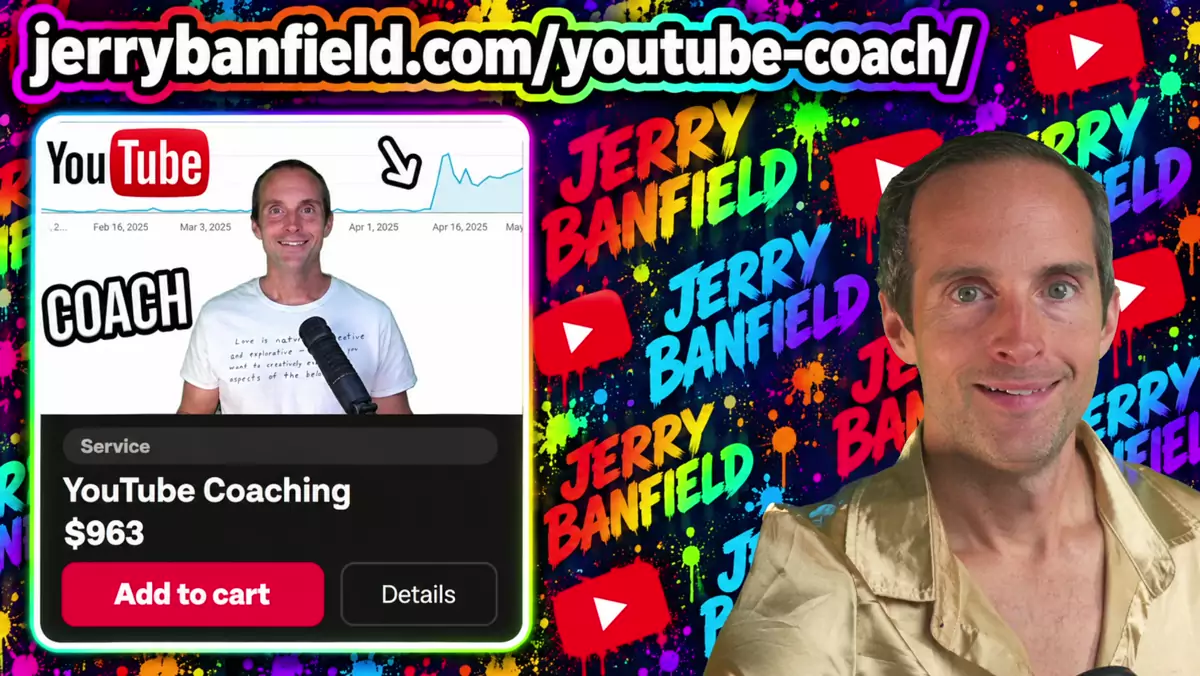
So every video now sells something and sends people to my website. The video is there for the free value. What I say and everything I show is the free value of the video. But every video needs to very clearly and obviously sell something. So all my videos on my Content Creators channel going forward will sell something related to this: YouTube coaching, content creator coaching, a complete YouTube course (videos like this are like practice for filming a more polished version of the course), or maybe a Jerry Banfield shirt or something. But for every one of my videos going forward, the thumbnail is a great place for me to show something I'm selling. You see it right there: Jerry Banfield, YouTube coach. If somebody who's never seen me before understands the context of my video, it's "okay, this guy's telling people about YouTube," and then my video title gives people the value.
Fewer views, far more people who know what I sell
Now, in some cases I may get fewer views doing that. But I'd rather get fewer views on a video like this. Let's say a video like this gets a thousand views. If I have a generic background on it, or I put some generic YouTube logo and a rising views chart on it, like an old thumbnail I used before for my YouTube coach service, then maybe I'm selling YouTube coaching, maybe not. You don't know what it costs. But the new one is also reactable. My haters, my critics, the people who like to make fun of me: I've made this so it's very reactable. They'll be like, "Look at this failed YouTuber who's trying to sell YouTube coaching." That'll generate additional reaction videos, and it has the URL directly on the video, so those could bring people in.
Let's say in scenario one I get 3,000 views on a video because it had a generic thumbnail. Sales from that: probably zero, because I wait till the end of the video to sell it, I hardly mention it, people don't know how much it costs, and by the time I mention it, half of them, if not two-thirds or three-quarters, have already left the video. Whereas with the new thumbnail, every single person who even scrolls by it sees what I'm selling.
So let's say I only get a thousand views on this one instead of 3,000, because I'm blatantly selling something in the thumbnail. It could even be more drastic, but it's probably not, because I've tested thumbnails for smaller channels that people have never heard of, and they don't actually matter that much. You can do whatever you want in a thumbnail, make it over-perfect; people haven't heard of you, YouTube doesn't know who should see it, it's a competitive niche, and it doesn't matter what you do with your thumbnail. It's not going to matter that much. I went through that evidence in No Title or Thumbnail Will Get Your Small YouTube Channel Views, and it's exactly why I can afford to use the thumbnail as an ad.
So realistically, maybe I get a thousand views blatantly selling like this. However, how many people now know that I'm selling YouTube coaching? On the generic one, people might realize I'm a YouTube coach or they might not, but they don't know enough about where to go and where to buy it. On the new thumbnail, even if I only get a thousand views, I get 10,000 impressions, if not 20 or 30,000 impressions. It shows exactly what it costs. It's super obvious. And instead of pitching to a tiny fraction of people at the end of the video, I've just pitched to 10 or 20,000 people. This thumbnail is also more likely to get a person who's actually interested in my coaching to watch, because they see the price up front and it's within reach.
Why I sell coaching the opposite way from everyone else
A lot of these YouTube coaches have this stupid crap where they try to make it as scarce as possible, because all the authority people are telling them to do that. That does go with a lot of human psychology for the masses and the way people are used to being sold to. However, there are other groups of people who are tired of all that crap. And if you just tell them how much it costs and where it's at and show some experience, they go buy it immediately. So that's my people. My people are tired of it. They're tired of wasting time. They're not going to apply to some dumb YouTube coaching program. They're not going to be in the next jumpstart cohort. They're not going to get some vidIQ coach or TubeBuddy coach or whatever.
I have never done somebody else's YouTube coaching program. And I've gotten over a billion impressions online and hundreds and hundreds of millions of views. You don't need other people's programs. I've talked to many people who've taken other programs, and they generally don't tell you anything better than what you could watch for free. You just get tricked into it. To me, the only value in YouTube coaching is to have somebody who's actually done this look at your channel and give you feedback.
So that's all my YouTube coaching is. I will look at your channel. I'll give you feedback. I'll talk to you personally. There's no group coaching, none of that garbage. It's just me directly interacting with you in four one-on-one calls, pure value, no fluff. And then I'll answer questions in between calls. If you're asking about this title or that thumbnail, if you have specific questions, I'll answer those. I wrote about how I arrived at that format in I Built the YouTube Coaching Offer I Could Never Find.
So my YouTube coaching is set up to provide massive value, where the majority of the programs I see out there do not appear, from what I've seen and from the people who've taken them, to provide much value for most people. Occasionally there are outliers, and those get survivorship bias. The outliers from other people's programs probably were going to do well anyway, or maybe they didn't know that stuff yet and they could get it. So the idea is that if you're watching this right now, and I don't know for sure that you are, but I'm guessing it's probable, I know that I'm filming it.
I know that every one of my videos will have at least one person watch the whole thing, if not hundreds. And I want to get people to click on my video who have some openness to paying for YouTube coaching. So this thumbnail strategy is a pretty hard filter, as well as a way of selling to a whole lot more people.
Transparent selling attracts the people I want
This is my latest thumbnail strategy, and I'm really excited about it, because I want to make $10,000-plus a month, and I want to offer you value that's worth it. In order to do that, I need to communicate to you exactly what I'm selling, so you know what it is, and it's transparent, and it's not weird. It's not hidden. It's not "how much income do you make?" The way most YouTube coaching is sold is disgusting to me. And therefore I'm selling in a different format, which then attracts people who are interested in that specifically. So that covers the relevant offers and services quite a bit.
What we're going to get to next is the new content production formula to support that. The thing I've been obsessing over is: what should my workflow be? How do I use my time effectively? And one of the big things I just hit on is that I should be selling something in every video, because that's a real monetization opportunity. For a small YouTuber like me, it should be super obvious. If it's not super obvious, I don't have enough people watching to make a whole bunch of sales on the hundred people who actually watch all of my vlog every day. But on the much bigger audience that scrolls by, and the people reacting, I do.
My new content production formula for six channels
Here's my new content production formula with six channels. First: one complete vlog per day, which I already filmed today. It was 30 or 35 minutes. I told the whole story, and a lot of times my vlog gets me to figure out what else I want to talk about. If I ended up talking about dating for 20 minutes in my vlog, then it's clear: let me do a dedicated dating video. And lots of times I can dump the video into Claude, get a transcript and metadata, put that into ChatGPT, and it will give me more ideas based on what I already talked about in my vlog that I can then elaborate on in a dating video. Today I was talking a lot about YouTube, so I thought, all right, I need to just get all this information out.
That vlog is a nice baseline. That's a video I do every day no matter what: good day, bad day, ugly day. I think it's really important to consistently publish one video a day, and that's something most people should be able to do. I made that argument in One Video a Day: The Simple YouTube Strategy Nobody Wants to Hear, and the daily vlog is how I actually live it. That's what I do every single day, a vlog, because those are the videos you're going to appreciate most that you did 10, 20, 30 years from now.
If I could go back to when I first started doing videos on YouTube in 2011, the one thing I wish I'd filmed every single day was a vlog. Just talk about your day. Talk about whatever you're feeling. I wish I could go back to the day I met my wife. I did do a daily autobiography series, like the day I got separated. I'm so grateful for that, because at the time I wasn't doing YouTube, but I put it into a book called Daily Autobiography. There are some amazing days in there. There are about six of those books on Amazon, and I probably should have a copy of my books here to show, but in some of my videos I will sell my books on my vlogs channel.
So I think the number one form of content every YouTuber should create is a vlog. Just get on there and talk about your life, real and authentic, like I'm doing. And then from there, it should inspire the rest of what you're creating. If you're brand new, that's also the fastest way to get the reps in, which is why I wrote New YouTubers: Publish One Video a Day to Win Long-Term.
So what I'm doing after the vlog is creating some videos on ICP a few times a week, a few crypto reviews every week, a few dating videos every week, maybe one or two videos on the Content Creators channel, and I'm just going to play around with the games a lot more.
Default length, and not repeating yourself
The default video length is ideally 20 to 30 minutes: shorter when the topic deserves less time, longer when it deserves more depth. This is a very deep video. And what I do now is, if I don't have a bunch of new information, I don't need to do a video. This is something I've recently realized: I don't need to do the same video every single day on a channel. I don't need to say every day that ICP is awesome and here's why it's going to go up. This video is a bunch of new information all packaged into one, so it deserves a complete master-class video. But until I have maybe several more days, a week, or two weeks of new data on YouTube, I don't need to put up another video about YouTube creation, because if I explained it in this one, I don't need to do it again. I've burned out my audience in the past by making videos that were way too repetitive, with the same content over and over. So don't do that.
Then Shorts: one to three strong Shorts per active channel per day when good material is available. What I'm doing right now is, if I have a backlog of Shorts, I'll crank out three Shorts a day. If I get to the point where I don't have a backlog anymore, I'll go down to one or two. Right now I've recorded so much content that some of my channels have 60 or 70 Shorts that need to be published. So I'm just cranking out three a day until I get down to fewer. I think over time I'll get down to one or two a day. For the automation, I use Restream, and they've got an affiliate program.
Live streams as planned community events
Live streams: one to two planned community events a week. This is one the data showed very clearly. I want one to two live streams, and maybe a gaming stream can be an impulse stream just for fun. But one to two planned community events each week, where all the Jerry Banfield people from all my channels can come hang out and interact with me. I'll share these in advance. We'll get as many people as we can on. We'll make it members-only chat to stop all the haters, and anyone who somehow says something nasty anyway gets banned, and we'll have an "I love Jerry, let's talk Jerry stuff" environment. The community events bring people together. They'll be a fantastic opportunity to sell anything, and for me to get to know my audience and learn what kind of videos I should make the next week. Each event needs to have a clear reason to attend.
How much I actually work
My time: I only spend about three to five hours working a day. This is what's cool. You don't have to grind this out. But I'm not working another job, so all my work energy is being dumped into YouTube. All my mind power, all my physical energy, is going toward YouTube. And this is seven days a week. Some days, like when I have my kids Monday, Tuesday, and Wednesday nights, I don't have as much time, and maybe I'll work one to three hours. Other days, when I don't have my kids, I'll work seven or eight hours. The goal is to be consistent over time: sustainable results without burning out.
What matters more than total views
To wrap up this part, let's talk about what matters more than total views. I don't check audience retention much, but if I do a 15-minute video that gets 16 minutes of average watch time versus a 30-minute video that gets 16 minutes, well, the 30-minute video was a lot more compelling. One of the big things I obsess about is how much time it took me to produce a video. This video will have taken about an hour and a half total: filming it, getting the research ready, and uploading it.
Then the big part of that is revenue and business opportunities. If I do this hour-and-a-half video and I get one single YouTube coaching sale, and this video plus the YouTube coaching takes maybe 10 hours of my time, then I've made a hundred dollars an hour. In the YouTube coaching you get four hours of coaching directly, video call to video call, and then let's say you need a few more hours of help over text message or WhatsApp. So my expected input is 10 hours for this video, and my expected output would be a thousand dollars.
So my goal, ideally, is that every single video I make has the chance to earn at least a hundred dollars an hour for my time, because then if I work 30 hours a week, I can make $3,000 a week. That's enough that I can pay all my bills and do this full time. So the bottom line needs to be that every hour of my work leads to about a hundred dollars an hour in income. I charge a lot more per hour for a single one-off call, but if it takes me several hours of making videos to generate one call, then that comes out to about a hundred dollars an hour. And if you want to have a call every single week for the next year, we can set that up on an ongoing basis instead of booking one call at a time.
So these are the key metrics: the time it takes me to publish it, how much people actually watch it, and then how much revenue I make off it. Because what separates a professional content creator from an amateur is that this is a business for me. I have stuff to sell. I'm not out here just trying to talk and get attention. This is my full-time job. So if my videos are not turning into income, I'm not doing my job.
And the income I get should add massive value to the people who pay it. My goal is that it should return at least 10 times that much to you. You talk to me once a week, and I'll help you identify things you're doing that are inefficient and wasting time, which I'm very good at pointing out, and help you identify ways you can do things faster, to get ideally double the results you're getting in half the time, which would be a four-times improvement in your workflow. So the goal with selling stuff is to give people value in exchange for what they're paying. And if I give 10-plus times as much value as people are paying, then people are going to be very happy to pay for my coaching, as they have been in the past.
The people who have made millions of dollars after spending a few thousand dollars getting coaching with me have said that was some of the best money they've ever spent in their business, and they've said it in some of their own videos. With that in mind, let's wrap up with the biggest lessons I've gotten from all these uploads.
The biggest lessons from 1,200 uploads
One: viral videos are not required to reach millions of views. You can literally just grind. I have made content for lots of different kinds of people. You can make content that helps a very specific person, get millions of views, and make plenty of money. Ideally, you want a combination: put a ton of value into one video that's easy to create, and then don't make another video until you've got a ton more value. Unless it's a video that's easy to create, like vlogs, and then just do that every day, for practice, to be regular, like bowel movements.
Two: a complete episode can be much more efficient than several short fragments. To me, I'd rather do one one-hour YouTube video every week than split it into two 30-minute ones, because yes, that's two different ideas, but that's also twice as much work planning and uploading, and then it's just one thing for you to share instead of several different things. However, not everything needs to be turned into a complete hour-long master class. A master class on your subject like this one is intended to give you deep lessons I've learned from 1,200 videos. This is a long subject with a lot of depth to it, and we're really just scratching the surface. This could be a 10-hour talk on all the details of everything I brought up here, but I've tried to give you the things that are most important without diving into unnecessary nuance.
Three: strong topics and titles matter more than hitting a publishing quota. What's nice with an hour-long video like this is that I can use the AI to go through all of it and ask it to find me the absolute best title. Then I can A/B test three different titles to see which one hits the hardest, and from there I can get the very best results in the algorithm. If you want the deeper version of how I think about titles and topics that keep working, that's How to Get So Good at YouTube You Can't Stop Going Viral.
Four: Shorts help with discovery, but they're only worth it if they don't add much additional time.
Five: live streams are valuable for community, but they should not dominate the schedule. This is the biggest learning lesson for me in the last 24 hours.
Six: every different channel has different strengths and deserves a slightly different production strategy, and ideally each one needs to fuel all the other channels as well.
Watch time and revenue are the only two numbers I care about
Watch time, to me, is one of the biggest metrics. Watch time and revenue. What I care about is watch time and revenue. If people are spending time watching my videos, those are people who are likely, but not necessarily, going to buy. But the bottom line for me at this point is revenue. If I had to choose what I'd rather have, a million views a month or $10,000 a month with any number of views necessary to get that, I'll take the $10,000 a month, even if it's only 10,000 views. This is a very important thing to get straight in your head. Would you accept 10,000 views in a month if that would give you $10,000 in a month?
Right now, this one video could make me $10,000, either from one person buying a lot of coaching or from 10 people buying one month of coaching. This one single video could make me $10,000. It also could make zero. But I'd imagine the estimated average revenue on it would probably be at least a thousand. So then look at it this way: if you do an ICP video where you get $20 in ad revenue, versus a YouTube video talking about coaching where you get a thousand dollars in revenue, even if you get five times as many views on the ICP video, the YouTube video is much more worth doing.
So to me, revenue, at least in terms of being full time, is the biggest measuring stick. If I'm not making revenue with my videos, it kind of doesn't matter. Views are nice. But the main signal is: where's the revenue coming in, and how can I do more of that? That continues until it gets to a point where I'm making tens of thousands of dollars a month, and then I don't urgently need to optimize for revenue. At that point, I need to optimize for consistency, sustainable consistency. I used to just grind out a video every day on every channel, and that's not necessary, especially if it's long form. Consistency would be valuable in doing one of those every week, but I don't need to do the other six videos.
Use quantity to discover what works, then concentrate
Publishing a large amount of content is useful when the results teach you what to do differently. And that's what I've done. I've published a ton of different content to try to figure out where I should optimize. I used quantity to discover what works. And now I've figured it out: I need to maximize more complete episodes, make better use of my time, and make every hour of my work count, where ideally every hour of my work is worth a hundred-plus dollars.
Sometimes on live streams it directly is, for every hour I'm live. A big community stream can add up to a hundred-plus dollars an hour in Super Chats. Every hour I spend on an in-depth YouTube tutorial or a content-creation case study can lead to hundreds or thousands of dollars in coaching sales, which is hundreds of dollars an hour on that. And I have meme coins in crypto, so every one of those videos could contribute to people buying meme coins. So it's got to be a complete business system.
How working with me goes
If you've read all the way to the end of this, I have extremely high confidence that my YouTube coaching program will be very good for you. It's utterly simple. No BS. You buy the program. Then I will reach out to you, or you'll get an email automatically that you can just reply to with your YouTube channel. I'll immediately look at it. We'll have a call once a week. If you want to do four calls in one week, we can do that, but the general pace is to have one call every week with me on Zoom, and we'll talk about your channel.
If you want to do a collaboration with me and talk about something like dating or content creation on YouTube, we can do a collaborative video where I will help my audience find you. What I'd love to do is have some of you who do the YouTube coaching get on Zoom for at least one of our four calls, and I'll do live coaching. It doesn't need to be live streamed; we can record it, and I'll go through and give you feedback live on your channel, and you can talk about it. That will be a really good video for other people to see me as a YouTube coach, to discover your YouTube channel, and to take some of the same kinds of thoughts and apply them to their own channel. I'd love to do some of that to introduce my audience to you. You'll find those sessions, along with everything else I've learned about YouTube this year, in my Content Creators playlist.
And for anybody who does YouTube coaching with me, any topics you cover that I cover, I will shout you out whenever possible, like Joe Parys and Superman Crypto in my crypto videos. They worked with me in the past, and I still shout them out years and years later, even when they have more subs than me now, after I deleted all my channels. I consistently shout out other creators I've worked with in all my videos where they're relevant.
Some creators, because I've been demonetized and banned and canceled a few times for going way too viral and for taking on the kind of BS system we're in, challenging the matrix, prefer to be kept private. They love and respect my experience, but they're like, "Yeah, don't mention me in public. I love what you do and you've helped me a lot, but I want to work with you on the down-low. Tell me what you really know. I don't want people to know that you're the reason I'm getting these results." So there's that too. If that's you, either way can work.
So I invite you to get YouTube coaching with me. It'll make my day.