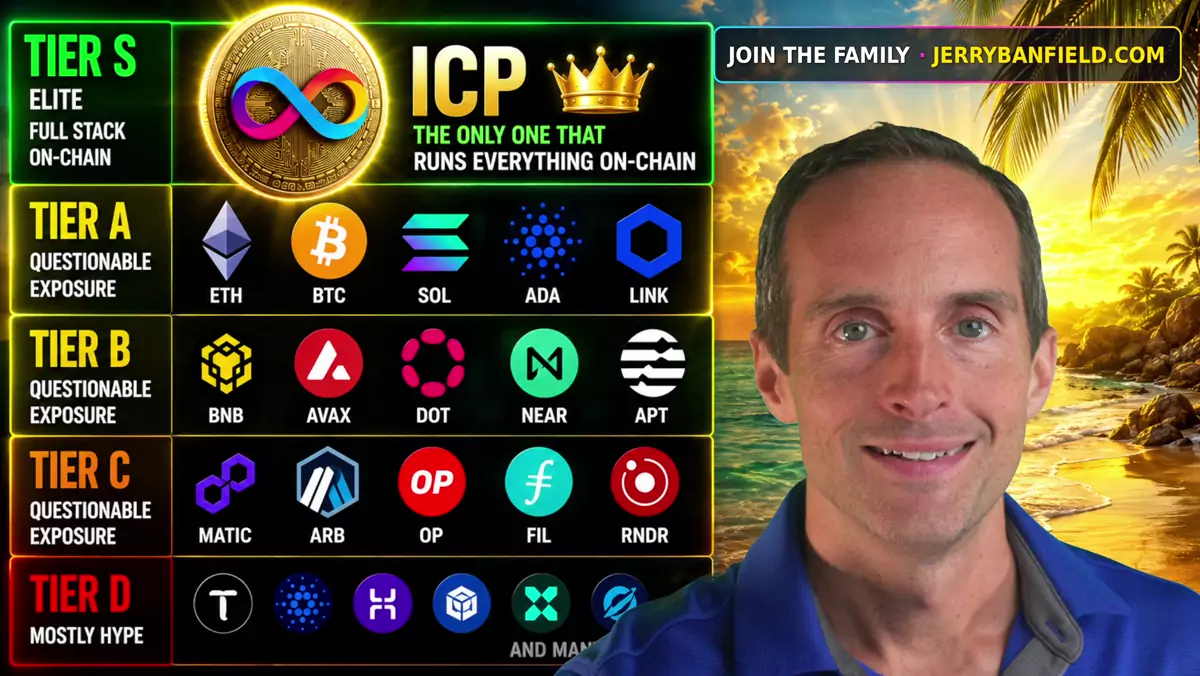
The Red Pill in the Crypto Matrix
The one clear finding from reviewing these top projects — AI, real world assets, DePIN, layer ones, meme coins, all kinds of things — is that the one that stands out from all of them is Internet Computer Protocol, because in my review it is the only elite full-stack on-chain platform, and everything else is what I will call fake exposure. I'm going to highlight the critical issue with every single other coin, because once you understand this, it kind of ruins the rest of crypto. This is the red pill in the crypto matrix, where you see that what almost everybody else is giving you, in my opinion, is fake exposure, hype, narratives, and speculation. The one project I don't see doing that is ICP, because the coin is the governance and it's the utility, it runs all of it on chain, and it's a new infrastructure for the internet. I have a Jerry Banfield ICP channel where I go through more about what I like about ICP.
What we're going to look at here is a very important concept you need to understand called fake exposure, where a project can have real technology, real user experience, real revenue, and real partnerships, but its token may give investors little or no direct exposure to that success. Now, that doesn't mean the whole project is fraudulent or useless. It means it's a very dangerous investment situation that people holding these coins are not appreciating. So let's dive into this. This is an outline with several thousand words in it, containing some of the most important information you can take into crypto.
Right now, people will look at a token and let it sit there in a wallet on a centralized exchange where you don't even actually have custody of it. You're just taking their word that they have an IOU. And even when researching, investors confuse the project, the company or the foundation behind it, the technology or the network, and the publicly traded token. Here's the thing: buying the token does not necessarily give you hardly any of the rest of that. Basically, if the token does not give you control by code or by law, in my opinion it is not a good thing, and it is extremely questionable whether you own anything valuable. The only token I've found that comprehensively gives you real voting power, with things set up where code is law and it's enforced on the entire infrastructure — not just on a tiny blockchain, but enforced at the level of the website, the images, the database, all the code in the app, and the state — is ICP. Out of all of crypto, ICP is the only one I've seen with that setup, where the token can actually control things physically by code. Most of the rest of our setup is based on being controlled by law — that's how most of the rest of our world works. The idea in crypto is control by code. But the problem is that can't be real unless the code controls everything, not just a blockchain where everything else is hosted off chain.
Chainlink: The Clearest Example of Fake Exposure
So let's dive into specific examples of many popular coins where I'm going to burst your bubble. Take Chainlink. To me, this is the clearest example of what I would call fake exposure. And this is where, again, you've got to watch what you're talking about: Chainlink the foundation, the company, the business — not the token. Chainlink the company provides useful blockchain infrastructure, although in my opinion it pales next to ICP and serves the old infrastructure. They have Oracle data feeds, cross-chain messaging, proof of reserves, automation, and identity and compliance tools. And obviously, I'm not a financial advisor, I'm all in on ICP because of the technology, and this is not financial advice.
But here's the critical issue almost no one understands — and what I'm telling you here is something you can verify yourself with AI. When people understand this, I believe all these tokens stand to lose massively, when people realize what they're sitting there holding. For example, if you hold the LINK token, you don't own any of Chainlink Labs. You don't own any of its software. You don't own any of its enterprise relationships. You don't earn any of the revenue earned by its affiliate companies. You don't earn anything from the assets its oracles report on. You get no percentage of the Chainlink network. LINK does have legitimate utility — it can compensate service providers — but that's vastly different from owning anything of the real project.
The question is: can Chainlink's businesses, partnerships, and adoption grow without LINK holders receiving an equivalent share of value? I used ChatGPT Pro to prepare this research, and its conclusion, based on the actual documentation, is yes. Chainlink as a business can do just fine while the token holders do not get a fair share of that real business growth. That doesn't necessarily make the LINK token worthless as long as people believe. But the problem is the token is an indirect proxy for the success. That's a phrase you should get in your head: indirect proxy. In my view, that's almost everything else in crypto besides ICP — an indirect proxy. Does investing in something that's an indirect proxy sound like a good idea? I certainly do not think it does, which is why I don't hold any of these other coins. I don't want to invest in an indirect proxy. When you're holding LINK, it's an indirect proxy for the success of the wider Chainlink ecosystem, and it provides no real ownership. And if the token goes to zero, there's no legal accountability. There's nobody who's going to be able to help you. And if you lose the token, same issue.
The Risks Nobody Is Appraising
To me, for the modest returns you could possibly get holding some of these altcoins besides ICP, I'd rather just hold something where there's no possibility of total loss. If you buy a stock and you've got it with your bank or 401k, there's no possibility you somehow lose your entire account — the law is going to make sure you keep your account. That's a gigantic risk with all these other tokens. ICP has the best setup for that as well, in my opinion, because it's fully on blockchain and none of these others can do that — though you still could lose your ICP account too.
So people are not accurately appraising the risk of holding all these tokens, which is what this post is about. You are holding tokens where you could lose the token yourself and nobody can help you. Or somebody else holding it for you, like an exchange, could lose all of it and nobody can help you. Or the project itself could go to zero, and nobody can help you, and nobody will be held accountable. Those are very dangerous investing situations. And this same pattern appears everywhere. Tokens across the board provide things like governance, staking fees, and access to services, but none of those make the token equivalent to the entity, the revenue, ownership, or a claim on the technology.
Now, ICP, to be fair, doesn't give you a claim on DFINITY either. It just has, in my assessment, the absolute highest level of value capture and control, by far. It does not give you control of DFINITY or the organization that created ICP, but it does give you actual voting power over things that happen directly on chain. In theory, you could even overrule DFINITY's voting power and control the network by holding the token. That's vastly different from what you can do elsewhere, where governance tokens are basically polling mechanisms, because the stuff off chain cannot actually be governed by the token. It's physically not possible.
AI Coins: Off-Chain Intelligence, On-Chain Rewards
Let's look at AI coins — another perfect example, in my experience, of people getting annihilated by putting money into something that's extremely questionable when you examine it. AI coins offer off-chain intelligence and on-chain rewards. I've been in crypto 12 years, I've done crazy amounts of research, and this setup immediately screams huge problem to me: a gigantic value disconnect. The AI category contains some real technology, but outside of ICP, very little AI is actually operating under blockchain consensus.
BitTensor, TAO, which I've ripped so many times, is a perfect example of this. All BitTensor does, as I see it, is coordinate a marketplace of specialized subnets — miners that produce outputs or provide services, validators that grade those, and subnet owners who define the incentives — with TAO emissions keeping this whole flywheel marketing thing going, which I believe will fail as soon as the price doesn't constantly go up. The blockchain can record registration states, validator weights, subnets, rewards, and emissions. But the AI models cannot run at all on the BitTensor blockchain. To me it becomes a total trust-me-bro system that looks like it could easily be gamed by insiders to pay themselves. At this point, you'd have to prove to me that's not happening, because in crypto, my default assumption is that everybody's out here to rip everybody else, unless you can offer proof beyond a reasonable doubt that that's not what's happening. And the only way to do that is to look at what the actual technology does and what problems it solves for the world, so I know it's doing something besides talking and trying to look useful.
When you look into the details with BitTensor, you have validators assigning weights to miners, but that's not the same as proving an AI answer was objectively correct, useful, original, or honestly produced. This means that in almost every case, in my opinion, it would be better to use centralized AI like ChatGPT, Google Gemini, and Claude, all of which I use every day. I see no reason anyone would use BitTensor once you understand how the infrastructure works. In my opinion, it is just there to extract value from people who do not take the time to understand the details. And I want you to be one of the people who takes the time to understand the details. If you're going to be holding money in crypto, the bare minimum you should do is your research — look into the details. AI can make that super easy if you ask the right questions and pay for a high enough model.
BitTensor is a perfect example of where, when you look into how this is designed, you could have — and I suspect there are — subnets where the miners, validators, and subnet owner are all the same, jerking the rewards in their favor, with no reason to even use any of it. And if people are exploiting the system, the centralized team has to step in and stop them. In my opinion, this is not decentralized AI at all — when you look into the details, I think it's a joke. But then one of the founders goes out there acting like this is the biggest invention since Bitcoin. When I go through the actual documentation using AI, I don't see how that claim holds up. In my experience, BitTensor and many other cryptos take gigantic marketing leaps where their real innovation is absolutely minimal. Somebody could use AI and spin up the exact same thing on ICP, probably within a few hours, using Claude.
Billions in Market Cap for a Scoreboard
Somebody could spin up the exact same basic thing that BitTensor has set up right now — a project that has somehow reached billions of dollars in market cap when, as I see it, all they're doing is running a token incentive marketplace for off-chain work. In my opinion, that's absolutely worthless. And the marketing describes it in a way that even the AI is nice about in its language. I'm less nice, because I believe you've got to be very clear and direct about what's happening here or you're going to get ripped off. The questionable leap, according to ChatGPT, is describing the marketplace as though the blockchain itself created or verified it. It did not — it had nothing to do with it. The chain sits there and confirms the scoreboard.
And there are all kinds of coins like this — pure category inflation, just sitting there trying to catch your attention. In my opinion, almost every crypto at this point functions as a distraction from ICP, because as soon as you see what ICP does, you're likely to do what I've done: sell every single other crypto, never have any interest in them again, bad-mouth all of them indefinitely, and only hold and buy ICP. That's why this information is so dangerous. That's why I believe almost nobody tells you this: they've been paid to show you the rest of these, they have confirmation bias showing the rest of these. Most other crypto influencers, from what I've seen, don't even do research anymore beyond looking at charts and doing the minimum to get you to watch their videos.
Why I Talk to You Face to Face
I actually talk to you all in the Jerry Banfield Family, unlike most other crypto content creators. I talk to you face to face. A woman came in just today, joined the Jerry Banfield Family, and booked an hour-long call with me for tomorrow. I see you all face to face, which is why I hold myself to a level of integrity and research beyond what almost anybody else offers. It's easy to lie to people you don't see. It's easy to say anything you need to make money when you don't see the consequences of it. I used to be like that. I stopped doing that years ago, and now my approach is: let me find the best information in crypto and just give it to people.
Render and the DePIN Problem
Now let's look at Render. It has AI-relevant infrastructure, but in my review it's the same actual problem as BitTensor: a token with a marketplace where everything real happens off chain. When you look into the details, I believe almost no one would try to render anything with Render instead of using centralized AI, because centralized AI is going to do a better job in almost every case. Trying to use consumer GPUs scattered all over a network with a token marketplace is, in my experience, an absolute nightmare. Almost no one who knew what they were doing would do it. I would suspect a lot of what is being done on it is paid partnerships and incentivized use of the network — more than likely, in my opinion, there is almost no organic use. And I've come to believe this describes most of crypto. I've been on the inside long enough to see how this works, and in my experience, almost none of it is legit. Almost everybody is saying whatever gets them paid. You should treasure anyone who actually cares about you enough to tell you the truth, when telling the truth is often actually punished. We could go across the board with all kinds of examples of that, but we'll stick to crypto here. The AI category, in my opinion, is totally poisoned. Almost everywhere you go in crypto, the game looks to me rigged to get you into something that has no value and is purely fake exposure.
DePIN is next — I just reviewed all of these same structures. Normally they work like this: independent providers contribute resources, a company or protocol coordinates the marketplace, and the physical work happens outside the blockchain, with a token sitting there supposedly trying to capture some kind of value — Render, Akash, io.net, Aethir. They provide some real resources, they might connect customers, they do have limited infrastructure. But the limitation is that the computation performed is difficult to verify, and the blockchain itself basically just concludes that a payment happened or a job was assigned. With this setup, in my opinion, you're better off just using centralized systems, because they're more powerful, there's more accountability if they screw something up, and they generally have much bigger infrastructure. These DePIN networks strike me as almost useless, because they are generally truly centralized — the blockchain itself does so very little.
Take Helium, for example. They did build some genuine community-operated wireless infrastructure. But all of that — the coverage and the package delivery — occurs in the physical world. The blockchain has to depend on all this stuff off the chain. So there is some real infrastructure created, but it's not the same thing as having it all on the blockchain, and it's not the same thing as the token really capturing all that infrastructure. And you can't even say it's really decentralized when the token itself cannot control the interfaces with the actual infrastructure. Then you have Filecoin, Siacoin, and Arweave. They do offer some limited functionality. But again, this gets into: why would somebody use these instead of Amazon, Google, or Microsoft, which have more storage for as cheap or cheaper and all kinds of other ways you can access it? If you want the blockchain, you really need everything to be on the blockchain, or much of it ends up being useless in my experience.
Real World Assets: More Risk, No More Reward
Real world assets — same story. Holding a gold token is, in my opinion, much more dangerous than having an actual gold bar or a gold stock sitting in your account. With these real world assets and all the hype, so much has to stay off the blockchain, and the blockchain is supposed to produce trust — but when all this stuff is off chain, it's hard to trust any of it. It looks to me like the blockchains are just being brought in to produce liquidity. You don't need a Pax Gold token. I talked to a guy on Zoom before he scheduled a call with me — this guy had around $70,000 that he couldn't find in Pax Gold, sitting in some wallet. I helped him figure out where it was. He had something simple he hadn't done — he hadn't loaded the token — and I helped him find it. But this guy thought he had lost $70,000 of a gold-pegged token because he didn't know how to access it. That is so much more dangerous than just having a gold stock sitting in your retirement account.
The problem is that all these real world assets offer so much more danger than the regular, legal ways of holding things — and they don't offer any more reward, which is huge. That's because all the underlying stuff remains off chain, which means you keep all the off-chain risks. Holding Pax Gold, you take all the risks you'd take with gold — the gold price could go down, something could happen to it — plus all the additional blockchain risks, with no additional gain. Or take a tokenized house. Imagine you have a deed to the house on chain. With everything besides ICP, you could not put the whole title history, inspection reports, photographs, insurance records, liens, mortgages, and taxes on the blockchain — which means it could all be hacked, which means you can't trust it. So I believe it's going to be hard to do real world assets using anything outside of ICP, because you can't trust the interface and what you're working with when everything off chain could be hacked or manipulated. And you have to trust some third party — at which point, why are we even using the blockchain if we have to trust a third party? Yes, there are some legitimate projects, but to me the risk doesn't make it worth it.
Scoring 100 Blockchains on 100 Questions
When you look into the layer ones and what they actually score on technology, like I showed in my last video, here's what I found. I had ChatGPT Pro come up with 100 questions about what the actual technology can do — zero-or-one answers, not speculation, not hype. Read the actual documentation, figure out what this blockchain is actually doing and what it's actually capable of, then score all of it. I made an entire gigantic website at cryptotechcap.com based on a 10,000-cell spreadsheet: 100 cryptos, the top layer ones, and 100 questions for each of them. These are technical capabilities that are very important to what a blockchain can do — for example, full-stack on-chain app hosting, AI and sovereign compute, cross-chain cryptography, DAO governance, ownership, identity verification, and performance. These are 100 things I believe your blockchain should be able to do. I still need to update the Crypto Tech Cap website, but in the updated scores, Tezos got a 28, and that was the highest anything got besides Internet Computer — and Internet Computer got a 97.
This is what the AI research showed me, and it looks to me like a lot of people on the inside of crypto would prefer you not to know it. Because as soon as you know this, in my view, the game of tricking you on all this stuff is up, and they have to pull their money from all these other projects. The main solution then becomes launching a whole bunch more projects on Internet Computer Protocol instead. To me, I hope we never have another bull market for all these other altcoins, and that the next bull market is purely an Internet Computer bull market — ICP and projects built on Internet Computer.
The reason for that is what these other blockchains can actually do in my scoring. Tezos answered yes to 28 out of 100 questions. ICP: 97. Algorand: 25. Ethereum: 22. Cardano: 22. Decred: 21. Near: 20. Sui: 19. Avalanche: 19. Aptos: 18. Solana: 16. BNB Chain: 15. Now, that doesn't mean they have absolutely no value. It means, in my assessment, they all basically work the same — except ICP. They all basically work the same, and their marketing is largely spin about what's supposedly so special, when I find there's almost nothing special about any of them. And the liquidity and the marketing will move to the best opportunity. As soon as enough people see that ICP is the best opportunity in crypto, I believe the liquidity is going to dump out of all the other stuff into ICP. Now, will that happen guaranteed? Absolutely not. Could anything happen? Yes. That's what makes this reality interesting — unless it's a simulation, in which case you can, like Neo, make changes in the matrix yourself and interface with it.
The 10 Percent Tipping Point
If this reality has some legitimacy to it, and the liquidity flows where the best opportunities are, then it happens as soon as enough people see it — and I would estimate it only needs to be maybe 10 percent. Right now, in my estimation, there's only a small percentage of people, less than 10 percent, who see what I see. But every day, there are probably 10 to 100 people watching my videos and waking up to: oh, there's one thing in crypto that's real, and everything else is basically fake exposure, marketing, hype, people getting paid, an industry ripping people off. Once you see that there's one truth and the rest is, in my opinion, basically lies and time-wasting, there's no going back. It's the red pill. You're woken up. And I think it's going to take probably less than 10 percent of people in crypto seeing that before the rest of it all collapses at the same time.
"Rug Them All"
Here's why: I don't believe the insiders are going to let crypto retail get the best of them. Some of them are aware of me. When they look through, using AI, and ask questions like "is anybody on to ICP?" — well, yes, this guy Jerry Banfield goes on about it every day. He's getting thousands of views and tens of thousands of impressions every day. He's out here telling people every day that ICP is the real deal. For now, that's a signpost. I'm converting more people constantly to ICP. And at some point, when it hits a certain level, I imagine the insiders calculating: game's up, rug them all. That literally may be something that happens in a back room somewhere. A guy is going to be sitting in a room, talking to a panel of people, and he's going to say: rug them all, pull them all at once. Bitcoin, Ethereum, Solana, Cardano, Avalanche — pull all of them at once. Pull all our money out of all of them. My hair stood up saying that. And they've probably already accumulated, silently, as much ICP as they can. It'll be some kind of crypto doomsday stock market crash — they'll pull all the money at once and just crush all the projects at once, and crypto retail will be sitting there broke.
So if you're not in ICP before that happens — not financial advice, and anything could happen — but if you don't know this before they know that you know this, I think you're going to get annihilated. I think almost everybody in crypto is going to get rugged to oblivion. It's going to go on as long as possible, and when they know the word is out, they're going to move. And they're only going to wait for about 10 percent of people to know, because if you let it get to 20 or 30 percent, they lose. The people on the inside have most of the money. If crypto retail figures out what's happening and pulls their money from all these other coins and puts it in ICP, you can't have very many people do that — because ICP is so small and these other ones are so big, and they can't absorb all that spot sell pressure when all these prices are based on leverage anyway. So you'd get a gigantic crash that would make you wish for FTX or Celsius. That's how destructive I believe this information is — it has the power to wreck everything else. But there will be a new day, and I expect all these coins and projects will try to put themselves on ICP, signal that they're on ICP, and say they're moving their infrastructure. These layer ones may all desperately try to move on and say they're on ICP. It may be a rush — when enough of us see what ICP is, the whole gold rush may be to get in on ICP. That's one possibility. There's another possibility that this is just a horrible place, nothing nice is ever going to happen, and everybody gets ripped off no matter what. That's possible too.
ICP Is Not Perfect
I've already gone on for about 30 minutes' worth here, and I've gotten through a lot of this. Obviously, ICP is not perfect. There are still software bugs, phishing, malicious governance, compromised devices, bad external information, protocol vulnerabilities, dishonest founders who rug their own protocols, and human deception. But the real thing ICP does, in my view, is eliminate giant attack surfaces. It eliminates entire industries. You can use AI to build your own version of something like Google Docs or Microsoft Office — your own entire document suite — and save a huge amount of money as a business or government doing that, while maintaining control of everything. And it's cheaper.
I was going to wrap up with the seven questions every crypto investor should ask, but I already made a video about that, so we don't need to do it again — you can find that and all my other breakdowns like this one on my Crypto Reviews playlist. I've given you a ton of value here, and this is the future I see coming. The question is whether it will happen and how long it will take. To me, this looks mostly inevitable right now. The question is how long all these other projects are going to keep going with what I call fake exposure.
Where to Go From Here
I appreciate you reading. If you want to keep going with this, join the family and get in that Skool community — I'm grateful we've had multiple people join today.
And here's something worth experiencing for yourself: when you visit my website, you are interacting with the blockchain. The site is served straight from the ICP blockchain into your web browser — mobile, desktop, tablet, or laptop. That's an advanced blockchain that can do that. The other blockchains cannot serve you a whole website like this, certainly not one that loads instantly with 1,200 pages on it like mine does.
If you want a one-on-one call to really talk this out and go deep on anything — dating, crypto, YouTube, life — you can schedule a call with me. Just talk, share your life, and build a two-way relationship where I want to know you. You've just taken in me talking for 28 minutes; I'd like to listen to you. You can share a 28-minute video of your life story, and I would love to hear it.
Hearing your story helps me do a better job as a creator. Thank you for being here.