The Most Powerful Information in Crypto
I'm reviewing every top 50 Layer 1 coin in 25 minutes here, and what you really need to know is that one of these is different from all the others. That's the most powerful information in crypto, and that's the information that is hidden from you as hard as possible. Everything else in crypto is designed to distract from what I'm telling you, and once you see this, you won't be able to unsee it. I'm going off a 60-plus page report of deep research that has scored all of the top 50 Layer 1s on what their technology is capable of. We're not talking hype and speculation and narratives and empty promises from founders — what does the documentation actually say the blockchain can do? Now, I'm not a financial advisor, and this is not financial advice. And you can guess which one of these I have my entire portfolio in, and which ones of these I bought and eventually sold once I realized what this is.
Stop having a one-way relationship with me where I talk at you, and make it a two-way relationship. I want to get to know you. Tell me about yourself and ask any questions you've got when you join the Jerry Banfield Family. You can ask me to review a crypto for you privately, or I'll roast your whole portfolio in the group. New members keep joining every day, and I'm really excited to get to know you.
The Executive Findings: One Chain Runs the Whole Stack
So here are the executive findings. Full transparency: ChatGPT Pro did the research for this following my guidance, and it dug up and read through a ridiculous amount of documentation and asked a huge number of questions to make all of this. This is the kind of research I'm hoping to inspire you to do, instead of just watching people show price charts and talk off the top of their heads instead of looking at the actual documentation.
Out of all the Layer 1s, ICP is the only project in CoinGecko's current top 50 Layer 1 list that is architected to run a complete web application stack. This is the most important information in all of crypto, and everything else in crypto is designed to distract you from how important this is. What does that mean? It means ICP can run the front end, the back end, the immutable storage, the immutable state, the authentication, the autonomous operation, and the cross-chain signing all inside one replicated computing environment. If you're still asking what that means, it means someone like me can host my website directly on Internet Computer Protocol, which you cannot do anywhere else. It means an enterprise can set up their company, rebuild their entire stack, and not be subject to centralized governments or corporations censoring it — and they can have ownership over all their data. It means you can directly interact with other blockchains, which is why there are things like chain-key Bitcoin. It means the entire governance system is built directly on chain. This is so far advanced past anything else in crypto. Everybody on the inside is desperate for you not to find this information, which is why I'm bringing it to you — because they haven't paid me anything to lie. If you're not going to pay me to lie, I'm going to get out here and tell the truth. And I'd hope I wouldn't accept a lot of money to lie like some of these other people have.
The idea here is that ICP's tech is the next big innovation in crypto. After Bitcoin, then Ethereum, then it's ICP. ICP is the only true next-generation Layer 1 blockchain. Everything else is very similar to either Bitcoin or Ethereum. We're going to dive into that now, and I'm going to go through every single coin, all the scorings, and what each one's technology can actually do. You can get the full report inside my Skool community, along with asking me questions.
Layer 1 Is a Label That Hides the Differences
The thing you need to understand is that while all of these are lumped together as Layer 1s, they are very different from each other. Bitcoin, Monero, BitTensor, Celestia, Canton, Hyperliquid, Filecoin, and Ethereum all solve radically different problems. Calling all of them Layer 1 coins hides the difference between what they do — and ICP can do what all of them can do. All of the capabilities they have, ICP can do all of that, and way more that none of them can do. That is how far it is ahead of everything else, and that's why almost nobody talks about it. The price chart has been crucified and everybody hides it.
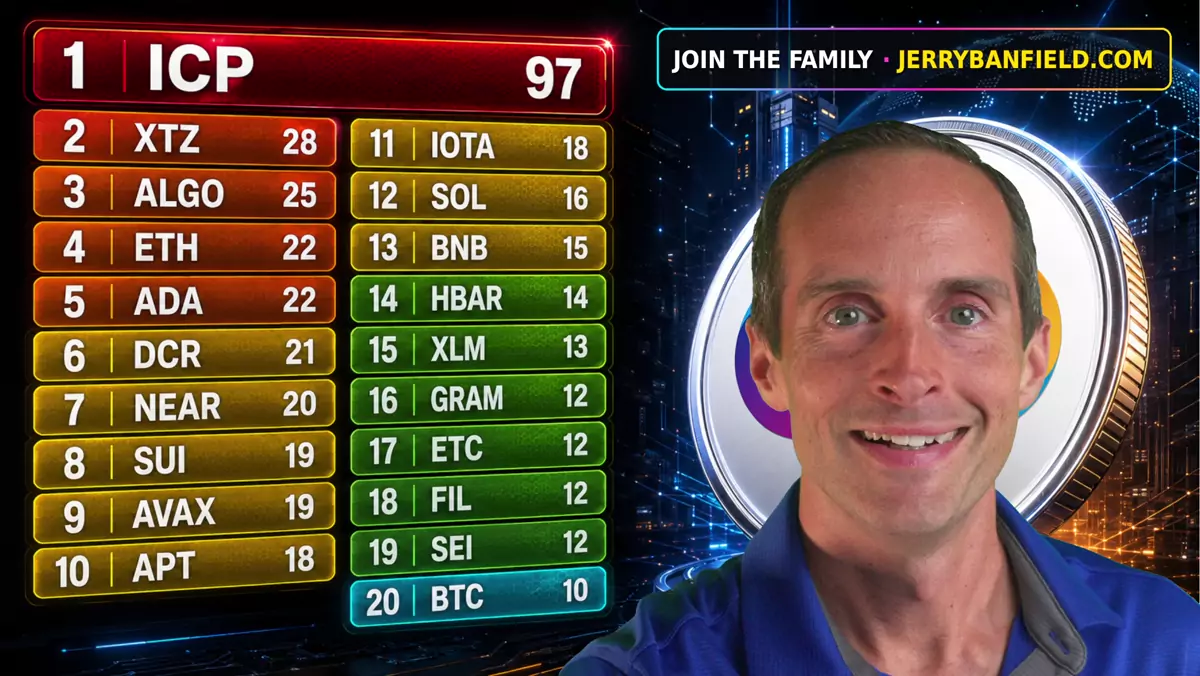
ICP scores 97 out of 100 on what the actual technology can do. The next score is Tezos at 28. Now, I'm not saying ICP has more users or liquidity. I'm saying that what the blockchain can do is powerful — and it's so powerful it solves real-world problems, like hosting my website, which other blockchains can't solve. They're just token settlement layers, which is basically a spreadsheet secured with cryptography. That's mostly useless, in my opinion, because then you have to build centralized tech on top of it, which defeats the point of using it in most cases.
I'll be honest — I had been putting off making this for like three hours. I kept thinking, for God's sakes, can I just say the same thing I've said every other time, then move on with my day and feel like I did some good trying to help one person wake from the crypto matrix? So here's the red pill from the crypto matrix. Do you want it, or do you want the blue pill so you can go back to sleep and speculate on garbage coins?
Yes, there are some of these that are specialists. But here's the truth: most of these smart-contract Layer 1s are technically closer to each other than the marketing suggests. Ethereum, BNB, Solana, Cardano, Sui, Avalanche, Aptos, Sei, Monad, Kaia, and similar chains may vary in tiny details, but the infrastructure and how everything works around them is very similar — unlike ICP, which is not. Then there's Hyperliquid, which you've probably heard about. It puts a tiny bit more of an exchange on chain, but everything else is still off chain, which is not going to work for the long term. Filecoin decentralizes storage, but accessing it is a huge problem. Celestia provides data availability. Canton offers selective institutional privacy — and that's not going to be very useful compared to institutions being able to build their entire infrastructure on sovereign hardware with a blockchain built into everything. Canton is useless next to ICP.
BitTensor is an absolute dumpster fire. It claims to coordinate AI, and it sounds far better than what it actually does. It's a scoring system on the blockchain to score off-chain AI outputs. It's absolute trash, and the marketing behind it is more dishonest than most projects. It's so bad. Watch my BitTensor videos — I destroy it repeatedly. I don't see how a logical person could hear the truth about BitTensor and not conclude this is an utter scam. And then Monero and Zcash protect payments, but you can set up privacy like that on ICP if you want it. These, again, have so many problems: they can only do one tiny thing, you need external wallets, and it's a nightmare. I try not to explain some of this in too much detail.
How Most Layer 1s Actually Work — and Why ICP Is Different
Here's how most Layer 1s work and why ICP is different — honestly, this whole review is basically why ICP is different, and this is what you should understand. The rest of these Layer 1s are useless garbage that has been sold to you like junk food, and like junk food, they're not going to nourish your crypto portfolio over the long term. All of it is crap. People like me who figured this out will never buy any of these garbage coins again, and we'll only talk bad about them. Sooner or later the rest of crypto is going to figure this out. And if you figure it out before the ICP price pumps, I think there are huge opportunities. Most people are going to figure it out after it happens, though.
Here's the dominant pattern. You have these tiny little things on chain — consensus, execution, smart contracts. That's how everything but ICP works. Then you have all this stuff off chain: the compute, the jobs, the files, the media, the search, the RPC providers, gateways, API keys, front end, CDN, DNS, custom interfaces, oracles, keepers, bridges, admin panels, and upgrade keys. That is the mess. That is why everything else scored so low, why the rest of these are so bad, why they keep getting hacked and exploited, why they're utterly unsustainable, and why they don't fundamentally innovate.
The Methodology: 100 Yes-or-No Questions Per Chain
So let's look at the actual ratings, starting with the methodology. There's a 100-question capability matrix — a 5,000-cell spreadsheet with 100 yes-or-no questions asked of each one of these Layer 1s. There are no maybes. There's no "the founder thinks it's going to do this in the future." It's either yes — it's live, native, documented, and you can use it right now — or no: partial, experimental, testnet, just talking about it, roadmap unclear, third party, gateway. This is why everything scored badly.
What's really important is being able to do full-stack on-chain app hosting. Because if you have a token like Chainlink and all the rest of the business is off chain, the token itself is fundamentally a meme coin. It's just a meme coin where you're trying to give something value that's not actually attached by code to any value — and it's not attached by law to any value either. If your Layer 1 isn't attaching value by code or by law, you've got nothing. All these blockchains attach tiny little bits by code and then all the other stuff is off the chain, where it can't be attached by code and isn't attached by law. What you need is to be able to put as much as possible on chain — and for the future, you need to be able to do AI and sovereign compute. If you can't do AI and sovereign compute, you're useless in the future, or in the nicest case, you're undifferentiated. If you just want to send transactions, there's a ton of options — there's no real competition for that. But there is nothing else that can do AI and sovereign compute. And all these chains talking about AI? I reviewed all of them. They're all liars, besides ICP. Their marketing is blatantly dishonest. Take Near Protocol — they're paying out tokens to do stuff off chain with AI. That is ridiculous and useless. I'm just cutting through all the BS for you.
That's how it was scored, and here's the tier interpretation: 85 to 100 is S tier, and the report had to put A tier all the way down at 25 to 34. That's how incompetent the rest of these chains are. Only Tezos and Algorand even had significant increases over the rest.
The Tiers: From S Tier to F-Tier Cults
You can see how the rest of these all lump together. Ethereum, Cardano, Decred, Near, Avalanche, Sui, Aptos, IOTA — all in here doing about the same basic things as each other. Then C tier: competent smart-contract infrastructure with major stack gaps. That's Solana, BNB, HBAR, XLM, TON — formerly Gram — Filecoin, Sei, and Ethereum Classic. Again, they barely do anything. Then almost everything else lands in D tier. And then there's absolute F tier: XRP, Pi, and Kaspa. I love to hate on all of those. They're such trash. They can hardly do anything technically. It's all marketing. It's all basically a cult — you're just drinking Kool-Aid.
And this is what the AI said. I didn't say this. I didn't tell it to say this. I told it: make sure you understand ICP and why that's important, differentiate that from everything else, and look at the big picture. I did not tell it to put XRP, Pi Network, and Kaspa in F tier. This is what it came up with: minimal broad app capability, immature production evidence, or category mismatch — for XRP, which has such a huge market cap and so much mind-control marketing and authority signaling.
I'm trying to help you all wake up here. If you don't want to wake up, go back to sleep. I'm sorry if I've disturbed your dream that this was somehow going to work out with all these garbage coins. And should you really be surprised that all these crypto chains and influencers are ripping you off? Are you surprised that everyone else in this game understands it's rigged and they're ripping you off? I know that kind of sucks, doesn't it? But I've been on the inside of this long enough to know. Everybody on the inside knows the goal is to rip you off. Some of them consciously try to narrate their way around that, while others have the attitude that the viewers are dumb and deserve to be ripped off. That's basically how everybody else telling you about crypto is operating — because this is the cold, hard truth the AI pulled from the actual documentation.
The Scores, Side by Side
You can see the scores right there: Internet Computer, 97 — and on full stack, 25 out of 25. Then you can see how little everything else can do by comparison. Ethereum can barely do anything full stack. Algorand — look at how bad this stuff is. Solana has an elite transaction engine; that's it. Conventional stack, everything's off chain. BNB is just an exchange coin built purely on speculation and BNB pumping its own bags. Basically, all these other blockchains besides ICP are so similar that they're competing for something that isn't even going to be there in the future. They're all fighting over doing something that ICP will do better. ICP does everything these other chains do, within reason — maybe there's a tiny thing or two that others do better. But if you want to send transactions or do smart contracts, ICP does it better, faster, more scalably, fully on-stack. It's a world of difference.
The Entire Ranking, Top to Bottom
So let's go through the entire ranking, so I can show you I actually reviewed every single one of them. Right now, ICP is ranked 23rd among Layer 1s. And that is the secret right here: once more people in crypto know this, the market cap is going to go up at least 10x, if not 100x. This is the hidden information you've been looking for. ICP is sitting there at number 23 on the list — almost nobody would even notice it sitting down there at a billion-dollar market cap. But it's the one outlier that's different.
The next highest is Tezos. Here's the thing, though: Tezos' capability is only slightly better than Algorand, which is only slightly better than Ethereum and Cardano. So why would I want something with only slightly better capabilities? At best, this is a tiny bit bullish for Tezos. But I bought Tezos before and sold it, and I would never buy it again. It's an extremely limited blockchain.
So at the top — and again, these are scores out of 100 yes-or-no questions about what your blockchain can do — Tezos, 28. Algorand, 25. Ethereum, 22. Cardano, 22. Decred, 21. Near Protocol, 20 — with extremely limited functionality for anything you can actually do with AI. On Near you have to do almost every single thing off chain with AI and then just send a transaction or two. Useless — because everything Near Protocol is saying about AI, Tezos, Algorand, Ethereum, Cardano, Decred, Sui, Avalanche, Aptos, Solana, and Hedera could all say the same things. All those foundations could make the same basic claims. It would all be inaccurate, and it would all come down to: we're going to give somebody money to incentivize them to launch a token, the token is going to do a bunch of talk and marketing about AI, none of it is actually going to be on the blockchain, and everybody's going to lose money. How's that for doing AI?
And look at how bad these get. Aptos down at 18, Solana down at 16. This is something people are so hyped about — there are people making Solana hype videos every day. And here's the truth: ICP can do 97 things, Solana can do 16. Yet most people would think Solana is better just because of the market cap and the marketing. But one day, somebody with a few hundred million dollars is going to see information like this, and they're going to tell their assistant: I want you to go buy Internet Computer Protocol and try not to move the price too much, but we're going to buy as much Internet Computer Protocol as we can get. It's just going to take one person with some serious money thinking, I'm going to become a billionaire off of Internet Computer Protocol by itself. That's what I think is going to happen. They're going to look at the rest of these and see they're all trash — and the AI can replicate this research for you. This isn't something I just made up.
Look down at Stellar. So much hype about Stellar, and it can do 13 out of 100 things. Gram, 12 out of 100. Ethereum Classic — why is this still around? This is the original Ethereum from before they forked it and made their own version to lock out the DAO hacker. Filecoin, 12. Bitcoin, 10. This is the number one market cap in crypto, and the Bitcoin blockchain itself can do 10 things while the ICP blockchain can do 97. That's the difference. Any sane person holding Bitcoin has to realize: dang, I've got all my money tied up in something with a trillion-dollar market cap that can do 10 out of 100 things a blockchain should be able to do, and there's something at a thousand times less market cap that can do 97 out of 100 things a blockchain should be able to do. Hmm — maybe I'll rotate my money, or at least some of it, out of Bitcoin and into ICP. That's what I did.
Continuing down: Tron, 10 out of 100. XDC Network, 10. Midnight, 10. Gnosis, 10. Monad, 10. Zcash, 9. Monero, 9. Injective, 9. Provenance — stupid branding here — Hash, 9. Flare, 8. VeChain, 8. Hyperliquid, 7 — and there's a gigantic problem coming for investors here. In 99% of scenarios, now is going to be a horrible time to buy outside of tiny little speculation and potential profits at some small point, and in most cases the price is just going to trend downward. Massive token unlocks, massive hype, and all it does is trade perps. We don't even need perps to be traded in the first place — that's people gambling on what the price is going to be in the future. In my experience, trading perps is absolutely insane unless you've got some advanced psychic research team that goes into an NDE state to look at the future for you. And if you don't have that, why would you be trading perps? It's just gambling.
Bitcoin Cash, 7. Litecoin, 7. Cronos, 7. MemeCore, 7. Celestia, 7. Then Stable, Ultima, and Kaia. XRP, 6. Then Plasma, Canton, and Pi Network. BitTensor, 3 — BitTensor's so bad. Kaspa, 2. Beldex. Telcoin, 1. And this is what their own documentation supports. Now, some of these companies or foundations may not have done a very good job with their documentation — in which case, the AI should be able to find your documentation pretty easily, and if it can't, you've probably got some sorry-ass foundation that's not even documenting well. I'm looking at Kaspa especially for that one. I just did a video ripping on Kaspa — Kaspa solves nothing. It's a couple of guys that threw together a blockchain that's very similar to other things that have already died; Kadena operates only slightly differently. It's just a cult. Technologically, it's useless. And that's the rest of these too: the rest of these are technologically 99% useless looking at least 5 to 10 years into the future. Once people see that, it's over.
Three Architectural Clusters — Really a Tier List
Here's another way to look at this: architectural clusters. Full-stack on-chain cloud — this is the future. Whether it's ICP or something else: one of the risks for ICP is that somebody comes out with something similar. But these other chains can't come out with something similar, because they're so far away from being able to do it. They would have needed to start five years ago. Instead, they put all their money into marketing and having people run their mouths, because they know they're not going to last the test of time. They're just here to make as much money and extract as much value as fast as possible, and then they'll quit when the game is up.
So the first cluster, full-stack on-chain cloud, is the future. Now look at the rest. General smart-contract ledgers: notice how all of those are just thrown in together. They don't stand out. They all do basically the same thing. Then monetary and payment ledgers — this is where Bitcoin, XRP, Tron, Zcash, XMR, and XLM sit. All the hype on these is absolutely insane, because they are monetary and payment ledgers. If ICP didn't exist, it would be different. But when you do have one coin — one infrastructure — that can run full-stack on-chain cloud, the Bitcoin stuff, the XRP stuff, the Kaspa stuff is so insane. Even if full-stack on-chain cloud didn't exist, you'd still have all these general smart-contract ledgers above them. So to me, this is a tier list. Tier one: full-stack on-chain cloud. Tier two: general smart-contract ledgers. Tier three: monetary and payment ledgers. You just have to appreciate how useless monetary and payment ledgers are going forward — they're not even general smart-contract ledgers. It's so useless in the future. In my view, Bitcoin's price is purely based on people having no understanding and doing no research at all. And it's extra crazy that people are looking to hide from inflation with things like Bitcoin.
The Specialist Networks Are Some of the Worst
People have been sold the narrative that Bitcoin is just going to go up forever. It's not. In my view, it could easily collapse just like everything else in crypto, because it's grossly overinflated and does almost nothing. And the specialist networks are some of the worst ones in the whole category. Take TON: what it says versus what it does — it's just a coin attached to Telegram, and it's all marketing. There's almost no actual utility for it. BitTensor's TAO is just blatantly misleading marketing. The top subnet called it out and said this isn't decentralized AI — it's totally centralized, and it's not even AI either. They've literally got the tiniest little simple blockchain setup, and all they do is score off-chain inputs on the blockchain. That's useless. Then Hyperliquid: it's an exchange that puts a little bit more data on chain, calls itself decentralized, and lets you trade stuff that's mostly worthless and not even a good idea to trade — while most of it is still centralized. For example, I can't even use it in the USA. How decentralized is that? If it were actually decentralized, the website wouldn't have told me I couldn't use it when I went there. That's how centralized it is: there's a centralized entity sitting there telling you that you can't use it. All this other stuff falls into the same trap, and there's a whole lot more of it.
What the Non-ICP Coins Actually Have Left
Now you can look into where the real non-ICP standouts are. To me, the only thing any of them have going for them is a cult community property — and the cult totally depends on the price. If the price goes down and stays down on these, everybody leaves. With many of these, you can see the communities are just bots — a huge portion of the quote-unquote community was bots, and people are realizing there's almost no community behind most of these. Even Ethereum's communities have dried up massively. All the branding and marketing for Bitcoin, Ethereum, BNB, XRP, and Solana — that's all they have. They don't have real tech at the end of the day. They don't have infrastructure you can really own and do much with using the coin. So in my experience, all of these are extremely, extremely dangerous.
One last note on the report itself: I didn't even look at the video-structure section it generated, because you don't need to tell me how to make a video. If you want the full 60-plus page report, to ask me questions about any of these coins, or to get your own portfolio roasted, join the Jerry Banfield Family — I'd love to see you get in there today.
And if you want to see me break down more of these coins one at a time — including the videos where I go off on BitTensor and Kaspa — you'll find all of those reviews on my Crypto Reviews playlist. Thank you for reading, and I hope this wakes at least one more person up from the crypto matrix.