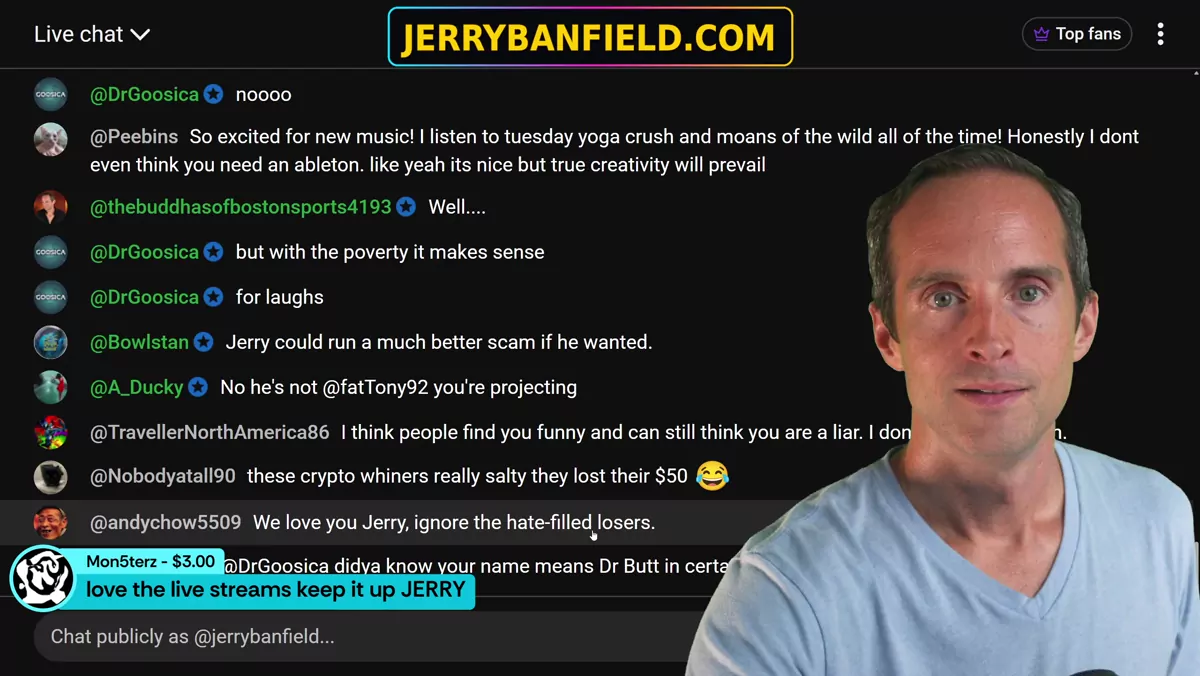
One of the hardest things about being a YouTube creator, and a content creator generally, is that you have to think about who is spending all the time online. Who is spending enough time online to watch all my videos and watch a bunch of other people's videos too? A viewer put it this way: we love you, Jerry, ignore the hate-filled losers. My comments are often filled with hate-filled losers, and you have to ask who is spending all this time online. Is a person who is having a great life hanging out watching hours and hours of content?
Now, I'd like to think the people watching my videos are having a great life, that I'm one of the only people you watch, and that most of the rest of the time you're out living your life and having a great time, and I'm one of the only shows you follow. I would like to think that's my audience: people who love me, find something special with me, and don't spend a bunch of time watching other people's videos. However, you have to think about the reality of who the main people are that spend ten-plus hours a day online watching videos. Most people watching that much content are, at best, having a normal life or one a little below average.
I can say that the times I spent the most time online, at least when I wasn't doing this for work, were the times things weren't going so well. Look back at my life. Look back at when I was spending eight or ten hours a day drinking and playing Call of Duty zombies, and yes, I was out there talking a bunch of junk whenever I was commenting on other people's stuff too.
The sane, supportive people are not the loudest voices
So one of the challenging things about doing YouTube or content creation is that a lot of the people who are sane, who are going to be nice and are going to support you, are not going to be the loudest voices. In fact, one of the clearest signs that you're having some success is that you will attract people who hate you, and they will take time to comment over and over again. They will take time to tell you how much they hate you and how wrong you are.
I just watched some guy on here saying that I rug pulled my meme coin, which makes no logical sense. In order to believe that, you would have to believe that I'm a complete fraud and a liar, that I don't mean anything I say, and that my whole brand is built on authenticity while I do the opposite of that in real life. You would think, why would somebody who thinks that way watch your content? Well, it's nothing personal. That's what they think of everyone they watch. I don't understand why you would watch anyone's content that you don't like, but if you spend that much time online, you're probably going to end up watching all kinds of content.
If I don't like somebody's content, I'm not going to watch it. If I don't believe somebody, I walk away. For example, I've had people, and I'm not going to name them, whose books I read and whose channels I was a really big fan of, and I stopped following them after they lost it a few years ago and went off on crazy rants. I didn't go on some big rant and leave a bunch of comments. That's what's challenging: lots of times, people who are more functional are just going to walk away quietly.
Tell people what they want to hear, or else
I've certainly seen what happens when I stopped telling people what they want to hear. One of the huge problems with YouTube is that it's a system where you essentially have to tell people what they want to hear, and if you don't, they're often going to stop watching. One of the challenges with content creation is that if you don't tell people what they want to hear, they're going to hate on you, and if you do tell people what they want to hear, they're often going to get bored. Often people who are watching are in a bad place in their life, and they're going to watch stuff that makes them angry all day, because that's the kind of life they're having.
So one of the challenges for me has been to understand this, because sometimes I don't even get who's watching my content. I only watch content from people I love and respect, and generally, if they do something I don't agree with, I just walk away quietly. I don't go off and go nuts in the comments.
The algorithm rewards reaching people who are online all day
At the same time, it's tricky as a content creator because lots of times the people who are on all day are going to be the easiest ones to get a hold of in the algorithm. If you're trying to reach somebody who's not online all day with your content, it's comparatively much more competitive. And when most of us as content creators are optimizing for views, who do you think is generating the majority of views online? It's people who are sitting on their phones, TVs, tablets, or computers for ten-plus hours a day. What kind of mood do you think someone is in who is spending that much time on devices?
I do this full time for work, and I don't do that much of it. I've struggled to even understand what people want to watch. I struggle to figure out what kind of video is going to go viral because I don't watch YouTube that much. I mostly get on YouTube to make content, and I'm pretty picky about who I watch. If someone doesn't make me feel better when I watch them, I can't stand to watch them. So I struggle to understand why somebody would come into my chat and just try to talk a bunch of trash. Some people in my chat have gone through and put up fifty comments that are all critical. Another viewer said we all crave entertainment, so don't be so harsh on your viewers. That's absolutely true, and I'm learning it, because so many of you, most of you who watch me, are very supportive.
Negativity is more stimulating, and that is the trap
Another challenge is that negativity tends to be more stimulating, and I hate that. The majority of the comments during the two and a half hours I had been live that day were so positive and so supportive. But then which comments did I react to? So there's even an incentive, if you want to generate reactions, to be as toxic as possible, because at least someone noticed you. If you really want to get noticed by almost anybody who's live, say the most toxic thing you can think of. Even if you get banned, well, somebody noticed you.
So it's really challenging as a content creator to put all these things together, because a lot of the people who watch the most online are often not going to be great paying customers. Somebody said something about so many unemployed people with so much money. Well, there are a lot of unemployed people watching who also don't have any money and are not going to buy anything.
Optimize for community, not quantity of views
So what I'm learning is that I need to optimize not for quantity of views, but for community members who really love and care about me. That means there's a lot of negativity I have to ignore or take with a grain of salt, and I need to focus on the people who love me and show up. One supporter has sent hundreds of dollars to support me, and when he says something, I'll listen. It also means I need to figure out what I'm doing that gets the right kind of people to watch, versus just a quantity of viewers. I can make content that gets a lot more views, but it generates more hate and criticism and doesn't bring in more people who actually love my content.
It's so tricky to balance all these things out as a creator: my own personal mental health and my wide range of moods, and then the audience, while remembering that most of the audience is supporting me. Even the haters, by chatting and criticizing, are still helping make sure my videos get watched even more. Some of the haters who react get my videos out even more, and some of the haters actually inspire the videos I should make. There's more on this in my Content Creators playlist.
So it's pretty challenging to balance all this stuff, and you're going to have to learn how to do it if you're a content creator.