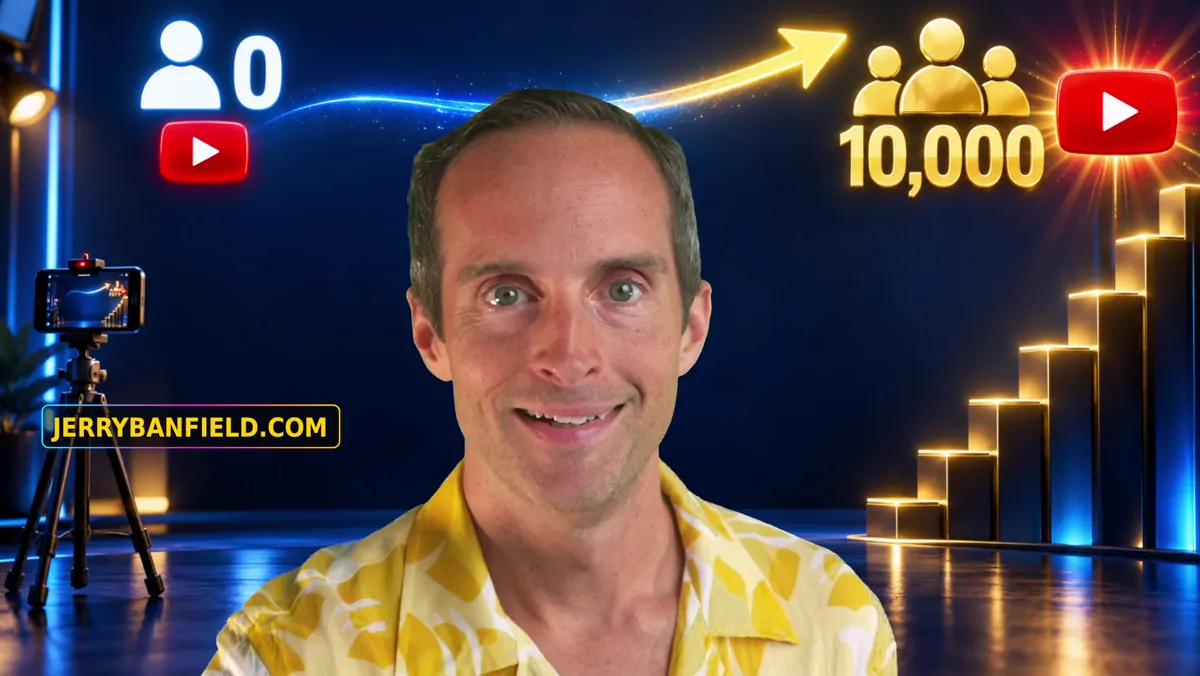
This will be the most valuable YouTube training you are ever going to see if you're between zero and 10,000 subscribers. I was inspired to make this after I watched a guy named Jake Trinder do a video talking about the most valuable YouTube training you'll ever watch. My big problem with it is that what he's saying does not work well if you are under 10,000 subscribers. What you need to understand as a YouTuber is that what will work for you under 10,000 subs versus what works for a bigger channel is drastically different. I'm living proof of that.
If you're new, I'm Jerry Banfield, and I'm doing some incredible things on YouTube. I deleted all my YouTube channels last year, then started six brand new YouTube channels this year, so I literally did start from scratch. Four of them are monetized already. This Jerry Banfield channel has 188,000 views. I have a dating channel that just got monetized, and that channel has 100-and-some thousand views on it. I have a games channel. I have a music channel. I have a tech channel that has hundreds of thousands of views on it, and a money channel that has 400,000 views. So I've gotten millions of views across six brand new channels on YouTube. What I'm an expert on is building a new YouTube channel up to a million views.
I've got thousands and thousands of subscribers, and the advice for getting there is completely different. Something like 90-plus percent of it is different from what you would do with a bigger channel. Jake, in his video, was talking about optimizing your titles and deep-researching your niche. Some of that's great if you just want to try to be an authority, print money on YouTube, be boring, do the same thing every day, and turn YouTube into a job. But for most of you, that's not your dream on YouTube. Your dream is not to grind out authority-based videos that basically turn YouTube into a job. Your dream is much more like my dream, which is to be an internet personality.
What I'm actually doing right now
Let me describe some of what I'm doing. I have channels that are reacting to my videos and giving me thousands and thousands of views for free, sending people to my website. One channel paid $2,000 to premiere a private video I made for a woman on that channel. Who Are These Podcasts, a show I went on live last night, has given me hundreds of thousands of views over the last few months, reacting to my videos over and over for free. I'm now selling things like my shirts; the shirts I'm wearing are listed on eBay. I am firing my content out with automation all over the place onto other platforms like TikTok and Instagram. I have six different channels. Another channel started up just to react to my videos and gets me even more views for free, and a new guy has started reacting to my videos recently. I have an automation workflow. I'm getting hundreds of thousands more impressions on X. Keep in mind all of this is within the last six months, starting from zero, with a completely different strategy than trying to optimize your titles and your thumbnails.
I am printing money off of YouTube super chats right now. When I go live, and I just got started going live, I'm printing money off of super chats from an incredible community that's been built within just a few months. So if you are closer to zero, or less than 10,000, I'm going to describe exactly how I've built all of this up and the things that are different that you need to do if you're small.
The hard truth: titles and thumbnails barely matter when you have no audience
The hard truth, if you're small, is that almost nothing you do with your title or thumbnail matters, because you have no audience. If you already have an audience and you optimize your thumbnail and increase your click-through rate by 2%, you might get hundreds of thousands more views. But if you have no audience, it doesn't matter. It doesn't matter what thumbnail you use, because nobody knows you and the algorithm has no idea who it should show your videos to. And it doesn't matter what you title your video. I've seen so many small YouTubers with the best clickbait title, the most beautiful thumbnail, and 100 views. That's the harsh truth.
So you're going to ask, wait a minute, are you saying that if I'm a small YouTuber, I can't just do better titles, better thumbnails, and better video ideas? For most of you, 99% of you, yes, that's accurate. If you are very experienced on YouTube, you could come out with a perfect title and a perfect thumbnail straight out of the gate and go straight to tens of thousands of subscribers. But this is not a training for that 1% of you. The challenge is that a lot of YouTube trainings are aimed at the 1%. Then, when you realize you're not the 1%, they're going to sell you coaching, and you're going to figure that what they do must work, because it works for them even though it's not working for you. No. It's a different strategy you need to take if you're in the 99% that doesn't honestly know what the hell you're doing on YouTube. And it's the strategy I'm taking.
It is brute force. Be radically honest, share personal stories, and just get out there and say things that people will react to. If you do that, it's not going to matter much what your titles and thumbnails are. And if you then use AI to improve your titles and thumbnails, even better. I actually encourage that. My workflow is this: I have kind of an idea of what I could say, but I just film the video, and then I use AI. I go into Claude and I drop my video into a folder called Long Videos In. I record the video live on OBS, which I use to record all my videos, and I've got a whole studio tour in other videos. Then I drag the recording into my Long Videos In folder and run a transcript and metadata on it. Then I pop into ChatGPT, give it what I actually did, say "here's the title and the description and all that," and ask what is going to be the best title for my video. The AI helps me make better titles. I don't have to come up with them myself.
The centerpiece: grind out videos as fast as possible
But the basis of all of this is grinding out content. This is what almost nobody is going to tell you, except MrBeast did say it: if you want to do YouTube, do a hundred videos and then get back to me, and just try to make each video a little bit better. This is what I do. This is how I get so many views and how I get people reacting to me. YouTube, for 99% of creators, is going to be a grind. You need to make as many videos as possible, as fast as possible. That is the centerpiece of this training. You need to speed up the rate at which you crank out videos.
Look at what I do: 7.6 videos a day, 89 minutes a day of video, 929 videos published since May 18th, 2026. And that has been with me experimenting a bunch. I've actually increased the rate at which I put up videos. It used to be an average of five a day. Now I've got it up to about seven-point-something, and I think we're going to get over eight pretty soon. What I try to do every day is put out a long video on each channel.
You need at least two channels, and one of them is a vlog
You do need different YouTube channels. You should have at least two. One should be a vlog channel where you just talk about your life. Your vlog channel is your wild card. It's where you just say whatever's going on, and it's where you generate video ideas. My vlog channel spun up into another channel entirely, a dating channel. When I started my vlog channel, I was just experimenting, talking about a bunch of random crap. Then I realized people were really resonating and vibing with my dating content, so I made an entire channel dedicated to dating. And that channel has now got other channels going in and reacting specifically to my dating content. I just started that vlog channel and was doing vlogs off the top of my head, and it has turned into a dating channel with hundreds of thousands of views. I made it on May 6th, four months ago as I film this, and it's monetized and it brings in views. I did one live stream on there, but mostly what I do is go through and just make videos.
If you want to break out of being a tiny YouTuber, you can't do what other people are doing. For example, when I started that channel, I started doing advice videos. This is exactly why advice that works for bigger channels usually does not work for small channels: bigger channels can get away with giving advice, telling people what to do, and looking like an authority, but small channels cannot. Nobody believes you. You have no subscribers. When I tried videos telling people what to do, the views were tiny. Me giving people advice went absolutely nowhere, except one basic little tutorial that did decently, and even that didn't get me a lot of subscribers.
What started getting serious views
So what did I do that started getting some serious views? Let's go through my most popular videos and see what changed the game. "She said our date was a waste of time, then she walked out." "I paid $625 to argue with a woman for 30 minutes," which somebody else reacted to and gave me 8,000 additional views, and I actually clipped that one from a live stream. "I was really into her, then one comment, and then a date." "I dated 22 women after my divorce." "I made a leaderboard of the women I'm dating." "I started talking to 14 women at once." "My dates keep failing, so why am I a dating coach?" "The worse my dating life gets, the more money I make." "I stood there awkwardly for 20 minutes."
What do you see on all of these more popular videos? Every one of them is a personal story from my life, often an embarrassing failure story. If you want to build up from nobody knowing you to lots of people knowing you, share your embarrassing failure stories. That is the easiest way to monetize a channel, because it's what most people don't want to share. And generally, if you're going to get ahead, you need to do what most people are unwilling to do. All kinds of people are willing to give you advice, act like an expert, and tell you what to do. Almost nobody is going to admit that they paid $625 for a matchmaking date with a woman that turned into an argument and her leaving after 30 minutes. Most people are not going to tell you that they were really into someone and then one comment ended the date.
And here's the crazy thing: two of those videos were both about the same date. "She said our date was a waste of time" and "I paid $625 to argue with a woman for 30 minutes" were the exact same story.
I literally told the exact same story three days apart. Not only did it get thousands of views each time, but then a reaction channel picked it up and it got thousands more views on their channel. And that's just the reaction videos I've found; there are probably others I haven't seen. What you'll notice is that when I started talking about my life and my struggles, people started watching, reacting, and caring. If you want to grow, you need to make content that people will react to.
Watermark everything
And you need to watermark your videos. That's why all my videos have a jerrybanfield.com watermark. People react to so many videos these days that, yes, one guy managed to clip the watermark off the thumbnail. But when you go in and play my video and react to it, my website is going to be on there. My website at jerrybanfield.com has all kinds of services, all of my YouTube channels, and all my socials. So when that guy is making money off my content, which he chose because it gave him great content to react to, the watermark is pushing people over to my website, which then gets people to follow my YouTube channels, my X, my Instagram, and my TikTok, and gets people to join my Skool and pay for Zoom calls. Somebody just paid for a call that I'm going to have with them in the next few hours. I have a Cameo where, if you have a question you want to ask me, you can go to jerrybanfield.com, click on the Cameo, and just tell me the question, and I'll make a personal video directly for you. I have a chat on my website too. All of this gives me a bunch of ways to monetize.
Be dramatic, go after the hard conversations, and post everywhere
My entire brand is that I have all these different channels so I can talk about different subjects and then people react. Dating right now is the subject people are reacting to most. But I also talk crypto, and I'm as dramatic as possible. I go after the hard conversations. I roast people who roast me. I make entire videos just to diss people. I get as dramatic as I can and talk as much as I can, and when somebody hates on me, I fire a video back at them. I generally don't give them any credit in the video, though, because I don't want to promote them. I want to keep all eyes on me.
Then I post all my long-format videos on X as well, and I post my long-format videos and my short videos on Facebook at the same time, because these other platforms have a bunch of free views. It might not look like anything is happening on my Facebook page, but if you go into the insights in the professional dashboard, what you'll see is that I just started a brand new Facebook page and I've got 13,000 views in the first month. I'm getting free views. I've got 20 hours of watch time on a brand new page, starting from scratch. Thousands of people have discovered me on a Facebook page that literally had nothing on it, and I started three other Facebook pages at the same time. Then I have Instagram. I have four different Instagram accounts, all brand new, and all of them are getting followers for free. I'm just firing out videos via automation.
If you're a small YouTuber, learn to use AI
If you're a small YouTuber, what you really need to do is learn how to use AI, because AI will help you make better titles for your video without you even having to do anything. You don't even need to learn about better video titles. You just need to be able to drop your video in. Get Claude installed on your PC, or ChatGPT on your PC, then let the AI run through your video, transcribe it, and tell you what the titles for your video should be.
For my vlogs channel, I did exactly this and started doing one video after another. That channel is fully monetized now. It's the third fully monetized channel I've built from scratch in the last six months, and the exact same thing worked for growth. If you look at the last 90 days on that channel, I was experimenting with all these random videos. Then, on July 13th, I met a woman at yoga that I called the Queen, and I started doing daily vlogs. I started crying, embarrassing myself, getting frustrated, and posting all of it as vlogs. Then people started to get interested. Then more people got interested. Then Who Are These Podcasts started reacting. And now I've got an audience, and now they're interested in going on. I tested just doing live streams over there too.
Watch hours are the metric that matters
What you really want to watch is the watch hours. On that channel you'll notice the typical small YouTube channel pattern: I had 10, 20, 30 watch hours. Hardly anybody was watching my videos. But then I started putting out some real personal material, I started struggling on camera, and the watch hours started piling up. This is the main metric you need to watch. Then I did some long live streams and the watch hours really piled up. Even when it dropped back down, what works is grinding out a video every single day. Doing live streams got me a shorter-term push to the watch hours, but then I stopped publishing daily videos, had a few days where I didn't publish, and my watch hours plunged.
For example, one video I put out a few days ago has almost 100 watch hours on that one video. Another one has 297 watch hours, and it's just a 39-minute vlog of me talking off the top of my head. It has the same basic title as a video on the dating channel, because the AI helped me identify the best angle. I don't even have to think of titles. I just talk: "It's September whatever, here's my vlog." I just talk, the AI finds the most clickbait part of my video and tells me what to put in the title, and then the AI writes the descriptions.
Entities and hashtags in every description
In my descriptions, I have all these entities. YouTube has entities; it tags what's in your video by numbers. So when you're talking about all these different random things, you're pulling in all these different potential audiences via entities like Hinge, DFINITY, MrBeast, Kelly's Heroes, ICP, Eminem, and matchmaking. Dating, first date, these are all specific entities. Then I slap five hashtags on there, always #jerrybanfield for one, #vlog on the vlogs, then a couple of others. Again, I just tell the AI how to do that, and it does it for every single video.
Thumbnails: real beats perfect when you're small
For thumbnail backgrounds, this is a good example of where thumbnail backgrounds don't really matter. What I noticed is that I saw so many small YouTubers blowing up, and they would literally just be in their bedroom, using any old picture of themselves talking, selected from the video. This is the magic. If you're a small creator, your thumbnail generally doesn't matter that much, in the sense that it's better to have a real, authentic, easy, effortless, natural thumbnail than to try to make some perfect thumbnail and waste your time on it. The smaller you are, the more you need to grind out videos that people will react to, as fast as possible, and then clip those.
Shorts: film once, clip with AI, post everywhere with automation
AI can also do the clipping for you. What I do is record my videos vertical and horizontal at the same time. That way the vertical version of a video is perfectly cropped and has its own little background. Then I drop the vertical version of the long-format video or the live stream into the AI and tell it to give me a bunch of shorts. Then I use automation via Repurpose, which is linked on jerrybanfield.com; if you use my link, I'll get a little affiliate commission and you'll feel great about yourself the rest of the day. I use automation and Google Drive, and every one of these clips is posted automatically to YouTube. I'm not manually posting them. For example, one clip called "40, divorced, broke, and still not a loser" is a 55-second clip from my live stream with 800-and-some views.
You can even ask YouTube Studio how many subscribers you've gotten from shorts on a channel, and you'll see that subscribers from shorts are really important for getting discovered. Shorts are free discovery, but what sucks is spending a bunch of time to film shorts. What works better is clipping. In the last 28 days I've gotten 20 subscribers from shorts on one channel and 38 on another, only about 3% of the total, which doesn't seem like a big deal. But the smaller your channel is, the more 20 or 30 subscribers matter, especially if they then come back.
You can also ask how many of these subscribers are watching videos and lives, and what the crossover is between your shorts and your other formats. You can see that shorts, even if they're not generating new subscribers directly, get people watching who then start watching your longs. 44% of my viewers watch both shorts and standard videos. Most people are not watching my shorts only, but there are some viewers who haven't even subscribed yet who are watching my shorts. I'm getting discovered. I'm getting new people to know me.
What the shorts really are is remarketing. They are free remarketing. Let's say people watched a long-form video a week ago, kind of forgot about me, and then they're in a shorts feed. Boom, here's my new short. They already subscribed on a long-format video, and now it's a reminder: oh yeah, I wonder what Jerry Banfield's posted lately. So shorts are awesome to get new subscribers and to re-engage subscribers who have already found you, and the same goes for live streams. Right now 37% of my viewers watch both shorts and live streams, 29% who have watched shorts only watch shorts, and 34% only watch live streams, but the largest percentage of my audience is watching both. 51% of my total viewers watch both long-form videos and live streams, and the crossover between shorts and long-form is about the same. Shorts have only given me 58 watch hours so far, which is not that important for monetization, but they've gotten 11,000 views. So shorts are great free discovery, great free remarketing, and great marketing on other platforms.
With Repurpose, I'm firing shorts out to four different TikTok accounts, and one of those TikTok accounts has gotten thousands and thousands of views. These are just free views I'm getting from automation, thousands and thousands of views from people finding me. One Facebook page has tens of thousands of free views, and I have four of them. Instagram, thousands and thousands more free views off the same clips. I put them on four different platforms and it takes me almost no extra effort. And remember, I'm showing you what you can do starting from absolute zero. I've got 73 followers on one Instagram account, organically, with no effort. The effort is dragging a file: I go to my Shorts Out folder, go to the dating folder, grab the file, go over to Repurpose, drag it into the shorts dating folder, drop it in, and it shoots out to four different platforms. Then I just get free views from there that bring people back to my channel.
And here's the thing: none of these shorts have even done very well yet. My top short right now I made with my friend, so I didn't even have to film it; she filmed it and gave it to me, and it has 2,000 views. So this hasn't even started to take off. What will happen is that one of these shorts at some point, either an existing one or a new one, will kick off and get 10, 20, 50, 100,000 views, and then 10, 20, 50 of my other shorts will pump as that short sends a whole bunch of viewers into all the rest of them.
From there, I bring more people into the videos, and from there I bring more people into the live streams. And then when you actually go to my channel, I have all these other channels. I have it set up this way because you usually can't do everything on one single channel. You need to niche yourself to some degree. So what happens now is that if somebody watches me talk about dating on my vlogs and finds me there, then goes to my channel page and sees that Jerry Banfield has a dating playlist, they go watch that. Some of them are gamers, so they start watching my gaming videos. Some of you are content creators who find me through videos like this one and want to go watch the dating content. I have tech and money channels too, so people found me on those and then went over to watch the dating, the games, or the vlogs. Some people follow all six of my channels and get six long-format videos a day they can watch, plus two shorts a day on every single channel. That's six videos a day and 18 pieces of content a day that I put out on YouTube, and if you add all the other platforms up, I do something like 50 individual pieces of content a day.
Two X accounts, hundreds of thousands of impressions
That includes my posts on X. I have two X accounts. I split my X into a money and tech account and a plain Jerry Banfield account, which is a new one I just created a little while ago. On the Jerry Banfield account I share my long-format videos, and sometimes these get thousands of impressions, even though that account only has 208 followers. That account has gotten tens of thousands of impressions. My other account, the Jerry Banfield money and tech account, has gotten half a million impressions: thousands of impressions on every single video, 30,000 impressions on one, and going back a little farther, 15,000, 20,000, 117,000, then nine and ten thousand, 7,000, then 30,000, 13,000, and 58,000 on another.
So the strategy is clear. Grind out videos as fast as possible. Use AI to enhance your workflow and speed up what you're doing. You don't need to obsess about titles or thumbnails. Let the AI help you make the videos. Before I deleted all my channels and started fresh this year, I had hundreds of thousands of subscribers on YouTube myself, and I observed that what would work for me would not work for my followers. Because I had so many followers, I could do almost anything and people would watch. But if my followers tried the same thing with a hundred subscribers, they'd get one or two views, while I'd do it and get thousands of views because I had the audience. So if you're small, this is the information you need. This is the cutting edge of content creation. This is using AI, and yes, you can use AI-generated thumbnails. They're brighter and they get better clicks. I try to keep my AI thumbnails simple, but sometimes I don't use AI thumbnails at all. For my vlogs, I just use pictures of my studio.
Tell your raw story until people make channels about you
This is the formula. You need to grind out so much interesting content, by telling your real, raw, authentic story, that people will make channels dedicated to it. One channel reacting to me is new, made 13 days ago. Another was created 14 days ago and already has 18,000 views. All they do is react to and summarize my videos. How many more channels are there that are going to pop up like this?
Also, never copyright strike anyone else for using your content. Just allow everyone to use your content. Allow everyone to react to your content. Celebrate every reaction, even if it's on a channel that looks like it's destroying you. It doesn't matter. Let people do whatever they want with your content. Who Are These Podcasts is giving me tons of views, and look at some of their titles: "Jerry Banfield preys on lonely people." "Meet the world's dumbest cult leader, Jerry Banfield." "Gay rumors: Jerry Banfield." "Jerry Banfield gets dumped." "Dumbest guy ever lets AI run his life." "Worst guy ever." "We thought Jerry's private video was for the Queen," which got 16,000 views on that emergency episode. "Jerry changed his business again." "Jerry Banfield, worst songwriter ever." So what?
A lot of you are thinking, oh, I don't want people talking bad about me. If you want more subscribers, you need people talking bad about you, because that's how they're going to hear about you for free. I don't have to pay people to react to my videos. I don't have to pay to sponsor anything. I'm so interesting that people are out there looking for content to react to all day, every day. When I'm pumping out shorts, I'm giving people content to react to. When I'm pumping out videos like this, I'm giving people content to react to. And then I'm celebrating and showing them reacting to my content. I went on Who Are These Podcasts last night and gave them additional content from that. I said thank you, I appreciate y'all supporting me. They roasted me a little bit, they asked me some questions, and they were really nice. The clip is titled "Gay rumors," the Jerry Banfield interview, and that's awesome, because hardly any of it was about anything gay and I've never been with a man. At the same time, anybody talking about you is good publicity at this point when you're small.
Be interesting first, become an authority later
This is why you need to set yourself up as a small YouTuber to be interesting rather than to be an authority. That's what almost every YouTube video gets wrong for small creators: almost every one of them tells small YouTubers to become an authority, but you're generally not going to be an authority until you've got an audience. The more I build up an audience, the more I can become an authority. People have come onto other creators' channels and said, well, you don't know anything, Mr. I've-Got-540-Subscribers, I've got 76,000, what do you know about YouTube? Well, the bigger this channel gets, the more people assume I know about YouTube. So when you're small, the goal is to get big. When you're big, you can do almost whatever you want: you can be an authority, you can print money. But most of the time you're not going to get an audience by trying to be an authority, making perfect titles and thumbnails, and trying to make everybody like you. Most of the time you're going to be boring and easy to forget. You're going to waste a bunch of time and energy making videos people don't watch, and if you do that, you're going to have a hard time monetizing, you're going to hate YouTube, and you're going to have to get a job again. I don't want you to have to do that.
Then sell, sell, sell
What I do is interesting, it's fun, it's watermarked, and then I sell, sell, sell. I have all these channels. I make ad revenue and super chats. I have calls people pay for. I have my Skool community, and I'd say always have a community; a low monthly Skool is a great way to do one. And always have calls. Allow people to pay to schedule time with you. People have paid thousands and thousands of dollars to talk with me, about all kinds of stuff, especially if you know anything technical.
Your basic two channels should be, one, a vlog channel where you just talk about your life, and you can discover opportunities from there too. And two, a technical channel about something you know that you can teach, so people will pay you to teach them. I did two technical crypto channels, and I've made thousands and thousands of dollars from people paying to talk to me about crypto. You can monetize instantly, with no watch hours and no views. If you teach a technical subject, people will come to you for it. I haven't sold any dating coaching yet, because that channel only has a few hundred subscribers, but I did sell a dating-based Cameo yesterday, where somebody paid to have me make a video, and I just got a five-star review on it, which is awesome. I have people pay just to talk to me for 10 or 30 minutes, just to say hi, just to FaceTime and say, oh, I really enjoyed your videos. I sold a video: I made a video for a woman and sold it for $2,000. I'm getting sponsorships in crypto and selling sponsored videos.
And on jerrybanfield.com, now with eBay, I'm selling the shirts I've worn. I'm going through and selling clothes with history, like the shirt I wore on the first date with the Queen, the date behind the video that sold for $2,000, the story tens of thousands of people have heard about. The shirt I'm wearing as I write this is one of them. eBay is super easy to monetize. You can sell autographed copies of books; you can sell anything you can sell on eBay. Right now you could bid on the shirt I'm wearing and have a piece of Jerry Banfield history. This is something you can set up with no monetization on YouTube at all. Then, once you get the 500 subs and basic monetization on YouTube, you can start setting up stores inside YouTube and set up affiliate links. There's just so much you can do. I've got affiliate links at the bottom of my homepage as well. I've got a leaderboard of people who've tipped me. I've got a game I made with AI. I have a chat people can access. And I have tools like MaxFi and Repurpose linked there that I get affiliate commissions from.
I guarantee this was worth your time
If you are a small YouTuber, I guarantee you this is the best YouTube training you've ever seen. I guarantee that if you learned one thing out of this, it was absolutely worth your time. There's plenty more where this came from in my YouTube Coaching playlist.
And if you want more help, go to jerrybanfield.com. Just ask me a question to start. Go to my Cameo, try asking me a question, and I'll make you a video. Or, even cheaper, join my Skool community, where you can DM me or post to the community, and I'll usually look at your channel. You can schedule a Zoom call, or talk to me now if I'm available, for more detailed help. I've got a huge amount of experience that, when I look at your channel, I can apply to help you be an internet personality instead of just trying to work YouTube as a job.
Thanks for reading. If you found this helpful, I trust I'll see you at jerrybanfield.com soon.