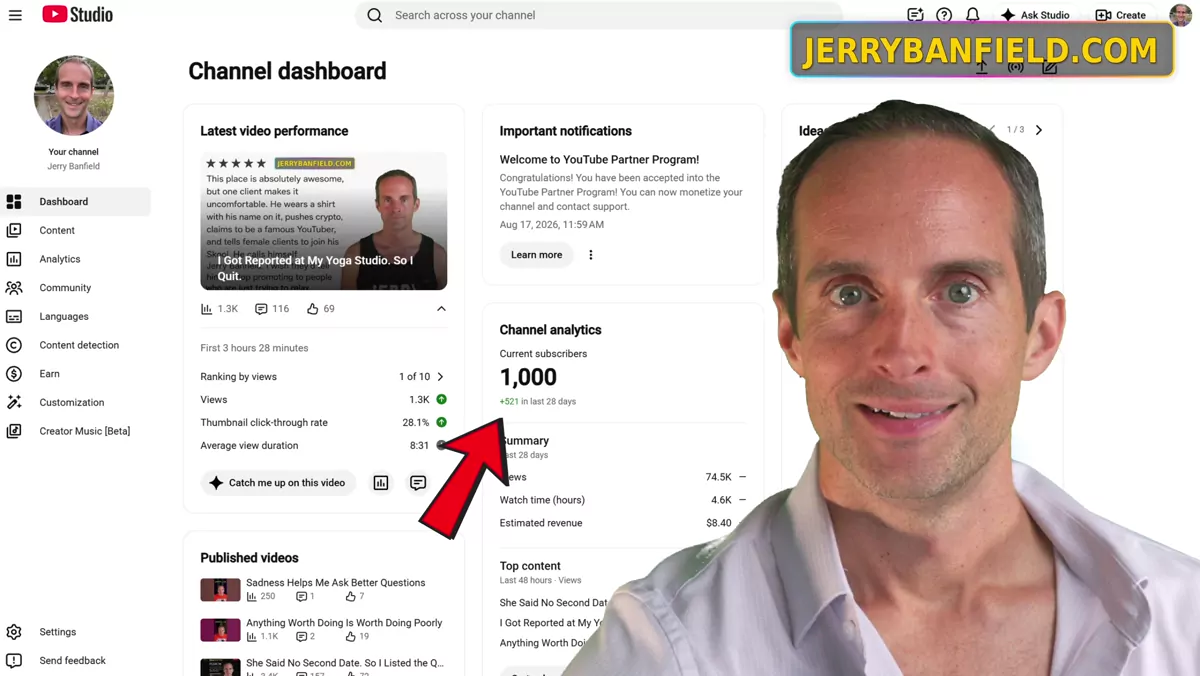
I just got a YouTube channel to 1,000 subscribers doing vlogs, and I got 521 subscribers in the last 28 days. I'm fully monetized, and what's awesome is I just started this YouTube channel in March of 2026, and it is now August 2026. So I did this in five months, and I'm going to explain the key things that have helped me do it, so that if you want to make vlogs and get a fully monetized channel, you can learn from my experience.
Daily Raw Vlogs Were the Number One Thing
Here's the number one thing I did: I just cranked out videos every single day that were real-life, authentic, raw vlogs. My channel is at Jerry Banfield, and my playlist for this is called The Jerry Banfield Show. I also have other YouTube channels — a Jerry Banfield dating channel, Jerry Banfield games, creators, ICP crypto, Crypto Reviews, and so on. Some of the people on this channel came over from those other channels, but most of them did not. Most of them discovered me organically on YouTube.
Testing Until Something Worked
So what did I do that helped make that happen? Well, first, I tried a bunch of other kinds of videos — more generic vlogs, other topics — and most of them didn't do that well. If you go back further in my vlogs and my videos, you can see I tested talking about my diet. I tested doing some dating videos, and the dating videos started doing well. I also tried a couple of ads. The ads did nothing and were worthless.
Here's what worked, though. I've done stories about my personal life, about things people would usually keep private. And then I have the AI go through the transcript and find the most viral titles. Whereas when I did videos before, they didn't get a lot of traction — I was talking about YouTuber stuff, dating life, a lot of kind of random videos. And I remembered, over the 15 years I've been on YouTube, what's really important: the main videos I'd care about are the ones that talk about my day-to-day life and would be something I could watch later. In some of the first series of videos I did, I started talking about how I borrowed money to do YouTube full time, and people seemed to resonate with those. But then some of the other videos I did trended down.
Here's where things started to turn. I did videos about AI and money, but then I made this video called "I'm Betting Everything on YouTube. What If It Doesn't Work? Then I'm 42, Divorced and Dead." And then I went out on a date with a woman, and I started talking about the date in graphic detail — this story, me being very emotional, me struggling. With a video like that, it almost didn't matter what I titled it. I started to make my content more of an ongoing series by talking about my life each day. And then when people would find one of these videos, they would want to continue watching. That's what's absolutely essential. Look at the click-through rate on my newest video today: 27%. I don't know how much you do YouTube, but 27% is one of the highest click-through rates I've ever seen on a video.
Using AI to Find the Most Clickable Title
I go through and I use the AI to look at my video and find the absolute most clickbait title — what is the thing I said in a 30-minute vlog that will most get people to click on it? This is what I didn't do before. And I do this by getting a transcript of my video, which there are lots of different ways to do. I just drop it into Claude and generate metadata and a transcript. Then I drop it into ChatGPT and go through the video. What I've started doing too is screenshotting my previous videos — I screenshot the videos I did before, and I ask ChatGPT to consider the transcript, the metadata, and the previous videos, so that it considers what would make a good continuation of the series.
That's what I've done: I've developed a series where, after YouTube puts one of my videos on someone's feed and they discover it, they find that one video organically — but then when they see the new videos, they care about them.
Emotion Makes People Care
In order to get your videos to go out, you really need to communicate emotion, where people care, where people can relate to you. What's really fantastic is when I share very emotionally, when I share raw from the heart, that helps people care. And this is what a lot of people don't want to do. A lot of people don't want to put out raw, emotional, heartfelt, vulnerable content — "this is what I'm struggling with, and here's the magic that's happened."
For example, there was a woman I met and dated. I was really so into her, and so excited, for about a week — and this is where my whole channel turned from me just kind of making stuff people didn't care about. I started talking about this woman I dated. I made a video called "I Met Her Five Days Ago and She's the Center of My World. I Cried Walking Home From My Date." And then this escalated into it not going well, and I'm literally crying and emotional in the videos. Then there's a YouTube channel called Who Are These Podcasts, or WATP, and they started reacting to my videos — saying how cringe I am, making fun of my clickbait titles — and some of their viewers came over to start watching my videos.
So the more emotional, the more heartfelt, the more passion you have in your videos — the more you're willing to share things that other people won't, the more you're willing to say things that stay within the community guidelines but that most people wouldn't say, the more you're willing to embarrass yourself and be honest — that's the way I feel about it. That stuff helps people relate to you.
An Ongoing Series That Escalates
For example, one of the videos that took off the best was "I Shouldn't Have Sent This Message at 6:48 PM." I sent a message to this woman, and that became one of my highest-viewed videos — one of my first videos to go over a thousand views. I published these back to back — I missed a day in there, but most days I put videos out. I made a series where, if you watch the video called "The Queen Goes Cold," then you see the message video next. "I shouldn't have sent this message at 6:48" — and then you're like, all right, what did he do? You care. There's an ongoing series. And you can see how these each escalated: this video a thousand views, this one 1,100, this one 1,200. Now, some of them slip back down, but that's fine — you just keep going.
Then there was the video where I had four dates canceled in a row — 3,000 views on that one. A painful day. But again, sharing my raw pain, my frustration with dating — this is stuff people can relate to. And because people can relate to it, they want to watch it. You'll notice that one got 154 comments. I don't even read the comments on the videos, either — if people want to comment and talk to me, you can go to schedule a call with me.
And the crazy thing is, when I had all those dates canceled in a row, it escalated into an ongoing series that people watch. People continue to keep watching day after day. It builds a solid foundation. It tells YouTube that people like this channel, and then YouTube starts putting the videos out more and more. So I'm creating this feedback loop: I'm sharing an ongoing story, you wonder what's happening next, people are having a good time on the channel, they're watching, and I'm putting out a video day after day that's unedited, real, raw, authentic, and heartfelt. So the people who are watching and subscribing are consistently clicking and watching a huge amount of each video, and that's signaling to YouTube that people love this channel. Then YouTube sends the videos out to more people the algorithm thinks will like them, and it creates a snowball effect.
Curiosity and the 1 A.M. Text
One title was a fantastic example of ChatGPT finding the best hook in the video. It's called "At 1 A.M. I Sent Her One More Text." That one got 2,949 views — and what's more, look at the minutes watched: people spent 200 watch hours on it. That is outstanding, and it's actually still going out into browse features now. When you get people to actually want to put time into watching a video, and they have a good experience watching it, the story pays off.
What's interesting and surprising to me is that in a lot of my videos, I had taken the approach that I should just literally repeat the title and get straight to the point. Well, this video is an excellent example of the opposite. "At 1 A.M. I Sent Her One More Text" does not pay off right away. ChatGPT went through my entire transcript, and this title is really good because it triggers curiosity. Who did he text? Did he text the queen? Did he text one of these women he was dating? What's funny with this title is it was actually about a woman I dated back in 2017 — and even I was like, oh my God, when I thought back on it. So the title creates curiosity, and one of the biggest things you have to do with your videos is create curiosity.
And it paid off: if you look at the average watch time, the average person spent six minutes watching it. The reach has been consistent — it's been shown 30,000 times, and the click-through rate is 5%, which is solid for where it's at today. It got people to click and want to watch the video, and it was a fantastic story that I told in the middle of the video — it opens up with a vlog, it opens up talking about other stuff. This is one thing AI is fantastically helpful for, because sometimes when I tell a 24-minute vlog story, I don't know what the best part of the video is. I don't know what the most clickbait headline is — I just talked about my life. But the AI will go through and help you figure out, okay, out of all of this, what would people most want to hear? The 1 a.m. story of me sending this woman a text was the best part of the video.
But it doesn't pay off immediately. The viewer has to sit through some other stuff without knowing when they're going to get it. And what creates attraction for people — like in dating — and what creates emotion, is often anticipation. People see the title, they're expecting a payoff, but it's unpredictable as to when they get it. What I had often been doing in my videos before was just kind of ruining that anticipation.
In a lot of my videos in the past, I would have told the story at the very beginning. Then a lot of people wouldn't have watched through to hear what happened. So now, when somebody sees my thumbnail and they see my title, there's anticipation. There's a payoff. There's a story — people love a story. And there's ambiguity: it's vague, they don't know exactly who I texted. And then you have to wait until 12 or 15 minutes into the video to hear that particular story.
I've taken this same approach with lots of different videos. For example: "My Date Canceled, Then Five More Women Said No." And this one: "I Spent $1,000 on Hinge, Zero Results. The Problem Was Me." And this one: "She Said No to a Second Date, So I Listed the Queen Video for $2,000." And then: "I Got Reported at My Yoga Studio, So I Quit." That last one is the culmination of doing this a whole bunch of times, all built into one video — and it's paired with a screenshot of a review in the thumbnail. It has all come together from doing this repeatedly.
Building Momentum on the Queen Story
What can be difficult about YouTube is if you're not building momentum. What I'm describing is building momentum, where the videos I made a month ago are still working for me. It's August 31st, and I've been building solid momentum with this story about the queen — that's a nickname for a woman I dated. I made a story about the queen over a month ago, and I've been steadily building momentum on that story ever since. And it literally paid off.
There's a video I haven't even published on this channel yet. I had listed a video I made for this woman at $2,000. And look at how the titles keep escalating — here's a little teaser for people who watch the channel: the next one is "I Met Two Women Today, Both Want to Get Married." Look at the emotion and the rollercoaster ride. I'm living my real life in a way that facilitates this, too. So first I said, "She Said No to a Second Date, So I Listed the Queen Video" — 3,000 views. And then the next video sold the queen video. Somebody paid $2,000 to get ahold of this private video I had sent to this woman. I edited out the roughly five spots where I said her name and personal things like that. I did not plan on any of this at the time.
But what you can see is that I've built momentum with my videos. I tell very personal stories. I share emotions. I get embarrassed. I talk honestly about where I'm at. And then this momentum builds to where the people who subscribe are happy with the content they're getting, they want more of it, and then YouTube gets the channel. Look at the up-and-down emotion: "I Got Reported at My Yoga Studio, So I Quit" — that was partially from people online watching my videos, not even stuff happening at the studio. There was some stuff there too, and it involved me, but this creates huge curiosity. People go, what the hell happened? I've got to see this. Then the next one: "I Met Two Women Today, Both on a Date Tomorrow." You can see how this is all building up — I went to a speed dating event and I went to a singles mixer with the idea that this will generate content no matter what happens. And then a massive payoff: I went out on both dates, and the queen video sold for $2,000 between the dates.
You can see how this is momentum building on itself. It's giving people stories. It's sharing my raw, authentic life. It's emotional rollercoasters. It's using AI to pull the best titles out of everything I'm saying. I just start talking off the top of my head and turn it into a video — I get a vlog and I don't know exactly what I'm going to say. But you see the synergy: I'm creating a powerful human experience, and that powerful human experience is drawing people in. Then I'm using AI to figure out the best way to describe that experience — to take a several-thousand-word transcript and pull out the one sentence that will most captivate people.
The Repeatable Formula
I'm going to repeat this formula, because to me it's the most repeatable formula anyone could have for a vlog channel. If you're making vlogs, if you're making videos online, this is the formula that in my experience gives you the best chance for success. I've got over a thousand subscribers on a new YouTube channel and built some serious momentum doing it. I share my real, raw, unfiltered, unedited human experience around personal subjects that people want to hear about — things like dating, which most people don't want to talk about, and things like money and finance, which most people want to avoid and keep private. I share the often embarrassing things I'm struggling with, the challenges I'm facing. I share these in daily vlogs, and I do a video every day.
Then I combine that with AI. I use AI to get a transcript of the video, and the AI takes my thousands and thousands of words and finds the most curiosity-driven, clickbait hook title — one that gives somebody an idea of the reward they'll get for watching, and that shares the most interesting part of a much longer video. And then it pays off. It's never inaccurate — the title is always related to exactly what happens in the video — but it often doesn't pay off immediately. Sometimes you have to watch 10 or 20 minutes to really hear the full story. Then people react to my videos, and this builds momentum that snowballs over time, to the point where my newest video has a 26.9% click-through rate, 1,400 views within the first four hours, and an eight-minute average view duration on a video that is 19 minutes long — that's about half of it.
So this is the formula I've used to monetize another brand-new channel from scratch and to build most of my audience directly, organically, from scratch. I've also put some Shorts up, and I have some other YouTube channels, but what I've just shown you is the main thing I've done. If you want more of what I've learned about growing a channel, I go deeper in my YouTube Coaching playlist.
I'm Here to Support You
So if this has helped you, I have a one-on-one call with me that you can buy — you can schedule a one-on-one call with me, and you can join my Skool community to ask questions and give me your YouTube channel for feedback. You can also get my totally unfiltered chat, where we can talk about anything and there's no third party in it, which is amazing. I'm here to support you as a content creator. I've been a full-time content creator — I've not had another job since 2012, and I started on YouTube in 2011. This is what I do. I know how to do this. I'm fantastic at it. I crank out tons of videos across all the platforms every day.
And all of this just snowballs — to the point where, literally within the last 24 hours, somebody paid $2,000 for a video I made that was originally supposed to be a private video to a woman. They wanted that video because they watched for over a month. I talked about it, I made all these videos they could see, but there was this one video they couldn't see — and one person, who is probably going to react to it and make their own content out of it, was willing to pay for it.
So this is what it takes if you want to be a full-time content creator. I'm here to support you. If you want a better experience creating content, I'm here to help you — come find me at jerrybanfield.com.