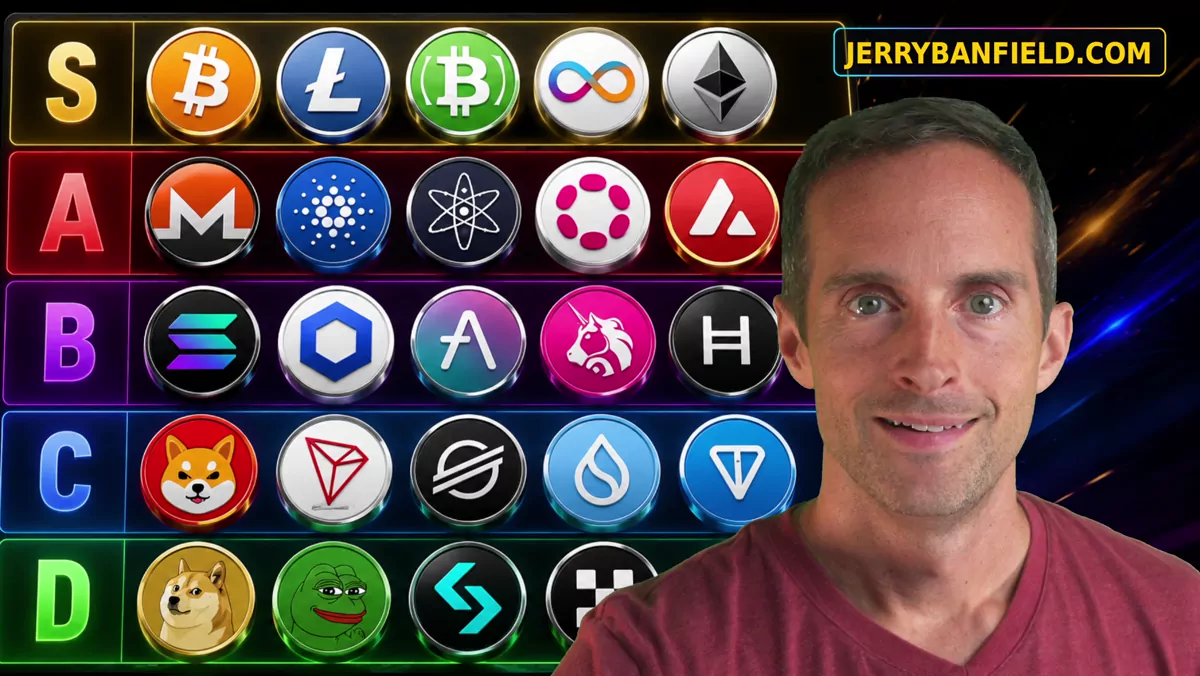
I ranked the top 50 cryptos by which ones are hardest to fake. That means which ones have some substance and can't just have bots or inflated TVLs or transaction metrics make them look like something real is happening. The number one hardest to fake, somewhat obviously, is Bitcoin. The second hardest to fake is Litecoin. Third is actually Monero, which is kind of ridiculous. Then you have fourth, Bitcoin Cash, fifth, Internet Computer Protocol, and sixth, Ethereum.
In order to generate this, I did a detailed research report in ChatGPT Pro and went back and forth on the prompting, and I didn't tell it what to say this time. I just said I want to figure out what's real, what is not just hype and speculation, what has the strongest reality to it. Because a lot of crypto is just kind of fraudulent — we'll do anything to get transactions and TVL and exchange volume so that people will trust our coin.
Why Bitcoin Wins, and Why Litecoin Surprised Me
Out of these rankings, Bitcoin was the clear winner, which makes sense. It already has the largest market cap. At the same time, though, the big problem with Bitcoin is that most everything that is, quote, happening with Bitcoin is actually happening on some centralized exchange where people are swapping and trading. That said, all the metrics and everything with Bitcoin are the hardest to fake. It is the most — at least — not just fraudulent. People aren't trying to push Bitcoin transactions. There's almost no incentive to try and fake anything on Bitcoin because it has such a strong reality.
Now, one thing I thought was, what the hell is ChatGPT thinking putting Litecoin at number two? Because it says Litecoin is hardest to fake, too. Litecoin is one of the original basically Bitcoin copies or forks. They made some minor changes to it. And Litecoin, for what it does — it doesn't do a whole lot — but it is at least legit. And it doesn't look like anybody's heavily incentivized to fake a bunch of Litecoin metrics.
Next you have Monero, XMR, which for the market cap is a pretty promising result for Monero. Then Bitcoin Cash below that. Yeah — I guess I asked it to find which is hardest to fake, not which has any real value. So Bitcoin Cash comes out.
Internet Computer Protocol Is the Big Outlier
But then the outlier in this whole series — and again, this is all I'm looking for, outliers — out of all these top 50 coins that I've ranked to see which ones are the hardest to fake, Internet Computer Protocol actually comes out to number six on this list, which is way above where it is on market cap. It is the biggest outlier out of all these coins.
It's hard to fake because the technology is the most dominant technology in crypto. It's hard to fake things like a service nervous system, a DAO that runs fully on chain, and hosting websites. The metrics that are on Internet Computer Protocol are things that are very expensive to try and duplicate or to fake. That's why Internet Computer Protocol is a big surprise out of these 50. Consistent research almost always shows that Internet Computer Protocol, when you look through the top 100 coins, is the biggest outlier. It is a thousand times smaller market cap than Bitcoin, and it's hard to fake what's happening on Internet Computer Protocol.
Next, predictably, you've got Ethereum — again, a huge ecosystem, arguably a bigger ecosystem than Bitcoin in terms of all the different applications that are connected to the Ethereum blockchain. Then, literally forked from the original Ethereum before the current Ethereum, you've got Ethereum Classic. Hard to fake also, not genuinely that useful, though. Then you have Aave, Uniswap, and Dogecoin coming in at the ten hardest to fake.
The Ten Easiest Cryptos to Fake
The next thing I want to look at is the ten easiest cryptos to fake. The ten easiest cryptos to fake are ones that make you think something is happening, but when you dig deeper there's almost nothing interesting. The top ten are World Liberty Financial — the absolute easiest crypto to fake to look like something real is happening — then Aster, MemeCore, Pi Network, OKB, UNUS SED LEO, KuCoin Token, BitGet Token, Pump.fun, and Worldcoin. Those are the top ten easiest cryptos that can be made, or that exist, looking on the surface like something substantial, but when you dig into the details, very easy to fake.
How the Fakeability Scores Were Calculated
So why are these easy to fake, and how did we calculate these? The scores on this are based on about six or seven different categories.
First, token and market control, about 20 percent. Second, activity signal manipulability. From some of what I've seen people saying, and what seems accurate for what I've seen in crypto in 12 years: if metrics can be manipulated, influencers will push them, and then there's every incentive to manipulate things like transactions, wallets, number of wallets, volume, total value, and users. There's every incentive to use bots to push metrics up for most of these coins, especially the bigger the market cap, because the more pressure there is for people to expect something to actually be happening. The more influencers point to concrete data metrics as proof that something's happening, the more incentive there is — and the easier it is — to fake like something's happening with armies of bots.
Then you have subsidy and incentive dependence. This is why Bitcoin scores so high. There's no subsidy and incentive dependence left for Bitcoin outside of Bitcoin mining. But a lot of these chains will do anything with rewards, points, airdrops, grants, yields, or referrals — like Pi Network, heavily manipulated metrics, trying to do all those things to push. Can that work long term sometimes? Maybe, but usually it's not sustainable long term. Usually you're going to lose when you have something like Bitcoin that just kind of coasts and doesn't have to do all that stuff, and then you're having to do all that stuff and you can't even get it up there. Ha. Oh, that's way too easy. That's what she said.
Then you've got governance and operational control — a small set of validators, upgrades, treasury, onboarding. Then narrative and partnership opacity, and that falls into all the partnerships, ecosystem, automated market makers, all that stuff. Then media and community manipulability. Then hard-to-fake evidence deficit — signals that indicate you're doing something that's not easy to copy and paste. Because in crypto, you have to assume that almost everybody's doing copy and paste by default. If you can just fork a blockchain, slap your own name on it, manipulate the metrics, and make a billion dollars, unfortunately most people in crypto are going to do that instead of doing the hard work to make it.
What Is Actually Fakeable in Crypto
So let's look in a little more detail before we wrap this up. What you should know in crypto is that things like trading volume, TVL, transactions, active wallets, developer accounts, partnerships, community reach, and governance activity can all be very fakeable. And there's every incentive to fake these things as much as possible to get influencers to then point to them, and to get crypto retail and even institutions to start dumping their money into them.
Examples of how things can mislead: transactions can be bots, spam, low-value transfers, internal exchange operations, low fees — all these things can make something look like there's activity when there's not. With TVL, you can recycle TVL, borrow and use against it, use incentives, and double count tokens; price appreciation flows into TVL too. I remember Kyle from DFINITY saying you can make the TVL whatever you want it to be. At DFINITY, if they wanted to cheat the TVL, they could just make it whatever they wanted it to look like, because that's how easy TVL is to manipulate.
On trading volume, I've heard that some coins have actually paid exchanges, along with their listing, to wash trade and increase the volume on their coins. This is controlled in an often non-transparent exchange environment. Especially when you have environments where there are no fees, you can just make a transaction and start trading. They can artificially inflate the trading volume. Active wallets, developer accounts — all these things can be faked.
What's harder to fake is when you have real revenue, persistent spreads, real technology and things actually built on it, real code that's actually being run and used by real people. The more you have hard-to-fake replacements you can see, to me, the much more trustworthy that is. So that's what ChatGPT went through and did deep research on, to try and figure out where's the truth, where are the hard-to-replace things, versus where are cryptos just faking and looking much more active — with more transactions and TVL — than actually exists.
Six Findings That Summarize the Full Audit
There are six findings that really summarize the full audit. Exchange-linked tokens dominate the easiest tier to fake, and issuerless proof of work dominates the hardest tier to fake. That's why you had things like Bitcoin, Bitcoin Cash, and Litecoin even getting up there, and even Dogecoin getting up there as well.
Another big point: incentives are not adoption. Paying people to build something that's off your blockchain and then connecting the blockchain to it is not real adoption, and it's especially not meaningful in terms of producing value to the token. And even when there is a real product, there can be an easy-to-fake token story — Ondo, Chainlink, Worldcoin, Canton. You can have real businesses, but the token is basically unnecessary and just used to raise liquidity.
Meanwhile, you have ICP as the hardest full-stack application network, and that is insanely difficult to fake, which is why nobody's been able to actually fake anything like it yet. That's why it beats Ethereum, Cardano, Solana, Sui, Avalanche, Polygon, Near, BNB, XRP, Tron, and Hedera. Because hosting a website on chain is not something you can fake. You can't even fake that with some other blockchain. And all the features like running an AI model fully on chain, and facial recognition — that's stuff you can't even fake with another blockchain.
Now, harder to fake does not mean best investment either, and this isn't financial advice. I'm all in on ICP because of everything I've said about it and all my massive amount of videos about it. And as I said in the beginning, Litecoin and Bitcoin Cash — just because they're difficult to fake does not mean they're good investments. I think Litecoin and Bitcoin Cash are trash, but I do respect that Litecoin, Bitcoin Cash, and Dogecoin are harder to fake the metrics on, because it starts to get expensive and there's very little incentive to even try and fake almost anything on there. Ethereum best of all — it's hard and expensive to try and fake stuff on there too.
The Full Ranking, Easiest to Hardest
If we look at the full ranking, we'll go through it to wrap up. The easiest to fake: World Liberty Financial, which I did a very critical review of before. Then Aster and MemeCore. You can see the primary fakeability factor, like issuer control and narrative — anything around a narrative is very easy to fake.
MemeCore, with the proof-of-meme incentives. Pi Network, with all those referrals. OKB — basically the exchange tokens, like LEO, KuCoin, BitGet — and Pump.fun behind it, the memecoin launcher. Those get a lot of money. Very easy to fake all the metrics, because there are all kinds of incentives and there are real platform fees. But in terms of who's actually building anything meaningful on the blockchain, is there anything here besides the centralized entity that's behind it? In most cases, no.
Cronos, Hyperliquid — keep this in mind, this is number 12 ranked, where a bigger number is better, so the opposite of being at the top. Hyperliquid, very easy to fake. I've warned so many times on the dangers of Hyperliquid. All the stuff with Hyperliquid is insanely easy to fake. And yes, you do have the order books and the positions and the real fees. But all the volume, the TVLs, the things people push in Hyperliquid — very easy to fake and inflate all that stuff, and it could all come crashing down at some point.
BNB, Ethena, Canton Coin, Sui, Mantle, Bittensor — high fakeability. A mission-driven scoring could easily be one validator, subnet owner, and miner all working together to extract value from Bittensor TAO subnets just to make it look like something's happening. And literally the centralized controllers in the middle have to step in to stop that manually. So not a good situation for Bittensor. Ondo, Tron, Hedera, Shiba Inu, Pepe, and Near Protocol all here as well.
Then XRP falls in the middle — offensive partnerships, paid shills, and from what I saw, bots covering XRP positively. The Graph and Toncoin: platform adjacency and incentives, again, make it look like there's something where there's not.
So this is how I'll wrap this up. Polygon, Solana, Avalanche, Algorand, Sky, Stellar, Polkadot, Cardano, and Chainlink get toward less fakeable, but still. Kaspa — all the Kaspa people will be happy — actually makes it 37 out of 50 for being hardest to fake. Bitcoin at 50. And Zcash, Cosmos Hub, Morpho, Dogecoin, and Uniswap at the bottom.
I'm keeping my videos to 15 minutes or less. I respect y'all's time, so I condense this and put it into multiple platforms. These are the hardest coins to fake in crypto, along with the easiest coins to fake in crypto. If you want to go deeper on any of these coins, I've reviewed a lot of them one by one in my Crypto Reviews playlist. I hope this crypto research has been helpful for you. See you soon.