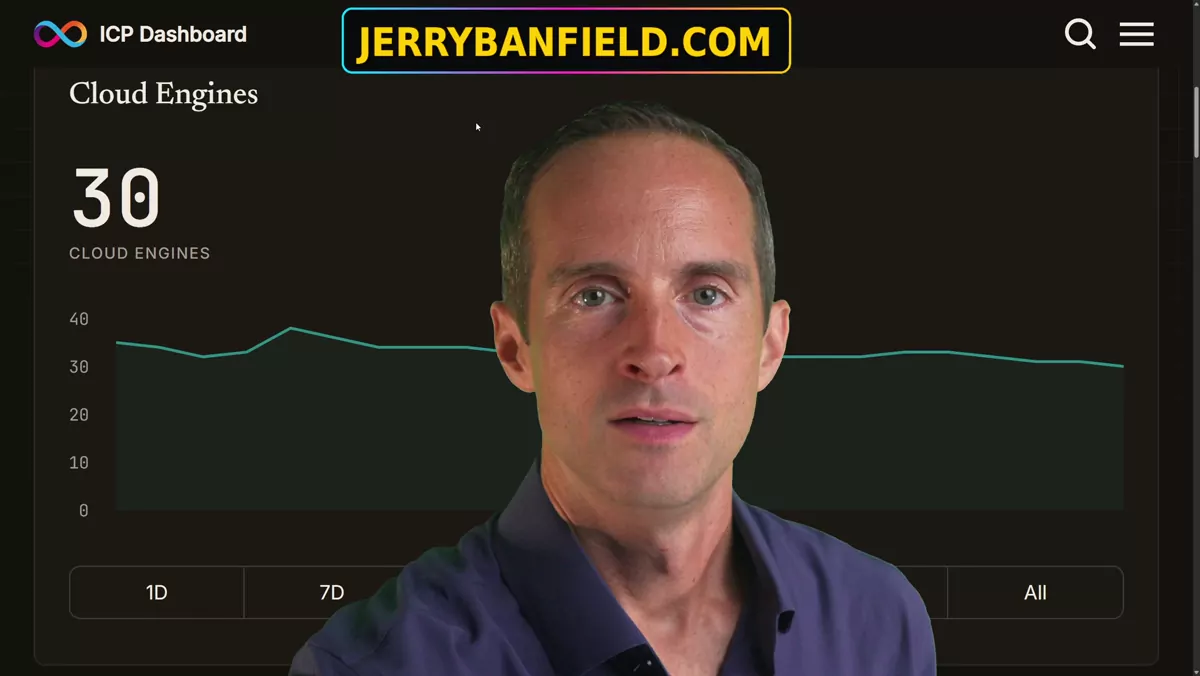
There's a new metric on the ICP dashboard called cloud engines, and it's another sign that everything is moving in the right direction. Today is a great day to be bullish on ICP. Let's take a look at what this means and how big of a deal it is, because this just popped up — it started being tracked July 24th, 2026, which is less than a month ago. Right now there are 30 cloud engines, and you can see all the statistics related to them. If you want to see where this sits on the dashboard, they've featured it: there's mainnet, and then there's cloud engines.
Mainnet Versus Cloud Engines
The difference comes down to this. The mainnet is a public network that everybody can easily access through the command line interface. That's what I'm using to build my website on at jerrybanfield.com, where I just added my Officer Banfield book yesterday — the whole book, MP3 downloads, and PDF directly on the blog. So I'm building that on the public mainnet, which makes sense for me: I have a website that's a few hundred thousand lines of code and not that many gigabytes of data. But what if I had a much bigger website and a bigger business, and I didn't want to have everything on a public mainnet? What if I wanted control over how powerful it is and over exactly where the nodes are? If I want full control, then I use a cloud engine instead of the mainnet.
The rest of the stats on the dashboard reflect the mainnet, but one of the biggest things to be bullish on for the future, to me, is cloud engines, because a lot of bigger businesses, companies, and governments are not going to want to just throw their stuff on the mainnet. When you run on a cloud engine, though, it can very easily interface with the mainnet. A cloud engine is a dedicated compute platform on ICP. Basically, they were trying to do something like this with Utopia, but cloud engines are a much better version of that. You can pick nodes on Amazon, Google, Microsoft Azure, and other node providers and dedicated data centers, then spin up your own cloud engine, which acts kind of like an ICP subnet — and you can run your own. It's all yours then. You get to have full control of it.
The Numbers So Far
We'll look at opencloud.org in a moment. Having 30 cloud engines already, when this is so early, is very exciting. You've got 42 data centers, 13 countries, 20 node providers, and 124 out of 1,500 node machines. Look down at the details and you can see the node providers and where they're at — some in Pakistan, lots in the US, Switzerland, Brazil, and so on. The node providers are listed there, then the node machines — individual machines from DFINITY and other node providers — and then the node classes.
To me, one of the big things to pay attention to is the node classes, because we're going to calculate approximately how much money these cloud engines should be bringing in right now — which is extremely bullish because, again, this just launched. This could scale to 300 or 3,000 or 30,000 cloud engines over the next year to a couple of years. Right now, the basic nodes they have are very simple: a couple of virtual CPUs and just 8 gigs of RAM, with plenty of storage. That would be enough for me to run my website on — I don't need a whole lot of processing power to run jerrybanfield.com right now. But you can go all the way up to 32 times as many virtual CPUs, 256 gigs of RAM, and four terabytes of storage. If I had something a lot more serious and bigger, I'd want the dense node. This is going to help us keep the cost of these cloud engines in mind — keep in mind what costs people are paying for these cloud engines right now. Most of the action currently seems to be geared toward either nano or dense, which makes sense: if you have something simple, it works just fine on the nano, and if you need something powerful, you go dense. It's interesting that there's not much in the middle right now, but I think that depends on what people choose to use — and I think part of it is capacity too. They're still getting this set up.
Why Would Anyone Use a Cloud Engine?
Now let's look through OpenCloud, which is at opencloud.org, and start to estimate how much money this is bringing in already — and again, keep in mind this just became available within the last month, so we're in the earliest part of the process. The question to consider is: why would people use these? Well, you can create them to build your own sovereign cloud. That's very important. And for AI agents, this has the infrastructure for tamper-proof execution. If you're going to build on a cloud engine, you're getting tamper-proof execution, safe upgrades, auto scaling, and again, sovereignty. This is extremely powerful technology.
Here are some of the basic properties. Tamper-proof execution means there's no vulnerable operating system or servers, no firewall — so this is a place where you could cut out a lot of your security team. Moving onto a cloud engine gets you a lot of enhanced security. Fault-tolerant operation is huge: they replicate the computation and the data across the underlying compute nodes. That means if a node or two goes out, if your data center gets blown up in a war, or if there's an upgrade that breaks one of the nodes, you will still keep running. Then another very important property is orthogonal persistence, where it's set up for software to run forever. You don't have to have databases, because the data is inside the software — the variables, all of it, in the same space. And this is where the sales pitch is: it massively simplifies backend software. When you combine that with massively simplifying the security surface, then you have safe production upgrades. The Motoko language helps you upgrade without breaking your data, which is very important when you're doing something like what I'm doing on jerrybanfield.com.
Safe Upgrades Matter More Than Ever With AI
I'm grateful that yesterday two people dropped the $25 tip and the $10 tip. So now I've got a $50 tip up, and all your tips are cumulative too — I'll keep putting up bigger tips so somebody can top out on the leaderboard. And that feature is a perfect example: when I built it with Claude, directly on the ICP public mainnet, it was important that when I ship an upgrade like that, it doesn't break the rest of my website. This is a problem with all the other vibe-coding setups — they're not built on a programming language that was made to handle AI coming in and messing with a bunch of the code all at once without considering whether an upgrade is going to break something. This is very important. For example, my tips are directly connected to the leaderboard. So if you're signed in and you drop a tip, or you want to push above the others on the leaderboard, then when I add the tip functionality, it doesn't break the leaderboard, and it still allows everybody to continue chatting. I just add it to the existing products on there, and then I can continue using AI to build my website and build additional features. Map Technical Forecasting just built his own platform on ICP too, with calls and everything, and we were talking about that in the chat.
It's very important when I go into Claude and say I want to add a feature: if I'm risking breaking the rest of my website by adding it, then what I can do is very limited, and it gets more and more dangerous as I go forward to do anything to upgrade it. Now, you could always try to roll back the code or keep a copy and re-upload it — but you can see what a pain that is. Instead, the Motoko language warns you and stops you if you're going to break something with your upgrades, and that's very important for AI. I'm telling you all this so you can understand very clearly why these cloud engines are so important, and why they're so attractive for next-generation infrastructure. I've got to say it, because so many people go, "Well, the price didn't move." This is data that suggests there are huge reasons to use cloud engines — and the more people use cloud engines, the more the price will move.
Serving Data Straight From the Blockchain
Horizontal auto scaling is a feature I don't have on the public mainnet. I can use up to the public mainnet capacity, and then I can try to go between subnets. But if my website got to a certain size — right now, it's pretty small. I don't have much data. I've got the leaderboard, the profiles, the pictures, what's in the chat, and the images people put in there. I just put about 300 megabytes of audio on-chain for the Officer Banfield book. And here's what's nice about that. If I hosted this on Google Drive, and somebody shared the Google Drive link and it went viral, I could actually get my Google Drive suspended for having a lot of data moving. Serving it straight from the blockchain, I don't have to worry about a bunch of people breaking Google's download limits on Google Drive. Only people who are actually signed in to their account and have bought the book can download the audio. And then if somebody shares the audio on their own Google Drive, that's not my issue, not my problem — and it's fine.
This is very important — keeping my data so that you have to actually buy the book to get the audio files. And then if you want to share them, that's up to you, but it's not something that can easily be shared off my account. I got my Dropbox account suspended before, because I had these courses up there and I shared the link to it, and somebody shared the link and everybody was downloading. It's humbling. I had all this stuff on Dropbox, and they just suspended my account. Like, what? How do you get your Dropbox account suspended? "Well, you exceeded the thresholds of data that we allow you to download on it." So this is why the blockchain is important. I have my book now, you have to be signed in to download it, and you download it straight from the blockchain — not Google, not Amazon, straight from the blockchain.
All right, so right now, that's fine for me to serve on the public mainnet. But what happens when I have 34 other books and I add all of those on here? What happens when the Jerry Banfield chat community — and I'm very grateful for everybody who's bought the chat community; you can see on the leaderboard that everybody at 96 or above bought it — gets to be 100 people, several hundred people? And I just launched this a few days ago.
What happens when, instead of just me and Map Technical and Truce Elfin talking, there are hundreds of people talking and all posting pictures, and the data starts to accumulate on the blockchain? And look at Mike's Technical Forecasting maps — this is what you can build on ICP. This is important. He has an entire website up with Bitcoin, ICP, and SPX price predictions. He's got all of that on there, he's got a system, and he built it with ChatGPT Codex, then shared it and talked with me in the chat about it.
Horizontal Auto Scaling
So what happens when my website expands to the point where I need more power than I'm getting on the mainnet — where I'm reaching limitations on the mainnet? Well, then I have the option now to get the ICP infrastructure, and I said all of that to get to point five: horizontal auto scaling. Remember, we looked at the different providers before. Right now, I could start out on the nano server — my website is less than 100 gigs, and I don't need more than eight gigs of RAM at this point. I could start out super cheap. And I might as well be on mainnet, because it's so cheap right now to be on mainnet. But if my website gets bigger and I want full control — if I don't want the whole public mainnet in control of my website, and I want things set up so I can scale better — then I can move onto a cloud engine, have dedicated compute and RAM and storage, and just upgrade. I can scale it up as needed. I could go from 100 gigabytes of storage up to 500 gigabytes, all the way up to four terabytes, which I might need to do if I ever wanted to serve videos. The horizontal scalability is amazing: you can just start adding in more nodes, and upgrading the nodes too, and you're all set. This is an incredible feature.
No Vendor Lock-In
On top of all that, most everyone else requires a vendor lock-in. The same companies right now are tied to all these specific vendors, and they're tired of it. Their data is stuck. They're stuck paying whatever the vendors charge, and they can't integrate AI with all the other stuff without custom integration — which I don't imagine they just give out for cheap. On cloud engines, you don't have a vendor lock-in. You can pick a Google Cloud node, an Amazon node, a Microsoft node — and if something happens with Microsoft, you just drop that node and put in a node from somebody else. The hosting for the apps isn't even interrupted, because it's all replicated. Let's say Microsoft raises their prices or bans a certain type of content or whatever: you just drop the Microsoft node, stick another node in, and your users don't even know.
I've explained all of that because it's important for everybody who's full of fear, uncertainty, and doubt, constantly saying all that matters is the price. You need to look at why people would use cloud engines. How big of a deal is it that there are already 30 of these running with what, to most people, would be very little marketing? This is basically insiders who know about this stuff and want it so badly that they were intentionally looking for it and ready to try it as soon as it went live.
What the Pricing Tells Us
The last thing we'll look at is pricing — how much revenue is this bringing in right now? Let's look at the prices for these. Right now, the nano nodes are pretty cheap. If I wanted to have a website somewhere like Kinsta on the Google Cloud platform, I'd be looking at the equivalent of nano nodes and I'd be stuck paying probably $100 a month, totally stuck on one infrastructure, with a bunch of WordPress crap, and I couldn't do everything I'm doing with AI on that. So right now, if you want some nano nodes, the price is very affordable, and most of the nodes right now are set up for nano nodes, which makes sense if you're just starting something. All you need to do is a basic build-out, get it working and functional, and then you can scale it up. Most of the nodes, as we saw, are either nano or dense. Now, notice the dense ones are $2,000 a month instead of $1,000 a month. And I don't know whose idea it was to put "$40 to $41 a month" on one of these. Really? We couldn't have just said $40? We had to do $40 to $41? Like this one at $2,275 — really, it's not $2,275 to $2,276? We got an exact number on that one. Well, that dollar is really important right there. Anyway, you can see the cost of these, so now we can estimate.
Then there are upgrades. If you want SEV, that could be very important if you want confidential computing — where you don't want Google or Amazon or any of the node providers to be able to just spy on all of your data. On a website like mine, that's not that important. But if you're a hospital, a law firm, or a government, you might want SEV, and that costs additional on the premium. Then you've got the data costs. You can see how simple the public mainnet is compared to this — this is geared toward companies, enterprises, and governments that want full control. And you can see exactly how much these come up to.
Right now, if you wanted a hobby engine — something that would make sense for me — you'd be looking at $92 to $220 a month. You'd have 100 gigabytes of data on AWS and 20 terabytes through Hetzner, and you can mix it up: Hetzner and AWS, four nodes. That means even if you had one or two nodes go offline, everything would still continue running fine. Those are the low-end cloud engines, at maybe $100 a month. Now swing over to the other side and you can see how it scales up. A standard startup production setup would run you $600 to a couple of thousand dollars a month — seven standard nodes with eight CPUs and 32 gigabytes of RAM, and you can see the rest of the details there. Then if you're up at production level — the levels you'd be getting to if you're a company or a government — it goes even higher. If you want high-resilience regulated, you're looking at $25,000 to $40,000 a month. Now, do we have any high-resilience regulated engines on there at this point? Not necessarily. But this is where some of the huge money could be coming into ICP, because these are very valuable offerings. I don't know where you'd get a setup like this anywhere else in tech right now. If you want a high-resilience, regulated, sovereign setup that's under your control, this is your best option for it.
Estimating the Revenue
At this point, I'm guessing based on the pricing we're seeing here — and this is all paid in cycles, which ends up burning ICP — that at the absolute low end, the cloud engines are bringing in at least $3,000 a month, even if they're all just the basic nano nodes. But if you have a few more expensive ones in there, even just one or two testing higher levels of the network, you could be looking at tens of thousands a month in revenue for a brand new offering. And it looks like you can actually just create your first cloud engine publicly right now — cool — and you can request an early-access discount. So these are very early still, and there are already 30 of them. This is one single data point to watch.
With the node machines, you can actually calculate it — well, it depends on how many are actually being used. If I look at the data, it says there are 124 out of 1,500 being used: 1,500 looks like the capacity, and 124 looks like the actual amount in use. Do the math on that and there are around four or five node machines for every single cloud engine. So it looks to me like there are mostly nanos on there right now, though there might be a couple with many more nodes that are being set up for something more serious. This is brand new, and there are already thousands of dollars a month in revenue — maybe toward tens of thousands. That means thousands of dollars more in ICP being burned every month.
Why This Is So Bullish
What's really exciting is the potential. Look at that: DFINITY actually shipped this in the middle of a market where almost everybody else across all of crypto is just talking — just not doing anything fundamentally useful. DFINITY shipped cloud engines, and there are 30 of them running right now, alongside and complementary to the mainnet burning ICP. This is a huge deal — a very clear data point that everything is moving in the right direction and that everything about our thesis with ICP is correct. And in my view, the price means the opportunity is here. As soon as the price goes up, the opportunity is not as good as it is today to get in. That's why I'm in. It's extremely bullish for ICP that this is live.
So if you'd like to chat about all this stuff, go to jerrybanfield.com. Sign in with your Internet Identity and join the community chat — we can talk there. I'm going to start making some individual chat channels. Join the community, see what other people are building on ICP, and enjoy seeing yourself featured on the leaderboard.
And if you want to try out what it's like to buy a product straight off the blockchain, I'm going to be putting more books, more courses, and some comedy in the store on my website.
I've also got a Zoom call if you want to talk with me about getting set up, getting yourself building something, or asking questions about building with AI directly on ICP — you can schedule a one-on-one call with me.
If you want to support and send a message, the tip wall is there to show off whatever you have to send, and all of that shows on the leaderboard as well.
a one-on-one call with me is still here too, if you want to direct message me and post there.
Thank you very much for watching. If you'd like to keep going with videos like this one, check out my ICP Crypto playlist — and I hope to see you on jerrybanfield.com soon.