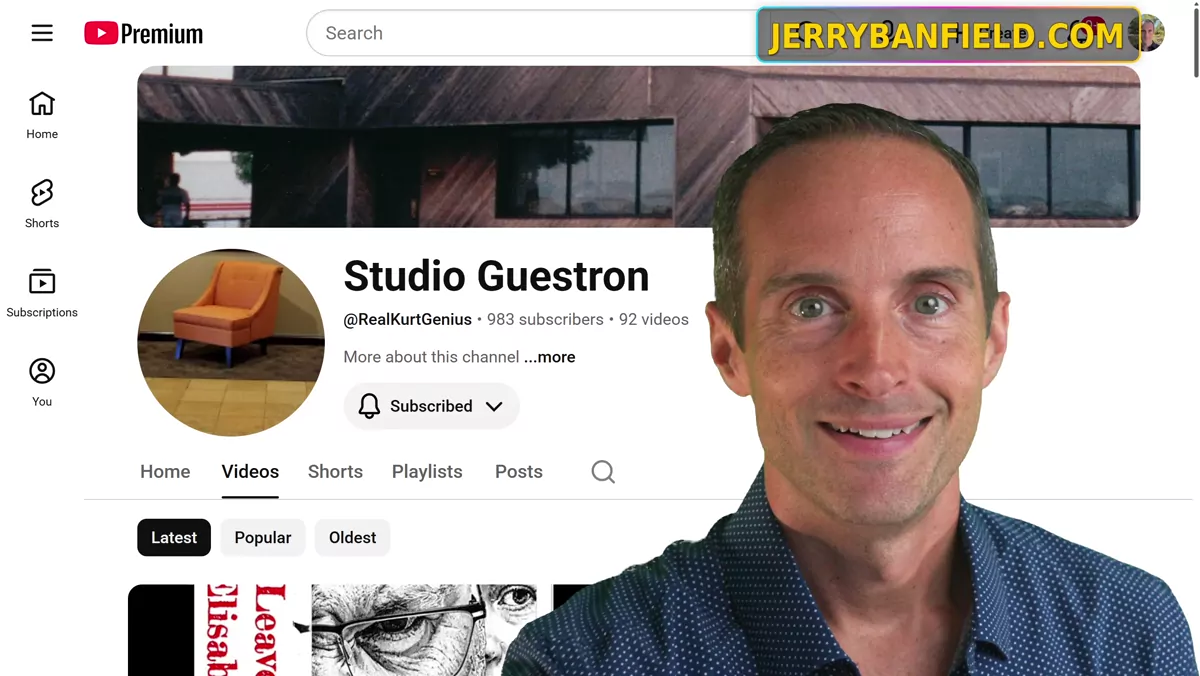
Real Feedback for a Real Small Channel
I'm a YouTube coach, Jerry Banfield. I've been on YouTube 15 years, and this is real feedback for a real channel that just joined my community at jerrybanfield.com and said, "Jerry, I want to get more views on my channel. What do you recommend?" This is going to be super helpful for you if you have a small YouTube channel and you want some real talk, because a lot of my feedback for many of you will be the same. Kurt's channel is right now mostly music videos, so this will be especially useful if you're making music videos, but a lot of what I'm saying applies to almost anyone on YouTube.
First, with this channel, it looks like Kurt is just doing it for fun. The channel has been on YouTube since 2006, which is amazing — five years before I was on YouTube — with 92 videos and 6,000 views. If this is just a channel for fun, why do you need more views? Let's think about that for a minute. You want more people to watch your videos — I make a lot of videos, I get that. But if it's just a hobby, then so what if a video gets 14 views? It doesn't really matter how many people watch it. I watched some videos on this channel on a different one of my YouTube accounts. I listened to Krista Marie, and I could really relate with that song. I listened to Take Me Away. Kurt has good music here. I also listened to Anisha's Got a Boyfriend, and I was laughing. These videos are certainly good enough. But there's a reality you need to face on YouTube: if you want more views, there are going to be three basic ways to get them, and this will be especially relevant for Kurt's example.
Way One: Pay for Views
The first and easiest way is to pay for views, and there are two basic ways to pay. Especially with music, it is very often just pay to play. Even some of the top artists do this. I talked to a guy over a decade ago who said he was using massive networks of bots to push the top music videos on YouTube — we're talking millions and millions of views from bots pushing the very top artists on YouTube. This is the reality that I see on YouTube: a whole lot of inauthentic traffic. YouTube certainly seems to try to crack down on it, but they also have an interest in getting views, so there's a conflict of interest there. Now, I'm totally against using bots or artificial traffic. But if that's the reality of what the top music channels and music videos are doing — using bots, plus big studios that already have huge audiences, and potentially ads too — then it's ridiculous to think you're just going to make music videos and the YouTube algorithm is going to hand them an audience.
So the first way to pay is Google Ads. If your videos are appropriate for Google Ads — and Google Ads has some crazy standards — all you need to do is take your song lyrics and your video, put them into Google Gemini, and ask, "Would this video be appropriate or accepted in Google Ads?" And Google Ads views are hella cheap. You can get views on a music video for a tenth of a cent each. Literally, it could cost about $6 to double the views on this entire channel. That brings it back to why you want views. If you just want people to watch your videos, then with Google Ads targeted globally to a music audience, assuming your video gets approved, you're talking a tenth of a cent per view. That's a thousand views for a dollar — $6 to double the views on this channel. If you just want views, Google Ads will do that for you.
Then it goes deeper: what kind of views do you want? Do you care if someone in Indonesia sees your video on an ad, kind of clicks on it, doesn't really pay attention to it, goes AFK while it plays in the background — or maybe with an ad blocker your video gets clicked on and doesn't even get watched? If you just want higher numbers, Google Ads will do that for you. Now, if you're thinking, "I want people to actually listen to my music and care about it," then the second scenario where you pay is paying somebody who already has an audience to promote your music, or whatever kind of videos you're making, to their audience. That will often cost a lot more. I've talked to a number of people who had music videos they wanted to promote and would spend thousands and thousands of dollars to do it. For example, I talked to a YouTuber who had hip hop videos he was making, and he paid thousands and thousands of dollars to get them on a world hip hop channel. They promoted his video and got him a good amount — thousands of relevant views from what I would imagine was a decent portion of real hip hop listeners. But did that really monetize for him? No. It got him some views and some real listeners, but it didn't make him a bunch of money. And I watched this guy's career over time, and a lot of those listeners didn't stick with him.
If you want true fans that really stick with you, then you're going to have to play the longer game. In my experience, paying for ads can start that. I started out on YouTube building hundreds of thousands of subscribers by paying for millions and millions of YouTube views with YouTube ads. That ended up getting me hundreds of thousands of subscribers and tens of thousands of people who followed me over time — even when I've deleted my channels and changed my content, they still keep coming back and joining the community. I've got A one-on-one call with me. Those YouTube ads brought people who then gave word of mouth recommendations, shared my videos, and so on. This is what most YouTubers don't tell you. And if you're just starting out — Kurt has made 92 videos, which is enough; you've made enough videos. The oldest video on this channel is from two years ago, and often a new channel will work better than an older channel. The most popular video on the channel has 776 views, and there's one from February with Luke and Leia in it — you couldn't advertise something like that. So your options come down to this: you're going to pay for views, you're going to play the game in the algorithm, or you're going to make content that really solves a hard problem for people.
Way Two: Solve Hard Problems in a Hungry Niche
Here's an example of really solving problems for people. On my website you'll find my chat, and people join my chat because I'm solving problems for them — I'm helping them out. People go to my website and leave tips because I solve problems. If you look at my YouTube channels, I have a Jerry Banfield ICP channel. Why do people watch it? Because I solve hard problems for people on that channel. I provide content where there's a very hungry audience that wants videos about ICP all the time. Almost anybody who makes ICP videos will at least get some views, and if you really help the people, you'll get lots of views.
So if you want views organically: number one, you're going to have to pay for it, or number two, if you're not going to pay, you need to make videos that really solve problems and satisfy demand that's sitting there in the YouTube algorithm. There's demand for videos about Internet Computer Protocol just sitting in the algorithm — an audience where there are fewer videos than there is demand — so any video anybody makes about Internet Computer Protocol has a waiting audience. Music videos are the opposite of that. There are so many music videos in the algorithm that it's close to hopeless — you're almost never going to get views making a video where you're counting on organic demand for music you just wanted to make because it's fun to make.
One Channel, One Type of Content
Also, if you're going to play the algorithm game organically, you generally need to laser in on one type of content. For example, my YouTube coach channel is all YouTube coach content. If you're going to make music, you generally want an entire channel that's just music. If you mix vlogs onto a music channel, that's usually not going to work as well, because people want to come there for one thing. That's why I have an entirely separate channel for my vlogs, and my vlogs are able to take off by themselves. Across my channels: I have the Jerry Banfield Show, at Jerry Banfield, which is just vlogs — that's all I do on that channel. I have a dating channel, and all I do on that channel is dating videos. I have a gaming channel — all gaming. YouTube coach — all YouTube coach content. And then I have two crypto channels where I do different kinds of crypto videos: one is just ICP, and the other is everything else.
If you want to get views organically, it's generally going to be an absolute grind, and that's what I do — an absolute grind. My YouTube coach channel has 130 videos, and it's a new channel I made on March 21st, 2026. Generally, new channels will work better, and that's just one channel. My Jerry Banfield dating channel has 118 videos since May 6th, 2026 — that's three and a half months, 118 videos. Then I cross-promote my channels too: people on my YouTube coach channel will find my vlogs, people on my ICP channel will find my dating channel. I grind out videos — I've filmed and published over 600 videos in the last three and a half months. So if you want organic views, you're going to have to grind out videos and/or find a specific area where people really want your videos. That means you can't just make whatever you want. And with music, that's very difficult. You have to find exact keywords in music where there's untapped demand — for example, there was a trend of people wanting light language singing. You have to find obscure things like that, put your videos into obscure lanes like that, and target those specific keywords. That's much more difficult to find and research, and then you have to modify what you're creating for the organic algorithm.
Way Three: Play the Algorithm Game
That ties into number three. Number one was just pay for it. Number two was find a niche that's in demand. Number three is play the algorithm game. Playing the algorithm game means you need to figure out what's in demand, so number two and number three have a high degree of overlap — basically, you've got to figure out what people want to watch. And sometimes you're going to miss, like I did. My video on how YouTube just changed what counts as a view got 284 views — pretty good for a channel with a few hundred subscribers — and another got 473 views, also pretty good. But you're going to miss sometimes.
You're Going to Miss Sometimes — Keep Shooting
Like my video from yesterday — it just missed for some reason: 52 views. You're going to have to take shot after shot on your videos, which means you're going to need to grind. And that makes the choice clear: if you don't want to grind out videos every day and research the content, the algorithm, the trends, and the keywords — if you don't want to make your content all about the algorithm — then you're pretty much stuck just paying for it.
If you just want to make whatever you want, then even if it's a hobby, spend $10 a day to push your YouTube videos. For $10 a day, you could get 10,000 views a day on your videos from all over Earth, from people watching music. Enjoy that, and look at it as a hobby — you're just enjoying what you're doing. Even then, you're going to have to be compliant with Google Ads. And obviously, you can also pay people who will react to your content, create videos about it, or feature it elsewhere. This is the reality of what it's like today.
Shorts Are Easier to Get Views On Than Longs
You can also create shorts on YouTube. YouTube shorts tend to be easier to get views on than YouTube longs, especially for music. Now, my ICP videos actually get more views in the long format. But my YouTube coaching videos tend to get more views as shorts — almost all my shorts on my YouTube coach channel get more views than my longs do. So for music, doing shorts can be very effective. You can literally take the music videos you've already made and put them into shorts, and that will get more views. If you want to really get subscribers and true fans, long-form horizontal videos tend to be much better — but you don't have to choose. You can do your videos in shorts and in longs; just put the same video up in both formats.
For Kurt, all he needs to do is take some of these music videos — he's only done a handful of shorts so far, and those actually did get more views — render them with a thumbnail set up for a short, make them less than three minutes by putting the beginning of a song on there, and publish them all in the shorts format. So there it is: about 14 minutes of real talk for Kurt. This is the reality, and if you want more views on YouTube, this is what you can do to get them.
Where to Go From Here
If you want more help with what you're doing on YouTube, go to my website and look at what I'm doing on my channels. Keep in mind, I've been a full-time YouTuber for 15 years. I got burned out and deleted everything last year, tried to do something local and in person, and it just made me appreciate being a YouTuber. Let me tell you, when you can essentially print money from home doing videos like this, it's not very attractive to try to do something in person instead.
If you want to be a professional like me, I have a one-on-one call with me where I will help you become a professional.
This is what I do full time: I have six channels, I grind out an average of seven videos a day, and I get tens of thousands of views a day on average — starting from scratch in March, which was six months ago. Even the dating channel gets thousands of views a day, starting from scratch in May.
If you want to chat and just ask questions, go to schedule a call with me. Post your YouTube channel there — maybe I'll do a video like this for you.
And if you want coaching like this, I'll talk with you about how to really do everything in detail.
If you use Skool, you can also schedule a call with me.
If you found this channel review helpful, there's a lot more where it came from in my YouTube Coaching playlist, where I share what's working across my channels day by day.
And if you want to talk one on one, you can schedule a call with me.
That's it — I hope to see you on jerrybanfield.com soon.