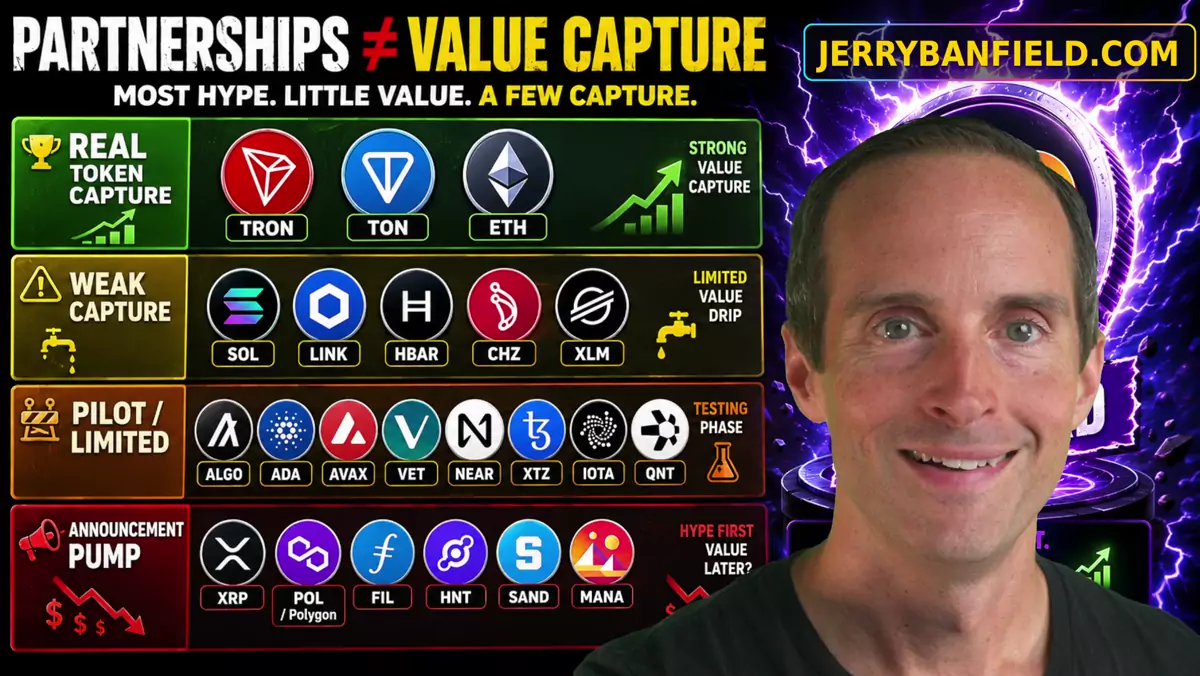
I was having a conversation scheduled on jerrybanfield.com with someone in crypto, telling them how partnerships on Internet Computer Protocol are different from partnerships everywhere else. So I did the research through ChatGPT Pro to go show what happens with crypto partnerships and how they fare over time, and to show you how most partnership announcements — most everything everyone's saying and hyping in crypto — are nothing more than reasons for the token to pump speculatively. There's a fundamental design flaw in how blockchains besides ICP are actually built that means partnerships have almost no effect on the long-term token demand, price, and business model. ICP is different, and I'll explain that now.
Then I'm going to go look at a history of all kinds of partnerships across 22 of the most popular blockchains and their biggest partnership announcements, and show how most of them consistently flopped, mean nothing, and aren't worth much at all. Then I'll show a couple of notable exceptions, where some tokens have had real token capture from partnerships — but it's rare. It's rare because of the infrastructure and how it's built. For example, Tron and Gram — formerly known as Ton — and Ethereum have had some value capture just because of the way the fees are set up. However, even these, some of the best examples of meaningful partnerships in crypto, have their problems, and almost all the other ones have been worthless. It's because of how the infrastructure is set up.
The Design Flaw That Kills Partnership Value
Here's the most concrete example I can give. I have a website at jerrybanfield.com, and I'm grateful we just got the first tip on it — I set this up like a day or two ago, somebody dropped a tip, and we've got the leaderboard now with three people up there. My website is hosted on Internet Computer Protocol, which means I pay my web hosting bill straight to ICP. That means if I pay some influencer to hype up all of my videos and I get a bunch of traffic coming into my website, that increases the amount of money I have to pay ICP to host my website.
You might be like, "What? Why are you even talking about that?" Well, let me explain what would happen if I built this differently and it wasn't built on ICP, and I had a token behind it. I'm trying to give you the most concrete examples possible. Let's say I had some meme coin I created on Ethereum instead, and then I hosted the website on Amazon Web Services — this is how most of crypto is built. In that scenario, if I paid a bunch of influencers to hype up the coin, then all the people who came to my website — and I had a guy come in, schedule a call yesterday, and I talked to him within six minutes of him paying for the call — in that example, the token itself would get almost no value, because it would just be transacting people buying and selling. And my web hosting bill would be getting paid to Amazon.
Some of you are still like, "I'm not getting it." All right. When these tokens announce partnerships and almost all the details for the partnership are off-chain, that means it's very hard for real value to come to the token, even if the partnership is substantial. What's different on ICP is that when partnerships are announced and they build real things, the value comes back to the ICP token — because you have to buy and burn the token to pay your web hosting bill, which is where the majority of the cost of really delivering a partnership is. Do you understand that? Understanding this is the foundation of seeing why all these cryptos I'm about to show, all these partnerships and all the things they announced, were basically useless: there's not enough on-chain value capture. Even if the partnership is successful, the amount of value that goes into the token — the amount of token that's burned — is almost meaningless, because all the biggest expenses are off the blockchain and paid off the blockchain. ICP is the only infrastructure that offers something different.
That said, if you have a big enough partnership that is ongoing and lasts long enough — which is rare, difficult to execute, and requires everything to be set up perfectly — then you still can get some more real token capture. But then you have something like Ton or Gram, which has a bunch of dilution and problems with the token itself. So even there, with the Telegram partnership, it's difficult.
Research Seriously or Get Ripped Off
So let's look at all these blockchain partnerships that were a huge deal, that were an excuse to pump the token. This is part of a long document — a 50-page document with all kinds of exact details about this. If you want it, it will be in my community when you schedule a call with me, and I'll put a collection of these into a course or something you can buy on the website as well, with all my research from a whole bunch of different coins.
If you're going to be investing in these things — this isn't financial advice, this is life advice — you should research things you're investing in seriously. You should not be buying stuff because you like the logo, or because some influencer who got paid to shill it and has bags full of it is shilling the partnerships. You need to look deeper. Otherwise, you're going to get ripped off. The game is set up to take advantage of you not knowing what you're doing and being confused. I'm here to support you in knowing what you're doing and not being confused. These partnerships are a big point of failure where people get ripped off, and you need to be ready to basically disregard almost every announcement you hear for a partnership going forward, unless it fulfills what I just said: can the hosting be so expensive and such a big deal by itself that it creates a huge demand for the token? Here's what didn't happen in these other partnerships.
EOS, Tezos, IOTA, and Immutable X: How the Hype Ends
For example, EOS. I just ripped on that recently because I told everyone it sucked in 2017. I looked like I was wrong for a few years. It sucks, and I will be right for the rest of eternity about that. One of their partnership announcements was a Google Cloud block producer candidacy. This was part of the reason it pumped — something all the shillers were talking about. And the outcome? The repository was archived. No production workload found. The unfortunate reality of almost all these partnership announcements is that's how it's going to end up.
Let's look at the next one: Tezos (XTZ) with Ubisoft — Quartz, Ghost Recon Breakpoint, the Quartz beta NFTs. Here's the problem, though. When the native token link is just backend fees, there's not enough value capture even if the partnership goes well, because these are video game companies with almost everything off-chain — almost no value can come to the blockchain even if the partnership works. And how did it end up? There are no more Breakpoint drops and no durable engine.
IOTA, same story. Jaguar Land Rover, the SmartWallet — they shipped a vehicle trial. Big deal, big hype. The native token, IOTA, was a reward asset with zero fees, and then there was no public broad rollout.
IMX — Immutable X. I was actually using Immutable X, playing Gods Unchained, when this GameStop NFT marketplace came out. Hype for the token, pump, speculation. The reality is it was an NFT marketplace with almost everything hosted off-chain. If it had been built like ICP, there would have been a lot more real demand — the partnership would have used a whole lot more of the token, burned to pay for computation. But it's not, because everything was hosted off-chain, because it's a basic copy-and-paste, me-too blockchain. The NFTs, the pictures and everything, are all stored off-chain. And the native token link? All it was is grants and backend fees — it was Immutable X giving GameStop a bunch of money to pay for the partnership. And what happened? There was no meaningful revenue. The business wound down. Once you see how this is what's normal, you'll be extremely skeptical that any partnership means anything unless you're looking at big potential token burn from the actual infrastructure powering the whole thing. And that's what's in place with ICP and the partnerships there.
Polygon, Algorand, and Cardano: Paying for PR
Polygon (MATIC): huge partnership announcements, gigantic token pumps, influencers all over, just wrong all over the place. Starbucks Odyssey and NFL ticket NFTs — "this is going to go 100x" — all wrong. Loyalty and ticket NFTs are what shipped, the native token link was tiny gas fees, Starbucks closed Odyssey, and the ticketing shifted. Unless a blockchain has the infrastructure to host a whole partnership on its coin — where you have to buy the coin and burn it to pay for all of it, the website, the backend, the database, the AI interface — their partnership announcements will mostly, 90-plus percent of the time, continue to be useless, just like all these useless partnerships.
Algorand: FIFA and FIFA Collect. I remember all kinds of hype for that. And you know what? Because it's not hosted on the blockchain, there were tiny little ALGO fees, and then FIFA migrated away from Algorand. Why would they even do that partnership in the first place? I imagine — and I could probably scroll down and look through the data more — they got paid to do that. Almost all these blockchains are just paying. Like Immutable X — I think they gave GameStop $150 million. That's what's going on. It's just "pay to talk about us." But it won't work long term.
Cardano. Oh, I remember this one — "Cardano's taking over Africa." I remember this was such BS at the time, and I called it out. The Ethiopia Ministry of Education and Atala PRISM had an identity implementation pilot. Again, same failure: most of it's not on-chain, the ADA fees are often abstracted away, and there's no evidence at all of five million production users. It totally fell short. Just PR.
Stellar, Sandbox, and Quant
XLM — Stellar Lumens — and IBM World Wire, the cross-border settlement network. Here's a nice detail: XLM was optional. Boy, that was a great partnership, wasn't it? Again, this is the stuff people were putting in "XLM's gonna 100x" stupid price targets over. You've got to think better. You need to think better than the people ripping you off — you've got to think at a higher level than them, and then you won't get ripped off anymore. Maybe in the short term you still take hits; I've lost money on ICP in the short term. But in the long term, I'm going to be very rich in most scenarios off ICP. This is the opposite. What actually happened with XLM? It created minuscule fees, the current volume and XLM demand are opaque, and it didn't go anywhere.
Sandbox: the HSBC metaverse land. I remember this one too. It feels so good, because at the time I was saying this is all stupid, this is crap, these stupid partnerships — they're just paying to promote themselves. I roasted most all of these coins, and now they've all failed. All their partnerships have failed, just like I said they would. And this is going to keep happening unless they fundamentally change the infrastructure — which, well, they can't, because it's too hard to build something like ICP if you didn't start working on it ten years ago. This was a land purchase activation, a one-time SAND-linked purchase, with no visible ongoing banking workload. Absolutely flopped.
Quant: the SIA interoperability test with Overledger. And what shipped? An interoperability test. Great. Then there was the licensing.
I'm not even sure what happened on that licensing. Production volume and Quant demand: unverified.
AVAX, Near, and XRP: Indirect Demand Goes Nowhere
AVAX had a big partnership announcement with Amazon Web Services — cloud enablement deployment. And AVAX itself? Only needed if the resulting changes require it. Useful distribution, sure, but here's the failure point that shows up all the time: indirect token demand, because the token can hardly do anything itself.
Near Protocol: the Google Cloud ecosystem partnership. "Guys, Near is going to 100x — Google Cloud!" It was cloud support for startups. But look at this detail: NEAR gas gets used only if the apps succeed. Boy, that's useless, because almost none of the apps are going to succeed. And even if they succeed, it's a very small amount of gas — the capture is almost nothing. This was a win for Google. They sit there and make money, and NEAR holders lose.
Then the MoneyGram partnership with XRP: production ODL corridors, the XRP bridge shipped, and tiny XRP burns. The subsidized partnership was terminated. XRP is a perfect example of endless partnership announcements, and the truth is, there are a few hundred dollars a day of XRP being burned. There's no evidence to indicate that any of these XRP partnerships are ever going to even do more than 5x the usage, because for years they haven't — if you look at the blockchain data, XRP usage has barely grown for years, despite price pumps and despite endless partnership announcements. And even if they 100x'd the usage of the XRP token, it would still only burn a few tens of thousands of dollars a day. Meanwhile — there they go, the Archons are slipping stuff into my mind — the ICP burn is already several thousand dollars a day. It's already ten-plus times higher than XRP at a fraction of the market cap, a fraction of the awareness, and a tiny percent of the partnerships — again, because of how the infrastructure works. The only thing you need to understand in crypto is basically how big of a deal ICP is and how much of a fraud almost all the rest of these are. Once you get that, everything else is pretty easy.
Hedera, Chainlink, VeChain, and Flow
Avery Dennison and atma.io drove a massive, massive amount of transactions on HBAR, and HBAR has fixed dollar-denominated fees. Then atma.io stopped, and transactions fell 99 percent. Is there a consistent theme here? They do something to boost their transaction count, the HBAR hypers go talk about how Hedera this and Hedera that and Hedera 100x and some dumb Hedera price target, and then it just stops and the transactions go down 99 percent. The infrastructure can hardly do anything beyond send basic transactions, and it doesn't matter how much adoption you get — there's no real demand you're going to be able to create for the token 99 percent of the time if all you can do is send transactions.
Chainlink with Swift and DTCC: those are all interoperability pilots. They did successful institutional pilots, and this is one of the better partnerships — the service fees can convert to LINK. But again, same problem: the attributable LINK revenue is opaque. It is so difficult to try to force stuff through tokens when there are all kinds of other ways to make money that can bypass the token. If the infrastructure itself is not on the blockchain, it doesn't require a token.
VeChain (VET) and Walmart China food traceability — one of the better partnerships. They do have some production traceability, and there was a little bit of VTHO burn. But again, indirect VeChain and VET demand. It appears durable, but the fees are not disclosed, and revenue on VeChain is not looking promising.
Flow did the NBA Top Shot partnership. That's a big brand, the NBA, for a little coin. It's a consumer collectibles app, but again, there are almost no fees transacting for this — a very narrow use case, and the Flow gas and security are often sponsored. They did get real users, but for the token holders, you've got to have a real business that actually involves the token, and there's very low fee capture versus the marketplace value. A perfect example of a legit partnership that brings almost no value to the token holders.
Solana, Ethereum, Chiliz, and Toncoin
Another common theme here: Solana and Visa, USDC settlement. One of the better, more meaningful partnerships. The Solana gas and staking for the native token link are real and expanding, but again, sub-cent fees. The Solana blockchain absolutely dies without billions of dollars a year of new Solana being handed out to incentivize the whole operation. And the fees themselves are so small on Solana that even sending probably 10 or 100 times as many transactions as are happening now, you're still not going to get a big enough percentage of fee burn where it's going to matter that much for Solana token holders.
I've repeated the same thing over and over because repetition is the key to learning. When you see this, you realize it's not something specific to one coin — it's how the whole ecosystem works, how blockchains are designed. And if you don't understand that, you are extremely vulnerable to being ripped off.
Ethereum: BlackRock, Securitize, BUIDL — the billion-dollar-plus tokenized fund, with Ethereum gas and burn. It's real production, but again, most of the economics are off-chain and multi-chain. A huge deal, very little real value. Now, there's speculative value as people try to guess what the price could be later and buy off hype narratives. But Ethereum is currently inflationary and is a ways from even being deflationary again — billions more dollars of Ethereum are being given out because the network can't even burn enough fees to take it deflationary. That's the opposite of progress: it was deflationary for a while, and it's gone backwards.
Chiliz, with FC Barcelona and Socios.com — fan tokens and engagement. Chiliz was required for the Barça purchases, so it did make some direct demand and durable relationships. But again, how much of that is actually coming to the token?
Toncoin: the big integration into Telegram, a huge amount of users, lots of integration — but the massive token unlocks for the Gram token are extremely questionable. Even though there's deep, recurring platform integration, making a real business system out of this that can survive billions of dollars of token unlocks is unsustainable.
Tron: The Best Partnership in Crypto Is Still Vulnerable
Finally, Tron. This is one of the best partnerships in all of crypto, and Tron's price consistently went up over time, giving it one of the best price charts in crypto because of how they do the energy system — and the fees on Tron are high. You don't see me using Tron to send transactions; the fees are ridiculous on Tron. It's got the direct USDT settlement rail, and this has resulted in significant TRX resource staking and burn. It's one of the best examples of a partnership in crypto. However, how sustainable is it for the future? What happens as more infrastructure is built on ICP and people can settle USDT cheaper and faster across ICP — or even Solana? You could just move over there. That's the problem: when a cheaper, faster, more integrated option becomes available — like Chain-Key Ethereum, which takes USDT directly from Ethereum and can send it instantly from ICP — once people know there are better options, the worse options stand to lose a lot. So even Tron, with the best partnership setup in crypto and the most real token value capture, is a total outlier, it's almost totally centralized within Justin Sun's ecosystem, and it's unlikely to go up a lot compared to how much it could go down as better options for USDT settlement rails emerge going forward. And there's tons of competition too.
Be the Investor With the Best Information
I hope this has been helpful for you, because I want you to be a crypto investor who has the best information possible. If you'd like to chat with me, I've made it super easy on jerrybanfield.com. I'm grateful people have already been buying the chat there — you click on the chat on my website and you can immediately get in. I literally built this with AI on ICP, and I'm burning ICP to pay for my website running. If you'd like to chat, you can just pop into the store, and you'll get lifetime access for a one-time payment, both with cards and on ICP.
Want to talk to me about the coins you're holding, or just anything else in life? I've got my Skool community — the Jerry Banfield Family — where you can DM me, and you can also schedule a Zoom call with me in advance; if I'm online, you can pop in and get a call, text, WhatsApp, or Zoom almost immediately.
For more breakdowns like this on the coins I'm researching, watch my Crypto Reviews playlist. That's enough for this one — I hope to see you on jerrybanfield.com soon.