Can We Measure Which Crypto Has the Best Community?
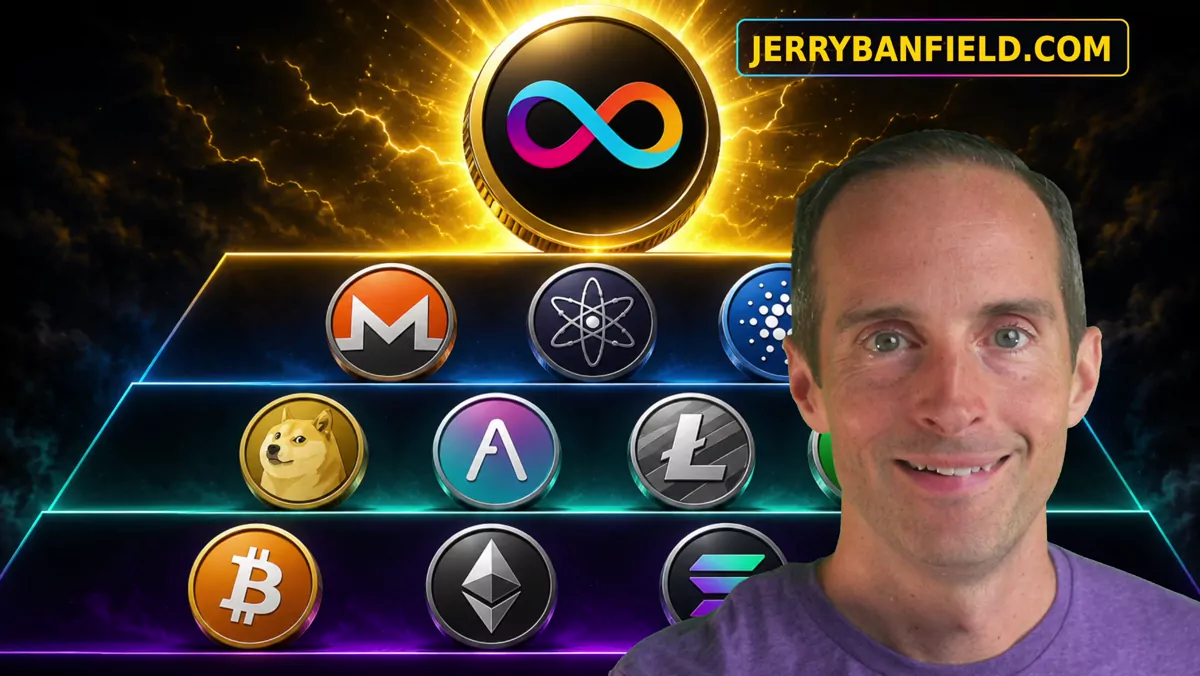
In crypto, we always hear about the importance of community — which cryptos have the best community. So I wondered: can I do some kind of reasonably objective research and make a system to figure out which cryptocurrencies have the absolute best community relative to the size, the market, and what would be expected? Here are the results of my research — the top 12 — and I'll go into lots of detail on this. I'm also putting a product up in a one-on-one call with me that has all of these big research documents I've done with the ChatGPT Pro model.
I asked this question because when you have all these people talking all over the place in crypto, it's hard to sort through the noise and find where the signal is — where is something that's not like everything else? That was the goal of this research, based on the top 50 cryptos.
Now, ICP, according to my research here with AI, is the highest quality-adjusted outlier. What does that mean? It means that relative to the market size and the actual environment the coin is in — the kind of content and conversations being had — ICP has the best community. Which obviously is biased, because I'm all in on ICP, and this isn't financial advice. And yet there's a whole lot of data behind this that supports it, and it matches what I'm seeing firsthand. I've created a lot of crypto videos — I used to create a lot of crypto videos for other communities — and one thing that drew me into ICP, especially relative to the small market cap and the manufactured 99%-down price chart, is that the community is shockingly resilient and full of real people who talk about it out of genuine excitement for the technology, rather than a lot of paid shills saying the price is going to go up. So out of all the top 50 cryptos, from what I see, ICP has the strongest community. But we're going to look into some of the others too.
Full Disclosure: The AI Put Kaspa First at First
Full disclosure — the AI kind of messed this up when it first did the research, because the first version said Kaspa had the best community. I'm like, oh, no. When it did its initial research based on my initial ten-minute-long prompt, it didn't realize Kaspa had all these paid shills from the ambassador program. It didn't quite agree with me at first, but I said Kaspa also seems to have a lot of bots that push their videos, and almost everything with Kaspa is just talking price action — there's almost no substantive content behind it. So it laid a heavy penalty on Kaspa after that. But full disclosure: in the first version, ICP was fourth, Monero was third — or Cardano or Monero third — and Kaspa was first. A lot of these reports I've let come out straight off the top, but that one, I'm like, no, we've got to fix that, because that's garbage. So all the Kaspa shillers can hang on to that — the AI put them first when it wasn't directed otherwise. And I'll show you the methodology behind it.
Number two, Monero comes out very strong on here as well. Cosmos also comes out very strong — significantly behind ICP on both of these, but still, out of the top 50, Monero and Cosmos are two of the next best, strongest communities. Now, these are relative to the market cap. So yes, Bitcoin and Ethereum obviously have the two largest communities in crypto, but they also have gigantic market caps. You have to look at Bitcoin's community and everything going on with it relative to its market cap: it should be a thousand times bigger and better than Internet Computer's. Well, what you find is that it's not. It might be maybe 50 or 100 times bigger than Internet Computer's, but it's not a thousand times bigger the way the market cap is.
Then you've got Bitcoin Cash ranking surprisingly high up here, even though it's just a fork of Bitcoin from the 2017–2018 era. Polkadot comes up here again — even though I said it's finished, the AI actually likes Polkadot better than a lot of other stuff. Then Aave, Litecoin, and Cardano — Cardano at ninth in the adjusted rankings to account for the 60%, a significant amount of subsidized reach. And I feel Cardano is like an insider in the crypto-bro system and publishing and all that. Maybe the Cardano people would disagree with me on that, and I'm happy to hear how it's not. BitTensor TAO comes in at tenth, despite the heavily incentivized participation and shilling of BitTensor — there's still a significant amount of discussion around it, which to me has been led by paid shilling. Uniswap has a lot of actual, real adoption. And Zcash is number 12.
ICP Number One on the Chart
Now let's look at how this looks on a chart. ICP is number one here by far, but then Monero and Cosmos are strong behind that. And obviously, as I said, Bitcoin, Ethereum, and Solana have enormous absolute communities, but their valuations are already based on that. So to me, here's what I'm looking for: ICP's community looks like it should have a higher valuation. That's what I'm looking at based on just the community in ICP. And perhaps the same argument could be made for Monero and Cosmos — that based on their communities, the market cap should be higher. Now, Monero's is a bit lower because it's a privacy coin, which exchanges have been a bit hostile with. And Cosmos — the branding across all the stuff that's built on Cosmos is not very solid. Ethereum's branding is really good with all the stuff like Layer 2s — most of that is not even actually happening on Ethereum, but Ethereum still gets a lot of the branding. Whereas with Cosmos, there are a lot of blockchains, like Cronos, that are actually built with the Cosmos SDK, but you don't even associate Cosmos and Cronos together — most people don't. So Cosmos suffers a lot from branding, but the actual quality of the community is pretty good.
The Weights: What Counts as Real Community
So let's get down and look into some more detail. Here are the weights for this. Independent high-quality audience carries the strongest weight. That means substantive videos — not just videos saying the price is going to go up. That was one of my major criticisms: you can't say Kaspa has the best community when every single video and post is just "price is going to go up, Kaspa is the best." There's not substance behind that. What counts is tutorials, technical analysis, governance coverage, application demos, and critical discussion.
One thing I adjusted for is that it can't just be about the coin itself — there have got to be substantial, real things built on it. That's why Cosmos shot up a lot in this adjusted ranking, because there's a ton of stuff actually built with Cosmos, like the SDK. ICP has the same thing: you've got entire blockchains built on ICP, like the Bob blockchain — a blockchain on a blockchain — and then you have DAOs that are actually fully on-chain and are the most active DAOs in crypto. These things all contribute. Initially the AI didn't make it as well-rounded, and I said, make this more well-rounded. It should not just be people shilling on X as your idea of community, because shallow shilling communities can be manufactured by bots and paid ads and temporary narratives. Having substance — real videos showing what you can do, governance, applications, building, critical discussion — these things are much more real indications of community than just people talking about the price going up.
Even Bitcoin suffers horribly from this. So much of the narrative, so much of the Bitcoin quote-unquote community, is people saying "price go up" — that's a huge part of Bitcoin videos, that the price is going to be higher later. If you strip out "the price is going to be higher later" from Bitcoin videos — conservatively 20 or 30%, if not 50%, of all Bitcoin videos are just looking at the price chart, talking about the price and how the price is going to go up. And that's because there's just not that much else to talk about technically, based on what the Bitcoin blockchain can actually do. So I said it needs to be more than "price go up" or price action. There needs to be a well-rounded look at community, because when the price doesn't go up, the community tends to go away — unless there's something deeper than just price, which there's not for most of crypto.
Then real participation in building gets 25% of the weight: operating DAOs, shipped applications, unique proposers, code contributions, technical support, and community tools. So 55% of the weight is on things with more substance — things that are not as easily manufactured with paid shills, ads, bots, hypers, or paid journalism and things like that. Then there's independent creator breadth: do you have multiple creators producing repeated substantive work — people like me — with any single creator's contribution capped?
Then adversity persistence. ICP scores really well here. Bitcoin and Ethereum have resilience, but if the Bitcoin price chart looked like the ICP price chart, it'd be a ghost town. Same thing with Ethereum. Solana — that community dried up quick when the price went down to $9. And then people came back, but I was there when it was down to $9. I was buying, and people ran from the Solana community when FTX crashed. And you add people like Vitalik Buterin stepping in to try and save it — which is insane when you really think about it, that the founder of Ethereum tried to step in and save Solana. Seems like there's something irregular going on with that. And then he doesn't mention the best technology in crypto — a real world computer. Seems like there's something irregular with that too, isn't there?
Contamination Deductions
The final factor is discussion quality and independence: troubleshooting, disagreement, criticism, governance disputes, and useful analysis — analysis other than uniform bullishness. And then there are the contamination deductions. Initially, ChatGPT thought ICP had a bunch of paid shills, but it doesn't. There's no community grants program. In fact — all right, I'd better keep my mouth shut on that. But there's basically nothing supporting ICP content right now, and ChatGPT didn't realize that. And it thought there was nothing supporting Kaspa content, and I'm like, no — go look at the ambassador program.
Right now, a lot of cryptos have a ton of ambassador programs, creator campaigns, PR placements, foundation-paid promotion, and treasury-funded applications. And then you've got a lot of people who just loaded their bags at some point — maybe they were paid at some point, but they're not getting paid anymore, and they're just trying to push their bags. And then you have a lot of people just chasing views, who didn't get paid anything directly, but they see other people getting views, so they're making videos just to get views themselves. Kaspa falls in here, along with several of the others, on suspicious engagement patterns: reciprocal promotion clusters, burst timing, repeated account overlap — and risk is not proof. What a lot of these coins do is collaborate with each other. They'll like another coin's posts, and you see something like Cardano going and partnering with a bunch of these other coins, and they almost never produce anything substantial out of it — all they do is community engagement farming. Like the Cardano and Filecoin promotion: they partner up, they do posts, and then they both get likes and engagement from each community. But is there anything meaningful coming out of Cardano–Filecoin? Probably not. And then there's low-information content share.
Low-Information Content Is Most of Crypto
Low-information content share is the majority of crypto right now. Hardly anybody does what I do in crypto — dives in deep, does all kinds of research, presents it from different angles. Almost everybody does price targets, hundred-X claims, chart-only videos, copied announcements, and repetitive hype. I am an absolute outlier in crypto content, which is why I've been able to grow these crypto channels pretty fast — because almost everything else in crypto is low-information content. And then there are affiliate and referral commissions. The centralized coins like Binance's BNB got penalized heavily on this, because if your whole thing is shilling some exchange, the community behind that is very questionable — you just have people who are paid shills.
So these are the overall rankings, and you can see the deductions and adjustments — ICP took 2.5 in deductions. But then here's the thing: the expected score. You can see the score here — it goes 40 plus 13 times log base 10 of the market cap in billions. This is a transparent comparison curve: the bigger the project is, the bigger and better you should expect its community to be. So again, we're looking for something that's different. To me, the most important thing to do is to look for something different. Monero is up here with 2.5 in deductions and adjustments against the expected score, and it comes out second.
Now you can see Kaspa, where I had to encourage the AI to slap it with some serious deductions because of the stuff up here: bot and coordination risk, low-information content share, promotional subsidy contamination. That's most of Kaspa content. You have some of the top creators literally wearing masks shilling Kaspa — that's clearly pretty low-quality content. I can't believe people actually watch that, and it makes the argument heavily for bots as well: there have got to be bots pushing that content, which then does get real people to watch it. So those are the top scores right there. Cardano gets the 20 deduction on here as well, and still comes in at 62.
Looking for Hard-to-Fake Signals
Now we'll go look at the full chart. With ICP, there's hardly any developer funding right now. And one of the big things is that I'm looking for harder-to-fake signals. ICP has the most active governance in any crypto, and that's a much harder-to-fake signal — that is something that would take a serious amount of effort to set up and fake somewhere else. Once you see how people are willing to do anything to make money in crypto, you become extremely skeptical of any metric that can be faked. View counts are easy to fake. It's easy to pay people to promote things. It's easy to fake transaction counts. It's easy to fake TVL — Kyle from DFINITY one day said, you just tell me what you want the TVL to be, and it could be that. There are a lot of metrics used to discuss which cryptos are the best and why. Volume? Very easy to fake, especially if you pay an exchange a hundred million dollars to list your coin and they agree to give you ongoing volume manipulation in the context of listing your token. So a lot of the metrics most looked at in terms of evaluating a crypto are very easy to fake, and that's exactly why they're the ones everyone focuses on. There's a system to this.
I was watching Cheeky Crypto, and he doesn't think there are people in a back room talking about ICP. I'm like — you don't know how the world works, do you? From my view, almost everything that happens in our world is like the Truman Show. Obviously there are unpredictable things that happen — there's magic, there are catastrophes — but this reality, as I see it, is mostly scripted. Even things like wars are scripted, with both sides being played by the same hand. And the voices in crypto that are loudest are being told what to talk about. Some of these channels have been outright purchased when they got big — people came in with lots of money and bought some of the top crypto channels — and others of them are industry plants. They're told — they don't say it exactly like this — to focus on the easily fakeable metrics: TVL, transaction counts, raw numbers of views and things like that. These things are very easy to fake. The coverage is often focused on easy-to-fake metrics, and the coverage seems allergic to focusing on hard-to-fake metrics, like technology — things like all these DAOs that are on ICP and all the governance. That stuff certainly could be faked, but the difficulty of faking it is a lot higher: you'd have to go through raising funds and then make all these proposals on an ongoing basis. Somebody certainly could fake it, but there's also less incentive to fake it. With some of these chains like Solana, Ethereum, Avalanche, and Sui, there's a huge incentive to game the numbers. Hedera had this one partnership that inflated their transactions to insane levels, and then it dropped 99% when it stopped. There's a huge incentive to do anything to push your transactions up, because a lot of people reviewing coins use transactions. So that's what we're getting at in this research: what is hard to fake?
Web Search Undercounts the ICP Ecosystem
Then there's this: ordinary web search can undercount the ecosystem, and ICP is drastically undercounted. My website, when you're doing research, is not going to come up — even though if you look at jerrybanfield.com, you will see that it's a website built on ICP. You don't realize that this entire website is built on the ICP blockchain. So when something like AI is doing research, it wouldn't know that the site is actually built on the blockchain, along with everything that's happening on my website — like the community chat. If you want to chat with me, you can schedule a call with me — you get lifetime access, you can pay with ICP or a card, and I'm in the chat every day. I've got coaching on here, I've got a Skool community, I've got calls, and I have sponsored crypto videos — if you'd like to talk about a coin or a protocol, or you have some kind of research you want to partner with me on to present, you can sponsor a video and we can work together on that. And I'm grateful for everybody on the leaderboard. So when you're looking at something like ICP, ordinary web search has a difficult time accounting for all of those things that contribute to the community.
And a big part of having real community is not having incentivized traffic. I got into ICP with no incentive. In fact, when I started covering ICP, there was every incentive not to go all in on it. I knew I'd lose a bunch of traffic going in on ICP, because I had community-farmed like 50 other coins and had all their audiences on my channel. People were literally paying me $300 for a crypto course so they could try to find out which of the 50 coins I'd community-farmed I actually liked the best. It cost me a fortune to focus on ICP, but I did it because of the technology. I did it because it's the most real thing in crypto. And I feel the most integrity I could have as a content creator in crypto is to give you the absolute best information straight, without confusing you and making you dig through it. While almost everybody else is putting out noise, I'm putting out signal. And that's the question to me: where is there some real signal, and not just incentivized traffic?
Surviving the Most Extreme Adversity in Crypto
Then, fifth: did the community survive some extreme adversity? That's where ICP gets some bonus points, because almost no community with the price chart that ICP has would have survived it. And the price chart was intentionally manufactured by a group of exchanges that, from what I can see, all collaborated to artificially list the price crazy high — so that then, of course, it would be a rug pull. And then the entire narrative, from all the paid shill influencers around it and all the people who just didn't know any better, would be that it was a rug pull, and people would assume that DFINITY did that — when really the crypto exchanges are the ones who listed the price artificially high, not DFINITY. They're not DFINITY's exchanges. DFINITY had the coin listed on the exchanges; the exchanges set the price, not DFINITY. So the ICP community has arguably survived the most extreme adversity anywhere in crypto, and therefore it gets a bonus for that, because none of the other top 50 assets has had that extreme adversity.
There are popular crypto channels where ICP is banned in the comments. You can't even mention ICP, because they don't want you to find out about it while they're sitting there talking about all these garbage coins. They don't want you to find something that's real, because you're going to stop watching their channel. So ICP is literally banned on some of the popular crypto channels. And most of the top crypto YouTubers are either so clueless, or lack any integrity, or are paid to stay silent, that they haven't even ever covered ICP — the best tech in crypto. So that's the space we're in, and that's what we have to account for in this research.
Right now, Monero comes up as the strongest authenticity signal behind ICP, and Cosmos comes up as the highest technical depth with difficult token attribution, as I mentioned before. Now, that said, ICP has the most development and building of any crypto by far — even far superior to Ethereum at this point — because right now people are building like crazy with AI on ICP. And Electric Capital literally censored ICP's AI-based building out of its report, because it put every other coin to shame. The chart just went straight vertical, like the Bitcoin price chart did recently, but much more dramatic. That's AI building with Caffeine AI — and that's not even counting Claude and Codex building. Building on ICP has just gone parabolic, and Electric Capital made sure to censor that. That's the ecosystem we're in.
Kaspa does have some real supporters. Cardano does have a real community, but the media layer for it is significantly subsidized — and/or it's like a good-old-boy network where you scratch my back, I'll scratch yours. The coverage of Cardano could be a lot better, to say the least. Kaspa does have some real supporters, and the fair-launch narrative is way overblown — because who mined all of that? Insiders. And at the same time, there are certain coins like Kaspa that appear to have significantly used bots to push their videos and their content. Many of the top coins use bots to push their content, because there's no accountability — nobody gets in trouble when bots push these videos. And I've seen it, I've had the conversations with creators firsthand. I've literally talked to crypto YouTubers who have asked projects not to use bots to push their videos.
Bots, Exchange Tokens, and an Ugly Environment
That's what an ugly environment this is — you have crypto creators who don't even want these bots pushing their videos, but the coins themselves use bots to push their videos anyway. XRP seemed to use a lot of bots to push. When I did XRP videos three years ago, there were heavy bots on my videos pushing them. There was some organic traffic, but when I put up a thumbnail that said XRP to $12, bots just slammed that video — so that when anybody searched for XRP that day, my video came up first, because it had a $12 price target on it. And that's the environment we're in.
And some of the worst communities were actually exchange tokens and Tron: LEO, OKB, BitGet, KuCoin, Cronos, Tron. At least in the English-speaking community, the market caps versus the communities are very, very low.
The Full Top 50 Audit Spreadsheet
Now, for some reason the report didn't put the entire rankings in — I don't know why it didn't put all of them in there. It just put the top 12 communities. But there is a spreadsheet that has all 50 of them. It didn't put all of them in the Word document, but I grabbed the spreadsheet and opened it right before wrapping this up, so you can look at all of them and how they came out in one place. Here's the top 50 audit, and you can see the overall score. To me, what we're looking for is the outlier rank. The adjusted organic score for Bitcoin is 83, and the expected market-cap score is 81 — so it's basically right where you'd think it would be. There's nothing surprising, nothing exceptional going on based on the market cap. Yes, there is a high-quality audience for Bitcoin and Ethereum, and at the same time, what's interesting to me is the outlier: is there anything unexpected happening here? No — Bitcoin has the largest market and it has the largest organic community. That's not surprising. And Ethereum has the second-highest-quality audience — highest at least in publicly visible participants and building — with a little bit higher score than Bitcoin, but again, not surprising, although it does come in at 14.
Then you've got Binance here at 17 — that's pretty bad for BNB. And then XRP comes in next, at 49, below expected. Below XRP is Solana — based on the market cap, a bit below expected. Tron, very weak. And you can keep going down here and see all of these. Hyperliquid is a little below expected, and that makes sense, because the market cap has pumped a lot lately for Hyperliquid and the market cap is way ahead of the community. Dogecoin, a bit below expected. Zcash, a little above, at 59. Chainlink, 56. LEO, absolutely awful right here. Cardano — if you look at this one, a little bit above expected, and there is a sizable organic Cardano community while the market cap's not that big compared to Bitcoin or Ethereum. Monero, significantly above expected. Stellar Lumens coming in a little bit above expected. Bitcoin Cash. Canton — for those of you excited about Canton, very weak, very weak on Canton in this report. Then you've got Gram coming in a little above expected. Litecoin, above expected. Hedera — yeah, Hedera is a little bit above expected. Sui, way below expected. Avalanche, above. Shiba Inu, below — a lot of people got into Shiba Inu just off the paltering videos showing the initial price and how much you could have made, which is unrealistic.
Then let's look at some of the worst ones in here. BitTensor and Uniswap are in expected ranges. World Liberty Financial and OKB, way below expected. Aster, way below expected. Ondo, not doing that great. Aave, a little above expected. Mantle, not doing that great. Pepe, OK. Pump.fun — for the market cap, the community is very small on that one. MemeCore, very small. Polkadot, above average on here. And then you've got Internet Computer at the highest outlier score, way down here at number 40. To me, out of all of these, that's what's most interesting. You'd look at the BitGet token compared to Internet Computer — similar market caps, totally different kinds of crypto investment — and the BitGet community is just dead: paid shills and affiliate links. Same thing for KuCoin. And Just and Cosmos, way down here, above average. Kaspa, for all the Kaspa shillers, was higher until I made sure it got penalized.
The One Special Thing in the Top 100
So that's looking at the top 50 crypto communities and finding the best outliers — trying to figure out, you know, how I can shill ICP in another video. But for real: out of all of these, ICP is the one special thing in the top 100. And I did give a little support to some of the other coins, but I don't hold those, and I don't see them doing that well long term. If you appreciated the depth of this research, go to jerrybanfield.com.
I'm a full-time YouTuber, and I've got six channels. You might even enjoy my vlogs more than my crypto research channels — the Jerry Banfield Show is very entertaining, with my day-to-day life, and I'm talking a lot about dating right now. I'm grateful for all the support as I work toward being fully monetized with ad revenue. I also have a dating channel, a gaming channel, a YouTube coach channel, and my ICP channel.
I've got the leaderboard if you want to support. I've got the lifetime chat if you want to ask about anything. I've got Officer Banfield from my police days — you can get the audiobook here. I've got dating coaching and YouTube coaching.
I've also got a Skool community, Zoom calls, and schedule a call with me. And if I'm online, you can pay to talk to me almost right away.
If you enjoyed this research, you'll find all my coin and community deep dives in my Crypto Reviews playlist. I appreciate your love and support, and I hope to see you in another video soon.