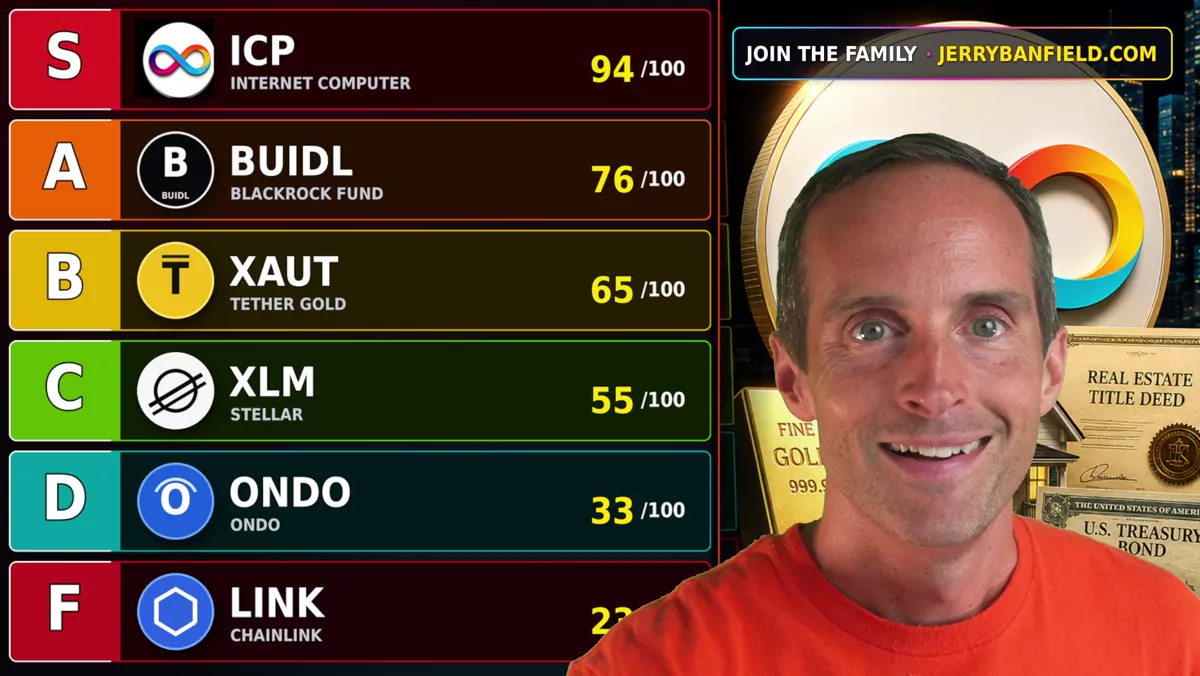
Every Top 50 Real World Asset Coin in One Review
You're about to experience me review every top 50 real world asset category coin in one single review in just about 25 minutes. I am doing this with a 73-page report that goes through the CoinGecko top 50 and adds ICP, because ICP is the best real world assets infrastructure in the world by far. Somebody just joined my community for a full year today — if you want in on this kind of research, join the Jerry Banfield Family and get in there.
To begin, this is research you can replicate yourself. This is research you should be doing on all the coins in your portfolio. I did a deep prompt with ChatGPT to create this gigantic report, and I will share the main findings of it here with you so you can look deep into the details yourself.
The Executive Finding: ICP Is the Strongest Full-Stack RWA Infrastructure
Here are the executive findings: ICP has the strongest full-stack real world asset infrastructure in this audit. Now, full disclosure, I'm an ICP maxi because of the tech, and I don't have any other coins. And this is why I don't have any of them — because of this research and all the other research I've done. This isn't financial advice. This is research from AI that has cut through all the BS and read the documentation behind all these projects. Well, it's cut through most of the BS — I will help you discern the rest.
The headline here is the main thing you need to know: ICP is the strongest full-stack real world asset infrastructure. Why? The AI explains it — because the application logic, authoritative digital state, records, files, exchange, and payment logic can all run together under replicated consensus. Now, that does not make ICP a direct claim on a house, treasury, stock, or gold bar. But it makes the ICP infrastructure the benchmark that exposes how little most on-chain real world asset systems actually add up to.
The Red Pill: Most of Crypto Is a House of Lies
In case you didn't know, crypto is almost all organized crime — ripping people off, saying anything to steal your money. If you didn't know that, I'm happy to be the one that gives you the red pill and wakes you up out of the matrix. Crypto is one of the nastiest, most insane industries anywhere on earth. It's almost all a house of lies, and I'm here to try and help you cut through that and fight all this, so you stop getting ripped off by people lying to you. I'm one of the only people out here who actually cares about you, has done a ton of research myself, and is not just paid to say a certain thing.
Here's what we need to dig into, and here's how inaccurate crypto is: when you go looking through these real world asset coins on CoinGecko, first off, ICP is not even there — even though it has the best infrastructure in the world for real world assets. And when you have AI evaluate it next to the others, the result comes out that ICP is vastly superior to anything else, and some of the popular ones like Ondo and Chainlink and Stellar XLM are absolute garbage by comparison. They're making promises their blockchains can't actually deliver.
CoinGecko's Category Is a Mess
Let's look at one of the biggest problems when you're looking at real world assets. We'll go through each coin, but you need to get the big themes first to make sense of all the others, because then all the others are easy to understand. CoinGecko's asset category mixes up direct asset claims — like fund shares, notes, gold, and private credit products such as PAX Gold — with governance coins, generic chains, Oracle middleware (which is Chainlink), and payroll products like Zebec. A direct treasury fund token and LINK are not the same kind of investment. Buying PAX Gold and buying Chainlink are vastly different things to buy, and CoinGecko just sloppily throws them all in the same category, which is ridiculous — and then doesn't put ICP in there when it's the best place to build this stuff out. So either they're incompetent or somebody is massively dishonest. You figure out which one it is. I'm already on top of which one it is.
The Central Failure of Most RWA Tokens
The key thing when reviewing all of these is the central failure: for almost all of them, all the blockchain does is prove that a token moved. It doesn't prove that the underlying property is there, that a loan is performing, that the vault bar is not encumbered, that the NAV is correct, or that anyone has an enforceable legal claim. Basically, you are still depending on the issuer, the transfer agent, the custodian, the servicer, the bank, a court, or a private database. Which means in most cases — and I think this, not financial advice — you're better off just not bothering. I would rather just buy some real gold or some real silver or platinum, or buy something in a trusted setup, because blockchain introduces all these other trust avenues while removing some of the ability to actually get help if there's an issue.
Why ICP Ranks 94 Out of 100
Here's what the evidence supports, and then we'll go through the exact scores starting with the top 15. ICP ranks 94 out of 100, because if you're going to build the highest-trust real world asset environment, you need to put as much information as possible on the blockchain — and none of these other ones can do that. On ICP, you can put the business logic, the application, the website, the records, the documents, the images, the permissions, the ledgers, the order book, and the audit trail all in one single replicated environment — or, for short, all on chain. Meanwhile, all the rest of these have tiny little bits of data on chain, and then it's "trust me, bro" for everything else off chain. That doesn't make them totally worthless, but having real world assets connected to a blockchain that barely has any of the data on it is only an incremental improvement over what we're already doing. Not worth investing in, in my opinion.
Some of these tokens are decent, and we'll get into that in a minute. But the unavoidable weakness for everything outside of ICP — and even if you put stuff fully on chain — is that you still have to deal with law and physical custody. For example, there was a failed real world asset project on ICP, and even with all that stuff on chain, you still have to deal with law, physical custody, and the administration of it. But these other chains have all those problems on top of everything else. You can have legitimate securities sitting on top of a weak blockchain implementation — this is the stuff people don't think deeply enough about. You could have an error somewhere between the blockchain and the user, like on the website, where people get ripped off and lose a whole bunch of money even though the underlying asset never had an issue the whole time.
And then you have things like Chainlink, Ondo, Quant, Zebec, and others that don't even have direct ownership of real world assets. It's ridiculous that these tokens are in this category, because they're just tokens — governance tokens — and Quant is supposedly building some interoperability thing that ICP does way better, with the whole thing already live in public. These are so bad. On top of that, the market caps displayed are economically inconsistent. And even with ICP, no blockchain can force a court to recognize a title, inspect a gold bar, collect a defaulted loan, or make a county recorder update a deed. You see, this is why you need to minimize the off-chain trust boundary. These other blockchains have no hope of putting enough on the blockchain to minimize that trust boundary. ICP is the only one that has a hope of doing that. Even there, you're still dealing with titles and things that can require real-life enforcement — however, the more government functions get put on ICP, potentially the more things can interact directly, fully on chain.
The First Pass Through the Top of the List
Now let's go through the actual scores. I think I've said enough about Internet Computer Protocol, so let's go to the next ones. ChatGPT Pro chose all these rankings based on going through the documentation, which gives it a degree of impartiality — and I didn't tell it what to rate Internet Computer either, so there's that.
Figure's tokenized stock (FIGR) is up near the top. The report says it's one of the stronger direct real world asset products: it represents a real legal and economic claim, and settlement events occur on chain — but the asset itself and most of the administration remain off chain. The yield products get a similar review with the same exact issue. Then you have Spiko's EU T-Bills money market fund — same basic issue. Janus Henderson's treasury fund — same basic thing. Down the list, BlackRock's institutional digital liquidity fund (BUIDL) — again, much of the asset itself and much of the administration remain off chain, which makes it risky in a way people don't appreciate. I don't get it: if you want to use blockchain, why go back to "trust me, bro" systems? Either just stay in the traditional trust-me-bro systems or get something actually decentralized. I don't see the point of getting into an institutional digital liquidity fund with BlackRock when you could just put your money with BlackRock a whole bunch of other ways without having to mess with the blockchain. Maybe it makes access easier for people around the world, but they're taking risks putting money in that they wouldn't be taking otherwise — and how big are the returns, really? Same basic issue with all of these: Janus Henderson, Superstate, the other institutional funds, and the Figure HELOC token — the same basic problem. Most of the asset and the administration remain off chain, and that's a huge problem.
What "Fully On Chain" Actually Means
The more of it that's off chain, the worse it gets. Here's what fully on chain means, layer by layer: ownership and the legal register, settlement, asset records, the application, and the AI and automation. Ask yourself what happens with one of these products if the issuer's website, AWS account, transfer agent database, NAV spreadsheet, or servicing platform disappears or gets hacked. That's the problem — you're not holding real world assets with the same level of legal custody you'd have doing it off the blockchain.
And here's a real example: Finca Metals has publicly described an ICP-based metals platform in association with the Swiss subnet. They're looking to tokenize what is a many-trillions-of-dollars market, and they're looking to do it on ICP because it's the only setup they can find that is both regulatory compliant and able to maximize trust by putting everything in one single environment.
Here's the methodology that was used to determine the scores. A big part of doing real world assets successfully is being able to put everything actually on the blockchain — because if you can't, you're depending on so much trust that there's no point in messing with the blockchain at all. Why bother? If there's just a token, then everything else is trusted to somebody else and not actually controlled by the token. Now that we've covered the basics, here's the basic interpretation: a strong real world asset system earns S tier, the full-stack infrastructure benchmark — and only ICP is there. Then the A-level tier is strong direct asset claims or serious on-chain architecture. Most of these coins, though, fall below even that.
The Ranked Results and the Outliers
You can read the full report for details, but let's look at the ranked results and the outliers now. To me, ICP is the only real top-tier real world asset infrastructure — you can build anything out on it — and some of these other projects may end up moving more of their infrastructure over to ICP, or may already be secretly building on it or have plans to.
Here are the A-level ones, which include PAX Gold, USYC, VBILL, Figure HELOC, OUSG, BlackRock's BUIDL, USTBL, JTRSY — all of those. Then in the B tier you can see a whole cluster of similar treasury-style products like TBILL, and what's interesting is asking how these even stand out from each other — the branding is not even that distinct between them. But look at the F tier: Zebec, LINK, and Quant. And the D tier: XDC, Syrup, TRAC, and Ondo. Some of these you guys are so bullish about — put the AI to work to do some real research and cut through the BS. That's why I do these reviews: to help you cut through the BS, because almost all of crypto is BS. ICP is the one thing I've found that's truly worth paying attention to. Everything else, at this point, is meant to bury ICP and steal your money. It's insiders already holding things like Bitcoin and Ethereum trying to sell them to you as they unload, and it's people creating all these other blockchains and coins to make themselves money as easily as possible. And then ICP is sitting there and almost nobody gets paid to talk about it — so almost nobody talks about it — while all these people are getting paid to talk about all these other things that are pretty useless.
The Full Technical Ranking, From the Bottom Up
Let's look at the full complete technical ranking. Figure's tokenized stock is up here at 83, and the yield funds are right behind it at number three. But we'll start from the bottom of the list and work up.
Quant sits at the very bottom — category pollution, evidence-poor exposure. There is no reason Quant should be in this list. F tier: Chainlink — category pollution, evidence-poor exposure. I'm not going to accuse anybody of anything, but it's hard to imagine it isn't intentional that Chainlink got put in real world assets. It doesn't represent a meaningful real world asset claim or a real world asset control system. Same thing with Zebec Network. Then Ondo: very weak exposure — the project may serve real finance, but the listed token is indirect, poorly coupled to the assets, and heavily dependent on off-chain truth. OriginTrail (TRAC): weak exposure, and the listed token is indirect — same thing. Same thing with Maple Finance and its Syrup token. Same thing with XDC Network.
It gets a little bit better with the tokenized gold products — real technology, but the chain usually records a receipt while the decisive record, the legal rights, and the operating system remain elsewhere. And this is the same basic story for everything up through the C tier. Algorand: the infrastructure is incredibly weak for doing anything with real world assets besides recording a transaction. Injective — I've been toxic about Injective the whole time — it records a receipt while everything else remains off chain, which is basically useless. You go up to Tradable, the Singapore fintech doing tokenized private credit, and I don't see why I'd want to be involved in any of these either. These are like proxy trading vehicles to give you exposure, which could have some utility, but you'd be better off getting something with more direct exposure and legal control, because any of these could break down and you could lose everything while the underlying asset remains just fine.
Stellar XLM: Marketing Dressed Up as RWA
Stellar XLM is so poorly set up to do anything with real world assets that it's just marketing. They're just talking. All it can do is send transactions on a blockchain, which by itself is basically useless — everything else has to be off chain in a complete, total trust-based system with almost no recourse if something goes wrong. That's my problem with trust-based systems: if something goes wrong — say you're using Stellar XLM for some real world asset application and something breaks — you have no recourse. You can lose everything. And that is a piss-poor setup, because a lot of these things are not going to make you a lot of money anyway.
PAX Gold and the Risk-Reward Problem
Take buying gold, like PAX Gold. PAX Gold is actually one of the stronger direct real world asset products — the token represents a real legal and economic claim with meaningful ownership, and settlements occur on chain, while the asset itself remains off chain. But here's the problem: if you bought gold a different way — physical gold, a gold stock through your bank, something in your money market, wherever you buy it — you wouldn't have this huge risk that you could lose everything. When you're sitting there buying PAXG, which off the top of my head is on Ethereum and some other chains, what happens if there's a problem with the token contract? What happens if your MetaMask gets stolen while you're letting your PAX Gold sit in there? That's the problem when you're holding this stuff on the blockchain while basically everything important is off chain: you're taking all the blockchain risk while getting the same reward you could have gotten in a much safer environment. And the reward is usually not going to be that high.
Most of these are treasury products — short-term government bonds. The risk you're taking screwing around with these things on the blockchain, in many cases, does not make sense based on the return you're getting. It's the same basic problem for all of them. Why would you want to play around with the EU T-Bills money market fund — even though Spiko has one of the better offers on this list — when, if something happens with your crypto wallet, your crypto exchange, or the protocol itself, you could lose everything and go to zero? Is anything you're going to be making worth that? Now, if these were built better, where it was harder to lose everything — and only Internet Computer Protocol can facilitate that without introducing a centralized third party like a crypto exchange in the middle — it would be different. ICP is set up so you can have your wallet and your sign-in and everything straight through the blockchain, which is why it's vastly superior, and that's why none of these other ones are worth holding to me. In my opinion, ICP is going to provide a much, much better return than holding any of the rest of these — not financial advice, just my read.
And I don't see why you'd have your money scattered all over the place. If I wanted short-term US government bonds, I'd just use something like a 401k account, load them up in there, and take the tax advantage. That's another thing with all of these tokens: taxes get much more annoying. Now, this can be helpful for people around the world who aren't in the US — but why, if you're in Africa, for example, would you want to fool around with OUSG on Ondo trying to hold short-term US government bond funds? That makes no logical sense to me.
How Do You Even Tell These Apart?
Then you've got all these lookalike products — how can you even tell which one is trustworthy? Is it Ondo's US Dollar Yield (USDY)? Is it the short-duration US Treasury fund? Is it the tokenized reinsurance product? Provenance Blockchain? The Apollo Diversified Credit Securitized Fund? Tether Gold? Well, now you've got Tether Gold and you've got PAX Gold — which gold token is more trustworthy? I'd rather have real gold in my hands, because I know I'm not going to suddenly lose that over something that happened online. Then there's Ondo's tokenized CRCL stock, Kinesis Gold, Kinesis Silver — I'd rather just buy silver. I have a silver coin in my house. I'd much rather load up on real silver coins, because maybe I can just sell one to somebody in person: "Hey, you want a silver coin?" Maybe take a girl on a date and be like, "Look, I'm going to pay with these silver coins right now." All of these tokens are introducing way too much third-party risk and way too much speculation. If I want SpaceX stock, I'll buy it in a 401k-style account — I'm not going to buy it with some token. That's insane. And then the other ones like Quant are just blatantly misleading.
The Market Cap Trick in One Sentence
What's even worse is the market cap ordering on these — these are the first 50 entries you see. Figure HELOC is actually a decent product, but CoinGecko is turning unpaid mortgage principal into a "crypto market cap" at the top of the category, and the chart that produces is ridiculous. Chainlink is absolute ass here — it's price feeds, not real world assets. Ridiculous. Stellar XLM can host assets and tokens, but buying XLM does not give you a single dollar of the funds sitting on Stellar. Ridiculous. Then you've got Ondo down there: you can tokenize billions in assets while ONDO holders have zero dollars of those assets. That's how the AI put it — that's the entire trick in one sentence. You should realize that almost everybody in crypto is out here to trick you. They're not out here to help you. They're putting on smiling faces and saying anything to get you to give them your money. And Quant? The AI said Quant is the hallway between databases, and CoinGecko labeled the hallway "real estate." This AI is getting pretty smart — it's actually trying to make jokes. I like it. XDC Network is like a crappier Ondo-and-XLM clone, and then you've got XRP — all of these technologically almost exactly the same, all trying to do almost exactly the same things, and there's no way this works out in the long term for almost any of them.
The Outliers, Summed Up
The AI even gave me a structure for presenting this, and it confirms what I've already explained: ICP is the main outlier, and Figure is a little bit of an outlier too. The direct funds — PAXG, XAUT, USYC, BUIDL, all of those — do have some direct legal claims, which makes them a bit better than the others. But again: why wouldn't you just buy some BlackRock stock? Why wouldn't you just buy physical gold, or buy gold through your bank or your retirement account? It doesn't make any sense to me.
If you want the full report with much more detail about all of these coins, the 73-page report is available in the Jerry Banfield Family. And what would be even better? Go reproduce this research yourself. I'm trying to inspire you to do more research on your own — to say, "Maybe I should be going to the AI, paying for ChatGPT Pro, and asking it these kinds of questions myself to see what it says without Jerry in here doing it."
Do Your Own Research — Almost Everybody Is Compromised
The main thing people are doing wrong in crypto is not doing enough of their own research. You've got to be careful who you listen to, because almost everybody is compromised. The only reason I love ICP is because the technology is so good — it solves huge real world problems — and almost everything else is extremely limited by comparison. I'm big into opportunity cost: ICP deserves my attention based on the tech, and these other projects don't. That's why I consistently roast them, and if you want more reviews like this one, you'll find them all in my Crypto Reviews playlist.
Build a Relationship With Me
If you appreciate this kind of research, come build a relationship with me — make this a two-way relationship where I know you and you know me, because I don't know you right now, and I want to get to know you. It's very easy: join the Jerry Banfield Family. You can join annually, you can have a one-on-one call with me every month if you upgrade to the premium membership, or you can have two hours of calls with me every month on the VIP membership. If you've got a big crypto portfolio, that would absolutely be worth it. You'll get to know other people in there too. You can direct message me anytime, post questions, share links, and request videos — if you want me to do a video, research, or a deep dive on a particular project, you can request that right in there.
That's also the only place I read comments and direct messages. You're welcome to say whatever you want in the YouTube comments and X comments — I'm not going to read them, because I put my attention where I do this full time. The Jerry Banfield Family is what I'm setting up to be my paycheck. Some people say I'm a cult leader — well, this will be the place where you enter the cult going forward. The first step is to jump in there and introduce yourself. You obviously don't have to, but I'd like to get to know you. If you make videos, send me your videos — you can make a personal video on your phone and message it to me. I would love to get to know you instead of just talking at you.
Thanks a lot for reading. I would love to see you in the Jerry Banfield Family. Have a great day, and I hope this research was helpful for you.