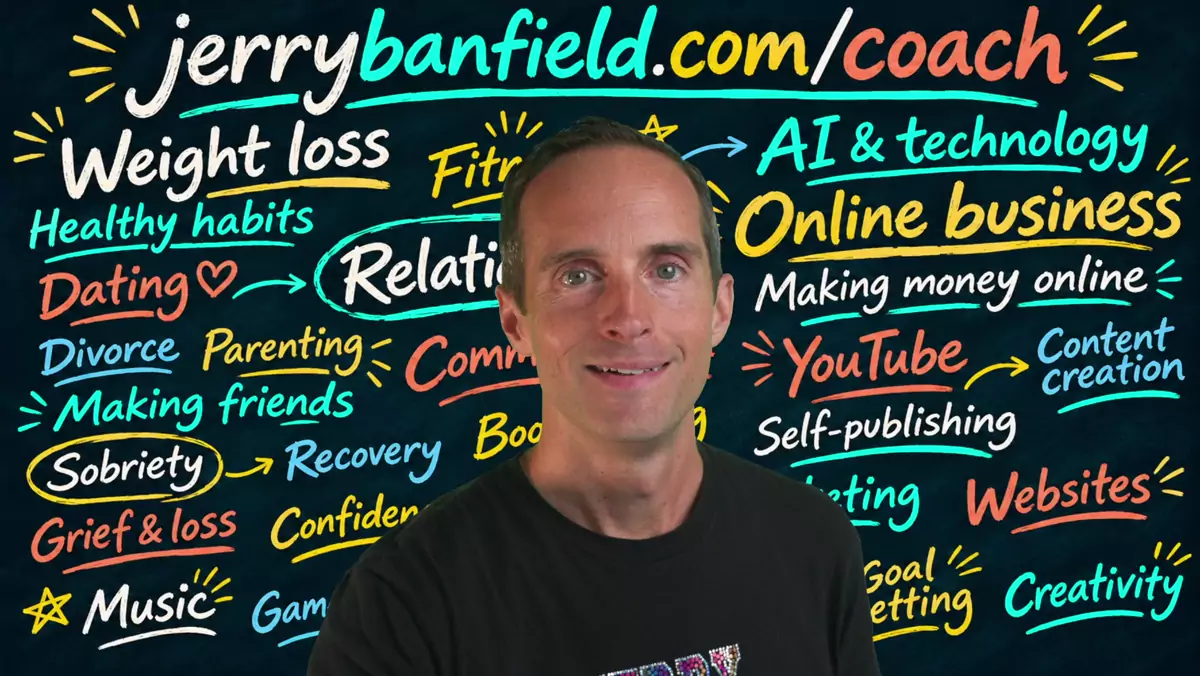
A coach is not somebody who does everything better than you. Some of you make more money than me, are in better shape, have been sober longer, or have published more books (35 is a lot, but go ahead). What I can promise is that I have been at the bottom of almost every area on that chalkboard and I know the way up from the inside. These are the stories. Every one of them has a longer version on this website, and most of them have a whole book.
Sobriety and recovery
April 21, 2014 was my last drink. I have not had one since.
I drank from college in 2002 until I was 29. I had stretches of sobriety, six months in 2007, five months in 2012, and every one ended the same way, because I never changed anything except not drinking. On the night of April 21, 2014, I drank for more than twelve hours, gambled $500 I did not have online, something I had sworn I would never do again, and watched my wife at the time tell me she could not do this anymore. My father had died of cancer a few weeks earlier and his memorial was a week away. The next morning I woke up throwing up blood, and I understood something I had never admitted: it did not matter whether I wanted to quit. I would change my mind as soon as the hangover passed. So I prayed, to a God I did not believe in, "God, please, I'll do anything to get sober." The thought that came back was that a meeting of Alcoholics Anonymous might be part of anything. I went that day.
I walked in with an attitude, more than 70 pounds heavier than I am now, and told them not to talk to me about God. For the first ninety days I did nothing but go to meetings. Then I did what actually worked: five meetings a week, not two and not when I felt like it, a sponsor who called me every single day, a ten-thousand-word life story as my Fourth Step, and a Fifth Step where I told one human being the thing I had never told anyone. He said, "God loves you," and I remember thinking, that actually worked. One afternoon that summer I stood in my kitchen with an open bottle of vanilla vodka fully intending to drink it, and three thoughts came one after another: you are stupid if you drink this, it is poison, and you promised an old-timer you would call him first, so if you drink you are a liar. I put it down. Those men and women shook my hand and loved me until I could love myself.
"I stay sober no matter what. Whether I have a wife or no wife, a job or no job, kids or no kids, none of it changes that fact."
Twelve and a half years later I still go to meetings almost every day, I sponsor other men, I started my own meeting when nobody in my neighborhood offered one at four in the afternoon, and I am one of the seniors in the room now, which still blows my mind. I quit gambling the same night I quit drinking. I quit video games about six separate times before I finally deleted every channel and sold every console, and now I can play a game without it eating my life. My kids have never seen me drink. I went through my divorce sober without ever wanting a drink, and I can tell you exactly what I did on the hardest days, because I wrote it all down.
What this lets me coach on: getting sober after many failed attempts, staying sober through a divorce or a career collapse, gambling and gaming compulsions, and the difference between not drinking and actually recovering.
Read the whole story: Does Alcoholics Anonymous work? · Emotional sobriety after ten years · My drinking story · Video game addiction · If you hate getting sober
Weight loss, health, fitness and habits
I weighed 250 pounds the month I got sober. I weigh 175 today, and I have kept it off for more than a decade.
I know what it is like to be fat and feel out of control and in denial. At the police academy in 2007 I was 240 pounds at five foot eleven, and my thighs rubbed together on the three-mile runs. By April 2014 I had hit 250. Getting sober took off about twenty pounds by itself, and then it stalled. So for a full year I logged every bite in MyFitnessPal with one rule: you can eat whatever you want, but you have to admit it. That took off another thirty. The change that stuck came in the summer of 2016. My uncle, a doctor who has given every new patient the same book for decades, told me to read How Not to Die by Dr. Michael Greger. I resisted, because I loved meat and cheese. Then I ate a huge meal with five kinds of meat at the Detroit airport and within thirty minutes my mood had gone dark enough that, two years sober, I was thinking about the airport bar. That was the day I understood that the food I eat creates the thoughts I think. I listened to the whole audiobook on the flight home and switched to whole plants. My weight went as low as 160. My blood pressure dropped about twenty points.
I have eaten a whole-food plant-based diet for ten years now. I take no supplements other than a little nutritional yeast for B12. I have not been sick in four years. I am 175 pounds with about 130 pounds of it muscle, I run three miles at under ten minutes a mile, I play singles tennis for hours in the Florida sun, I do a hot power flow yoga class that brings gym bodybuilders to their knees, and I get a massage every week. I was not an athlete. For years my body was so stiff I sprained ankles walking around the house. I took up yoga in my late thirties and tennis in my forties, and my eight-year-old son is getting harder and harder to keep up with. My weight is something I used to feel completely helpless about, and today it is almost entirely in my control.
"As long as I continued to poison my body with alcohol, nothing else I did to be healthy made a significant difference."
What I will tell you on a call is what I did, in order: sobriety first, then honesty about what I ate, then whole plants so that I am full and nourished and never walking around hungry. I will tell you honestly what I think of keto and carnivore and why I have read those books and still eat the way I do. I am not a nutritionist and none of this is medical advice. It is what worked for me for ten years, and I understand exactly what makes it hard, because a lot of the people around you are selling you the stuff that keeps you sick.
What this lets me coach on: weight loss that holds, eating when you are busy and surrounded by junk, building a body that tolerates activity in your forties, and the habits that make the rest of your life easier.
Read the whole story: How I lost the weight and kept it off · Why I stay well · How Not to Diet · Yoga · Tennis · A day in my life
Losing a career, asking for help, starting over
In September 2009 my police department told me to resign. It was the best thing that ever happened to me, and I could not see that for years.
I was a corrections officer on the night shift at a juvenile prison in South Carolina, then a state law enforcement officer, then, in April 2008, a police officer at the University of South Carolina, which was my dream job. I was also drinking before shifts, gambling online at night, running up credit card debt on a $20,000 salary, and completely unable to stop. A badge and a gun do not fix that. By September 2009 my life was out of control and my department told me to resign. I handed over my last uniform shirt and sat alone in my apartment with my whole identity gone.
I could see two very clear choices in front of me. One was dark and would have wrecked my life and other people's lives. The other was to pour the vodka out, call my parents, tell them the truth, and ask for help. For a few terrifying minutes I really debated. Thank God the scared little boy in me won out. I called my dad and said, "They just fired me." He said, "You're going to drive home right now and move back in with us." I cried, drove eight hours to Mississippi, told strangers at restaurants along the way that I had just lost my job, and got hugs from people I had never met. The next day I felt a relief I could not believe. I had been so afraid of leaving law enforcement that I never imagined how good life could be outside it.
I studied for the GRE, got a master's degree in criminology with a 3.97, started a business a year into the PhD, and dropped out in 2012 to work for myself online. I have never had a boss since. The drinking did not stop with the job, which taught me the other half of the lesson: changing your circumstances does not fix a compulsion. Having a wonderful woman, my own home, and a business I loved did not fix my drinking. Only the work did.
What this lets me coach on: losing a job or an identity you built yourself around, the moment of choice at the bottom, asking family for help, and going back to school or starting a business after a public failure.
Read the whole story: Police officer stories · My life story · the book Officer Banfield
Money, debt and online business
I have made millions of dollars online, owed $650,000, deleted everything, and started again from zero in 2026. I know money from every side.
I grew up believing money was the root of all evil. My father would ask strangers in a bar for a hundred-dollar bill and rip it up. I knew that belief would cap me, so when I went online full time in 2012 I read Rich Dad Poor Dad, The 4-Hour Workweek and a pile of business books on purpose, to rewrite my own programming. I made nothing the first year. In 2013 I had my first month over $10,000, most of it profit, teaching people Facebook marketing after I grew a page past 100,000 likes for under $1,000. I had set that $10,000-a-month number clearly and hit it within three months of getting clear and acting.
In 2014, newly sober and newly fatherless, my client work was failing, so out of desperation I filmed one course for Udemy. It did not sell, so I gave away thousands of free coupons. The free students watched so much that the course climbed to the top of a trending topic, and by November three courses made $6,400 in a month. I went all in. From December 2014 to June 2016 Udemy paid me more than $600,000, I became one of the top ten instructors on the platform, and I made my first million dollars online in the same office where I had stood and decided I would. Then, in June 2016, they banned me with no questions asked. I thought I was an independent businessman. I had been as dependent on one platform as my mother had been on the military.
I became one of the first crypto YouTubers, turned $10,000 in one coin into $80,000, made hundreds of thousands promoting coins, and then watched my audience buy higher and sell lower than I did while I profited. I quit crypto in 2018 feeling like a bad person, and years later I turned down offers of more than $100,000 a month to send my followers into copy trading, because it was a trap. In 2019 I borrowed hundreds of thousands of dollars, some of it at 17 and 18 percent, to build my own competitor to Udemy, and by December I was sitting in a bankruptcy attorney's office wondering how my wife and I had accumulated $650,000 in debt. I walked out of that office thinking I did not want my story to include bankruptcy. I had created this, and I would create my way out of it. I told my wife everything, which was the hardest conversation of my life, got disaster loans at 3.75 percent on thirty-year terms, and put every new dollar toward paying it down.
In May 2020 I sold a studio worth tens of thousands of dollars for a few thousand, tried an in-person show that nobody came to, and by August had one five-year-old laptop. I bought a $600 used PC off Facebook Marketplace, a friend mailed back an old Xbox, and within a year I was one of the top twenty gaming partners on Facebook with more than $100,000 in profit in 2021. Then in the summer of 2025, after reaching more than a billion views and building fifteen YouTube channels and a verified page with millions of followers, I deleted all of it, including the passive income, because what looked like freedom from the outside felt like a prison. By December 2025, the month my divorce was final, my book royalties were $23. I counted my runway on zero-percent credit cards, built one page with one button, and three days later a stranger paid me $200 to get his ICP wallet working on four devices, where I also found $15,000 he had forgotten about. On August 12, 2026 my own website made its first sale after fifteen years of middlemen, and this year I have made tens of thousands of dollars starting from scratch on YouTube.
"I remember walking out of the bankruptcy attorney's office thinking that I did not want my story to include declaring bankruptcy. I knew I had created this, and I wanted to create my way out of it."
I have also coached other people's businesses for a long time. Joe Parys hired me to coach his YouTube channel when it had fewer than a hundred subscribers and one or two videos. I told him to publish one video every single day for years and, when he wanted to monetize, to sell a course. That channel has made him millions of dollars, and I have been on calls with him for more than a decade. On my calls I have talked with hundreds of people in more than twenty countries: a caller who recovered $90,000 of crypto he thought was gone across three calls, a $70,000 balance that turned up because one token needed loading, six figures moved into self-custody, a course creator who could barely pay rent and whose Udemy earnings have since passed mine.
I am still carrying debt today, and I will tell you exactly how I think about it: I know how to leverage it, I have never missed a payment on any of it, I have borrowed and paid back hundreds of thousands of dollars, and I no longer think the balance decides whether I am free. If you want someone who will look at your real numbers without panic, I have looked at worse ones of my own, out loud, on camera.
What this lets me coach on: the money beliefs capping your income, starting and selling online, courses, ads, YouTube, platform risk, debt without shame, telling a partner the truth about money, and rebuilding with no income.
Read the whole story: My $600K debt story · I made millions online and I'm still in debt · From top 10 to banned on Udemy · Nine years of crypto money lessons · What streaming fame cost · Building work that fits you · My website's first sale
Divorce
My ex-wife and I were together fourteen years and married thirteen. Our divorce took fifteen minutes on Zoom, and we hugged afterward.
In the last week of September 2025 we had the worst fight of our marriage, with ugly words from both of us. The next night, instead of repeating my argument, I sat on the other corner of the bed and asked quietly, "What are we going to do?" That one question opened the first honest conversation we had in years. We both said the thing we were afraid to say. And then something I did not expect: I looked at her and thought, I want to do whatever I can to help her have a wonderful life. We agreed to walk through it holding each other's hands instead of tearing each other apart. It felt like breaking a generational curse.
The next night I sat in the dark in the kids' room with a T-shirt for a tissue and sobbed for the life I thought I would have. I did not numb it. That morning I went to a meeting and told the room I had gone to bed saying thank you for a peaceful divorce. A friend with decades of sobriety helped me see the ways I had been selfish and demanding, and I dictated an amends letter to my ex-wife in tears, printed it, and handed it to her. She said it was exactly what she had wanted to hear. We did the paperwork ourselves, without lawyers. I wanted her to keep the house outright with no stake for me, even though I was earning almost nothing at the time. We notarized the settlement at a UPS store on what would have been our thirteenth anniversary, and on December 17, 2025, in separate rooms of her house, a judge finished it over Zoom in about fifteen minutes. Then we hugged. She remains a friend and the mother of my children, and the kind of relationship I want next is one where, even if it ended, we could stay friends for life, because I know now that is possible.
"I've never known anyone who's gone through a divorce like this, so kind and considerate right from the beginning."
I am not going to pretend I was calm and enlightened the whole time. I wrote three books during those months and the middle of them is a real dark night. There was a morning I handled badly in front of my kids and repaired within a day. There was a week I nearly moved to Tampa, and then to Michigan, until a friend sat in a parking lot with me for two and a half hours and dismantled the plan, and I noticed my own resistance to being told the truth and listened anyway. What I can offer you is every one of those days, in order, and what got me through them.
What this lets me coach on: deciding whether to stay, ending a marriage without a war, making amends, splitting things without lawyers, and grieving a dream while you build the next life.
Read the whole story: Divorce after thirteen years · Why I tell my whole life story · How I release uncomfortable emotions
Parenting
I parent my children without threats, timeouts, or punishment, and I see them most days even though they live mostly with their mother.
When I was about eight, my father caught me lying, spanked me, shut me in my room for what felt like forever and made me write lines. I have never again been as lonely or hopeless as I was in that room. Years later, in a session where I went back to that moment, I pictured myself at my father's age and offered him another way: a parent does not have to break a child into blind obedience. You can honor a child's spirit and play with their rebelliousness instead of crushing it. That is the opposite of how I was raised and it is exactly how I raise mine.
We told the kids on a Friday after school, together, so they had the weekend, with soccer and their grandmother waiting afterward. My daughter burst into tears. My son asked why I could not just be happy there. We did not try to stop the tears. When my daughter said she was afraid I would love new kids more, I told her the truth: love may be infinite, but attention is not, and she would always be my first child. Then I played Uno with them until bedtime and let my son win a round. I moved into a small rental two and a half blocks away, later a house five minutes from them with a park for the kids and a quiet room to record books, and most days I see them four times: wake-up, school, after school, and bedtime, where I sing "You Are My Sunshine" and offer five dollars to anyone who is ready for bed by 8:25.
In my house nobody threatens the kids with timeout or losing video games. I ask instead of ordering, because "are you ready to get ready for bed?" invites cooperation and "get ready for bed" invites a fight. I pay them twenty dollars an hour for real work and name the bonus in advance. I let them fill their own carts at the grocery store without nitpicking. When they are fighting I hold the space instead of escalating, and when I noticed my own emotional crash one afternoon looked exactly like my daughter's forty minutes earlier, I used it for compassion instead of control. I am a present, loving parent who communicated clearly with my children through a divorce, and I can help you communicate with yours.
"Every revolution starts with a small shift in language, and tonight, ours started with bedtime."
What this lets me coach on: parenting without fear, co-parenting after a split, telling kids hard news, teaching them about money, and breaking the pattern you were raised with.
Read the whole story: Single dad: how I co-parent and tell my kids the truth · Forgiving my father · Family trips and money lessons
Dating and relationships
I went on about fifty dates with 26 different women in the year after my divorce. I learned more about dating in 2026 than in the previous twenty years.
Five weeks into the divorce I went to my first speed-dating event and did exactly what they told me: be yourself. I told the most attractive woman there that I was 41, getting divorced, with two kids, and watched her interest drain in real time. I treated the night as data. Then I put ten to twenty hours and $200 into Hinge, Bumble, Tinder and a sober dating app, did everything the companies say will work, and got zero real matches. A good-looking friend told me he had put about a thousand hours into the apps over a decade and met two women. I deleted every app one night and dictated a book the next morning about how to meet people without them, with twenty-five ways I was already using: a spiritual community where I had a two-hour conversation on my first visit, tennis, yoga, dinner parties, asking friends to set me up with one clean sentence, athletic, wants kids, sober or sober-friendly.
I paid a matchmaking service $7,500 and got zero second dates. I mailed 850 letters to neighbors and got one reply. I asked women out directly and heard no, and I was proud of how I handled the no. I spent most of 2026 blaming women for the results, and the breakthrough came when I finally took an honest inventory of how I had treated the women I dated, the way I had led people on, and decided to be as kind as I could in every interaction even when I got no reply. Dating got better immediately. I can tell you exactly why I was able to go out with so many good-looking women this year: I lost the weight, I have healthy habits, I am at the yoga studio and the tennis club, I am confident, I can communicate in person and read social signals, and I was willing to spend money on it. If I were as fat as I used to be, none of it happens.
"I'd much rather say hi to a thousand real people than swipe a thousand dead-end profiles. Saying hello opens your life. Swiping shrinks it."
I also know what I did wrong in my marriage, and I tell new women first: I was so distracted by games, social media and work that I could barely be present, and I did not disclose my alcoholism early. I believe clarity is kindness, so I wrote a book to my future wife saying exactly what I want, marriage and more kids and a sober home, and what I am flexible on. There were nights I wondered what kind of woman would want a divorced, sober, 41-year-old author who does not want to sit on the couch with Netflix. I wrote, "This book is me choosing to stand up anyway." I am absolutely certain I am going to have an amazing second wife and more kids. If you are a woman who looks great and cannot understand why the apps are not working, or a man who has given up, I have a very specific point of view on where your point of power in dating is.
What this lets me coach on: dating after divorce, getting off the apps, approaching people in person, standards and honesty, handling rejection, and the inventory that fixes the pattern.
Read the whole story: What I got wrong dating after divorce · Asking women out and hearing no · My standards and how I searched for a partner · The $7,500 matchmaker · 100 reasons dating is worth it · Be yourself in dating · Open heart dating
Grief and loss
I have lost my father, all four grandparents, my first sponsor, one of my best friends from college, and people I got sober with. I am very comfortable talking about death.
The last time I saw my father, his cancer was so advanced that his arm broke when he rolled over in bed. I left the house in a hurry and was drinking the next night. When my mother called to tell me he had died, I decided I was being heroic by waiting an hour before I started, and I drank until morning. A month later I saw three faces on my wall, my father, my grandfather and my great-grandfather, all alcoholics, and screamed at them for an hour. I put the last hundred-dollar bill from his wallet on a craps table in Las Vegas and lost it. His memorial was the week after my last drink. For years I would have told you what I felt was grief. It was mostly self-pity, and learning the difference changed how I handle every loss since.
In January 2015 I did a meditation from The Miracle of Mindfulness where you picture your own death in detail, and then your wife's, your mother's, your family's. I hit a wall and scream-cried in the shower, and then everything went silent and one thought appeared: well, you're alive now, aren't you. Life felt like a gift and the crying turned into laughing. Two years later, full of rage at my dead father for how he raised me, I asked to understand him and saw his whole life in one night, his own father hitting him, Vietnam, the shame and the escapes. He parented me with more love than he had ever received. It did not excuse what he did. It changed how I carry it.
When my best friend from college died of colon cancer, I did not go to the funeral, because it was a seven-hour drive to a room full of my old drinking friends, and after eleven years sober I respect myself enough not to put myself there. My first sponsor fell from a building site and was left with brain damage, and he still called me every day to keep it simple and tell me God loved me. When a bad night comes now I say, thank you for this level of depression, because it is in this exact state that I take action. Grief that comes out sideways, as a drink or a binge or a fight, is something I know from the inside.
What this lets me coach on: grieving fully instead of numbing, forgiving a parent without excusing them, boundaries around funerals and old friends, and the fear of death that quietly runs a life.
Read the whole story: What nobody tells you about grief and loss · Forgiving my father · Healing after heartache
Making friends and loneliness
I sobbed through the start of a yoga class last February and asked myself what I actually needed. The answer was people.
I used to make a friend and then lose him once he saw how I drank. Sober, I made more friends than I ever had, and most of them came from showing up to the same rooms: an AA meeting most days, a yoga studio where the staff and the students know me, a tennis club where I play doubles with men twenty and thirty years older than me. On one of the worst days of my divorce I stood between sets and told three of those men, "I do not know what I am doing with my life right now," without trying to sell myself or spin a story. One of them, with a long finance career, offered to look at my résumé on the spot. I won all three sets and left grounded.
On February 13, 2026 I cried on my mat because a woman I barely knew was not in class, and on my knees a question came: what do you need? Not a book, not a counselor, not a drink or a game. A room of people where I could say out loud that I was crying at yoga. The next morning a friend and my sponsor, within ten minutes of each other, told me to go to a street festival. My mind was toxic the whole drive. I went anyway, and in an hour the hopelessness broke. I believe the opposite of addiction is connection, and I have proved it to myself more than once. When my mother was lonely and grieving a dog, I flew down and moved fifteen thousand pounds of her belongings in a week so she could live near us, and now my kids walk to her house.
I also learned that friendliness is a setting, the same hello to the barista as to the person I want to meet, and that boundaries are what make friendships last: no draining late-night calls, no lopsided friendships, no trips with people who have no interest in who I am. For a decade I have handed a twenty-dollar bill to people I see living on the street, because abundance means having enough to share without judging how it gets used.
What this lets me coach on: making friends as an adult, loneliness after a move or a divorce, asking for help without pretending, and keeping the friendships you make.
Read the whole story: We need to talk about loneliness · The opposite of addiction is connection · Be the friendly one you are looking for · Why I give $20 and serve first
Confidence and communication
I have shocking, some would say delusional, confidence, and I earned it by telling the truth on camera for fifteen years.
Confidence for me did not come from affirmations. It came from saying the thing out loud. A woman at a meeting once told me, "You say the things we are all thinking, but we know not to say." I have published my entire life, the police career, the drinking, the debt, the marriage, the divorce, the dating, in 35 books and thousands of videos, and I have taken enormous amounts of criticism from strangers for it. I got canceled, lost audiences, and got mass-reported into a channel termination for admitting I had been wrong about crypto. I just keep getting stronger. Honesty is what keeps a person from repeating the worst of their life, and hiding our weaknesses is what makes us lonely.
The communication I teach is the kind I had to learn. I used to pretend I was fine when I was hurt, then say something sharp days later. Now I feel the hurt right away and say it: that hurt me. I learned to ask one quiet question instead of repeating an argument. I learned to write a ten-page letter to family and hand-deliver it, to make amends in writing without needing them to change the outcome, and to tell a woman I was interested in the first ten minutes and leave gracefully when the answer was no. I also learned when to stop talking: I spent a year of my marriage being tired by my own advice, and I now believe that pushing people, even from love, usually breeds resentment. Real influence comes from living in a way that makes people want to ask better questions of themselves.
"You say the things we're all thinking, but we know not to say."
In person I read body language and social signals in a way I cannot through a camera, which is why the highest level of what I do happens in St. Petersburg. But it starts with a phone call, and if you enjoy talking to an AI, you will like talking to me better. My brain has operated a body in the real world for 42 years, and the answers I give will make ChatGPT look like it does not know much about real life.
What this lets me coach on: speaking on camera and in rooms, saying the uncomfortable thing kindly, hard conversations with family, criticism and haters, and the confidence that comes from having nothing to hide.
Read the whole story: Radical honesty · Releasing uncomfortable emotions · What internet fame cost me
Books, music and creativity
I have published 35 books, most of them dictated in days, and hundreds of songs. The one thing I would change about my life is that I did not start sooner.
I failed at writing books in 2024 because typing was slow. On Saturday, September 6, 2025, I dictated about two thirds of I Was Famous on the Internet in one day. My process is simple: I talk into a good microphone, run the transcript through AI to make it readable, and put it on Amazon, Kindle, Audible and a laser printer that produces a short book for about fifty cents to give away. In three hours I can dictate twenty or thirty thousand words. I have written a 150,000-word memoir, an hour-long money book I submitted the same morning I dictated it, a daily autobiography series of honest diary entries, and a book to my future wife that I rewrote from scratch after the first draft showed me how judgmental I sounded. I have sat at a folding table in a gym with fifty copies, left books in little free libraries, and watched a stranger buy two at once because I was standing there.
Music came the same way. In 2016, after my grand-sponsor died, I bought a basic keyboard and played for an hour on lonely nights. In 2023 I bought an Ableton Push and released hundreds of songs on Spotify and YouTube Music, including a full album. I have made comedy, podcasts, video courses, and games. I will tell you plainly what I believe: your story is the one thing AI cannot create, and the hardest part of a book is not writing it, it is finishing and publishing it. My own mother has hundreds of thousands of words on her computer that nobody can read. I coached a life coach who sounded flat on the microphone to move her hands and treat it like a performance, and on the third try she narrated forty minutes straight. That is what I do.
"If there is one thing I wish I had done differently in my life, it is this. I wish I had started a daily autobiography as early as possible."
What this lets me coach on: getting the book out of your head in days, self-publishing, a daily writing practice, making music and games without being a musician or a programmer, and finishing things.
Read the whole story: Writing books for a living · Doorstep letters and free books · Your story is the one thing AI can't create · Play, fun and music · my books in the store
AI, games, websites and technology
I built this entire website, its store, its community and six games with AI, and it runs on the Internet Computer for less than ten dollars a month.
For fifteen years I earned my living on platforms that could ban me, demonetize me, or take a cut whenever they liked, and each of them did. Udemy banned me in 2016. Facebook demonetized me in 2022. YouTube terminated a channel in 2023 and I got it back after a week of appeals. So in 2026 I built my own. Everything on jerrybanfield.com, the store that sells my calls, books, shirts, collectibles and games, the chat and direct messages, the leaderboards and the tip wall, was written by an AI coding agent working for me night and day, and it is hosted on the ICP blockchain, which makes most of the attack vectors, takedowns and cancellations that ended my other businesses nearly impossible. With thousands of visitors a day, hosting comes to under ten dollars a month. The real cost is the AI subscription, and I will tell you exactly what I pay and why.
I also made six games with AI, and half of them have made sales, including my own Duke Nukem 3D-style browser shooter where trolls in hater shirts take cover behind cars and a King Troll waits upstairs in a copy of my filming studio. I think every content creator should have their own game, and I just want to be a game developer now. When a troll attacked my website, I filmed what happened and what I changed. I use AI every day as the best tool available, and I have written a whole essay warning about what happens when the machine is objectively better than you at everything, because I believe your sovereignty is the thing worth protecting.
So one of you might come in the door saying, I want a website like yours where I can sell my shirts and my coaching and my books and my courses, with messages and a chat, so I cannot get canceled anymore. We can do that. And once you have opened up about your business and how you want to use AI, we can get to the thing that is actually in the way.
What this lets me coach on: building a sovereign website and store with AI, hosting on ICP, making your own games, using AI without losing your judgment, and getting off platforms that own your audience.
Read the whole story: How I built and host this site on ICP with AI · Everything I have on the Internet Computer · Jerry Banfield 3D · I made my own game with AI · Will AI take control of our lives? · Why I'm bullish on ICP
Spirituality and purpose
I came into the rooms saying do not talk to me about God, and the prayer I said on my knees in April 2014 is still the center of my life.
I did not believe in God except when I was desperate, and then I prayed, "God, please, I'll do anything to get sober," and the answer in my own head was a meeting I could walk into that day. I have come to think of that as my subconscious answering a question I finally asked sincerely, and I am careful about people giving away their agency to something outside themselves. Today I picture "Dear Earth" instead of "Dear God" and ask what I can do for Earth today. I chant, I meditate in a garden, I did a hypnotherapy session that took me back to being eight, and I have talked to my dead father and seen his whole life. I read The Power of Now on an eight-hour drive to a bachelor party at four months sober, drew one line, the beach and dinner but not the bar, and got fifty percent of the fun my friends had and skipped a hundred percent of the misery.
Purpose for me is not a mystery anymore. Five hours of silence in a car told me what I am for. On the day my divorce was final I shared an idea at an outdoor meeting of ten people: do not aim for perfection, aim to reduce your error rate. Out of seventy or eighty days of the hardest season of my life, there were only a handful where I felt really down, and in most of those moments I apologized and made amends within hours. A rough stretch does not have to define the rest of the story. I am the creator of my reality, one decision at a time, and I can be consistently optimistic without being one of the fake positive people, because I have days where I feel bad, I can handle a range of emotions and express them, and no matter how bad I feel I show up and try to help somebody.
"The goal in life doesn't have to be perfection. It can simply be reducing the number of mistakes and fixing them quickly when they happen."
What this lets me coach on: finding a purpose you can act on, faith without handing over your agency, meditation and prayer that actually changed something, and being honest about hard days without losing hope.
Read the whole story: Spirituality, God and reality · Faith is knowing it's coming · My higher power, sobriety and self-love · The meditation technique no one teaches
Goals, debt and the money mindset today
I have no backup plan. I have never had one, and I have hit every number I ever got clear about.
In 2013 I decided I needed at least $10,000 a month, and I made it within three months of getting clear and acting. In 2014 I saw people saying they made $1,000 a day on Udemy and thought, if they can, I can do $2,000, and within a year I was. In March 2026 I set up thirty-minute calls at $75 as the single entry point to my new business and did the arithmetic out loud: ten calls a week covers the rent, forty is twelve thousand a month. I timed myself printing, signing, folding and walking forty letters to neighbors in 58 minutes and committed to ten thousand of them. When 120 letters produced one phone call, I went to bed for two hours, admitted it was not working, and changed the offer instead of working harder at the wrong plan. That is how I set goals: a clear number, immediate action, honest measurement, and no shame when the data says change.
I also want you to know what I think about money now, because it is different from how I thought at thirty. In 2015 I felt rich at twenty thousand a month. In 2019 I felt broke at a few thousand, and the money followed the feeling, because I borrowed from scarcity instead of asking for help. Today I borrow on purpose, with the runway counted to the week, I have made every payment, and I have turned down a six-figure monthly offer and a $120,000 job because I would rather sit on a corner than sell my soul for money. I want the way I make money to be something that genuinely adds value to the world, and I want to make hundreds of thousands of dollars a year doing it. Both. Faith, to me, is knowing what is coming and being grateful it is coming. It is the opposite of fear, and I can teach you how I practice it.
"There's no time to waste surviving."
What this lets me coach on: setting a number and hitting it, testing cheaply, reading results honestly, using debt as a counted runway, and keeping your integrity when the market pays you to lose it.
Read the whole story: $100K in 100 days · How I plan to pay off my debt without feeling broke · How to stop living paycheck to paycheck · How I define success · This month's vlogs